|

John guests on Writing Excuses season 3 episode 16

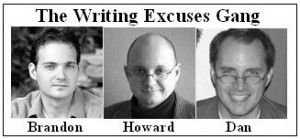
writing-excuses-the-guys2-300x139A while ago the Writing Excuses team asked me to record with them, and last Friday I got to do it and had a blast.

We recorded three episodes. In the first podcast we talk about putting and not putting ourselves in our writing and making characters who don’t all sound like the author. As usual, the guys had some great insights. Check it out: The Anti-Mary Sue Episode.

Share

Similar Posts

  • |

    Writing Update: 5/21/11 – visualize first, scene goals, the power of research

    I finished two chpaters this week. I’m quite a bit behind my stretch schedule which has me finishing the beginning of August although not too far behind my my conservative schedule which has me finishing the end of September.  A few more weeks and we’ll see if I’m giong to meet the stretch schedule.

    A lot of these first seven chapters are the same scenes as from before. Well, the same idea. But because enough has changed in the situations and because I’m writing some of the scenes from different points of view I have to rewrite them. So while I hope to catch up with some copy and paste from the last draft, I just am unable to do that here. 

    Visualize –> Report

    I thought I’d share one of my key methods for writing scenes. Here’s what I’ve found: when I can visualize the scene, it’s fairly easy to tell the reader what’s going on and to structure it in a way that achieves my purposes. When I can’t visualize it, I have nothing to tell. So for me the first thing I have to do is to see what’s going on. Then I can report as if I were there. Or if it’s from a more deep point of view penetration, I can report from my character’s eyes.

    So the sequence is to visualize (do the things that help me get that visual, feel, sound, etc.) then report in a way that will transport the reader and present the things I feel I need to present because they’re cool or because I want to generate a specific effect. 

    This is why I use the sketch/draft method. I sketch things out to get an idea of what’s going on first. Sure, I’ll discover details as I write. I’ll sometimes realize my first idea was off or wrong or won’t work. But if I don’t have an idea in the first place, I simply can’t write. It’s all a blank screen. One of the biggest causes of writer’s block is simply a lack of invention–of not having anything to write about because nothing’s in the mind of the writer.

    First have something to say. Then say it.

    Of course, you have to come up with the scenes in your mind before you have something to say. That takes some exploratory drafting, sketching, creative Q&A. You can see Orson Card doing some takes here in his writing lesson “Beginnings“, trying to help flesh it out in his mind. 

    The main tool I use to sketch is the summary–a bullet point or chapter outline like a posted about last week. However, sometimes it’s not enough. Sometimes I need an actual map to block out who does what and where. This week, for example, I was writing about Sugar coming into a village. She needed to enter then encounter some dead bodies.  I spent something like 45 minutes typing hardly anything and then realized-duh!-I don’t know what’s going on, where she’s going, why. I can’t see this place at all. I needed helping visualizing it first, not in super detail, but enough so I could report.

    So I took five minutes to sketch a simple map of the village, where she was when she entered, and where she was going, what was likely in the yards, the fences, etc. Once I saw it, I could then report, just tell what I saw as plainly as I could to the reader. I know these scenes fairly well, this being the FOURTH FREAKING DRAFT of this novel. And yet I’ve had to do some drawing for two scenes so far (the other drawing was for an ambush that wasn’t in the last draft). Because again, things had changed. And I had to see it before I could report it.

    Other tools that help me visualize and hear are actual photographs of things or people. Or audio of people’s voices. I was struggling getting a character in my mind for my short story LOOSE IN THE WIRES. I was listening at the time to Susan Grafton’s O IS FOR OUTLAW and when the actor performed this one character, suddenly I HEARD it. Boom, the guy came alive in my mind. Once alive there it was relatively easy to put him down on paper. Again, I was just relaying it to the reader.

    So I believe that what a writer must do is bring the situation to life in his or her mind first. It won’t be everything in exact detail. There’s a lot to be discovered in the writing. But it will be enough that it will feel like you’re simply telling something you saw or experienced.

    Scene Goals

    While writing, of course, I have objectives for my scenes. Sometimes I’ll do exploratory drafts, not having any goal except to see what happens and invent something cool. But that’s usually in my pre-draft stage. At this point I have a rough idea of where the story is going to go. I’ve already done a lot of the inventing. Now I have to translate it to scenes. And so I find having a quick list of objectives for the scene, along with my brief summary of what I’m expecting to happen, helps me visualize as well.

    Here are two examples of what a list of scene goals might look like for me.  These were for two scenes in draft 3 of CURSE.

    Example 1:

    • This is the time for her to make her HEROIC CHOICE. I want a heroic moment.
    • Terror of Legs being lost
    • Legs seeing her for the first time the next morning—he IS going to experiment because Urban is gone. Does he give something to her, his weave, twisted—Flax helped me.
    • Some tenderness
    • Last time with Mistress until the final battle

    Example 2:

    • Skir battle coolness. Need some surprises
      • Ayten dragging off souls
        • Sees it below on the ship
      • Seafire
      • What cool skir thing could there be?
        • Whirlwind
        • What would happen if a skir dived?
        • Some missiles, stones in the wind
        • First sight of that. She ship has slingers etc.
    • Sugar having to choose to leave people, see the beginnings of harvest
    • Oh Crap moment at end—this is going to be bad
    • This is the setup for the next scene where She and  Urban are spying and after the assessment, he says, we need to go. And she’s in indecision, and he says I will wait until, and then I will leave.

    They’re fairly simple.  Of course, I have other goals in mind that I don’t need to write down–“start and end with a hook,” or a rest, depending. “Transport the reader might be another,” meaning make sure I use what I know about presenting details. Another might be “bring the character on in an interesting way.” And because I generally know the big picture of what’s going to happen, I can focus on these other details as I write.

    Research: Monster Zing & Visualize Method

    Research is also a monster method for visualizing and for zing. I can’t tell you how much it has helped me in the past and on my current projects. In the thriller I’m working on where the main character is ex Special Forces, I could barely visualize anything. Some I’m reading books about it and talking to people who are in Special Forces and watching films about it. There’s no way I could build a story I cared about and believed in without research. I’m going to be doing a ride along with a cop, visit our state prison, and maybe talk to some ex-cons for this as well.

    Tim Powers came to the Writer’s of the Future workshop I attended many years ago. He talked about many things. But research was one of them. In fact, one of the idea generating methods discussed in the workshop, one on which Hubbard himself had written a fine article that we read called “Search for Research” (click the Next or Continued link at the bottom to continue through all the pages of the essay), was about the power of research. So Powers recently did an interview about the latest Johnny Depp Pirates release , which is inspired by his book of the same title (which I read and loved), and restated what he did so many years ago:

    Q: What inspired you to write On Stranger Tides?
    A: I was already hooked into using real historical places for settings. And so I thought, you know you loved Treasure Island…And I thought I bet you can set a nice fantasy story in among the pirates, Black Beard, that crowd. So I read a million books (that is probably fifteen books) about that particular crowd of pirates that were in the Caribbean in 1718 like Stede Bonnet, Black Beard, and Anne Bonny.

    What I always do when I’m writing a book is first I read all the history and biographies and things like that that I can find. And I look for stuff that’s too cool not to use. ‘Ooh that’s neat. Look at that. I like that.’ And I’ll write it down. And then I’ll find something else and say, ‘Oh wow this is great. You got to have a scene happening in this place. Oh you gotta use this guy.’ Eventually, I’ll have twenty or thirty things that are too cool not to use. And it’s kind of fun then because you say, ‘Well okay, here’s twenty or thirty parts of your book. You just have to connect the dots.’ And so I thought, ‘Ok, what was Black Beard really up to?’

    So to sum up.

    1. Visualize, then report.  That’s what I’ve found I have to do. It makes it so much easier to write when I have a picture in my mind.
    2. Scene goals help me visualize the scene and what needs to happen.
    3. Research is a huge tool for helping me find zing and to visualize and invent something I can visualize. 
    4. The Sketch/Draft process (I explained it in last week’s post and in the interview with Maya Lassiter) is another work horse of a tool for helping me visualize and invent by degrees.
    Share
  • Indie Thoughts: How To Sell Loads of Books

    From Russell Blake.

    This does not represent the only way to do things, but it’s my way, and is the synthesis of everything I’ve learned over the last 23 months of self-publishing:

    1) Pick one genre that’s popular and with which you are extremely familiar, and then write in that genre. Stick to it. Don’t hop around. It confuses your potential readers and muddies who you are in their minds, and will hurt your sales. If you want to write different genres, use a pseudonym, and if you like, let your readers know that moniker is you. But stick to one name, one genre, because you’re building your brand, and brand building is a function of clarity – clearly communicating what you do, and what your product is.

    2) Write a series. Why? Because readers like series, and you want to give readers what they like. Or you won’t sell as much. You can try stand-alone – I have – but my series outsell my stand-alone books 4 to 1. Once you have at least three books in the series, make the first one free. Earn your income from the rest, but give readers a whole novel to decide whether they like you or not.

    3) Write a lot. By that I mean try to write at least 3 novels a year. Don’t bother with short stories or novellas (40K or under) if you’re writing fiction – erotica, romance and non-fiction reportedly to do better with short form, but I don’t know from personal experience. Write 60-90K installments in your series, and release them AT MINIMUM every four months. Every three months would be better. Every two, better still. Momentum breeds success, and readers have short memories. The current market is a hungry animal, and you need to feed it, or risk being forgotten by the time your next one releases. Sorry. It’s the truth. And don’t start whining about how X famous author only puts out one book every Y years. If you’re Dan Brown and you sell tens of millions of novels each whack, then do whatever the hell you like. If you aren’t, listen up, or chock your strategy up to, “Become the next Dan Brown” and stop reading this drivel.

    . . . .

    5) Allocate time every day to write, and be disciplined. I suggest minimum one hour per day, or 1000 words. I actually ignore that and shoot for 5000-7000 a day when writing a novel, but that’s just my approach, and it’s not for everyone. My point is that you must be disciplined about your writing and develop that muscle. If you don’t make it a habit, you won’t write enough to put out one novel every four months, and you’ll already be way behind the curve.

    6) Allocate time every day to market. I recommend a 75%/25% writing to marketing mix. So spend an hour writing every day, and fifteen-twenty minutes marketing (social media, blogging, interviews, message boards like this). Two hours writing, half hour to forty minutes marketing. And so on.

    . . . .

    13) Price competitively and intelligently. Look at your genre. Where are most books priced? Are you undervaluing/underpricing your work? Price to sell, but don’t go cheap, no matter what Locke or Hocking did years ago. Use low prices occasionally to move product, as promotional pricing. But price your product consistently with the rest of your peers. Over time, you can increase prices, if your product warrants it and your readership is willing to pay it. My advice here is don’t price too low, or too high.

    . . . .

    19) Have realistic goals. Look at what the average person does in their first year, and their second. That’s average. It ain’t pretty. If you want to be different than average in a good way, you need to do something better/different, and you need to make your own luck. Don’t get bummed because you haven’t been an overnight sensation. I sold $300 of novels in November, 2011, after six months of 15 hour days and seven releases. In December, 2011, I released five novels I’d been working on for months, to create a massive Xmas surge. I leaped to $1450. With a dozen books out. That’s not exactly a ton for the big Xmas season. But I continued writing as though my work was in hot demand. And I kept investing in my product, losing money, until it turned the corner and I started making decent money in Jan of 2012.

    20) Book selling is a retail business, and retail businesses are promotions intense. You’re only going to be as good as your last, and next, promotion. Promotions are a necessary fact of life in retail. You have to generate noise – the product won’t do it by itself. There are millions of books out there. Yours are just more books. Figure out how to get some visibility. I won’t advise you on how – there are plenty of ‘experts’ that will charge you $5 for a book on what worked two years ago. Simply put, it’s constantly changing, so you need to experiment and push the envelope, share information with others and stay ahead of the curve. But if you aren’t promoting, you’re stalling. In business you’re either shrinking, or growing. If you aren’t promoting, chances are you aren’t growing.

    There are 28 tips in all at “How to Sell Loads of Books.”

    Share
  • I hate mission statements, but…

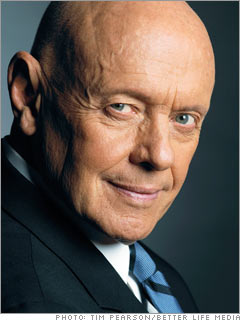
    Stephen R. Covey (or is it Lex Luthor?)
    Stephen R. Covey (or is it Lex Luthor?)

    First of all, if I could look like Stephen R. Covey does in that picture, I would shave my head and never look back. Holy moly, I love that picture. But that’s not why I’m writing.

    James Maxey is a writer who I respect and whose comments on the boards of Codex Writers often make me think or laugh. He recently started a thread about writing mission statements.

    Ack!

    I groaned when I first read the title of his topic. I know first-hand how useful goals are. I know how vital it is to identify what’s vital in any endeavor. Heck, I’m a Covey-lover through and through.

    But every mission statement I’ve seen has either been useless corporate toilet paper (because they’re printed on stuff that’s too stiff and rigid to be of any help in the bathroom) or it’s a personal artifact that has a six week half life, after which it turns into something like that singing fish you bought and can’t for the life of you figure out why or where to put it now that you realize you could have eaten a steak for just as much money and the pleasure would have lasted longer.

    And yet consciously thinking about how you want to live is so powerful. I think the corporate world ruined the term for me. I cannot bring myself to write a “mission statement.” I know what I want to do in my various roles in life. I know how I want to live. But I cannot use that label. Alas.

    So here’s my “what I want to do” as far as writing is concerned. It’s not crisp and clean. And if I had to write it again, it would come out differently. But it has the gist.

    —-

    I want to make people fall in love like I did when I first watched the Sound of Music–that sweet, pure yearning. And when they’re out of love, I want them to see a way back.

    Every once in a while I want the ground to shift under the feet of my readers like it shifted under mine when I first watched Les Miserables with Anthony Perkin.

    I want them to laugh.

    I want to give them the wonder and adventure that was given me when I read the Hobbit.

    I want them, at least once, to shout in triumph.

    I want to share my delight in people who are fascinating, flawed, salt-of-the-earth, odd, funny, strong or a hundred other wonderful things, but who show some courage, a little or a lot.

    I want readers to weep at the hope of redemption. I want them to despair at loss.

    I want the sun to shine. I want the world to crack.

    And when my readers are done, when the book’s closed and they sit back, I want the story and people to linger, I want my readers to want to go back. I want them to feel it was, not only a surge of living, but a good thing to have once been lost in the pages of my book.

    Share
  • Edward Bear Shares More Proofreading Secrets

    Mr. Edward Bear (pseudonym) shared an awesome secret for sussing out quote issues in a previous post. He’s back with a nifty way to help spot spelling issues.  It helped me spot a number of inconsistencies in Bad Penny, which I recently fixed. Take it away, Mr. Bear.

    * * * *

    Augmented Proofreading 2

    Last time, I mentioned checking spelling and spelling consistency, and this note is to fulfill my promise.

    To begin with, I’ll admit freely I do not recommend just running a spieling chucker over the text. And yes, I’m using the phrase deliberately. The spelling checker in the program I’m using to write this just waltzed right past it, despite the fact that neither word makes sense in this context. I got started trying to get some mileage out of spelling checkers a while back, when I realized that OCR scanners will work like hell trying to find a word and probably will come up with a word, but it will be the wrong word. Over at Project Gutenberg, they use the term “scanos” as an analogue of “typos.”

    The other adversary is consistency of spelling and usage. Examples might include “canceled” and “cancelled” or variant possessives, such as “Jones’” and “Jones’s” in the same text, or simply variant spellings of the same character’s name, such as “Erik” and “Eric.”

    So what do I do for these sorts of problems?

    What you need is a list of all the unique words in the story, and it’s easy with a dollop of regex. (See the first post on this topic. The one I’ve taken to using is the following:

    [^-‘‘’\w\d\r\n]

    This one I can explain, since I wrote it. 🙂

    What it says is to look for any individual characters within the brackets([]). The leading caret (^) says “Nope, they should not be in this list.” Following that are the hyphen(-), the straight  quote(‘), and the opening and closing curly single quotes(‘’). After that, it’s any character that would normally be in a word (\w), any digit (\d), any carriage return(\r) or any new line aka paragraph terminator (\n).

    And what you do with the above is to set Textpad (see previous post again) to replace all of them with a newline (\n) character.

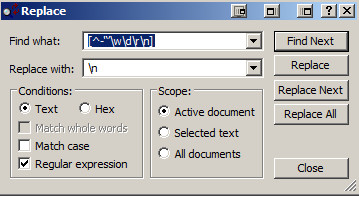
    Here’s what the search and replace box in Textpad looks like for this:

    Augmented Proofreading image001


    Notice that the “Regular expression” box is checked. And then you choose “Replace All”.

    The result is to turn this:

    Once upon a night we’ll wake to the carnival of life
    The beauty of this ride ahead such an incredible high
    It’s hard to light a candle, easy to curse the dark instead
    This moment the dawn of humanity
    The last ride of the day

    into this:

    Once
    upon
    a
    night
    we’ll
    wake
    to
    the
    carnival
    of
    life
    The
    beauty
    of
    this
    ride
    ahead
    such
    an
    incredible
    high
    It’s
    hard
    to
    light
    a
    candle

    easy
    to
    curse
    the
    dark
    instead
    This
    moment
    the
    dawn
    of
    humanity
    The
    last
    ride
    of
    the
    day


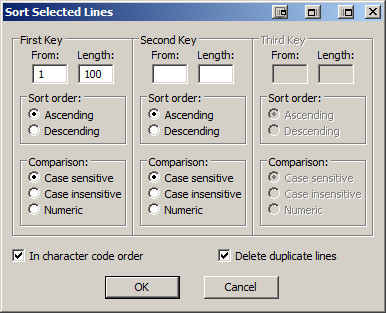
    For a book, this means what you have as a multi-thousand line long document and LOTS of repeated words. The next step is to lose the repetitions by sorting the list. For TextPad,  you’ll find Tools->Sort on the menu bar, and I generally set the sort up as the following:

    Augmented Proofreading image002

    This is a case-sensitive sort and “Delete duplicate lines”, of course, gets rid of all the duplications of words like “a”, “an”, and “the”.

    For the above text, you get:

    It’s
    Once
    The
    This
    a
    ahead
    an
    beauty
    candle
    carnival
    curse
    dark
    dawn
    day
    easy
    hard
    high
    humanity
    incredible
    instead
    last
    life
    light
    moment
    night
    of
    ride
    such
    the
    this
    to
    upon
    wake
    we’ll

    34 unique words.

    And here’s the payoff for all this funky text munging: Run a spelling checker over this, and it will find typos, of course, but it will also generally complain about most names, which aren’t generally kept in spelling checker dictionaries, and it will also show you words and their variants, nestled fairly closely together. Here’s an example from one of my projects:

    Swiss-born
    Take
    Talking
    Tallmadge
    Tallmadge’s
    Tarelton
    Tarleton
    Tarleton’s
    Tavern
    Tecumseh
    Tell
    Ten
    Thames

    The spelling checker landed on Tallmadge and its possessive form, but do you notice the “Tarelton” on the list? That’s the time for the Aha!, and you can fix the “Tarelton” form. The same thing applies to possessive variants and any other variant form you find.

    As with the last post, I’ll be peeking in on the comments and answering any questions that come up.

    Share
  • Update on book releases

    Folks, were are so close to having the cover work done for SERVANT and BAD PENNY. But it’s not done yet. So we’re slipping the delivery into November. CURSE will move back to early December. We lost two months with the issues we encountered with our original art projects. This time, though, we’re going to make it. And you will be pleased with the results.

    Share

3 Comments

Comments are closed.