Media and Teenage Sexuality

I don’t know how it’s possible to aruge that media does not influence our decisions. The evidience is simply overwhelming. Here’s another report of a study linking media sexuality to teenage decisions about sexuality.

“CHICAGO — Groundbreaking research suggests that pregnancy rates are much higher among teens who watch a lot of TV with sexual dialogue and behavior than among those who have tamer viewing tastes.” Full article here.

The study shows that while teenage pregnancies have dropped overall, those teens watching racey shows had, not just a small incremental risk, but TWICE the risk of getting pregnant.

Now, I know this article by the Guttmacher Institute focuses on the 1990’s, but it still is enlightening. It discusses the reasons for the dropping teenage pregnancy rates during those years. It’s conclusion is that both abstinence and usage of more effective contraception are the main factors for the drop in teenage pregnancies.

When I put the two articles together, it makes me wonder if the racey shows are encouraging more sex among the teens who watch them or the use of less-effective contraception or both. My guess is that the shows are influencing a decision for more sexuality.

Either way, what does this mean for a writer?

To me, it means that while I’m never responsible for someone’s actions nor in 100% control of what people take from my writing, I AM responsible for those things I know are highly likely to influence folks one way or another. I hope my works provide a wonderfully entertaining experience, but also avoid influencing people into decisions that will lead them down paths that will limit their happiness.

Share

Similar Posts

  • The main thing about villains

    The main role of villains and antagonists in stories is to generate suspense, anxiety, and fear in the reader. They make it possible for us to worry that the hero will not be able to avoid a significant threat or remove a lack. There are other effects–mystery, poignancy (about the human situation like in Les Mis). But those are secondary.

    For the main things to happen the villain has to be a credible, significant, and immediate threat…all the way through the book until he or she is smushed or wins.

    If he’s not credible, the reader realizes there is no real threat. If the threat is not significant, who cares? If it’s not immediate, again, who cares?

    So how do we make a villain like that? We make him or her smart, powerful, a few steps ahead of the hero, and dedicated to doing something we root against (because it’s just plain wrong or because we love our hero and want the best for him and the villain is pitted against him). He has to be able to put the hero on his heels most of the way through the book, and our poor hero is scrambling to adjust.

    You can have all sorts of villains–liked by many or few, kooky or calculating, eccentric or plain, noble or sadistic–just as long as they remain significant, immediate, and credible threats. The minute they lose threat status, the game’s over because at that point fear, anxiety, and suspense in the reader vanish.

    Share
  • |

    Science Fiction and Fantasy beat Thrillers?!

    “More than 50% of all traditionally-published book sales of any format in the US now happen on Amazon.com.”

    That’s just amazing. But I found something even more amazing this week.

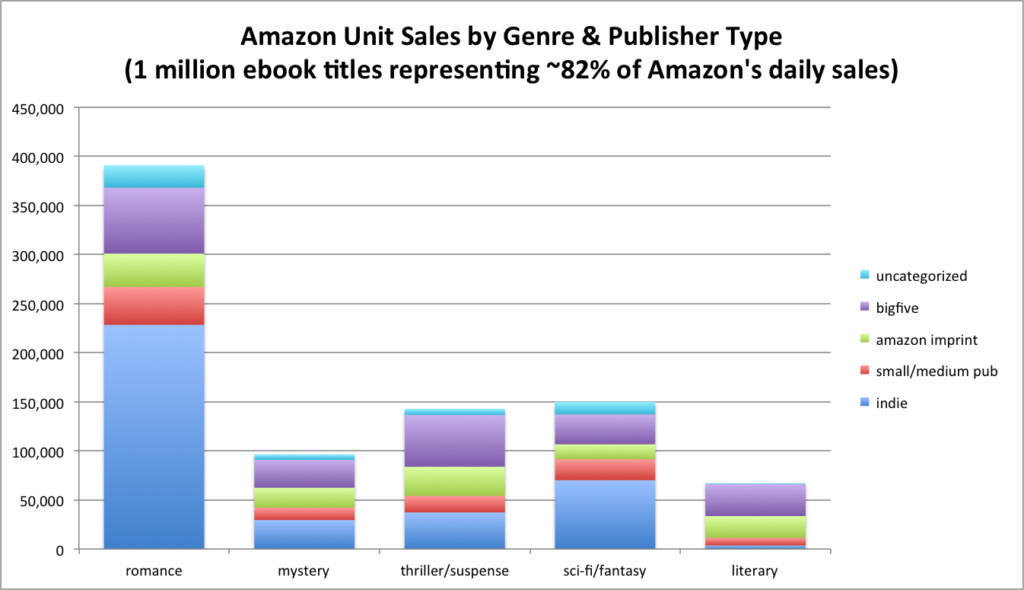
    Author Earnings released a report this week of their analysis of a million titles on Amazon. Data Guy, the tech guy behind the software gathering the information and crunching it, posted this graph in the comments.

    Do you see the amazing thing?

    AE-2016-06-genre-units

    Well of course you do, I gave it away in the title of the blog. Science fiction and fantasy sell MORE units than thrillers.

    More.

    What?!

    For, like, ever I thought SFF was a tiny portion of the market. Not so, my friends.


    Some may say, well, but this only represents Amazon. What about the channels traditional publishers sell through? Author Earnings explains a way to account for that in their report. Basically just double the size of the purple and red bars. If you do that I think thrillers might just edge SFF out. But it doesn’t dwarf it by any means.

    Furthermore, for an indie author, I don’t worry about those other channels because they’re not really a viable option for me. My world is selling online. And the online market for SFF is the SECOND BIGGEST MARKET after Queen Romance.

    Oh, BTW, next book in the queue is volume 1 of Lord of Bones. It’s going to start with something like this.

    The four men did not leave. Instead, they spread out just a bit in shallow semi-circle in front of Blaze.

    Four of them. One of him. There was definitely going to be blood.

    “You don’t want to do this,” Blaze said.

    The big one drew his sword and swung it a bit to loosen his shoulders.  “Oh, but we do. Because you’re not handing over the blackmeal. And we’re not leaving without it.”

    No, he was not going to hand that over. Couldn’t. Not if he valued the lives of his wife and boy.

    Two of the others drew their swords. The fourth brought his staff up and laid it on his shoulder in a two-handed grip.

    The big one would be the obvious target to take first. But Blaze knew that would be a mistake. The big one was there just to focus his attention. To fix Blaze in place. And then the silent one would slice him up the side.

    The man with the skinny face said, “Old man, the vultures will be picking your eyes out before lunch.”

    Blaze said, “Well, if you’re so determined, let’s not keep them waiting.” And then he rocked forward.

    I’ve not forgotten the Dark God series. I will finish it, but I need to get this smaller volume of Lord of Bones out.

    Share
  • |

    Writing Update: 5/21/11 – visualize first, scene goals, the power of research

    I finished two chpaters this week. I’m quite a bit behind my stretch schedule which has me finishing the beginning of August although not too far behind my my conservative schedule which has me finishing the end of September.  A few more weeks and we’ll see if I’m giong to meet the stretch schedule.

    A lot of these first seven chapters are the same scenes as from before. Well, the same idea. But because enough has changed in the situations and because I’m writing some of the scenes from different points of view I have to rewrite them. So while I hope to catch up with some copy and paste from the last draft, I just am unable to do that here. 

    Visualize –> Report

    I thought I’d share one of my key methods for writing scenes. Here’s what I’ve found: when I can visualize the scene, it’s fairly easy to tell the reader what’s going on and to structure it in a way that achieves my purposes. When I can’t visualize it, I have nothing to tell. So for me the first thing I have to do is to see what’s going on. Then I can report as if I were there. Or if it’s from a more deep point of view penetration, I can report from my character’s eyes.

    So the sequence is to visualize (do the things that help me get that visual, feel, sound, etc.) then report in a way that will transport the reader and present the things I feel I need to present because they’re cool or because I want to generate a specific effect. 

    This is why I use the sketch/draft method. I sketch things out to get an idea of what’s going on first. Sure, I’ll discover details as I write. I’ll sometimes realize my first idea was off or wrong or won’t work. But if I don’t have an idea in the first place, I simply can’t write. It’s all a blank screen. One of the biggest causes of writer’s block is simply a lack of invention–of not having anything to write about because nothing’s in the mind of the writer.

    First have something to say. Then say it.

    Of course, you have to come up with the scenes in your mind before you have something to say. That takes some exploratory drafting, sketching, creative Q&A. You can see Orson Card doing some takes here in his writing lesson “Beginnings“, trying to help flesh it out in his mind. 

    The main tool I use to sketch is the summary–a bullet point or chapter outline like a posted about last week. However, sometimes it’s not enough. Sometimes I need an actual map to block out who does what and where. This week, for example, I was writing about Sugar coming into a village. She needed to enter then encounter some dead bodies.  I spent something like 45 minutes typing hardly anything and then realized-duh!-I don’t know what’s going on, where she’s going, why. I can’t see this place at all. I needed helping visualizing it first, not in super detail, but enough so I could report.

    So I took five minutes to sketch a simple map of the village, where she was when she entered, and where she was going, what was likely in the yards, the fences, etc. Once I saw it, I could then report, just tell what I saw as plainly as I could to the reader. I know these scenes fairly well, this being the FOURTH FREAKING DRAFT of this novel. And yet I’ve had to do some drawing for two scenes so far (the other drawing was for an ambush that wasn’t in the last draft). Because again, things had changed. And I had to see it before I could report it.

    Other tools that help me visualize and hear are actual photographs of things or people. Or audio of people’s voices. I was struggling getting a character in my mind for my short story LOOSE IN THE WIRES. I was listening at the time to Susan Grafton’s O IS FOR OUTLAW and when the actor performed this one character, suddenly I HEARD it. Boom, the guy came alive in my mind. Once alive there it was relatively easy to put him down on paper. Again, I was just relaying it to the reader.

    So I believe that what a writer must do is bring the situation to life in his or her mind first. It won’t be everything in exact detail. There’s a lot to be discovered in the writing. But it will be enough that it will feel like you’re simply telling something you saw or experienced.

    Scene Goals

    While writing, of course, I have objectives for my scenes. Sometimes I’ll do exploratory drafts, not having any goal except to see what happens and invent something cool. But that’s usually in my pre-draft stage. At this point I have a rough idea of where the story is going to go. I’ve already done a lot of the inventing. Now I have to translate it to scenes. And so I find having a quick list of objectives for the scene, along with my brief summary of what I’m expecting to happen, helps me visualize as well.

    Here are two examples of what a list of scene goals might look like for me.  These were for two scenes in draft 3 of CURSE.

    Example 1:

    • This is the time for her to make her HEROIC CHOICE. I want a heroic moment.
    • Terror of Legs being lost
    • Legs seeing her for the first time the next morning—he IS going to experiment because Urban is gone. Does he give something to her, his weave, twisted—Flax helped me.
    • Some tenderness
    • Last time with Mistress until the final battle

    Example 2:

    • Skir battle coolness. Need some surprises
      • Ayten dragging off souls
        • Sees it below on the ship
      • Seafire
      • What cool skir thing could there be?
        • Whirlwind
        • What would happen if a skir dived?
        • Some missiles, stones in the wind
        • First sight of that. She ship has slingers etc.
    • Sugar having to choose to leave people, see the beginnings of harvest
    • Oh Crap moment at end—this is going to be bad
    • This is the setup for the next scene where She and  Urban are spying and after the assessment, he says, we need to go. And she’s in indecision, and he says I will wait until, and then I will leave.

    They’re fairly simple.  Of course, I have other goals in mind that I don’t need to write down–“start and end with a hook,” or a rest, depending. “Transport the reader might be another,” meaning make sure I use what I know about presenting details. Another might be “bring the character on in an interesting way.” And because I generally know the big picture of what’s going to happen, I can focus on these other details as I write.

    Research: Monster Zing & Visualize Method

    Research is also a monster method for visualizing and for zing. I can’t tell you how much it has helped me in the past and on my current projects. In the thriller I’m working on where the main character is ex Special Forces, I could barely visualize anything. Some I’m reading books about it and talking to people who are in Special Forces and watching films about it. There’s no way I could build a story I cared about and believed in without research. I’m going to be doing a ride along with a cop, visit our state prison, and maybe talk to some ex-cons for this as well.

    Tim Powers came to the Writer’s of the Future workshop I attended many years ago. He talked about many things. But research was one of them. In fact, one of the idea generating methods discussed in the workshop, one on which Hubbard himself had written a fine article that we read called “Search for Research” (click the Next or Continued link at the bottom to continue through all the pages of the essay), was about the power of research. So Powers recently did an interview about the latest Johnny Depp Pirates release , which is inspired by his book of the same title (which I read and loved), and restated what he did so many years ago:

    Q: What inspired you to write On Stranger Tides?
    A: I was already hooked into using real historical places for settings. And so I thought, you know you loved Treasure Island…And I thought I bet you can set a nice fantasy story in among the pirates, Black Beard, that crowd. So I read a million books (that is probably fifteen books) about that particular crowd of pirates that were in the Caribbean in 1718 like Stede Bonnet, Black Beard, and Anne Bonny.

    What I always do when I’m writing a book is first I read all the history and biographies and things like that that I can find. And I look for stuff that’s too cool not to use. ‘Ooh that’s neat. Look at that. I like that.’ And I’ll write it down. And then I’ll find something else and say, ‘Oh wow this is great. You got to have a scene happening in this place. Oh you gotta use this guy.’ Eventually, I’ll have twenty or thirty things that are too cool not to use. And it’s kind of fun then because you say, ‘Well okay, here’s twenty or thirty parts of your book. You just have to connect the dots.’ And so I thought, ‘Ok, what was Black Beard really up to?’

    So to sum up.

    1. Visualize, then report.  That’s what I’ve found I have to do. It makes it so much easier to write when I have a picture in my mind.
    2. Scene goals help me visualize the scene and what needs to happen.
    3. Research is a huge tool for helping me find zing and to visualize and invent something I can visualize. 
    4. The Sketch/Draft process (I explained it in last week’s post and in the interview with Maya Lassiter) is another work horse of a tool for helping me visualize and invent by degrees.
    Share
  • Indie Thoughts: Lessons from Marie Force

    Some promo tips from mega-seller Marie Force.

    I just changed the cover of a book (Maid for Love, book 1 in my McCarthys of Gansett Island Series) that’s been on sale for three years and free for two as a loss leader for a series that has 11.5 books (as of today–release day for book 11). I changed the cover (of books 2 and 3 as well) just ahead of a BookBub ad for Maid for Love. This book has been on BookBub quite a few times since it’s been free and lately, I could expect about 25,000 or so downloads across the platforms after a BookBub ad. This time, the number was closer to 70,000 downloads with a huge conversion to books 2 and beyond. Another thing we did before the BookBub ad was drop the prices on books 2-3 from $4.99 to $2.99 and books 4-6 from $4.99 to $3.99, leaving the front list at $4.99. I realized with 11 books and a novella in the series, it would cost a new reader more than $50 to buy the full series, thus the price break on the earlier books. Both the new cover for Maid for Love and the new pricing for books 2-6 yielded very impressive results. The series has sold more than 1.3 million ebooks since it debuted in 2011 and the last three have been top 10 NYT bestsellers. I was hoping to gain many more new readers from these strategies, and so far, it seems to be working just as I’d hoped it would. I love being able to try these things as an indie author!

    Another poster congratulated her and said he’d gone and purchased the book. It was free; why not give it a shot?

    Thanks, Bill. Hope you enjoy Maid for Love, and thanks for the congrats. The 1.3 million sales is especially thrilling when you consider that Maid for Love was rejected all over the place. Except by the readers. 🙂

    Find more at The Passive Voice.

    What’s Marie using? A series with a number of titles in it, competitive pricing, loss-leader sampling that sometimes includes a free book, and BookBub.

    More about Marie and her books on her website.

    Share
  • Writing update: Envy

    Bible’s full of great stuff. Look at this.

    (Old Testament | Exodus 20:17 – 19)

    17 Thou shalt not covet thy neighbour’s house, thou shalt not covet thy neighbour’s wife, nor his manservant, nor his maidservant, nor his ox, nor his ass [we’re talking animals, folks], nor any thing that is thy neighbour’s.
    18 And all the people saw the thunderings, and the lightnings, and the noise of the trumpet, and the mountain smoking: and when the people saw it, they removed, and stood afar off.
    19 And they said unto Moses, Speak thou with us, and we will hear: but let not God aspeak with us, lest we die.
    20 And Moses said unto the people, Fear not: for God is come to prove you, and that his fear may be before your faces, that ye sin not.
    21 And the people stood afar off, and Moses drew near unto the thick darkness where God was.

    Dude, the “thick darkness where God was.” The thick darkness . . .

    I love the images in that passage. Moses going to talk to God face to face. Talk about spectacle. As for the commandment, well, let me just say that I might be smite-worthy.

    I do not covet many things. Certainly not any dude’s butt, but sometimes it’s so hard not to covet my neighbour’s writing success. And it’s not the big boys that kill me.

    I read a Lee Child or Orson Card or whoever, and I can legitimately say, “Hey, those guys have been writing for years and have produced a lot of novels; it’s unrealistic to compare my skills to their current masterly levels.” I can legitimately say, “Hey, best-sellerdom takes craft and luck, and I just need to be ready the next time the opportunity train stops at my station.” I can even say of those who start off as best-sellers, “Dude, maybe they DID start out with more skillz than me. Doesn’t mean I can’t learn. Give me some more books, you’ll see the Brown dog rise.”

    These are all true statements. I’ve got the big guys down. I can spot the Brain Nazi trying to hit me with them a mile away.

    It’s the other folks that get me. The guys at my level.

    I just had an email exchange with one of them. (No, I’m not going to tell you who it is. Author X might read this, get a fat head, and then be ridiculed and derided by small children. I’m not that heartless.) X comes up with great ideas. Has a ton of them. X is one of those other pro writers I meet who are always lamenting about how many ideas they have. Truckloads. Boatloads. They could employ all of  the peasants in a small country like Mozambique just writing the fab things that flow from their brains.

    I don’t have boatloads of ideas. I don’t have a truckful. I’ve got maybe two or three riding around on a Yike Bike.

    Covet, covet, covet.

    Author X is also funny. X can take a pedestrian idea, twist it, maybe with a great character or situation, and suddenly I’m dying to know more. X watches a TV show I’ve been watching for years. Bim! Bam! Comes up with another great idea I want to steal. (I think I average about two ideas a week I want to steal from other authors.)

    Covet, covet, covet.

    Author X has great sales. Better than mine, at least.

    Gol-leeeee, Mother of Hacks, please, put me out of my misery.

    Or not.

    I’ve got this freaking Brain Nazi’s number as well. The truth of the matter is that while Author X may have some minimal amount of writer-fu, X has also sold his/her soul to the lizard people of the hollow earth. I think they’re going to breed X. So I could have writer-fu too, but I don’t want to become anyone’s genetic experiment. I have standards.

    And with that, I’ll sign out. Happiness!

    Share