|

Learn plot, character, scene, and more this Saturday, Oct 9!

All you Utah and mountain area writers & teachers, or those close enough to travel, I will be presenting and conducting workshops from 9:00 am until 4:30 pm this Saturday, Oct 9th as part of the Autumn Writers Conference sponsored by the American Fork Arts Council and the National Endowment for the Arts.

The sessions I’ll conduct include:

  • Finding and Working With an Agent
  • How to Write a Story That Rocks: First Principles & Story Concept
  • Creating Characters that Rock
  • Plot
  • Writing Scenes: The Basic Units of a Novel

There are four other tracks. Find all the details, including cost and contact info, on the organizer’s site: CalebWarnock.blogspot.com. I’m totally stoked for this. I’ll be sharing what I think are the Pareto factors in each of these areas — things I wish I would have known when I started and would have shaved years off my journey to publication.

A number of other authors will be there including:

  • Annette Lyon (women’s fiction and a new cook book called Chocolate Never Faileth)
  • Josi Kilpack (mystery and suspense)
  • LeAnne Tolley (health and wellness)
  • Scott Livingston (poetry)
  • Caleb Warnock (self-sufficiency)
  • Loraine Scott (mystery)
Share

Similar Posts

  • |

    The book trade is a . . . trade

    James Dawson, YA author, feels it’s somehow wrong to hold back on cussing in his fiction. He wrote an article about this in the UK Guardian called “Why Teens in Books Can’t Swear.” He thinks it’s unrealistic. He thinks it’s about gate-keeper censorship. You know, parents wanting to steer their children towards certain experiences and away from others.  

    People.

    Dawson’s approach to the whole problem is wrong-headed. This isn’t about the virtues and vices of fiction. Or about gatekeepers, especially in today’s ebook world.  Or what experiences parents want to provide their children. And it’s not about art reflecting reality. Reality includes trips to the toilet, and yet we somehow fail to include realistic bum wiping in so many of our tales. Good heavens, have we betrayed our artistic integrity? No. We’ve just naturally chosen to include things that appeal to us and leave out others that don’t. Every book is an exercise in hundreds of such choices.

    The fact is that Dawson’s forgetting that a fundamental aspect of the book trade is the trade.  The buyer trades his or her money for a product (the book) that provides a service (the entertainment, thrills, chills, etc. of the reading experience) he or she values.  A customer preferring one kind of experience over another isn’t censorship (the horror, the horror).  It’s choice.  

    As an author, you make your offer. If folks like it, they buy it. If not, they don’t. Nobody owes you a purchase.

    This means that in any business, and selling fiction is a business, the most sensible way forward is to offer your intended buyers something they are likely to value.  Something they’re going to like.  Something they want.  If your buyer is thirsty and wants water, offer him a cold glass of water, not a waffle iron.  And if you can’t bear to develop anything but waffle irons, then, by all means, develop waffle irons.  Just make sure you offer them to the folks looking for . . . waffle irons. 

    This business of making offers also means that we package our products and services so that customers can easily tell what’s in the box. You don’t want someone to purchase your box thinking it contains breakfast cereal when in reality it’s a bunch of bolts.

    Yeah, writing is an art. But offering it in trade to others is also a basic economic act.

    Share
  • Indie Thoughts: It’s a business

    Complaining is not a business strategy ~ Jeff Bezos

    I love that quote.

    That doesn’t mean folks should never express dismay, fear, or frustration. It can sometimes be very helpful to voice it.

    Name it.

    Pin it to the wall.

    And then move forward.

    So Amazon changed how they approach paying authors with Kindle Unlimited (KU). I think the move is fantastic. It rewards value provided to the reader. If you’re in the business of selling value to the reader, that’s a no-brainer.

    I also think this whole KU 2.0 thing illustrates why Author Earnings is so important.

    It reminds us that we are NOT Amazon.

    It reminds us that we are NOT the publishers.

    It reminds us that we are NOT the agents.

    We are a totally different group.

    Amazon is simply a partner. A great partner right now, but they are NOT us.

    Which means we’re responsible to make our own way. How do you do that? The only way I can imagine is to own the idea that you’re a business. And then think like a business.

    How?

    I haven’t run any better way than the lean startup approach.  I’ll be sharing some posts over the next few weeks that explains just what that means.

    Happy 4th of July! May God bless America and the disruptive freedom-loving form of government she introduced.

    Share
  • Sector Five Radio’s “Super Writers of the Universe” book signing

    I’ll be signing September 25 with a whole bunch of other SFF authors. Come by and say hello.

    Saturday, September 25, 11 am – 1 pm Book Signing West Jordan, UT Super Writers of the Universe and Friends from Sector Five Radio, AM 630 K-talk. 10 SFF authors, including me, Tracy Hickman, Dave Farland, Howard Tayler, Larry Correia, and Eric James Stone.

    Barnes & Noble – Jordan Landing 

    7157 Plaza Center Drive

    West Jordan, UT 84084

    801-282-1324

    Saturday, September 25, 3 pm – 5 pm Book Signing Murray, UT Super Writers of the Universe and Friends Same 10 authors, but this time at Borders

    Borders – Murray

    132 East Winchester

    Murray, UT 84107

    Share
  • Indie Thoughts: The Kind of Competition Publishers Want

    David Gaughran puts it all into perspective.

    Since the huge shift to online purchasing and e-books, a common meme is that there is some kind of “discoverability” problem in publishing.

    The funny thing is readers don’t seem to have any problem finding books they love. Any readers I talk to have a time problem – reading lists a mile long and never enough hours in the day to read all the great books they are discovering.

    The real discoverability problem in publishing is that readers are discovering (and enjoying) books that don’t come from the large publishers. What these publishers have is a competition problem not a discoverability problem.

    They have reason to. I had a stab last year at estimating how much of the e-book market self-publishers have grabbed in the US, pegging it at around 25%. The much more rigorous Author Earnings reports have confirmed that estimate, showing that self-publishers had captured 30% of the unit sales on Amazon and Barnes & Noble.

    * * * *

    So when large publishers say that the discoverability puzzle hasn’t been solved online, they are really expressing despair at retailers recommending books not published by them.

    And when large publishers say that online retailers haven’t matched the experience of buying in physical stores, they mean that they wish there was some way to relegate all that stuff from small publishers and self-publishers to the warehouse, and have tables piled high with James Patterson and Snooki.

    * * * *

    The fear-mongers always forget Amazon’s core philosophy: recommend the product the customer is most likely to purchase. It’s interesting to note that this is the exact opposite of traditional co-op: recommending the book that the publisher wants purchased.

    While it’s revealing to look at sites like Bookish and consider what Big Publishing would do with retail or discovery, we already know what it does with self-publishing. Exploitative vanity press Author Solutions runs self-publishing companies for HarperCollins, Simon & Schuster, Harlequin, is owned by Penguin Random House, and is now recommended by Publishers Weekly.

    Large publishers want to decide what gets published, what gets distributed, what gets recommended, what gets discovered, and what gets sold.

    Amazon – and the digital revolution it instigated – has made that impossible.

    Anyone can publish. Distribution has been blown wide open. Large publishers have lost power over what books get recommended and discovered too, with the agnostic approach of sites like Amazon, Goodreads, and BookBub. And large publishers have definitely lost control of what is getting sold: self-publishers have grabbed a huge chunk of the market, and more and more writers are beginning to realize they don’t need a publisher to reach readers and make money.

    This is the real reason why Big Publishing hates Amazon. Large publishers face real competition for the first time and they don’t like it one bit.

    More at Let’s Get Visible.

    Publishers have lost the barriers to entry that used to keep most of the competition out. Amazon set up a totally new distribution channel that has grabbed at least 41% of the book market.

    Forty freaking one percent!

    And of that 41% percent, it appears self-publishers have about as much of that channel as traditional publishers do.

    Think about that for a second.

    Almost half of book distribution is now out of publisher control. With no barriers, the hordes are running in to sell their books, pushing publisher books out of the good spots. The number of competitors is growing. And the publishers can’t get Amazon to relegate the riffraff to the back rooms. Can’t get them to feature only their books.

    Worse still, it appears lots of readers don’t mind that at all.

    Share
  • Curse, Raveler, Comic Con

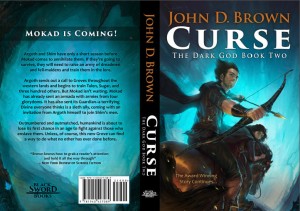
    CURSE_FinalCoverSpreadWebI’ve been busting my chops these last three weeks. CURSE is finished. RAVELER will be finished tonight. I will be putting them both on sale at smoking hot prices for those that have signed up for the newsletter in the next few days.

    This is also perfect timing for the Salt Lake City Comic Con. I’ll be there, participating on panels, chatting with readers, and selling copies of my books at a table in the Artist’s Alley (White, booth 40). I’ve invited two other awesome authors to join me at the table–Cheree Alsop and Eric James Stone. This is going to be a great event. If you’re going, please drop by at the table to say hello. I’ll have more on Comic Con in a post in a few days.

    Share

4 Comments

  1. This looks really awesome. If only I’d seen it before October 1st! (me = poor).
    But my wife is gone this weekend, so this could be an awesome way to get my writing groove on. Thanks for the tip! Maybe I’ll see you Saturday! 😀

  2. I’m still trying to decide if I will join you this Saturday. It sounds like all sorts of fun, but my daughters may need some time and attention. I laud the author and his brilliant parts, but I would prefer to avoid bunny cakes at all costs!:-}

  3. Number1,

    Not those kinds of bunny cakes! Sheesh. I’m talking real cakes. Birthday time :0

Comments are closed.