Similar Posts

  • |

    John guests on Writing Excuses season 3 episode 19

    writing-excuses-the-guys2-300x139

    Here’s the third episode I recorded with the Writing Excuses guys.

    In the first podcast we talked about putting and not putting ourselves in our writing and making characters who don’t all sound like the author. In the second, we talked about how to not repeat yourself as an author. In this one, I shared some basics about generating emotion in readers and dealing with negative emotions writers face when they encounter rejection, compare their career with others, hit writer’s block, or hear someone didn’t like their story.

    As usual, the guys had some great insights. Check it out: Emotion in Fiction.

    Share
  • How libraries select books

    Back in May I wrote about a Gallup survey that shed some light on how US adults select books to read. That poll revealed that book reviews only play a role 7% of the time with readers. The most important things to readers are prior experience with an author and recommendations from someone they know.

    But there’s another important block of buyers that don’t buy the same way. In fact, for them reviews are KING.

    Who are these buyers?

    Public libraries.

    And the library market isn’t small. According to  a fascinating Library Journal article, “there are more than 9,000 in the US, and that’s not counting branches.” Furthermore, “library purchases account for over ten percent of the $27 billion industry (excluding print textbooks for K–12 and higher ed). In contrast to consumer buying, which relies on discretionary dollars, the library market remains a consistent sales channel for publishers.”

    When looking at how many books average authors sell and what it takes to make a living writing, it becomes very apparent that libraries can have a huge effect on a midlist writer’s career.

    Of course, we all know there’s more to it than sales. The article points out:

    Libraries are far more than a market, however. Libraries create readers. They are the test bed, the petri dish for books, a place where people can discover a passion for reading as children and indulge it as adults and where passionate readers can sample new authors. Librarians are the ultimate handsellers of books (though they call it readers’ advisory), and increasingly they put their considerable technical skills into making library web sites rich interactive social networks for book lovers.

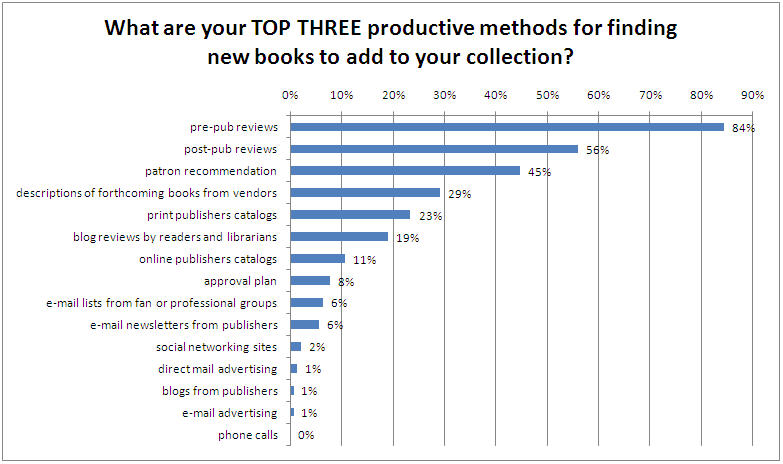
    I love libraries for this very reason. And because there’s no way I could purchase all the books I read. No way in heck. So how do they find the books for their collections? I mentioned above that they used reviews. But I didn’t know how much until I saw the data. Holy schnitzel (click on the graphic to see it full size).

    HowLibrariesSelectBooks.

    This only makes sense. Study after study has shown that buyers don’t want unlimited choice. Readers use prior experience and recommendations from people they know to manage the chaos. Libraries use reviews and then patron recommendations. Of course, this use of reviews has other implications as shown below.

    I get a lot of requests from self-published authors asking me to buy their books, and I have to explain that with limited resources and only so much space on the shelves, we have to go with books that are reviewed, that have been professionally edited. With nearly half a million books published each year—maybe half of them self-published, and most of those pretty awful—I just don’t have time to go beyond trusted sources. This usually doesn’t go over well.

    About 9 months ago I wrote about how cumulative advantage can drive product popularity–products that get early positive notice tend to get more notice. It appears that cumulative advantage is at work again. It’s just that with libraries the method isn’t a download counter. The article’s author concludes, “the best way to reach the library market is indirectly: by publishing books that people want to read and having them assessed objectively in reviews.”

    So what are the major sources for pre-publication book reviews? The article lists five big ones:

    • Booklist
    • Kirkus Reviews
    • Library Journal
    • Publishers Weekly
    • School Library Journal

    But what can an author do with this information? Authors can’t control reviews. Heck, according to the article the Library Journal itself only reviews about 10% of the books they receive.

    We all know the answer. Authors can control one thing: they can strive to write the best holy freaking heck book in their power. After all, what’s a review but a recommendation? Besides, patron recommendations were #3 on the librians’ list anyway. Nevertheless, it DOES help to have a publisher who sends your book out to the reviewers and their catalogs out to libraries. It helps to have a team that’s connected with librarians.

    The article ends by saying publishers and libraries are actually working together. I liked how the author summed it up.

    What publishers offer:

    • Discovery of talent
    • Shaping and refining books
    • Design, distribution, marketing, and promotion

     What librarians offer:

    • Discovery of books
    • Nurturing of diverse reading communities
    • Selection, distribution, marketing, and promotion

    Here’s to libraries! (And good reviews. And grandmas. And the little house trolls that give writers fabulous ideas.)

    Share
  • |

    Story zing method: fiddling with knobs

    One of the most basic way of coming up with story ideas is to take a familiar story or thing, list out what’s commonly associated with it, then start changing some of those elements.

    For example, you list out all the normal things for vampires–the coffins, black, bats, sucking blood, etc.–then you begin to twist. What if the vampire wears, instead of black, some styling plaid? What if it isn’t a person but a rabbit (whoops, that one’s been done)? What if instead of gothic places like catherals you find him in a trailer park? What if instead of being dangerously suave, he’s a drunk?

    Do you see? You can do this with anything.

    In this interview, Matthew Sturges talks about how he did just that with the movie The Dirty Dozen and ended up with with Midwinter, a novel about prisoners given another chance. According to Sturges, “In the case of Midwinter, the beginning of the story was, ‘What is prison like in Faery?'”

    Read the whole interview. I think you’ll find it enlightening.

    Share
  • Generating Story 12: Creative Q&A with Author Melissa Mead

    Melissa Mead lives in Upstate NY with her husband and cat. Her stories have recently appeared in IGMS and Daily Science Fiction. She’s a member of SFWA, Codex, and the Carpe Libris Writers Group: http://carpelibris.wordpress.com/.  She too had a story to tell about using questions to help her develop her published stories.  I think it’s worth sharing.

    Melissa

    My Double Dragon novel Between Worlds (Double Dragon Publishing) came about because of a reading mistake.

    You see, I’d come across the word “cantrip.” Not being a D&D player, I’d never heard it before, so I went to the OED and looked it up. The first definition said “A minor spell or incantation.” The second said “A mischievous trick,” but somehow I misread it as “A mischievous sprite.”

    Oh wow- a mythological being I’d never heard of! I ransacked the library looking for any reference to those mischievous sprites. Didn’t find any, of course. Finally I decided that if I couldn’t find them, I’d make them up. So I started asking myself “What are Cantrips?” From the definition, I figured they must have some minor magical powers, and were most likely small.

     So why hadn’t we heard of them before? Perhaps they were hiding.

    Why were they hiding? Perhaps something awful had happened between humans and Cantrips long ago, driving the Cantrips underground. Literally.

    Then why we were hearing about them now? Something must have happened that made staying hidden more risky than coming above ground. Starvation? Underground isn’t the best place to maintain a steady population. But that’s not very dramatic or personal, for story purposes. Maybe, in addition, there’s an outside threat.

    Ok, so someone needs to confront this threat. One person, so we have someone to focus on. Someone more adventurous than your typical Cantrip.

    And so Miska, and all the Cantrips, brought a new form of mischievous sprites to the world.

    All because of the question “What the heck is a Cantrip?”

    John Sez

    First of all, notice she followed her zing.  She stumbled upon this new creature and started to research.  Her research didn’t provide much, of course. But following that impulse is key.  

    Next, did you notice she kept asking why?  Why don’t we know about Cantrips?  Why did they go underground?  Why are they returning?  That’s a motive or cause question. 

    There’s no way you’d use those exact questions in your story.  But you WILL want to know WHY things are they way they are.  You will want to know motives and causes, internal and external.  You’ll want to know WHY your hero is facing this problem, WHY the antagonist is working against her, WHY the hero decides to tackle the problem instead of ignore it or run away.  When the hero reacts and makes a decision to do X, you will want to know WHY (as well as WHAT’S THE RESULT).  Same with the antagonist.  When building setting, you might find it useful to ask things like WHY did they build a village here or WHY is my character a tailor?  Do you see?

    In addition, I’ve found that replacing “why” with “what” seems to be more productive to me.  So “what led or caused my character to be a tailor” helps me more than “why.”  “What’s motivating the antagonist” helps me personally more than “why is he doing this?”  That might be my own weirdness, but I think “what” subtly leads me straight into nouns and situations and values and beliefs.  Try it on and see if it doesn’t help you.

    Finally, did you notice her use of objective. The story about overpopulation in the underground didn’t interest her much.  She wanted something with an active antagonist.  Something that could focus on a character.  Knowing that objective, she started generating options that might fit the bill.  Which lead to the cool idea of a new type of mischevious sprite.

    Follow zing. Use the “what” (why) to identify cause and motive.  If you can, state your objective; the clarity will give your wonderful mind a focus for its generating powers.


    For more in this series, see How to Get and Develop Story Ideas

    Share
  • |

    How to Write a Story that Rocks

    Folks, a huge thanks goes to Stephen Nelson for putting all this together. You may kiss his hand when you see him.

    This is a recording of “How to Write a Story that Rocks,” a two-hour seminar Larry Correia and I just put on at the annual BYU’s Life, The Universe, & Everything symposium. I think we had 130-140 people attend. This symposium is focused on writing fiction. And while the panels and presentations do include things specific to the science fiction, horror, and fantasy genres (both adult and young adult), a lot of time is also spent on story writing fundamentals that apply to ALL genres. So when I developed this workshop, I made sure I took the fundamental approach.

    The two-hour seminar has been broken down into 12 segments. To switch between the segments:

    • Hover your mouse pointer over the YouTube below
    • Click the forward and back arrows that appear on the right and left sides to move to the next or previous segment, OR 
    • Scroll through all 12 segments and select the one you want using the playlist control at the bottom

    If you prefer, you can watch all 12 on the How to Write a Story that Rocks YouTube playlist page.

    I’ve found whenever I develop any presentation or training that it takes a few iterations and revisions before it’s the best it can be. This is the first iteration of this seminar. And so below this video I’ve provided additional comments on each segment explaining key concepts, principles, and techniques that we might have failed to discuss or convey as clearly as we’d hoped. Enjoy!

    Handout

    How to Write a Story That Rocks – Handout

    Segment 1

    It’s documented–right-wing gun nut Larry Correia sang “Kumbaya.” What’s next? The hugging of small trees? Oh, Larry, the disilluion. The disillusion.

    The reason why I had Larry sing was not for his mellifluous performance, but to demonstrate the difference in reactions between him and our happy volunteer (“Country Road” by John Denver–this really was a love fest). The volunteer balked because he hadn’t taken any thought to know what to sing before he was commanded to do so. On the other hand, Larry and I had spoken before the seminar. So Larry had something to sing BEFORE he sang it. It’s a simple demonstration, but it illustrates a principle a lot of new writers forget. Writing is a performance. It helps to know what it is you’re going to perform before you perform it.

    It’s one thing for you to tell yourself to write. It’s much easier to tell yourself to write the scene where the rancher finds out one of his illegal ranch hands has been kidnapped.

    Now this doesn’t mean that you have to know everything. Or that you can’t write exploratory drafts to figure out what it is you want to write. But it does illustrate that whatever techniques you use, you’ll be a lot more effective in your writing when you have something to say first.

    But what do you develop? What are the things that bring the story to life? How do you go about getting those things to say? That’s precisely what I wanted to address in the seminar. In the segments that follow, I try to:

    1. Explain what I’ve found are the most important things to develop, the things that define the essence of story, that make the story come alive in the writer’s mind–the things that really matter
    2. Demonstrate techniques to develop those things so you have something to say

    Segment 2

    I think this segment went fairly well. What rocks will different from person to person, even though there will often be a huge overlap between people. So it’s important for authors to seek to develop the kinds of stories that rouse their passion. Watch this interview with best seller Debbie Macomber to see what I mean. So I can’t tell you what to write about. Or if whath you think rocks will resonate with a large number of people. However, what I can do is share the techniques I use that have been most productive in helping me develop initial ideas into something that has much more power.

    You can use the techniques to juice up any of the four parts of story. However, I will say that I find that the most productive, the most important parts, are character and problem. Plot and setting are important. I love them and work to juice them up. But when I get a good character and problem, that’s when the writing seems to flow the easiest.

    And no, I don’t list theme as a part of story. Everyone talks about theme, but when I read what they have to say or press them for examples, it seems that it always either boils down to (1) a story element or topic that’s repeated, (2) a story problem/issue stated in an abstract manner, or (3) some moral situation. Les Miserables is about the “theme” of mercy versus justice. But saying justice versus mercy is just an abstraction of the story problem and dilemmas the story deals with. So, no theme. 

    Segment 3

    Loved this bit about scenes from David Mamet: http://www.slashfilm.com/2010/03/23/a-letter-from-david-mamet-to-the-writers-of-the-unit/ 

    Segment 4

    I’ll be adding my comments to the rest of these segments over the next few days.

    Segment 5

    Segment 6

    Segment 7

    Segment 8

    Segment 9

    Segment 10

    Segment 11

    Segment 12

    Dan Wells on Story Structure

    Check it out: Dan Wells on How to Build a Story (story structure). I find Dan’s “start with the ending” technique helpful as well as thinking about a worst fears realized moment. Watch the videos and see if there isn’t something there that can help you develop your story idea.

    You can get the PowerPoint of How to Build a Story on Dan’s site.

    If you find this approach useful, you might want to check out what novelist Larry Brooks has written about the same material on StoryFix.com.

    Share
  • Read and report for effect, not rule compliance

    At a recent writer’s conference I was on a panel and someone asked what the pros and cons of writing groups were.  Writing groups can save AND kill your writing. So beware.

    Workshop Benefits

    Writing groups are great for:

    • Encouragement
    • Deadline motivation
    • Having fun with other authors
    • Getting a chance to think about and discuss craft
    • Testing your work

    The benefits listed above can all be huge helps to a writer. However, there are two traps that many individuals fall into. You want to avoid both of these because they are plagues that can not only infect, but kill your writing.

    Workshop Plague 1: submitting for fixes instead of effect

    The first problem occurs when a writer forgets that the purpose of sharing your work with the group is NOT to have them tell you what to do. It’s to test your product on readers who are likely to be in the audience for that particular type of story (please note the last part of that sentence as well).

    But in many groups this isn’t what happens. The writer submits his work and then hopes it does well. If it does, he purrs and goes his way rejoicing. If it doesn’t, he figures the group will tell him what to do to fix it. In such groups the readers often arrive with a list of “you shoulds” or “I woulds.”

    • The dialogue here is clunky, you should…
    • These characters are stereotypes, I would…
    • You have infodumps here, here, and here: you should…

    This all sounds great, right?

    Wrong.

    This tells a writer very little that’s worthwhile. What was the problem all these shoulds and woulds are trying to fix? You can’t tell. And not knowing the problem, you don’t know if the fix is really going to work. In fact, the suggested fix might be completely wrong for the story. You are the story designer. YOU have to figure out what’s really wrong and then select the right fix.

    Case in point: at this conference another author told of a time her editors came back and said the novel needed to be shorter. It was too slow. In reality, the novel was too short. The real fix was to make it longer. She was skimming the surface of the story in summary and needed to go deeper. She made it longer, and the story worked. But if she had been looking for fixes instead of symptoms she would have done the exact wrong thing for her story.

    The most productive thing a writer can hear is what effect the text was having on the reader. Was the reader bored, lost, or feeling it was made up? Or was the reader surprised, intrigued, fascinated, freaked out? In short, did it do what the story was supposed to do to the reader?  An accurate report of the reader experience is invaluable. But a list of shoulds and woulds by the Fixits is not. You want symptoms, not diagnoses and presecriptions.

    Of course, when you understand the symptoms, you can very easily open it up to the group for suggestions on ways to fix it. Sometimes brilliant solutions arise from such discussions. Sometimes they don’t. Othertimes, they simply provide a way for the writer to work it out in his own mind. But in the end, YOU as writer have to do what’s right for the story you feel in your gut.

    One time to be especially careful of this is when you submit revisions of a story to the same group. Here’s why: when someone says a revision lacks blood and vitamins, it may be this is actually the case. But it also might simply be a case of diminishing returns, e.g. the first ice cream cone you eat is great, the second okay, the fourth begins to make you sick. Would the movie you just saw on Friday night be just as powerful if you saw it again on Saturday? And then again on Monday? I know it’s not exactly what’s happening, but it’s similar. After reading a manuscript multiple times, a reader sometimes can see nothing but the stitching.

    Furthermore, a reader will often get revision ideas that jazz them about the story only to find the author was jazzed about some other revision idea. And that can often disappoint. And if this multiple revision reading goes through multiple cycles, I’ve found it becomes harder and harder for the reader to avoid becoming a director of sorts, the author trying to perform to their taste. I done this far too often to people feeding me multiple revisions. 

    There’s an easy way around this one: simply avoid submitting any individual story to the same set of readers more than once.  However, I don’t want to suggest you should NEVER submit revisions to the same set of readers. Orson Card submits all his work, originals and revisions, to his wife Kristine. I submit mine to my wife and editors. Many writers have trusted readers. Just be aware that submitting multiple revisions can very easily lead to our chasing someone else’s opinion instead of writing the story we feel in our guts.  Tread with caution.

    Workshop Plague 2: reading for rule compliance instead of effect

     The second problem occurs when you have readers who have forgotten that the ONLY thing that matters is effect. Many times writers will build a list of writing rules as they learn the craft. And they will forget that the rules are, by themselves, meaningless. Please see my post on Rules vs. Objectives. These well-meaning folks come, not with an accurate report of their reading experience, but with a list of your rule violations.

    So instead of hearing that the story immediately pulled the reader in but that by page four the reader’s mind was wandering, the reader points out that you started the story with dialogue and you shouldn’t do that. Or that you used said-bookisms, which was a very flabby and naughty thing to do. Or that you had more than one point-of-view in the chapter. Or that you chapters were too short or too long. Or whatever it is that that particular reader has in their rule book.

    This kind of feedback is worthless. I don’t care if my story started with dialogue. What I want to know is if it pulled the reader in. And when I say “reader” I mean  one who is looking for a story, not for rule infractions. What you want is an accurate report of the reading experience. That’s it. Both the good and the bad.

    Here’s an example of what I try to do when I read and report. It’s not the only way, but it illustrates what I’m talking about.

    1. I read the story as a normal reader. No pencil or pen in hand. I’m just thinking: okay, I hope this is good.
    2. I read until I’m bored, lost, or (hopefully) turn the last page in delight. Some folks may wonder why I wouldn’t read to the end of everything I’d agreed to report on. Simple. If I’m bored or lost I’m OUT of the story and cannot judge the effect of what follows as a reader. Maybe I’m bored because of the craft. Maybe I’m bored because I’m not in the audience for that kind of story. If this is the case, my experience doesn’t matter. You wouldn’t give a romance to a thriller reader and then expect them to love it, would you? Well, authors are no different. Just because we write doesn’t mean we automatically love everything (please see my blog Is 90% of Everything Crap). 
    3. I write up my experience, making sure I accurately report who and what I was interested in, what delighted me, what bored me, where I was lost, or didn’t believe etc. I’m also very particular to clearly separate  the things that had a big effect on my experience versus those that had a small one. For example, some confusion in an exchange of dialogue might be a small thing. Confusion in a whole chapter is a big thing. As a writer I don’t want a laundry list. I want to get a sense of proportion. And I want to know if the reader generally enjoyed the story or not. It’s one thing to know the story is busted. It’s another to know that it works, but has a few paint spots.  
    4. If I did not read through to the end, I do so now. Or maybe I skim. Just to get an idea of the whole story.
    5. Then I ask myself what I think this story was trying to do. What kind of an experience, what kind of delights was it offering up to the reader? Suspense, delightful characters, romance, wonder, cool textual pyrotechnics, etc.
    6. Having an idea of what the story was trying to do, I see if I can’t diagnose the problems and think of some ways to fix them.
    7. Finally, I give my report to the writer. I include #3. Then I add #5 and #6, stating that here’s “what I think the root of my issues were and some ideas that might help.”

    You might do it differently. Just make sure you focus on accurately reporting your experience reading for effect, not rule compliance. Once you have a number of reports you can see what’s working and what isn’t. If one out of ten people has an issue with a certain part, I may or may not ignore it, depending on my own judgment. However, if four to seven of them have an issue, I’m probably going to fix it.

    So writing groups can be wonderful. Just be careful to avoid these two plauges as if they were, well, plagues.

    Share