Signing on Saturday in Eagle Mt, Utah

BOOK SIGNING SATURDAY!

Saturday, November 20, 2010: 5 pm – 7 pm

It’s fantasy night at Dragons & Fairy Tales bookstore. I’ll be there with NY Times best-selling author Larry Correia, mega-popular comic strip writer Howard Tayler, ”I Am Not A Serial Killer” author Dan Wells, and others.

3535 E Ranches Parkway Suite A
Eagle Mountain, UT 84005
801-789-5014
Click here for store details

Share

Similar Posts

  • The 3-Book Deal

    On Feb 1, 2008 my wonderful agent, Caitlin Blasdell of Liza Dawson Associates, informed me that the details are all finalized and I can shout it to the world.

    Tor books (an imprint of St. Martins) has given me a very nice deal (as categorized on Publisher’s Marketplace) for a 3-book, traditional epic fantasy series. Each book is to be from 120-140k words. David Hartwell will be my editor (so stoked about that!). The three were sold based on my completed novel, SERVANT OF A DARK GOD, and the synopsis of the following two, CURSE OF A DARK GOD, and DARK GOD’S GLORY. The first should be out in the summer of 2009.

    Share
  • Awful Intent Update: Chapter 26

    I have now moved from the struggle into the resolution. It’s all down hill from here.  I expect the novel to be 70-80k words. The shortest novel I’ve written yet. But I always seem to add on most of my revisions. I hope to keep it shorter, but we’ll see.

    Now you may ask, hey, how does that compare with other thrillers? Well, here are the lengths of a few of James Patterson’s.

    Title Words
    Honeymoon 65,572
    4th of July 68,000
    Lifeguard 71,634
    Mary, Mary 72,426
    Judge and Jury 74,288
    Doublecross 70,753

    And here are some more by some other authors.

    Author Title Words
    Lee Child Gone Tomorrow 146,000
    Lee Child One Shot 124,000
    Lee Child Killing Floor 162,000
    Lee Child Persuader 164,000
    Michael Connelly The Brass Verdict 145,000
    Ridley Pearson Cut and Run 114,000
    Robert Crais The Watchman 82,000
    Robert Crais Taken 84,000
    Robert Crais The First Rule 76,000
    Robert Crais The Sentry 82,000
    Brad Thor Full Black 117,000
    Brad Thor Athena Project 102,000
    Dean Koontz The Good Guy 93,000
    Dean Koontz The Husband 94,000
    Share
  • | |

    Speculative Fiction, Gateway Drugs, and Literacy

    You can read the transcript of my remarks at the American Librarian Association (ALA) conference in Chicago on July 11 below as well as the supporting information.

    IS SF/Fantasy Key to Teen Literacy?

    Intro

    I am so happy to be here. And I’m happy share some good news. David McCollough, the Pulitzer prize winning historian shared this fact in his commencement speech at the University of Utah this spring. “There are yet “more public libraries in America than there are McDonalds.” [Cheering]

    We have not yet been assimilated!

    Of course, this is due in a large part to you, the librarians who care for the collections and take care of the patrons. Which is why I think you deserve a big round of applause. Give yourselves a hand. [Applause]

    Fiction is a literal drug

    I want to start my remarks with two quotes.

    Ray Bradbury was recently interviewed in a NY Times article  He said, “I don’t believe in colleges and universities.” This is what he said, “I don’t believe in colleges and universities. I believe in libraries.” He said this because when he graduated from High School he didn’t have enough money to go to college. So he went to the library three days a week for ten years.

    The next quote is from the great poet Dylan Thomas–“Do not go gentle into that good night, rage, rage against the dying of the light”–that guy. He said,  “My education was the liberty I had to read indiscriminately and all the time, with my eyes hanging out.”

    If you look at Bradbury and Thomas, they read, not because there was some grade involved, not because someone went after them with a stick—they read from hunger. From thirst. They read with wild abandon because they found in reading something they couldn’t find elsewhere.

    I want to suggest one thing they found was a drug. [Laughter] I’m not speaking in metaphor. I’m talking about real physical response. As real and physical as the response you get when you or I take aspirin, brandy, or crack. Well, I hope we’re not taking crack. [Laughter] 

    When we think about drugs we think about pills, smoke, injections. But those are simply one set of delivery mechanisms for chemicals that trigger a physical response. There are other delivery mechanisms. Other triggers. One of them is fiction.

    Now I don’t have time today to detail how this works. But I will write it up on my website for those who are interested. The key thing to remember is that fiction, the kind of fiction we love, the kind that keeps us up at night sitting on the edge of the tub or locked in a closet with a light, the kind of fiction goes beyond cognition, beyond data and facts. We find it so pleasurable precisely because it triggers and guides a physical response.

    So how does all of this apply to science fiction and fantasy? Here’s the deal. And here’s where we come to our topic. Science fiction and fantasy is, for our youth, one of the most powerful gateways drugs into the fictive experience. Of course, there are ideas in science fiction and fantasy that ripple out to the society. But even if there weren’t, the happy side-effect of an addiction to this drug is improved literacy. And we all know how much that impacts.

    Numbas

    Now I know those of you who work with young adult circulation have seen this. But I thought it might be interesting to get some actual numbers so we can start to gauge the scope of the science fiction and  fantasy effect.

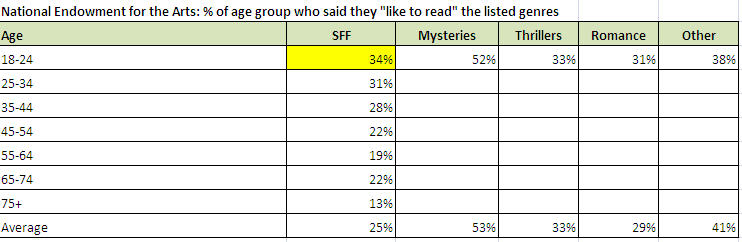
    My interest in this began when I saw the results of the latest NEA survey. They have this graph showing reading rates in all age groups dropping horribly since 1982. By 2002 the graph is taking a nose dive.  Then in 2008 everything turns around. And among the young adults (18-24), we see the biggest increase—9%.

    I saw they had a genre preference question in this survey. Of course, I wondered about science fiction and fantasy. So I contacted the NEA and dug into the details. It appears that 34% of the 18-24 group say they like to read science fiction and fantasy. That’s a big number. That’s 1 in 3.

    Of course, I wanted another data pont, so I went to BookScan and asked for data on book sales. Because the wonderful people there love librarians and Tor Books, they said of course. We looked at juvenile fiction sales from 2004-2008. What we saw was that science fiction and fantasy grew 144% during that period. All the other genres only grew 23%. We also saw that science fiction and fantasy currently make up almost 30% of the juvenile fiction market. So about 1/3.

    Now there are some problems with the BookScan data. Yes, it only cover 60-70% of the market. It’s not in Wal-mart, grocery stories, and a few other places. But what’s more problematic for this issue is that they don’t break up the juvenile sales by age. It includes everything for folks one month old to age eighteen. So I’ve got books like Go Dog, Go in the dataset along with Twilight and Go Dog, Go isn’t categorized as fantasy. [Laughter] My suspicion is that if we narrow it down to the middle grade and YA group, we’ll see more science fiction and fantasy.

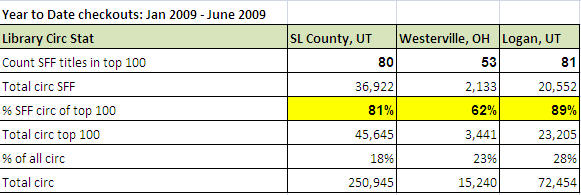
    So I needed someone who did break it up by age. Well, who does that? You do. Libraries do. Besides, a lot of youth don’t have the $ to buy lots of books. So I went to some libraries in Utah and Ohio and got their YA fiction circulation stats. Here’s what I found: 60-80% of the YA fiction circulation is science fiction and fantasy. This does not include graphic novels or magna. It’s text fiction.

    Folks, this is a big drug. I don’t know what part science fiction and fantasy played in the rise in reading rates, that would require a larger and more rigorous study. But I can tell you this: We want to see the impact of science fiction and fantasy on our society? We’re seeing it right now.

    My Story

    This large effect makes sense because science fiction and fantasy deliver experiences that are intersting to and matter to youth. It’s chock full of and encounter with the strange, weird, and wonderful; adventure and danger; doing something meaningful; being someone special, someone desireable, someone wanted in the group. All that coming of age stuff. So no wonder it’s a huge gateway drug.

    I know that it was in my case. I wasn’t a reader. I don’t think I read more than twenty or twenty-four book from kindergater to sixth grade. I look at the little fellows in my local school today and they read that many titles in the first six months of the first grade. But I didn’t. I wasn’t a reader. I do remember loving the look and feel of these small chubby books. [Laughter]

    I would take them them up to the librarian to check them out. She’d look down at me. “Are you going to read all that?” she’d ask. “Yes,” I’d say. Of course, it was lie. [Laughter] It was a huge lie because I would take them home and put them up on my dresser and just look at them.  Just loving the look and feel. And then when it was time to check them in, I’d take them back and give them to the librarian. “Did you read all that?”

    “Yes,” I’d say. And that’s how I became an author–lying to librarians. [Laughter] 

    Now in sixth grade my sister, we were in the car, I had four sisters and we had one TV, and so you had to reserve the time for your programs. So my sister says, “I have to watch The Hobbit for school.” Now I don’t know anything about The Hobbit. It sounded like a romance. [Laughter] I protested. No, way–we’re not going to watch some dumb kissing thing.

    “No,” she said. “It’s got dragons.”

    “You’re lying,” I said.

    I was convinced I was doomed. But it didn’t matter. We watched it. It had dragons. And I loved the experience so much I wanted another hit. Shortly thereafter my mother and father went on a business trip. I went over to my buddy’s house. So the first day we come up out of the basement to go to school and I said, “Oh, I’m feeling sick.” So my buddy went off to school and I went back down into the basement and played hookie for two days and read The Hobbit.

    It was amazing. More amazing than the movie. I had to have that experience again. And so I read Ursula LeGuin, Patricia McKillip, Donaldson, Terry Brooks. I kept reading because it delivered a cognitive-physical experience I loved. Of course, I didn’t put it that way back then. It was more along the lines of, duuuude. [Laughter]

    Now I got a BA in English and a Masters in Accounting. Those degress required a lot of reading. But I didn’t develop the requisite literacy skills in school. I developed them in science fiction and fantasy.

    And so when I started to write I was naturally drawn to fantasy. Having experienced this wonderful thing, I wanted to produce that and share it with others. So this novel that’s coming out has the gosh-wow I still love. It’s set in a world were humans are ranched by beings of immense power. There’s a young man and young woman in terrible trouble. So it has monsters, magic, and mayhem. But I also found fantasy big enough to let me explore other things that have become more important to me as I’ve aged. Like family, sacrifice, and redemption. And I hope people enjoy all that. But ultimately, I hope this book does for someone else what The Hobbit did for me and opens a door to a wonderful addiction. And, of course, as a powerful side-effect, improves the literacy of some rascal or rascaless. [Laughter]

    Conclusion

    I want to end where we began with that Thomas quote.

    “My education was the liberty I had to read indiscriminately and all the time, with my eyes hanging out.”

    That kind of wild abandon will happen when the drug takes effect. And for many of our youth, probably at least one in three, that’s going to be when they ingest a few ounces of SF & Fantasy.

    Thank you.

    [Applause]

    Supporting Numbers

    How fiction is a drug

    Emotion is not a cognition, although cognition plays a part. It’s not just in your brain. It involves a physical response, which means it involves chemicals. 

    We sometimes forget that our bodies produce a staggering number of chemicals. Sometimes they produce in response to external stimuli—the sun triggers the creation of vitamin D, ingested sugar triggers the production of insulin, the sight of a ravening lion standing not five feet away with nothing between him and me produces, among other things, adrenaline.

    Lots of these reactions, we don’t notice. But there’s a whole group of these physical responses that we do. We lump them together and call them emotions.

    Jenefer Robinson in her wonderful book Deeper Than Reason, explains, “Emotions are our way of responding to events in the environment (either external or internal)” that matter to us. They are “physiological changes that register the event in a bodily way and get us ready to respond appropriately.” Fight, flight, pursue, woo, investigate. They focus our attention, get us ready to take action, and communicate all this to others.

    So while I might not feel the production of vitamin D, I do feel the fear of the lion. Fear is a wonderful thing—it keeps us alive. It raises our heart rate, pumps us full of drugs that prepare us to flee or fight. The emotion writes itself on our faces in order to, among other things, communicate the situation to those around us, warning others and calling for help. It is a physical response. Yes, there are cognitions involved, but there are also chemicals.

    The latest research on emotion shows that emotion is a process that involves three things. (1) An affective appraisal of our environment that signals something important to us—a threat or opportunity. (2) This triggers an immediate physical response (chemicals, galvanic skin response, accelerated heart rates, facial expressions, etc.). (3) At this point cognitive (conscious thought) appraisals kick in and help us monitor the situation and moderate the physical response.

    For example, I go out to the yard and step on this thing that slithers through the grass. The sensory signals immediately trigger a physical response to get me ready to flee or fight–heart rate, adrenaline, etc. Then I notice the snake is far too long. I look closer. It’s the garden hose. My physical response changes. I laugh, feel relief. Research has shown that when we read text, the same process occurs. We do indeed have the same types of physical responses. In some cases they’re more intense.

    Now here’s the thing. This physical response is triggered not just by threats and opportunities we perceive with our senses, things out there. It is also triggered by thought. Thoughts deliver a physical response just as surely as crack does. We have the research to prove it. In fact, sometimes thought delivers a more powerful physical response. Here’s but one example. Did you know that people with a phobia of snakes have a stronger reaction to reading a passage about snakes than they do to the actual critter?

    This is where fiction comes in. As I stated in my speech, fiction, the kind of fiction we love, the kind that keeps us up at night sitting on the edge of the tub or locked in a closet with a light, the kind that lingers in the fabric of our clothes and our hair long after we close the book, that kind of fiction goes beyond cognition, beyond data and facts. That kind of fiction triggers a physical response.

    It does this, and this is one difference from emotion triggered by our own thoughts or the sensory data we pick up from the world, because fiction, by its very nature, its very structure, is actually guiding our emotional response. Our physical response. This management of the response is in fact one of the things that we find so pleasurable about it.

    To find out more, please read:

    • The Science of Emotion by Randolph R. Cornelius
    • Deeper Than Reason: Emotion and its Role in Literature, Music, and Art by Jenefer Robinson

    You may then want to search out texts by Dolf Zillmann, Jennings Bryant, and Peter Vorderer.

    Share
  • |

    Writing update: 5/16/11 – outlines & writing vividly

    Finished chapter 5 of CURSE last Saturday. Huzzah!

    The writing is a blast, even though it still requires work. Along those lines, I’ve been meaning for some time to write up the techniques and principles I use when drafting.  So I think I’m going to do a semi-regular post on a weekly basis where I share these tidbits as I run into them. It will be kind of like director commentary, although I’ll have to be careful not to toss out any spoilers.

    This week I’ll talk about using chapter outlines and writing vividly. 

    Bullet Outlines & Chapter Outlines

    Up to this draft, what I’ve done is work from a bullet outline.  Each bullet is a short statement of what needs to occur.  Sometimes it’s very general about the story arc–presentation of the problem, struggle, and resolution.  Sometimes it’s a very specific step.  Sometimes it includes cryptic notes.  For example, here are some bullets for SERVANT:

    1. Talen goes to village, they suspect him
    2. Talen runs, sabin catches him by his hair and pulls him back, field stone size of liver. Plant idea of him catching Hatchlings
    3. Woods back home, freaked
    4. Father is not as concerned, strange, sends him out to field–Talen starts to think about catching the Hatchlings himself

    As you can see, it gives me a roadmap (which often changes) so I’m not starting from nothing when I open up my chapter document.  But it’s very general.  When using this, I often have to use a number of takes to get the scene written because those first takes are me imagining the scene. In fact, my first take is usually a sketch of the scene with me blocking out my goals for the scene and how I expect the events to occur. However, in this last go at CURSE I wrote a chapter outline.  It took me about 25 hours, and the outline for CURSE ran 32 pages. I’ve pasted the first two chapters below.  You can see they’re still mostly in summary, but they represent the initial sketch of what’s going to happen.   

    1.               The Village of Plum – TALEN

    It’s past midnight, behind enemy lines. A thin moon hangs in the sky. Talen, Sugar, River, and five of Shim’s best soldiers crouch in the black shadows of the tree line running along the road to the village of Plum (Sugar’s former village), watching for soldiers or a village guard.

    Talen jokes with Sugar, telling her he wanted a dance tonight, not a sneak behind enemy lines, even if it was in the dark. He’s more than half serious. As they’ve worked together over the last three months since the battle in the cave, he’s become attracted to her.

    Also during those three months, the clans of the New Lands split into two factions. Five clans, led by the Fir-Noy, believed Shim, the leader of the Shoka clan, was being controlled by sleth. The remaining four clans followed Shim. The Fir-Noy faction immediately took up arms, initially to protect themselves, but they soon began talking about ridding the land of the sleth curse. Tensions rose, and in a series of altercations a number of people on both sides were killed. Now both factions have mobilized forces to establish pickets and patrols along a border between them.

    A few days ago, Argoth received word from his spies that something was afoot in the Fir-Noy clan, as if they were preparing for a strike. Futhermore, they’ve decided to excavate the grounds about Sugar’s old house. Argoth knows Purity had her own cache of weaves under the hearth of her old home, the location of which she revealed to Sugar just before she died. Argoth has begun to train up an army of dreadmen for Shim. But he’s stretched thin. He needs all the lore he can get. So he’s sent Sugar and the others to retrieve the items before they’re lost. They’ve come on the evening of the annual apple dance festival, hoping the Fir-Noy would be less vigilant. So far, they’ve been right. In fact, Talen begins to feel like it’s been a little too easy.

    As Talen and the others prepare to move forward, Sugar puts her hand on Talen’s arm. He can feel Sugar’s Fire and soul, and her touch only enflames his desire for both. He’s alarmed by this intensity, and finds it hard to focus, so he moves his arm away.

    “You’re going to give me a boost up,” she says.

    Up ahead in front of the Fir-Noy village stands a thick timber pole probably 11 feet high. Fastened to the top of that pole is what looks to be a skull.

    “You brought us round the wrong side,” Talen says. Their objective was the ash ruins of Sugar’s burned out house, not this pole. 

    “You can’t think we’d come all this way, and I’d leave without it.”

    It’s her father’s skull. The only thing of his that remains. Talen, not wanting contact, motions at one of the taller soldiers with them. “He’d be taller.”

    “Come on,” Sugar says and moves forward in a crouch. They move out of the shadows and into the moonlight, watching the village. Sugar climbs up on Talen’s shoulders and cuts loose the bonds holding her father’s skull. The whole time Talen’s desires make the experience uncomfortable.

    Once Sugar has the skull safely in her sack, the group keeps to the deeper night shadows of the tree line and moves around the edges of the village fields until they come to a ditch. Along the way, one of the soldiers touches Talen, and he feels that same overpowering desire. Something is not right inside of him. He knows it. But there’s nothing to do about it now as they follow the ditch to the ash ruins of Sugar’s house.

    Sugar and Talen sneak over to the hearth of the burned out home. River and the five Shoka soldiers take up watch. Soon Sugar finds the secret cache, but as she’s removing the items, they hear a sound come from one of the surrounding houses. Talen and the others stop and listen. Suddenly Fir-Noy soldiers burst out of the door. They overwhelm one of Shim’s soldiers and rush straight for the others.

    Talen and the others turn to run, but Fir-Noy soldiers begin to pour out of four other houses. Then a Fir-Noy dreadman emerges and shouts it’s the boy that’s wanted. They can slaughter all the rest. It’s clear these soldiers were waiting for them, but there’s no way they could have know Talen and the others were coming, unless they were betrayed. 

    2.               Hue & Cry – SUGAR

    Sugar stuffs the last item in the secret cache into her sack and rises. The Fir-Noy are shouting, but River charges a gap in the quickly forming mob. She fights ferociously. The others race after her, Sugar and another soldier bringing up the rear. Sugar and the others are multiplied, but they’re not fast enough to avoid the soldiers completely, and Sugar is forced to fight and kick to break her way through. When she finally does break past the men, she finds she and the last soldier have been separated from the others and there’s no way to immediately join back up.

    Sugar and the soldier run, but he’s wounded. He tells Sugar to run on without him. She refuses, then a company of Fir-Noy round the corner of a house. The soldier turns to face them and tells her once again to run. In her mind’s eye, Sugar sees the same situation unfolding before her as when the mob came after her mother and da. She ran then and regretted watching her father get butchered. She isn’t going to run now. Besides, she’s multiplied. So instead of running, she rushes over to the soldier and, with lore-given strength, picks him up, puts him over her shoulders, and, despite his protests, speeds away.

    Sugar knows she won’t be able to outdistance her pursuers like this, but she also knows the villager Stout keeps a horse in the barn just ahead. She turns the corner on the barn, puts the soldier down, and tells him to get the horse. Then she darts back out into view of the soldiers following and leads them away. She glances back and sees the soldier slip into the barn. It’s the best she could do for him. If he can get on Stout’s horse, he’ll have a chance to escape.

    Sugar looks to see how she might join back up with Talen and the others, but it’s impossible now. And while most of the Fir-Noy soldiers chased after Talen and the others, a good number are chasing her. Furthermore, others in the village are coming out of their homes. She speeds past them. All over the village dogs begin to bark, but she hears one cluster that sends fear down her spine. The villager Solem keeps a pack of prize-winning sight hounds. He emerges from a barn with his pack on a leash.

    “There!” a man shouts. The barking of Solem’s dogs rises in pitch.

    Sugar increases her speed then hears Solem. “Stu, boys! Take her. Get the wretch!”

    The dogs shoot out after her.

    So how has it worked?

    So far it’s worked very well. Having that initial sketch done means I take a lot less time finishing each chapter.  However, it doesn’t change the general drafting process for me:

    1. The chapters still change as I write. I find cooler ways to accomplish what I need. I also run into things I haven’t imagined yet and have to invent them. For example, on chapter 2 when Sugar is having issues, I realized I didn’t know exactly where the houses lay in the village, so I had to sketch that. It presented opportunities and images.  For example, I thought about the Fir-Noy bowmen being on the roofs. I hadn’t imagined that before, but it was so cool to me, I had to put it in.  Then I felt I wanted Talen and her to huddle together at first. I had to run through a few options about how that played out before I found one that felt right.  
    2. I still find I need to sketch out my goals for the chapters and an initial blocking of what happens. This is much shorter than it’s been on previous drafts, but I still find it helpful. Blocking scenes helps.  This is me just figuring out where everyone is and how they move. Sketching this first helps me write faster.
    3. I still have to do takes, although I move through them more quickly.  

     As you can see, I find the sketch/draft method incredibly helpful.  Just like a painter, I sketch out what I’m thinking of painting. That might require a few sketches where I add in more details.  Then I switch over and begin to paint.


    Writing Vividly

    On another note, I read “Stories are made out of scenes; Scenes are made out of nouns” by author James Maxey again. I really like this essay. Everyone is always talking about verbs, but nouns are such powerhouses.

    Speaking of which, here is the opening to Maxey’s “To The East, A Bright Star” which was published in Asimov’s.  It has one of my favorite beginnings. And part of the reason is what Maxey talks about with nouns.

    TO THE EAST, A BRIGHT STAR

    There was a shark in the kitchen. The shark wasn’t huge, maybe four feet long, gliding across the linoleum toward the refrigerator. Tony stood motionless in the knee-deep water of the dining room. The Wolfman said that the only sharks that came in this far were bull sharks, which were highly aggressive. Tony leaned forward cautiously and shut the door to the kitchen. He’d known the exact time and date of his death for most of his adult life. With only hours to go, he wasn’t about to let the shark do something ironic.  

    Tony waded back to the living room. Here in the coolest part of the house, always shaded, he kept his most valuable possession in an ice-chest stashed beneath the stairs. He pulled away the wooden panel and retrieved the red plastic cooler. Inside was his cigar box, wrapped in plastic bags. He took the box, grabbed one of the jugs of rainwater cooling in the corner, and headed up the stairs to the bathroom. He climbed out the window above the tub onto the low sloping roof over the back porch.

    This all reminds me of Swain’s thoughts on bringing the material to life, which I thought Maxey did so well in those paragraphs.

    Few of us read voluntarily about the primer-level doings of Dick and Jane.  Simplicity is a virtue in writing, true; but never the primary virtue.

    What is?

    Vividness.

    How about brevity?

    It’s important too.  Within reason.

    Within reason?

    Who, just learning this business, knows where or when or how to be brief? In the wrong place, brevity can destroy you.

    So?

    As in the case of simplicity, brevity is never the heart of the issue. Vividness is.

    How do you write vividly?

    You present the story in terms of things that can be verified by sensory perception. Sight, hearing, smell, taste, touch–these are the common denominators of human experience; these are the evidence that men believe.

    Describe them precisely, put them forth in terms of action and of movement, and you’re in business.

    Your two key tools are nouns and verbs.

    (p25 Techniques of the Selling Writer)

    Of course, there’s more–the telling detail, metaphor, working memory overload, details from the point of view. But it all plays into being vivid.

    Share
  • Awful Intent update: Chapter 20

    Just finished chapter 20. It’s been a rough month for writing, but I believe life has settled down a bit, and I should be able to get the time in that I need. I hate giving targets publicly because the last time I did that I just missed and missed and missed. So we’ll stay with the progress gauge. Although I have to say that I might go over thirty chapters. I normally write chapters about 2,500 words long. But these are averaging 2,000. We’ll see. The outline always changes during the first draft.

    Share
  • Advance Praise for Servant of a Dark God

    My editor just emailed me another endorsement from one of the folks we sent the manuscript to. I’m so excited! This one’s from Kage Baker.

    I’m a total stranger to three of the four that have responded so far. It continually amazes me how generous the pros in this genre are with both their time and praise.

    Here’s the last one.

    “A classic heroic saga, dealing with the bedrock issues of good and evil and identity. These are classic themes because they matter; and Brown makes them matter both to his young protagonist and the reader. It promises to continue for quite a distance, and I hope it does.”

    —Kage Baker, author of House of the Stag and The Company series.

    Here are the previous ones.

    “Thoroughly engrossing from the first page to the last! John Brown shows himself to be a writer with remarkable depth and power. I haven’t seen a debut novel this good in years!”

    —David Farland, New York Times best-selling author of Runelords and Ravenspell series

    “In Servant of a Dark God, John Brown has created a complex and intricate world, filled with all the permutations of human good and evil, as well as evil that goes beyond the human, where neither heroes nor villains are quite what they seem at first, and where the cost of virtue is high indeed, yet where, in the end, the tenacity of such virtue is what is required to triumph.”

    —L. E. Modesitt, Jr., award-winning author of the Recluce Saga

    “A complex, powerful story of a youth trying to learn who he is and what he is, with no allies he can trust in a world stalked by a monster. A book that copies nothing I have read before and which goes its own way brilliantly.”

    —David Drake, author of the popular Hammer’s Slammers and Lord of Isles series

    Wow. I think I want to read this book!

    Share

2 Comments

  1. Man, do I wish i lived in Utah so I could come out and hang with you guys. If I thought I could find a job quickly I might consider moving.

  2. Life The Universe & Everything is coming up in February. If you wanted to hang with Utah SFF authors, that’s probably the biggest event.

Comments are closed.