What Robinson Wells Learned Last Year

Look, this is just an excellent post by Robinson Wells: Five Things I’ve Learned In The Last Year About Writing.

I kept finding myself saying yes, yes, yes!

Yes! I hate “networking” too. Icky, icky, icky. Like squishy underwear. Like buddying up to someone to get them into your network marketing downline. Like flies in soup. I love how Robinson replaces that with the real deal. I think I’m going to summarize him every time anyone asks me about networking. 

One point. I do think he might be overstating the you-need-to-know someone deal. It’s easier, sure. But Larry Correia didn’t know anybody. He just wrote a book a lot of people in a certain demographic loved. I didn’t know my agent from Adam. Didn’t know my editor, but did have an endorsement from one of his authors. But that didn’t get me any deal. It probably got me, at most, a fair consideration. I can name others who didn’t know a soul. In fact, go to the facts and figures page in the On Writing section. Look at the author polls there. A lot of authors didn’t know a soul. Of course, knowing someone can help.

Yes! Be cheerfully flexible. Oh, my gosh. This is such a good approach. And I’m living it right now, although there have been a few moments when I’ve had to regroup for a moment to capture the cheerful.

Yes! Sometimes the thing you love doesn’t work for the project. Sometimes it does. I would advocate making sure you get to the root of the issue. But we’re artists. If the thing we don’t love doesn’t work, we can create a new thing to love. That’s what it means to be creative.

Work! Yes! It’s amazing what happens when you work.

Good stuff.  

I’m so bullish on this, I say Robinson for President.

Of what, I don’t know. But he should be President, of something.

Share

Similar Posts

  • | |

    Speculative Fiction, Gateway Drugs, and Literacy

    You can read the transcript of my remarks at the American Librarian Association (ALA) conference in Chicago on July 11 below as well as the supporting information.

    IS SF/Fantasy Key to Teen Literacy?

    Intro

    I am so happy to be here. And I’m happy share some good news. David McCollough, the Pulitzer prize winning historian shared this fact in his commencement speech at the University of Utah this spring. “There are yet “more public libraries in America than there are McDonalds.” [Cheering]

    We have not yet been assimilated!

    Of course, this is due in a large part to you, the librarians who care for the collections and take care of the patrons. Which is why I think you deserve a big round of applause. Give yourselves a hand. [Applause]

    Fiction is a literal drug

    I want to start my remarks with two quotes.

    Ray Bradbury was recently interviewed in a NY Times article  He said, “I don’t believe in colleges and universities.” This is what he said, “I don’t believe in colleges and universities. I believe in libraries.” He said this because when he graduated from High School he didn’t have enough money to go to college. So he went to the library three days a week for ten years.

    The next quote is from the great poet Dylan Thomas–“Do not go gentle into that good night, rage, rage against the dying of the light”–that guy. He said,  “My education was the liberty I had to read indiscriminately and all the time, with my eyes hanging out.”

    If you look at Bradbury and Thomas, they read, not because there was some grade involved, not because someone went after them with a stick—they read from hunger. From thirst. They read with wild abandon because they found in reading something they couldn’t find elsewhere.

    I want to suggest one thing they found was a drug. [Laughter] I’m not speaking in metaphor. I’m talking about real physical response. As real and physical as the response you get when you or I take aspirin, brandy, or crack. Well, I hope we’re not taking crack. [Laughter] 

    When we think about drugs we think about pills, smoke, injections. But those are simply one set of delivery mechanisms for chemicals that trigger a physical response. There are other delivery mechanisms. Other triggers. One of them is fiction.

    Now I don’t have time today to detail how this works. But I will write it up on my website for those who are interested. The key thing to remember is that fiction, the kind of fiction we love, the kind that keeps us up at night sitting on the edge of the tub or locked in a closet with a light, the kind of fiction goes beyond cognition, beyond data and facts. We find it so pleasurable precisely because it triggers and guides a physical response.

    So how does all of this apply to science fiction and fantasy? Here’s the deal. And here’s where we come to our topic. Science fiction and fantasy is, for our youth, one of the most powerful gateways drugs into the fictive experience. Of course, there are ideas in science fiction and fantasy that ripple out to the society. But even if there weren’t, the happy side-effect of an addiction to this drug is improved literacy. And we all know how much that impacts.

    Numbas

    Now I know those of you who work with young adult circulation have seen this. But I thought it might be interesting to get some actual numbers so we can start to gauge the scope of the science fiction and  fantasy effect.

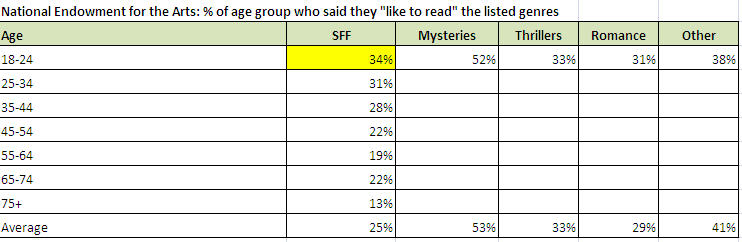
    My interest in this began when I saw the results of the latest NEA survey. They have this graph showing reading rates in all age groups dropping horribly since 1982. By 2002 the graph is taking a nose dive.  Then in 2008 everything turns around. And among the young adults (18-24), we see the biggest increase—9%.

    I saw they had a genre preference question in this survey. Of course, I wondered about science fiction and fantasy. So I contacted the NEA and dug into the details. It appears that 34% of the 18-24 group say they like to read science fiction and fantasy. That’s a big number. That’s 1 in 3.

    Of course, I wanted another data pont, so I went to BookScan and asked for data on book sales. Because the wonderful people there love librarians and Tor Books, they said of course. We looked at juvenile fiction sales from 2004-2008. What we saw was that science fiction and fantasy grew 144% during that period. All the other genres only grew 23%. We also saw that science fiction and fantasy currently make up almost 30% of the juvenile fiction market. So about 1/3.

    Now there are some problems with the BookScan data. Yes, it only cover 60-70% of the market. It’s not in Wal-mart, grocery stories, and a few other places. But what’s more problematic for this issue is that they don’t break up the juvenile sales by age. It includes everything for folks one month old to age eighteen. So I’ve got books like Go Dog, Go in the dataset along with Twilight and Go Dog, Go isn’t categorized as fantasy. [Laughter] My suspicion is that if we narrow it down to the middle grade and YA group, we’ll see more science fiction and fantasy.

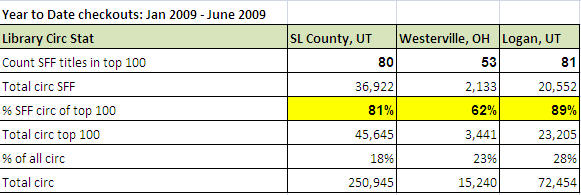
    So I needed someone who did break it up by age. Well, who does that? You do. Libraries do. Besides, a lot of youth don’t have the $ to buy lots of books. So I went to some libraries in Utah and Ohio and got their YA fiction circulation stats. Here’s what I found: 60-80% of the YA fiction circulation is science fiction and fantasy. This does not include graphic novels or magna. It’s text fiction.

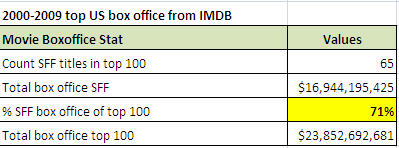
    Folks, this is a big drug. I don’t know what part science fiction and fantasy played in the rise in reading rates, that would require a larger and more rigorous study. But I can tell you this: We want to see the impact of science fiction and fantasy on our society? We’re seeing it right now.

    My Story

    This large effect makes sense because science fiction and fantasy deliver experiences that are intersting to and matter to youth. It’s chock full of and encounter with the strange, weird, and wonderful; adventure and danger; doing something meaningful; being someone special, someone desireable, someone wanted in the group. All that coming of age stuff. So no wonder it’s a huge gateway drug.

    I know that it was in my case. I wasn’t a reader. I don’t think I read more than twenty or twenty-four book from kindergater to sixth grade. I look at the little fellows in my local school today and they read that many titles in the first six months of the first grade. But I didn’t. I wasn’t a reader. I do remember loving the look and feel of these small chubby books. [Laughter]

    I would take them them up to the librarian to check them out. She’d look down at me. “Are you going to read all that?” she’d ask. “Yes,” I’d say. Of course, it was lie. [Laughter] It was a huge lie because I would take them home and put them up on my dresser and just look at them.  Just loving the look and feel. And then when it was time to check them in, I’d take them back and give them to the librarian. “Did you read all that?”

    “Yes,” I’d say. And that’s how I became an author–lying to librarians. [Laughter] 

    Now in sixth grade my sister, we were in the car, I had four sisters and we had one TV, and so you had to reserve the time for your programs. So my sister says, “I have to watch The Hobbit for school.” Now I don’t know anything about The Hobbit. It sounded like a romance. [Laughter] I protested. No, way–we’re not going to watch some dumb kissing thing.

    “No,” she said. “It’s got dragons.”

    “You’re lying,” I said.

    I was convinced I was doomed. But it didn’t matter. We watched it. It had dragons. And I loved the experience so much I wanted another hit. Shortly thereafter my mother and father went on a business trip. I went over to my buddy’s house. So the first day we come up out of the basement to go to school and I said, “Oh, I’m feeling sick.” So my buddy went off to school and I went back down into the basement and played hookie for two days and read The Hobbit.

    It was amazing. More amazing than the movie. I had to have that experience again. And so I read Ursula LeGuin, Patricia McKillip, Donaldson, Terry Brooks. I kept reading because it delivered a cognitive-physical experience I loved. Of course, I didn’t put it that way back then. It was more along the lines of, duuuude. [Laughter]

    Now I got a BA in English and a Masters in Accounting. Those degress required a lot of reading. But I didn’t develop the requisite literacy skills in school. I developed them in science fiction and fantasy.

    And so when I started to write I was naturally drawn to fantasy. Having experienced this wonderful thing, I wanted to produce that and share it with others. So this novel that’s coming out has the gosh-wow I still love. It’s set in a world were humans are ranched by beings of immense power. There’s a young man and young woman in terrible trouble. So it has monsters, magic, and mayhem. But I also found fantasy big enough to let me explore other things that have become more important to me as I’ve aged. Like family, sacrifice, and redemption. And I hope people enjoy all that. But ultimately, I hope this book does for someone else what The Hobbit did for me and opens a door to a wonderful addiction. And, of course, as a powerful side-effect, improves the literacy of some rascal or rascaless. [Laughter]

    Conclusion

    I want to end where we began with that Thomas quote.

    “My education was the liberty I had to read indiscriminately and all the time, with my eyes hanging out.”

    That kind of wild abandon will happen when the drug takes effect. And for many of our youth, probably at least one in three, that’s going to be when they ingest a few ounces of SF & Fantasy.

    Thank you.

    [Applause]

    Supporting Numbers

    How fiction is a drug

    Emotion is not a cognition, although cognition plays a part. It’s not just in your brain. It involves a physical response, which means it involves chemicals. 

    We sometimes forget that our bodies produce a staggering number of chemicals. Sometimes they produce in response to external stimuli—the sun triggers the creation of vitamin D, ingested sugar triggers the production of insulin, the sight of a ravening lion standing not five feet away with nothing between him and me produces, among other things, adrenaline.

    Lots of these reactions, we don’t notice. But there’s a whole group of these physical responses that we do. We lump them together and call them emotions.

    Jenefer Robinson in her wonderful book Deeper Than Reason, explains, “Emotions are our way of responding to events in the environment (either external or internal)” that matter to us. They are “physiological changes that register the event in a bodily way and get us ready to respond appropriately.” Fight, flight, pursue, woo, investigate. They focus our attention, get us ready to take action, and communicate all this to others.

    So while I might not feel the production of vitamin D, I do feel the fear of the lion. Fear is a wonderful thing—it keeps us alive. It raises our heart rate, pumps us full of drugs that prepare us to flee or fight. The emotion writes itself on our faces in order to, among other things, communicate the situation to those around us, warning others and calling for help. It is a physical response. Yes, there are cognitions involved, but there are also chemicals.

    The latest research on emotion shows that emotion is a process that involves three things. (1) An affective appraisal of our environment that signals something important to us—a threat or opportunity. (2) This triggers an immediate physical response (chemicals, galvanic skin response, accelerated heart rates, facial expressions, etc.). (3) At this point cognitive (conscious thought) appraisals kick in and help us monitor the situation and moderate the physical response.

    For example, I go out to the yard and step on this thing that slithers through the grass. The sensory signals immediately trigger a physical response to get me ready to flee or fight–heart rate, adrenaline, etc. Then I notice the snake is far too long. I look closer. It’s the garden hose. My physical response changes. I laugh, feel relief. Research has shown that when we read text, the same process occurs. We do indeed have the same types of physical responses. In some cases they’re more intense.

    Now here’s the thing. This physical response is triggered not just by threats and opportunities we perceive with our senses, things out there. It is also triggered by thought. Thoughts deliver a physical response just as surely as crack does. We have the research to prove it. In fact, sometimes thought delivers a more powerful physical response. Here’s but one example. Did you know that people with a phobia of snakes have a stronger reaction to reading a passage about snakes than they do to the actual critter?

    This is where fiction comes in. As I stated in my speech, fiction, the kind of fiction we love, the kind that keeps us up at night sitting on the edge of the tub or locked in a closet with a light, the kind that lingers in the fabric of our clothes and our hair long after we close the book, that kind of fiction goes beyond cognition, beyond data and facts. That kind of fiction triggers a physical response.

    It does this, and this is one difference from emotion triggered by our own thoughts or the sensory data we pick up from the world, because fiction, by its very nature, its very structure, is actually guiding our emotional response. Our physical response. This management of the response is in fact one of the things that we find so pleasurable about it.

    To find out more, please read:

    • The Science of Emotion by Randolph R. Cornelius
    • Deeper Than Reason: Emotion and its Role in Literature, Music, and Art by Jenefer Robinson

    You may then want to search out texts by Dolf Zillmann, Jennings Bryant, and Peter Vorderer.

    Share
  • Some Key Concepts for Love Stories

    My first four professionally published short stories were all love stories of one kind or another. I love good love stories. And so when the Writing Excuses team podcasted about this topic with Dave Wolverton, I was excited to hear what they had to say. Of course, they didn’t dissappoint. However, I would like to add a few things here.

    1. A love story or romance is a happiness story. The problem is one of danger to, lack of, or opportunity for the happiness that comes with having a close bond with someone else. To be loved and included, to be valued by someone.

    2. Love stories don’t have to be between two characters who are romantically interested in each other. They can be between two people who become friends or a person who is on the outs with a particular group as with RAINMAN, or between a father (or father figure) and son as in TREASURE PLANET, or a mother and daughter.

    3. It seems to me that these social story problems can be broken down into four elements.

    1. Raising the idea
    2. Making the characters attractive
    3. Raising obstacles and conflict
    4. Showing signs of progression

    RAISING THE IDEA

    Just as with any story problem, we have to know there’s an issue. The idea of possibility or lack has to be presented to us. And the specific person who we hope the character bonds with has to be identified. How is this done?

    Lots of ways. But I can see two big ones right off the bat. The first has to do with what a character notices about the other person. In a romantic love story, it might be some thoughts about another’s attractiveness, either looks or character. This could happen when the character sees the other person, touches them, hears them speak. And it doesn’t have to be a stranger. Perhaps they had a crush on that person when they were younger. There are all sorts of cues we use to signal romantic potential. All we have to do is raise a few of those for the reader and the idea is planted.

    The second way the idea is raised is by having some other character raise it. Someone else notices the person and thinks them attractive. Or they make a suggestion that our character getting together with them is a possibility.

    So when Jack sees Mary he can think about when the blankety blank she’s going to get off the commando team because all she does is distract the men. Not him, of course. Or Bill can tell Jack that Mary has been watching him. And Jack can say, she can look all she wants because she’s never going to get a piece of this.

    MAKING THE CHARACTERS ATTRACTIVE

    The second thing I see that’s necessary is that the other person is attractive to the reader. Or, at least, the reader could see how the character could be attracted to this person. This doesn’t always have to be physical beauty. Nor does it have to be sexual attraction. A buddy story would be about something else–about someone who we think is admirable in some way. But it has to happen for the reader to believe the story.

    Of course, our hero may be duped. Jack might be falling for Cindy when she’s really just after his money. The readers know both sides and can see how Jack’s choices make sense, even while we feel great anxiety of the trouble coming down the line. 

    RAISING OBSTACLES AND CONFLICT

    These are key, of course. No obstacles or conflicts and there is no story. Jack sees Jill. Says I love you. They marry. The end. So we have to have obstacles. They can start immediately with the character recognizing a possiblity. For example, Jack is simply oblivious to Jill’s interest in him. And when he decides to trust his friend’s advice to pursue her, he sees her with another man. She’s not an option for him afterall.

    If we think about yes-buts and no-furthermores and that usually the hero has to fail at the end of act 2 for us to feel triumph at the end of act 3, we’ll see that obstacles and conflicts progress just as they do in any other story.

    There are many obstacles or points of conflict. Distance (CASTAWAY), social status, fears of rejection, a stuttering problem, another person who Jack is interested in or who Jill is interested in, something Jill does that Jack doesn’t agree with, jobs that are demanding and keep them apart or make them keep secrets (TRUE LIES). Are too closely related. It’s against your vows or values (you’re a nun or he’s a client) Etc.  Many are internal and have to do with trust, fear, competing desires, and commitment.

    The key to the obstacles, I’ve found, is in making it hard to choose or fulfill commitment. It isn’t about sex or kissing. Because you can have a story where two people have sex and it doesn’t resolve any tension in the love story (what if the guy is seen that night with another woman?). It’s about two people being able to say I love or value you and meaning it.

    And so anything that would keep them from commiting works. And after they’ve committed, anything that would make one recant. Or be unable to enjoy that love going forward.

    SHOWING SIGNS OF PROGRESSION

    The last thing is that the audience needs to know that things are moving forward. In plotting, we need a few yesses along the way or the story’s over. How do we do this? What are the signs? I can think of a few.

    1. The character’s thoughts are more and more about the other person, noticing all sorts of things, dealing more and more with inner dilemmas.
    2. The character’s actions become more and more open. The lingering looks, or glances she tries to  hide, the touching. The character’s words become more and more direct. Usually oblique at first and then more clear later.
    3. There is more validation from other characters.

    Why do so many stories have the characters in a romance dance? Not because dancing is some mystical thing. No, it’s a romantic cue. We associate romance with dancing. And being in such close proximity raises the pulse. But you can put people in close proximity in many other ways–in a crate as they’re being smuggled into the country, standing smashed together in a subway, retracting a bullet from the leg, cutting and washing hair (John Travolta in PHENOMENON), etc.  The reason why we do this; however, is so that we can get a yes, a sign of progression. Of course, we could also use it to raise a devestating conflict as when Maria dances with Captain Von Trapp in THE SOUND OF MUSIC. But that’s only devestating because during the dance they had declared in subtle ways that they were interested in one another.

    So we raise obstacles and show signs of progression, back and forth, the obstacles pointing more and more toward disaster until at the end of act 2 Jack loses…and we get the no-but plot turn. No, he’s failed completely. But then a desperate glimmer of hope…

    In the end we need final confirmation. One thing that says, yes, they’re committed. Often in romantic love stories writers use sex as a blunt confirmation. I think it’s often the lazy way out. Here, show Jack and Jill having sex. Okay, next plot point. It’s lost most of its power for me. And such a thing should be anything but cliche. My advice is to think of many other ways that show commitment and value. A few examples off the top of my head are what Dean Koontz in his ODD THOMAS series did this for Odd and Stormy, FAR AND AWAY with Joseph and Shannon, WHAT ABOUT BOB, and SABRINA. In fact, having sex was turned on its head in this one. Lovely.

    At least think about other options because romantic love stories are not about sex. Sexual tension stories are. But that’s a different problem. A different type of story. And it seems writers sometimes confuse these two. Romantic love stories are about two people finally saying, yes, I love you, I value you, and I mean it, and always will. And as an audience, we believe.

    And if that doesn’t move you, then remember that one of the things we go to stories for is surprise. Something new. How wonderful would it be if something as simple and Jackbiking into Jill’s work place with a parrot on his shoulder is the ultimate moment of the story, and says everything that needs to be said? And when Jill looks up at the commotion, her heart to this point hardened or desolate, and sees the bird, the audience weeps or cheers…

    Share
  • |

    Why you can’t popularize literary fiction, part 2

    I voiced my opinions on the TC Boyle message board. Needless to say, I’m probably too aggressive in my stance. But a guy over there said: “(easy,chewable,harmless pages) shouldn’t be the goal of any writer with even the tiniest self-respect.”

    Here’s my response.

    —-

    I don’t know any of these successful authors who don’t have self-respect because I don’t know any of them who try to write based on what they think will sell. Everyone of them that I know writes from passion. And I know some NY Times Bestsellers. They might look at 10 projects they have passion for and choose one that might be more marketable. But the passion comes first.

    I don’t know how anyone could spend the amazing number of hours it takes to finish a novel unless they have passion for the project. In fact, I wonder if it’s possible to create something that’s actually sellable without it. Everyone’s always talking about these hacks out there with metal brains writing for money. But after all the writers I’ve met, I’ve yet to find one. In my experience they’re as scarce as the yeti.

    So my intent wasn’t to say you can write for love or money, but not both. My intent was to say that I believe most MFA programs have made themselves irrelevant to the greater stream of literacy in the country. The teachers have passion for fringe genre and teach their students how to entertain that fringe reader. And if they DO have passion for the types of fiction most readers want, such enjoyment is always talked about as some form of slumming. There’s an apology or at least a statement making it clear they know such fiction is not something you bring to the table where serious writers work.

    But this isn’t true. Serious writers, passionate writers work in those genres. And they deliver excellent work. By that I do NOT mean they deliver the tropes of literary fiction in drag. What they deliver doesn’t appeal to the fringe markets. But it’s excellent, nevertheless, because it delivers exactly what the people go to those stories for.

    Share
  • |

    Become A Story Idea Machine

    Now’s your chance

    Apply to take the next Novel Writers Academy course: How to Create Story Ideas That Beg To Be Written.

    • Six-weeks
    • Starts: Jan 2, 2022
    • Ends: Feb 21, 2022
    • Gobs of hands on practice
    • One-on-one guidance from me

    At the end of the six weeks you will be a story idea machine.

    I will be working with only a small set of people. And so you need to apply to get in.

    The deadline for applications is midnight, December 11th. So contact me now to get the application instructions.


    A cracking good story idea requires five critical elements.

    Until you have all five, you’ll struggle to plot. You’ll write a few scenes and run out of gas. You’ll feel like the story just isn’t going anywhere.

    And that’s because it isn’t. It can’t. A story isn’t a story without all five elements.

    However, once you develop these five things, your story will suddenly roar to life. There are a few other elements that are important as well, but these five things form the core of the story setup. 

    In this course you’re not going to merely learn about all of those story elements. You’re going to go deep and learn what can only be learned by actually doing the work and developing story idea after story idea with personal one-on-one feedback from someone who knows what they’re doing.   

    When you finish, you won’t just know story theory. You will be a story idea machine. And you will be that because you have put in the work. The right work.  

    Again, this is not a course full of lectures and videos. This is a course where you’re going to work. And develop the insights and skills that only come from doing the work.

    You’re actually going to:

    • Come up with story setup after story setup after story setup
    • And improve them with one-on-one feedback. 

    It’s going to:

    • Eliminate years of you wandering about in the story wilderness trying to figure things out on your own. 
    • Put you miles ahead of other writers who have no idea what’s really at the core of story. 

    You are going to learn how to develop killer story ideas on purpose instead of on accident. Which means you’ll be able to do again and again. Reliably. Like clockwork. 

    Course details

    The focus of the class is not on learning about story, although you will do that. The majority of your time will be spent on developing stories. 

    You can’t become a carpenter by watching videos and reading books about it.

    You have to get out on the work site, cut wood, and pound nails. You have to make the mistakes all beginning carpenters make, get feedback, and improve.

    The same goes for writing.

    And you’re going to work in this class. You develop 21 story setups. In fact, you develop more because the 21 are just the ones you turn into me. And with each one your skills, insights, and abilities grow.  

    In the beginning, your setups will be bare bones. By the end, they’ll be fully developed setups that beg to be written. Setups you can use to immediately write the first draft  of your novel, whether that’s in outline or chapter form. 

    Here’s what you do each week. 

    Week 1.

    • Uncover the secrets of what’s really at the heart of story and how to generate ideas. 
    • Define your genre requirements
    • Create story setups 1-3

    Week 2.

    • Uncover the secrets to compelling characters 
    • Create character sketches
    • Create story setups 4-7 

    Week 3.

    • Uncover the secrets to formidable obstacles
    • Create story setups 8-11 

    Week 4.

    • Uncover the secrets to interesting casts
    • Create story setups 12-15

    Week 5.

    • Uncover the secrets to managing multiple storylines and series
    • Create story setups 16-19 

    Week 6.

    • Create story setups 20-21. These are your capstone projects where you apply everything you’ve learned and take it to the next level

    In this class you develop story idea after story idea after story idea. You are going to be marinated in the work of developing characters, THOMs, goals, obstacles, settings, casts, and more. And because of that, each week will not only bring an explosion of insights, but new skills and abilities.

    Every week you get two private, one-on-one, live sessions with me where you get encouragement and feedback on what you’ve developed. And you’ll have access to a private Facebook group where you can apply the principles to brainstorm even MORE ideas for each other’s stories. 

    At first you might feel a bit shy and worried about your ideas and abilities. But you’ll soon get over that. By the end of the course you’ll be one of those people that can generate terrific ideas easily. And you’ll be able to do that because you will have put in the work to become a different writer.  

    What’s the price?

    Hours of one-on-one instruction from a professional editor or author costs thousands of dollars. An MFA program can cost $25,000 to $30,000 or more!

    But this course won’t cost anywhere close to that.

    Plus you’re going to learn things here you’ll never get in an MFA program (I know. I was accepted into a top-ranked program).

    The cost of this course is $799. And I personally guarantee your results. You’ll be totally oh-my-gosh-I’m-so-happy-I-took-that-class satisfied, or I’ll give you your money back. No questions asked.

    Now’s your chance to stop spinning your wheels. I can’t tell you how much I wish I’d had something like this when I’d started:

    • The secrets about the true core of story.
    • The secrets about how to come up with ideas. 
    • Actual work with personal one-on-one feedback. 
    • Laser focused on what actually matters, not a bunch of ridiculous writing rules. 

    When you finish, you will be a story idea machine. 

    You won’t know plotting. That’s a different course and set of skills. You won’t know how to write chapters. But you’ll know how to create the engine that powers all the rest of that. You’ll know how to create the core that makes awesome plots and chapters possible. 

    If you want to take this course, click the button below and contact me. I will tell you exactly how to apply.

    I’m not going to be able to accept everyone who wants to take the class. I have a very strict limit on the number of students I can work with. So you need to get your application in before the deadline of midnight, December 11th.

    Don’t wait!

    Contact me now to get application instructions.

    Share
  • What I’m looking for from SFWA

    SFWA has asked M.C.A. Hogarth to head up the new self-publishing committee. Hogarth posted about this and asks:

    So here’s my question for those of you who self-publish, either entirely or as a hybrid author: what services would you look for in a professional organization? What would make you say, “Wow, that’s worth $90 a year, sign me up?”

    I applaud SFWA’s move. And the many good things SFWA has done in the past. However, as an indie and SFWA member, here’s what would interest me: Business.

    That’s with a big B.

    That means . . .

    Distribution into brick and mortar venues. So indie authors can get on the Ingram’s catalog. Big whoop. The retailer still has to order. If SFWA was able to facilitate the sales function in some way, that alone would be worth it.

    One idea is a SFWA catalog of vetted work. I don’t know how you’d vet. Maybe some certain sales and revenue level. And revenue would have to be part of it. Brick and Mortar isn’t going to be interested in stocking the person who “sold” 50,000 units but only made $300 because 99% of them were free downloads.

    You might also consider the back lists of authors with work that was once published that has been brought back indie style. So a catalog of that includes new stuff and a section for the back list. Quality and popular indie work.

    BTW, this catalog would ALSO go to libraries.

    Education in cover design AND art direction. Maybe adding this to an awards category chosen NOT by the general membership but art pros.

    The Nebulas recognize author’s who sell. But what about recognizing those who are author-publishers, what about recognizing and celebrating quality and achievement in the key elements of publishing?

    Education in Marketing that has actually been tested and shows positive ROI. Not a bunch of articles about bookmarks and conventions. Real ROI.

    Interior formatting. Principles. Awards.

    News. What’s new on the indie front. New markets etc.

    Selling foreign rights as an indie with and without an agent.

    What about an award like RWA’s Golden Heart, but for indie books? Or make indies more inclusive in the Nebulas.

    A vendor forum where folks who provide services to indie authors (editors, artists, etc) can be listed and rated, GoodReads style, but only by SFWA members.

    And two things I have submitted to SFWA before as a trad pub author.

    Education and discussion of contracts and contract terms. What’s current. What’s alarming. I get more off of Kris Rusch’s blog than the professional organization I belong to. I should be giving my $90 bucks to Kris. What the heck?

    Education and discussion of current contract rates. Same as above. For a professional organization to not have data on current rates for novels is a real head-scratcher.

    How is it that Tobias Buckell can run a survey, but it never occurs to SFWA to survey and publish annual numbers?

    How is it that Brenda Hiatt, the romance writer who does an annual “Show Me The Money” and “Indie Earnings” report, provides more info on Tor advances than SFWA? Romance writers are better organized than any writing group on the planet, but do they need to spank us in our own house?

    These last two are no-brainers.

    This is a trade organization. These types of things would be a HUGE help.

    Share
  • What does an author earn per book?

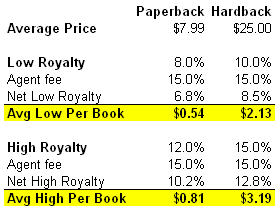
    People are always curious about this, so I thought I’d post it and refer to my previous post about what kind of sales numbers it takes to make a living as a fiction author in the US. Of course, the royalty rates depend on what’s in your contract. Many contracts have sales volume break points. For example, an 8% royalty on the first 50,000 paperbacks sold, 10% on anything above that. But this should give you a good feel.

    Earnings per book

    Share

8 Comments

  1. Yeah, I wish I could have come. It was just not in the cards with everything we had going on. I will be at LTUE and look forward to catching up. Was it well attended?

  2. The signing was at Sam Weller’s, and we had decent traffic. Not a big crowd, but decent traffic. For Laurie Tom and I, the real action was at the seminar itself. People kept asking for copies of WOTF 26, so I brought my box from home and sold all of them. Plus some copies of Analog too. That was fun. And of course the seminar itself was very, very good. Top notch content from some top notch professional writers.

  3. Regarding the commentary about networking, that’s a rather slippery fish. I think the big key to remember is that if you’re dealing with someone in the industry and you’d like something from them, you need to think about it in a reciprocal fashion. If the person might be able to help you, how might you be able to help them? Even if it means simply offering to buy them lunch or dinner, in exchange for some of their time or whatever else it is of theirs that you need?

    The other side of that is learning how to be relaxed and not “vibe” people. I’ve seen aspirants do this, and am probably guilty of it myself at times. You meet someone way farther up the food chain, you get this urgently excited tension, and it often translates badly. Especially if the person you’re talking to already has bruises from the numerous bombardments (s)he gets all the time anyway.

  4. Regarding the Superstars seminar, the most eye-opening things for me, were Eric Flint’s comments. Not because the other panelists didn’t have tons to offer. They did. It’s just that having done WOTF and being local to Utah, I’d already been exposed to a lot of what Dave, Kevin, Rebecca and Brandon had to say. Eric was the self-styled “grinch” who brought graphs and numbers and disected novel contracts, royalties, self-promotion, and so forth.

    If I had to boil it out, I’d say the things I picked up on most were:

    1) Self-promotion can be a very time-consuming, financially-problematic exercise that may or may NOT result in increased sales. Eric Flint seemed to feel that self-promotion, beyond occasional book signings or some simple items like customized bookmarks to hand out to fans on occasion, was a project of diminishing returns. He felt writing the next book was way more valuable — in terms of time investment — than doing a lot of self promo.

    2) Novel contracts. Eric took us all the way through one of his from Baen, and explained all the clauses. This was interesting on several levels, especially when compared to my Dell Magazines contracts. Lots more to worry about in the novel contract, but the Baen one was fairly straightforward. Eric warned that other publishers can have nightmarish contracts twice as long. I’d have liked to have seen what one of those looked like.

    3) Royalties and the realities of publishing economics. Eric had pie charts and bar graphs for this part — eye-opening material I’d never seen before. Holy smokes, it’s almost like the author gets nothing for paperback sales. And the publishers doesn’t expect to make money on the first book either, or so Eric said. He’s right, he’s the “grinch” of the seminar. But it was nice real-world material, and leavened the rest of the program.

    4) No replacement for writing, writing, writing. Kevin and Rebecca jumped on this a lot. It never hurts to be reminded that the #1 job of the writer is to keep his or her butt in the chair, and write. I’ve been too often guilty of FAIL in this regard, the past six months. I am trying to develop better discipline, but the number of good and not-so-good excuses to get out of writing are legion, as you well know.

    5) Also no replacement for persistence in the face of long odds and adversity. That one is also basic, but again it never hurts to be reminded. Eric talked about how it took him four years to sell his first book after he won Writers of the Future. Wow, I’d have gone nuts if it had taken me that long to sell after winning. So I count myself lucky with the Analog sales. And of course there is Brandon writing 13 books before he sells his first. Humbling data, that.

  5. That’s really good stuff. #4 and #5 resonate with me. #1 does as well. Some of the promotion I’ve done has cost me very little, but it’s been well worth the time. In fact, the things I spent a lot of money on, well, I don’t know that any were worth the dollars. I do think that it might have been better off to save the few thousand I did spend and take unpaid time off to FINISH MORE PRODUCT.

    I love talking to people. As an author I love answering questions from folks wanting to know more. When I want something from someone higher up on the food chain, I will simply ask. The thing that feels icky to me is not being genuine. And I say this more from my perspective having done this, not from folks approaching me. When I shake hands and talk, not because I’m interested at all, but because I want something, I just can’t stand it.

  6. I love what Robison has to say about networking. And reading these comments here were pretty useful too!

Comments are closed.