Will Kindle save Asimov’s, F&SF, and Analog?

It’s widely known that total circulation (sales) numbers for the main science fiction and fantasy magazines have been dropping for years. For example, in 1983 Analog’s circulation was around 115,000. Asimov’s and Magazine of Fantasy and Science Fiction, while not that high, were in the same general ball park. A lot has changed since then. Sales took a huge hit in the early 1990’s and continued to drop almost every year. However, last year something wonderful happened. Numbers went up.  
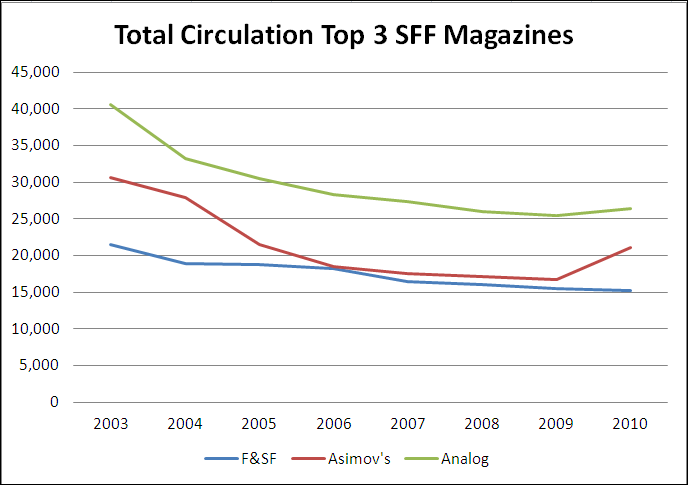
 

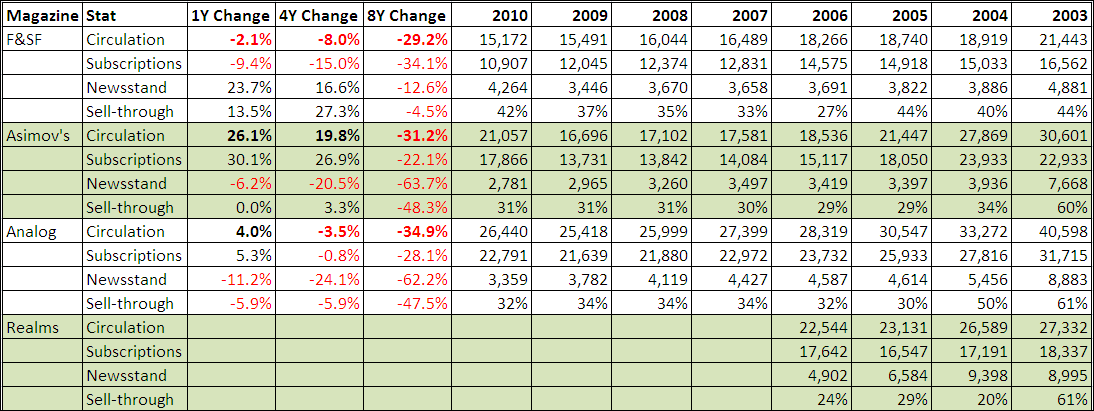
Gardner Dozois, in his summation of the SFF industry for 2010, found in The Year’s Best Science Fiction Vol 28, from which 2010 and 2009 numbers were taken, mentions that the growth numbers for Asimov’s subscriptions were driven in large part by “digital copies sold for e-readers through devices such as the Kindle,” and that Analog’s increase in subscriptions was “also largely because of digital sales.”

We all know that ebook took off last year. It will be very interesting to see the increase in total circulation continues for these magazines in 2011. Here is the supporting data that was collected from the reports in The Year’s Best Science Fiction volumes 20 – 28. Total circulation is made up of subscriptions and newsstand sales. Sell-through is a measurement of the % of the copies displayed in newsstands (at Barnes & Noble etc.) which sold. I added the Realms of Fantasy figures just so we could see, with the magazine recently dying its third death, just how big it once was.
 

Of course, a fascinating question is: what are the chief factors that led to such a drastic decline in the first place? But I don’t know anyone who has been able to provide data to suggest what the chief cause(s) are. If anyone knows of one, please post in the comments.

Wikipedia: Analog Science Fiction and Fact,

Share

Similar Posts

  • Indie Thoughts: Enticing with price

    The top two factors driving book sales both stem from having a loyal customer base. Building that base is the goal as it is in any business that depends on repeat customers. In a previous post I outlined these parts to building that base.

    1. Create a product (a book in this case) that’s likely to delight a certain set of consumers (readers).
    2. Let those consumers (readers) know about it.
    3. Make it enticing for them to give it a try.
    4. Make it easy for those who liked it to know when they can get another; and make it easy to get.
    5. Get more product (another book that’s similar to the last) out the door so your repeat customers can come back for more.

    In this post I’m going to share some thoughts on #3.

    So how do you entice someone new to give you a try? There are a lot of things I see that play into that:  a great cover, description, sample chapters, and reviews that all say quality and scream genre. But there’s another huge factor to making something enticing. And that is price. Or rather price vs. perceived value.

    I’m looking at Mark Corkers reports from Smashwords.

    I’m looking at slides 65-69. I know many of us have seen them.

    If the patterns are similar at Amazon, which sells more ebooks than anyone else, then a price of $3.99 on average will sell more than double the copies of $6.99.

    $3.99 means MORE readers who might develop some level of loyalty, MORE word of mouth, and it means MORE revenue than at other price levels.

    It means more than double the chances of getting your stuff in front on an influencer.

    More than double the chances for luck to come into play.

    And those odds grow exponentially.

    And, again, all along the way that price earns you more than if you were pricing at $6.99 or $9.99 because you sell more books.

    Of course, these are averages, which means folks are winning at prices above and below this. Furthermore, it’s not the same across genres. For example, it appears romance tends to sell better towards the lower end of the range Corker shows.  But it clearly shows that price is an important part of enticing a reader to give you a try.

    And when I look at the indies who are selling huge numbers and have built their customer base, the vast majority of them seem to have gotten there by tapping into the market forces Corker shows on these slides.

    That doesn’t mean they price all their books the same. Some are doing very well using a loss-leader/sample strategy where they offer the first book in a series for 99 cents or free. This also doesn’t mean they set their price and forget. it. They seem to do just the opposite, experimenting with different prices.  I noticed the Joe Konrath, who became a mega-seller at $2.99, raised his prices to $5.99 recently. He’s dropped them back down to $2.99 and $3.99. But he was clearly testing something. In an interview earlier this year with Simon Duringer, Russell Blake who is doing very well in the thriller category recently said this.

    Probably the most effective thing I did over the last two years other than Select, which came and went in terms of usefulness, was making the first book in my JET and my Assassin series free. That lowered the barrier to giving my work a whirl to nil, and my readership exploded from there. About a month and a half ago I stopped doing that because I saw my conversion rates were averaging about 12-13% from the first to the second book, and I questioned whether, with, say, 500 downloads a day, and seeing 60 sales of book two, it might not be more desirable to get 70 paid sales of book one, and seeing that same 60 on the conversion (because if someone pays for your first book, they’re probably going to read it, and soon, whereas if they get it free, it could take years, or more likely, never happen). So far so good.

    Clearly the folks who are doing well with this are experimenting with price to see which levels maximize revenue and loyal customers. And I think that’s the key. They are looking at what seems to be working for others, experimenting, and basing decisions on results.


    Share
  • Trusting the writing process

    I’ve experienced yet again the miracle of manure, of starting from scratch, and following the zing.

    This last week I’ve been rewriting a beginning to a novel. It’s a bit tricky because I can’t just rewrite it without constraint. Such a rewrite would cause massive changes to everything else in the book. In fact, a complete, unfettered rewrite of a beginning might end up requiring a totally different book. But Tor bought the book in hand. Besides, I don’t have time for a total rewrite even if they did want one. So the new beginning had to fit into the rest of the current story.

    At three different spots where this beginning needed significant changes I have had to write a pile of cow crap because it’s all I had in me at the time. I knew I couldn’t use those plops when I finished them. But there they were.

    The problem was compounded by my reading the recent Time article about Stephenie Meyer and starting to listen to Empire by Card. I have a weakness for comparing myself to others, and this time the comparison yeilded some depressing results.

    Then I asked myself what wasn’t working and how I might meet the goals of those scenes a bit better. I followed my heart. But in all three cases I had to stop trying to use the brilliant words I had written originally. Not the cow crap revision, but the original stuff.

    I’m not talking about the general prescription that we writers need to “murder our darlings” because the darlings are usually bad writing. I find general prescriptions to be wrong much of the time and that one in particular to make no sense at all.

    In this case one of the things I had to jettison was a beginning segment that had compelled 90% of the readers who glanced at it to read more. A beginning page that snagged agents and editors. A beginning page I still loved, even after reading it as many times as I had.

    But it just wouldn’t fit, couldn’t fit with the new structure. When I tried to hang onto it, I wrote crap. Which was fine. There was some good stuff in the crap. But I eventually had to trust myself and come up with something else completely.

    And while I don’t know if it’s going to suck readers in like the original, I think it’s pretty dang good. Back before Card’s boot camp I would have never made it to this point. I would have given up. But this is just the process for me now. It took some time to learn and trust it. But now I know that while sometimes I can write hot. There’s no reason to despair if I don’t. Sometimes it takes a few tries before I get to the good stuff.

    As for Meyer and Card, well, it’s not my goal to be a one-trick pony, now, is it. 🙂

    Share
  • |

    John guest posts about writing memorable fiction on ReidWrite

    Luc Reid is the author of, among other things, Talk the Talk: The Slang of 65 American Subcultures.  He is also the lizard king of Codex, which he started and of which I’m so happy to be a member. He’s always starting provocative threads on Codex, making us all think and reexamine the principles of story and the whole writing business. He recently posted some insights about what makes memorable stories. A lot of other fellow Codexians joined in the discussion. Happily, he asked me to share some of my thoughts on his site, ReidWrite. They begin as follows:

    YOU’RE MINE, DEAR READER

     Mwuhahaha.

     Okay, maybe not. But you are wired to be mine. And you wouldn’t have it any other way.

    Let’s back up. Luc wrote about writing memorable. I agree with the idea that the stories that produce a strong emotional reaction are the most memorable. In fact, I believe that triggering of emotion is THE reason why linear narrative that puts us into the trance has lasted so long in so many forms and makes so much money.

    But can writers guide reader emotions? Or is it all just by accident?

    Read the rest here: http://reidwrite.livejournal.com/8331.html.

    BTW, when you’ve finished that, you might want to check out Luc’s new site, WillpowerEngine.com. It’s a place where he shares what he’s found in his research for his current book project, The Willpower Engine, on how self-motivation works. I think you’ll find a number of the posts there very interesting.

    Share
  • Writing update: Envy

    Bible’s full of great stuff. Look at this.

    (Old Testament | Exodus 20:17 – 19)

    17 Thou shalt not covet thy neighbour’s house, thou shalt not covet thy neighbour’s wife, nor his manservant, nor his maidservant, nor his ox, nor his ass [we’re talking animals, folks], nor any thing that is thy neighbour’s.
    18 And all the people saw the thunderings, and the lightnings, and the noise of the trumpet, and the mountain smoking: and when the people saw it, they removed, and stood afar off.
    19 And they said unto Moses, Speak thou with us, and we will hear: but let not God aspeak with us, lest we die.
    20 And Moses said unto the people, Fear not: for God is come to prove you, and that his fear may be before your faces, that ye sin not.
    21 And the people stood afar off, and Moses drew near unto the thick darkness where God was.

    Dude, the “thick darkness where God was.” The thick darkness . . .

    I love the images in that passage. Moses going to talk to God face to face. Talk about spectacle. As for the commandment, well, let me just say that I might be smite-worthy.

    I do not covet many things. Certainly not any dude’s butt, but sometimes it’s so hard not to covet my neighbour’s writing success. And it’s not the big boys that kill me.

    I read a Lee Child or Orson Card or whoever, and I can legitimately say, “Hey, those guys have been writing for years and have produced a lot of novels; it’s unrealistic to compare my skills to their current masterly levels.” I can legitimately say, “Hey, best-sellerdom takes craft and luck, and I just need to be ready the next time the opportunity train stops at my station.” I can even say of those who start off as best-sellers, “Dude, maybe they DID start out with more skillz than me. Doesn’t mean I can’t learn. Give me some more books, you’ll see the Brown dog rise.”

    These are all true statements. I’ve got the big guys down. I can spot the Brain Nazi trying to hit me with them a mile away.

    It’s the other folks that get me. The guys at my level.

    I just had an email exchange with one of them. (No, I’m not going to tell you who it is. Author X might read this, get a fat head, and then be ridiculed and derided by small children. I’m not that heartless.) X comes up with great ideas. Has a ton of them. X is one of those other pro writers I meet who are always lamenting about how many ideas they have. Truckloads. Boatloads. They could employ all of  the peasants in a small country like Mozambique just writing the fab things that flow from their brains.

    I don’t have boatloads of ideas. I don’t have a truckful. I’ve got maybe two or three riding around on a Yike Bike.

    Covet, covet, covet.

    Author X is also funny. X can take a pedestrian idea, twist it, maybe with a great character or situation, and suddenly I’m dying to know more. X watches a TV show I’ve been watching for years. Bim! Bam! Comes up with another great idea I want to steal. (I think I average about two ideas a week I want to steal from other authors.)

    Covet, covet, covet.

    Author X has great sales. Better than mine, at least.

    Gol-leeeee, Mother of Hacks, please, put me out of my misery.

    Or not.

    I’ve got this freaking Brain Nazi’s number as well. The truth of the matter is that while Author X may have some minimal amount of writer-fu, X has also sold his/her soul to the lizard people of the hollow earth. I think they’re going to breed X. So I could have writer-fu too, but I don’t want to become anyone’s genetic experiment. I have standards.

    And with that, I’ll sign out. Happiness!

    Share
  • |

    LTUE schedule posted

    ltuelogoLTUE has posted its schedule for the upcoming conference Thursday – Saturady, Feb 12-14. I’m, of course, stoked to present and participate on the panels. But I’m also looking forward to attending some of the sessions.

    Look at this one: How a Military Unit Works in Real Life: Zachary Hill, Brook West, Robert J Defendi, C. R. Asay, Mike Kupari (m)

    Or this one: All about armor: Zachary Hill, J. D. Raisor, Kay Mildenhall, Charles B. Stanford (m)

    Or what about this one: Law Enforcement: James Ganiere, Zach Hill, Robin Ambrose (m), which conflicts with one of mine, dang it!

    Or this: Making Creatures Realistic to their Environment: Keliana Tayler, Brian Hailes, Jessica Douglas, Bryan Beus (m)

    This: Applied Biotechnology: Derrick William Dalton, Mikki Kells, Charlie Pulsipher, Chersti Nieveen, Ali Cross (m)

    This: How to Create a Language: Maxwell Alexander Drake, Dirk Elzinga, Valerie Mechling, Samuel Stubbs, Bryce Moore (m)

    And tons of others.

    Oh, and what about the keynote address on Saturday by Toni Weisskopf?

    It’s going to be a great conference. I’ll be giving these presentations.

    • How to Build an Action Plot. In this one, Larry Correia and I team up to share a model of plotting that should make developing your action story much easier. Attendees will be able to use the methods on a novel idea Larry, Joe (Larry’s son), and I came up with called Mech Runners. Basically, Larry turned to Joe and said, “What’s awesome?” Joe said, “Giant robots, bandits, and murderers.” We took it from there.
    • How to Build a Romance Subplot. In this one, I team up with romance author LL Muir to share a model of plotting that should make developing your romance plot or subplot much easier. Attendees will be able to use the methods on a story idea Lesli and I came up based on The Hobbit. It’s called My Precious.
    • Tapping into the Power of the Story Setup. The story setup is a fabulous tool that’s not only helped me drastically cut down the time it takes me to develop my ideas, but it has also helped me develop better ideas. In this presentation, I will explain what the story setup is and how you can use it to help you nail your novel.

    I’ll also be moderating or participating on these panels:

    • The Hero’s Journey & the Virgin’s Promise: Patterns and Archetypes for Better Characters:Michaelbrent Collings, Tracy Hickman, Blake Cassleman, Renee Collins, John D. Brown (m). Did I tell you I think the hero’s journey is stupid? This ought to be a fun one.
    • Action Sequences: John D. Brown, D. J. Butler, Peter Orullian, Adrienne Monson, M. Todd Gallowglas (m)
    • Self-Publishing Pros And Cons: Jared Abram Barneck, John D. Brown, Mikki Kells, Joe Vasicek (m)

    Hope to see you there!

    Share

7 Comments

  1. Personally, I always thought at least one factor for the decline was the end of the space race. Without such a big science fiction draw in the public eye to spur interest, they slackened off.

  2. I personally let my subscription lapse when I was so busy that I found I was almost 1 year behind in reading the issues. Maybe my situation was unique or perhaps culturally we are reading less? I also wonder about the younger generation. Is there a sufficient draw to attract that demographic into the genre? If not, then perhaps there is a certain degree of natural attrition at work. (As Colton alluded to, do kids dream about being astronauts anymore?)

  3. I don’t know if they do. But I can tell you they dreamed of going to Hogwarts the last decade.

    And literacy rates have been rising for the last years. Rowling had a lot to do with that in the younger ages in the late 90’s and early 2000’s. Stephenie Meyer continued it and spawned a whole new YA Paranomal Romance genre, which has become big enough that Barnes & Noble now breaks it out. Go to the stores and you see Teen Fiction, YA Paranormal Romance, and YA Fantasy and Adventure. Those categories are growing.

    Is it that the culture has no demand for SFF in short form, or that these magazines cater to an adult market? And maybe one that eschews the very stories that YA readers love.

    Kris Rusch raises that question in her essay “Barbarians at the Gate” in Asimov’s: http://www.asimovs.com/_issue_0612/thoughtexperiments.shtml

    Lots of speculation. No data.

  4. Total speculation here, BUT… I wonder if some of the decline is due to the prevalence of science fiction-ish technology in our lives these days. Tiny communication devices, for example, are no longer something to oooh and ahhh at on the big screen or in the pages of a magazine; we don’t really get the same sense of wonder from them anymore. (Though that same prevalence of technology is perhaps all the more reason and need for us to have people writing about the possible future effects and consequences of that technology… more need, but less people reading it?)

    Another possible factor is the blurring of the scifi and fantasy lines, how so much fantasy seems to have a scientific (or pseudo-scientific) underlay. I’d be interested to hear further thoughts on all this.

  5. S. Jeanne,

    I don’t know why the magazines made their big slide, but I don’t think SF & Fantasy has gone out of fashion or become less popular. There are boom-and-bust cycles with fiction genres. But we’re not looking at the genre as a whole here, just magazine subscriptions.

    There were lots of big grossing SF movies in the 1990s and 2000s.

    http://en.wikipedia.org/wiki/List_of_science-fiction_films_of_the_1990s

    http://en.wikipedia.org/wiki/List_of_science-fiction_films_of_the_2000s

    I don’t know about SF book sales, but if you look at books like the big selling HUNGER GAMES and UGLIES series (and others), SF has not gone away.

    Potter started a up a huge fantasy boom cycle. Meyer started up a huge paranormal romance boom. Hunger games started a SF dystopia boom. Not as big as those two, but significant.

    So I don’t know that we can say that SF and Fantasy is less popular. We can say that the magazine format is. But that may have more to do with the format than anything else. And maybe the timing–a recession, the rise of the internet, pc, and video games–all helped hasten the magazine bust. But I don’t know if that says anything about SF interest in general.

Comments are closed.