I am developing an online novel writing course and am looking for folks to pilot it with me and give me feedback. I’m thinking I want to limit it to 10-12 folks.
It’s free and will probably take two or three months to complete. If you join, your job will be to do the work. And there will be work. I’m thinking 10-15 hours of work per week. Please don’t ask to join if you don’t want to make this commitment. I only want folks who are serious and ready to give this a shot. In addition to the work, you’ll need to report your experience with the course as we go, sharing with me where you get stuck, what’s confusing, what’s helpful, what does and doesn’t advance your skill. In fact, if at some point the course just isn’t providing you any value, you are welcome to drop. That’s good feedback too.
It’s going to be a blended format that includes self-paced work and some type of weekly online meeting. I will be guiding the class. At the very least, we’ll meet and chat at my site. I don’t know if we’ll do a live meeting or not. Still working that out.
I struggled for many years, trying to figure this stuff out, then had a number of epiphanies during Orson Card’s boot camp and continued from there. Of course I still have lots to learn. But I want to share what I have.
I love teaching and have been teaching in one form or another for the last 20 years. I’m currently an education program manager at a large software firm. What this is all means is that I’m trying to build a course that guides folks through a process that will help them learn to WRITE novels. Not just talk about them.
So this is not a series of lectures with quizzes that test your ability to recall, although I will quiz you.
It’s not a course with an end goal of teaching you what I’ve learned about the concepts and principles of plot, character, and setting, although you will need to learn that.
This is about increasing your ability to get ideas, develop them, and then write.
It’s about doing the work. It’s about production. It’s about finishing product. And having a good time doing it.
If you already feel comfortable with your ability to finish novels, this is NOT the course for you.
You can learn more about the course here by clicking The Path in the On Writing menu.
Probably the only other thing you need to know is that the class is a PG-13’ish class. While the stories can deal with intense and adult themes, as the teacher, I’m not interested in working with stories with explicit or detailed sex or lots of language of the sort that would earn a movie rating more restrictive than PG-13.
Remember, this is a pilot. Even though I’ve taught about writing for a number of years to various audiences, there might be some rough spots. We might find we need to change the work requirements or activities or any number of things.
If you’re interested, click on the Contact link on the menu of my site, and shoot me an email.
Edit 1/30/15: I’m getting a number of excellent questions about the time commitment and schedule. Let me answer them here.
The gap I’m trying to fill
First, you have to understand that I am not interested in talking about novels and writing novels. I’m interested in helping folks finish novels. That’s a big gap I see in most writing instruction. It’s the gap I had. There was nobody to help me move from the theory to the writing, and writing all the way to the end. So this isn’t a class about novels. It’s a class where I hope to help you learn a number of techniques for developing and finishing one. And to learn those techniques, you have to actually use them. Which means you have to develop and finish a novel 🙂
So why 10 hours as a minimum?
If you’re a slower writer, it’s going to take you around 50 hours to develop and write a novel of 25,000 words. That’s the size of one of Louis L’Amour’s smaller novels (which we call sometimes call “novellas” today). It’s the size of some smaller romances. A lot of indies are writing serials around this size. If you want to write a 50k book, it’s probably 100 hours, maybe more. A 75k novel? 150-200 hours. The development and first draft of a 100k novel? 200-300 hours.
These are not exact times. Some writers are faster. But you get the picture. Writing a novel is a big project. And I’ve found that it’s just too hard to get any traction on less than 10 hours per week. When you spend much less time than that, you spend most of your time just trying to remember what the story is about. I’ve found it’s best to keep your writing engine hot, or at least warm.
So will these 10 hours be in meetings?
No. I don’t want to have a lot of meetings. That’s the beauty of online. We will have deadlines. But you should be able to complete you work during the times that suit you best.
What’s the course schedule?
I can’t give you an exact schedule. I haven’t timed everything. Figuring that out is part of what we’re doing in this course. But I do know what I want you to learn and how I hope to help you learn it. We’ll just have to see how far we get with each weekly 10-hour chunk.
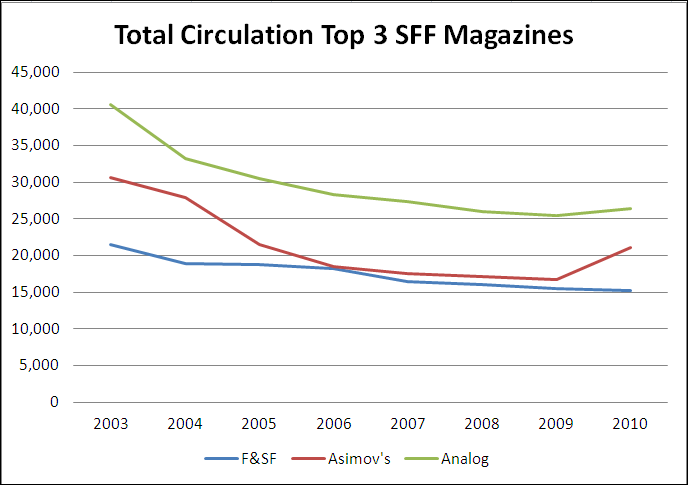
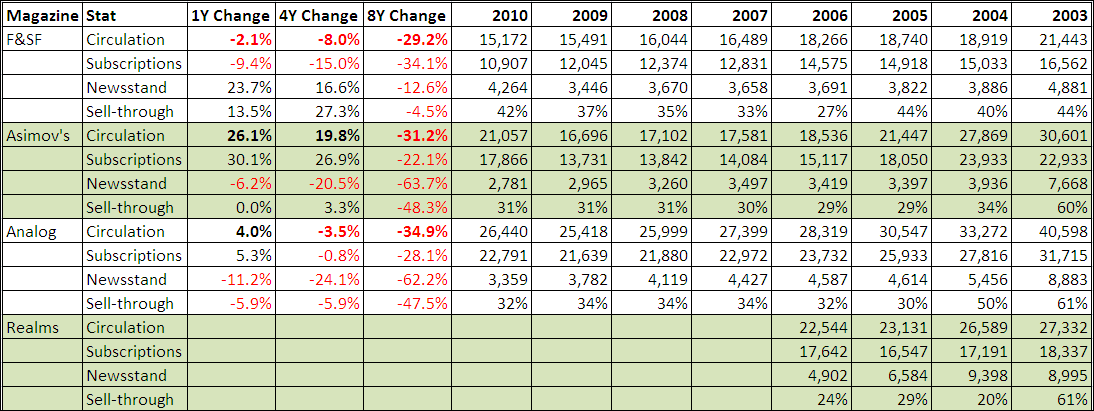

Personally, I always thought at least one factor for the decline was the end of the space race. Without such a big science fiction draw in the public eye to spur interest, they slackened off.
Hum, interesting theory.
I personally let my subscription lapse when I was so busy that I found I was almost 1 year behind in reading the issues. Maybe my situation was unique or perhaps culturally we are reading less? I also wonder about the younger generation. Is there a sufficient draw to attract that demographic into the genre? If not, then perhaps there is a certain degree of natural attrition at work. (As Colton alluded to, do kids dream about being astronauts anymore?)
I don’t know if they do. But I can tell you they dreamed of going to Hogwarts the last decade.
And literacy rates have been rising for the last years. Rowling had a lot to do with that in the younger ages in the late 90’s and early 2000’s. Stephenie Meyer continued it and spawned a whole new YA Paranomal Romance genre, which has become big enough that Barnes & Noble now breaks it out. Go to the stores and you see Teen Fiction, YA Paranormal Romance, and YA Fantasy and Adventure. Those categories are growing.
Is it that the culture has no demand for SFF in short form, or that these magazines cater to an adult market? And maybe one that eschews the very stories that YA readers love.
Kris Rusch raises that question in her essay “Barbarians at the Gate” in Asimov’s: http://www.asimovs.com/_issue_0612/thoughtexperiments.shtml
Lots of speculation. No data.
Literacy rates: http://johndbrown.com/2009/03/literary-reading-rates-on-the-rise/
Total speculation here, BUT… I wonder if some of the decline is due to the prevalence of science fiction-ish technology in our lives these days. Tiny communication devices, for example, are no longer something to oooh and ahhh at on the big screen or in the pages of a magazine; we don’t really get the same sense of wonder from them anymore. (Though that same prevalence of technology is perhaps all the more reason and need for us to have people writing about the possible future effects and consequences of that technology… more need, but less people reading it?)
Another possible factor is the blurring of the scifi and fantasy lines, how so much fantasy seems to have a scientific (or pseudo-scientific) underlay. I’d be interested to hear further thoughts on all this.
S. Jeanne,
I don’t know why the magazines made their big slide, but I don’t think SF & Fantasy has gone out of fashion or become less popular. There are boom-and-bust cycles with fiction genres. But we’re not looking at the genre as a whole here, just magazine subscriptions.
There were lots of big grossing SF movies in the 1990s and 2000s.
http://en.wikipedia.org/wiki/List_of_science-fiction_films_of_the_1990s
http://en.wikipedia.org/wiki/List_of_science-fiction_films_of_the_2000s
I don’t know about SF book sales, but if you look at books like the big selling HUNGER GAMES and UGLIES series (and others), SF has not gone away.
Potter started a up a huge fantasy boom cycle. Meyer started up a huge paranormal romance boom. Hunger games started a SF dystopia boom. Not as big as those two, but significant.
So I don’t know that we can say that SF and Fantasy is less popular. We can say that the magazine format is. But that may have more to do with the format than anything else. And maybe the timing–a recession, the rise of the internet, pc, and video games–all helped hasten the magazine bust. But I don’t know if that says anything about SF interest in general.