Generating Story 11: Creative Q&A with Author Janci Patterson

I was introduced to Janci Patterson at a local convention by author Sandra Tayler (some may know Sandra because of her husband Howard who does the online Schlock Mercenary comic).  Janci told me she’d just signed with a YA publisher. That was exciting. I asked her what her novel was about. She told me, and I immediately hated her because it sounded like such a fun idea, and I wanted to not only read it, but also write the story myself. Luckily I have a few scruples and did not pay the local Klingons to off her and drop her body in the Great Salt Lake for the brine shrimp to feast upon.

BTW, did you know that back in the day hucksters placed this ad in Boy’s Life magazine?
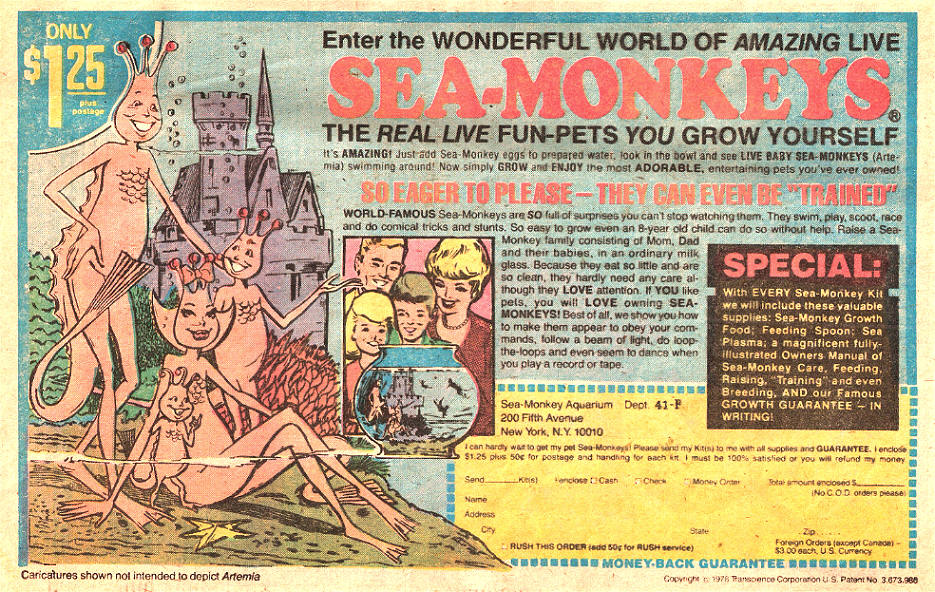
Look at that cute sea-monkey family. Look at the picture of the human family watching the sea-monkey family swim around a castle in a bowl. Click on it. See it large.

As a young lad, I, as every good Boy Scout should, subscribed to the magazine. I saw that ad over and over.  Who wouldn’t want a sea-monkey? So I saved up my money, earned by watering plants and trees at a nursery in the hot Utah summer sun, and ordered me a family to put on my own shelf.

The aquarium came. It was not a bowl and did not have a castle. But, hey, there were real live sea-monkey eggs right there in the packet. They weren’t just fantasy creatures! I mixed in the water and salt and dropped the eggs in. I can’t tell you how excited I was. Days later the eggs hatched. And what did I have?

Brine shrimp.

BRINE SHRIMP!

I could have had my mom drive me to the lake where I could have scooped up a million of them. For free. That was, I believe, my first great disillusionment. The first great step from child to adult.

Alas, sea-monkeys . . .

Anyway, back to story. Janci was one of those Codex Writers who shared how she used Q&A to develop her killer story idea. She agreed to share it with you. Here’s Janci.

***

The idea for CHASING THE SKIP started with a game of existential questions.  That’s like Twenty Questions, only with no question limit and much more confusing subject matter–like the Pythagorean theorem, or gas prices.  My husband and I like to play the game on long road trips, since a really good round can take two or three hours to play out. 

On this occasion, I chose a bounty hunter.  It took Drew about five minutes to guess that one–not my finest subject ever.  But after he guessed it, we started talking.  I knew that bounty hunters still existed, but I had no idea how chasing down a fugitive could be a part of our contemporary justice system.  Just what is it that bounty hunters did, anyway?  How did it all work?

After our road trip, that question stuck with me, so I began to do some research.  What I discovered fascinated me.  A bounty hunter could legally chase down his mark because of the bail bond process.  In order to be released from jail before a pending trial, an arrestee had to put up bail money as collateral, to ensure they returned for their trial.  Since most people can’t afford to post the full bail amount, a bondsman will post it for them, in exchange for a smaller fee.  When the arrestee skips bail, the bondsman is out the money–unless he can get bring the arrestee back.  In fact, he’ll have that person sign away their constitutional rights to privacy in addition to paying the fee.  He’s allowed to go find them if they don’t show up in court.  He can even break and enter to do so–dragging them out against their will.  But the bondsman is a busy man, so he signs those rights over to a bounty hunter, and off the bounty hunter goes, chasing down the skip.  If a person is good at it, bounty hunter can be a legitimate career.

As I researched, I knew I had the beginnings of a story.  This had all the elements–reality with a touch of danger, crime with a touch of justice.  I wanted to make it work. 

But I write YA novels, and no bondsman would sign on a teenager to go after his skips.  That would have all kinds of negative legal ramifications, and even if it didn’t, no reader would believe it. Enter my Creative Q&A, the question I always ask when I’m doing idea development for a novel: where can I put a teenager in this?

Answer: she couldn’t be the bounty hunter, but she could be the bounty hunter’s daughter.

That posed its own problems, of course.  No dad in his right mind is going to haul his daughter along on the road with him as he tracks down skips.  (Or, in question form, what would make a dad in his right mind bring his daughter into such a dangerous situation?)  I needed a crisis, so he had to bring her along, had to track down the skip, had to keep going with all of it, even when things got rough.  And if I could work in some interpersonal drama, all the better.

And so it was that Ricki became abandoned by her mother, forced to ride along with her bounty hunter father, a man she barely knows, as he chases down a skip who is more dangerous than his usual mark.  Why would he take this particular job with Ricki along? 

Ricki would like to know that, too.

***

John Sez: ins’t that a great idea?  I hate Janci.

While we’re hating her, did you notice that she got some random bit of zing playing 20 questions with her hubby? She followed it up by doing some research.  After doing that, she had a lot more zing. She also knew she had a general topic for a story.  She knew she had the beginnings of a story because her zing meter was going wild. 

But she didn’t have a story yet.  She had a vocation, which is nothing more than a bit of setting.

To have a story you need character, problem, plot, AND setting.  So she whipped out her Creative Q&A tool to help her find a character.  And the question she asked was one she’s found is very productive for her. It’s a basic question. But it’s an excellent question. And from that Q&A she started to develop the rest of the story parts.

The take away isn’t that playing 20 questions on road trips is the key to story ideas.

It isn’t that one question Janci asked, as fundamental and productive as it is.

It’s that the principles we’ve been discussing in these posts work. Develop the 6 Core Parts. Think about objectives. Start anywhere. Hunt zing. Generate your own zing. Use Creative Q&A. Work on the various parts using whatever tools you have until you have developed enough that the story comes alive in your mind.

I hope she sells a million.

For more in this series, see How to Get and Develop Story Ideas

Share

Similar Posts

  • How author Rachel Aaron wrote a novel in 12 days

    Well, not quite. It was 15.

    First read her essay “How I Went From Writing 2,000 Words a Day to 10,000 Words a Day”.  Now read about her 12 day triumph in “12 Days of Glory”.

    Amen on the pre-writing! I’d be lost without it. LOST. Sketching out scenes beforehand makes them SO MUCH EASIER to write. I can focus on the delivery, characters, dialogue, etc. instead of the events. It frees my creativity to focus on other things. Sketching out a novel beforehand does the same for the whole book. I have a simple sketch of the scene I’m going to write today. There’s no dithering about what to write. I KNOW what I need to write. So I do another more detailed sketch, the pre-writing for the scene before I jump into the day’s work. When I get the scene in my mind, the draft comes so much more quickly.

    Amen on time! I’ve found my mind is like a furnace: it takes time to get hot, and if I only dedicatetake small chunks of time, I’m forever warming it up. When I get 3-4 hours a day, I far more productive on a per hour basis than when I only get one.

    Amen on enthusiasm! There’s nothing worse than trying to write something that bores me. I can’t do it. And her little method for reviewing scenes is very similar to what I do.

    Great posts, Rachel! Now I just need to get back into my dedicated time groove.

    Share
  • |

    Superstars Writing Seminar DVDs

    Aspiring authors, I wasn’t able to attend, but heard from a few who were that the Superstars Writing Seminar in Pasadena with Eric Flint, Brandon Sanderson, Dave Wolverton, Rebecca Moesta, and Kevin J. Andersen was EXCELLENT. 

    See clips of parts of the videos here (still a lot of good info): http://www.youtube.com/view_play_list?p=2F211054CBD822A8

    Purchase the full recordings on DVD or MP3 here: www.writerscanon.com

    Topics include:

    • Econ 201 for Writers: Economics of Commercial Publishing
    • Inside Editors: How editors look at manuscripts, novels & short fiction
    • Dirty Secrets: What you need to know about being a Professional Author
    • From Slushpile to #1 New York Times Bestseller in 4 Years
    • Intellectual Property: How to Exploit Yours
    • Balancing Acts: Writing World & Real World
    • Agents: the A Word
    • Networking for Writers
    • Self-Promotion for Authors
    • Novel Contracts
    • Self-Publishing: Realities & Pitfalls
    • Pitching the Big Proposal
    • Two Heads Are Better than One: Collaborative Writing
    • New Media: Using It to Get an Edge
    • E-Publishing
    • Movies, TV and Authors
    • Anatomy of a Major Book Release
    • Myths of Publishing
    • Eleven Tips to Increase Your Writing Productivity
    Share
  • |

    John guest posts about writing memorable fiction on ReidWrite

    Luc Reid is the author of, among other things, Talk the Talk: The Slang of 65 American Subcultures.  He is also the lizard king of Codex, which he started and of which I’m so happy to be a member. He’s always starting provocative threads on Codex, making us all think and reexamine the principles of story and the whole writing business. He recently posted some insights about what makes memorable stories. A lot of other fellow Codexians joined in the discussion. Happily, he asked me to share some of my thoughts on his site, ReidWrite. They begin as follows:

    YOU’RE MINE, DEAR READER

     Mwuhahaha.

     Okay, maybe not. But you are wired to be mine. And you wouldn’t have it any other way.

    Let’s back up. Luc wrote about writing memorable. I agree with the idea that the stories that produce a strong emotional reaction are the most memorable. In fact, I believe that triggering of emotion is THE reason why linear narrative that puts us into the trance has lasted so long in so many forms and makes so much money.

    But can writers guide reader emotions? Or is it all just by accident?

    Read the rest here: http://reidwrite.livejournal.com/8331.html.

    BTW, when you’ve finished that, you might want to check out Luc’s new site, WillpowerEngine.com. It’s a place where he shares what he’s found in his research for his current book project, The Willpower Engine, on how self-motivation works. I think you’ll find a number of the posts there very interesting.

    Share
  • Indie Thoughts: Russell Blake’s Indie Author Myths

    This is from Russell Blake, a pseudonym for Craig Osso, a 52-year-old retired home developer who has sold close to 450,000 copies of the 25 books he published in the last 30 months. The man has made over a million bucks at this.

    1) Books Sell Themselves. No, sweetie, they don’t, at all, and never did. That’s why trad pubs spend massively on promotions. Because they know that visibility sells books, not invisible cosmic forces or author brilliance. It’s a highly competitive market with millions of choices, and it’s a retail market, and in retail, visibility is key. Which means constant promotion. Which most authors hate. But it’s reality, so get used to the idea. A companion to this aphorism is the next one…

    2) Just write the next one. Sure, if you want to have two undiscovered gems instead of one. Look, writing the next one’s important, but not if it’s used to justify not promoting the last one, which is often the case. You have to both market the last one AND write the next one. Sorry. You do.

    3) It’s all about luck. Well, perhaps some of it is. Maybe even much of it is. But so’s everything. You drive to the market, and 30 seconds after you pass the intersection some dumbass crashes into the car behind you. Luck. A hundred people start restaurants in town and two do well while the rest fail. Luck. A mugger attacks you after a movie. Luck. Sometimes good, sometimes bad. The book biz is no more or less random and chaotic than life, and yet some folks seem to consistently do better than others. I believe you need to work very hard, prepare, and be persistent, thereby creating some of your own luck. As an example, it’s possible you always wear your seat belt and the other driver didn’t today. In that case, bad luck becomes disastrous due to a simple lack of preparation. Or in the case of the restaurants, perhaps the ones that prospered had owners that worked 18 hour days and were talented chefs, and further, were savvy and inventive about getting people to try their cuisine. Preparation, persistence, hard work combine in that case to drag Lady Luck in their direction. With the mugger, maybe you have pepper spray or spent years on martial arts or have a concealed carry. Your preparation is the mugger’s bad luck.

    Luck may be a factor, but in my experience it’s only one factor, and that perspective of it all being all about luck breeds apathy.

    4) Do everything right and you’ll make it. Huh. If that were so, every book put out by big pubs would do well. The vast majority don’t. But that doesn’t mean you don’t have to do everything right, unless you want to worsen your already slim odds rather than improving them.

    . . . .

    10) Your muse cannot be forced to dance. Of course it can. If you were a writer on 24 or CSI or SNL you’d be expected to perform every week or you’d be out of a job. Most who work hard enough to get those gigs don’t want to lose ‘em, so they perform. Whether they feel like it or not. Whether they’re particularly inspired or not. The notion that you need to wait for your muse to decide to infuse you with story is fine if your books sell 10 million and you can afford to wait 4 or 5 years between each one. If that’s not you, you need to develop two things: a work ethic, and a system to inspire yourself.

    One technique I use is to ask myself how I can make this book, or this chapter, the best I’ve ever written. You get completely different answers depending upon what questions you ask yourself. “How can I consistently write 5K a day and enjoy it?” will get you a different answer than “How am I ever going to do this?” If you’re stuck, ask better questions.

    . . . .

    12) I’m too busy to read. Who’s got the time? This one kills me. How in the hell do you expect to be a good writer if you don’t read a lot of good books? Intuition? Divine guidance? Magic?

    . . . .

    1[6]) Write a good book and you will make decent money. Or write a lot of good books and you will make decent money. Would that it were so. Reality is that the overwhelming majority of good books, which is to say competently written-and-edited tomes, fail to sell much.

    . . . .

    My message is simple: working very hard and very smart can improve your terrible odds, but that’s all it can do. It’s not a magic pill, nor a recipe for success.

    . . . .

    I can tell you how to operate your writing and publishing company intelligently, but you need to recognize that most well-run publishing companies fail. Just as most well-run any-kind-of-companies fail. Most start-ups don’t last. They go belly up. Even those with the smartest people and shiniest wow products. That’s just how it works. Don’t start a company if you’re uncomfortable with that idea.

    . . . .

    I’m a big proponent of choosing a genre that can support you, which means one that’s popular, and sticking to it (with the caveat that if it doesn’t meet your expectations after a massive, concentrated effort, pay attention to the result you’re getting, and switch to something with better odds). I’m also big on publishing regularly, meaning every three or four months (more often if possible) if you intend to make this your living. I’m huge on pro editing and covers and proofreading. I consider your cover and your blurb essential to success. But those are the basics. Important basics, but still, building blocks.

    They will narrow your long odds because most authors simply don’t do what they should to make themselves successful. Understanding that is an advantage. It means you already know more than 90% of those who will publish on Amazon this year. If you do everything right, that will make you the 10% that has a chance.

    But still, it’s not a lock. By any stretch of the imagination. Get clear on that. In all businesses, this included, you can do everything absolutely, spectacularly right, and go nowhere. Because God hates you. Or because the world’s unfair. Or because you’re not good enough. Or were born under a dark star. Or didn’t get breast fed enough as a child. Pick your reason. It doesn’t matter what it is, as long as you recognize that in ALL industries, most businesses do not succeed.

    . . . .

    I wish I could tell you how to avoid being that person. I wish there were a formula. What I’ve come up with I share openly: Pick a genre you love and that’s large enough to support you, stick to it, write a lot of seriously good books, focus on improving your grasp of craft each time you sit down to write, make each book your best ever (meaning respect your reader above all else), package and quality control your books like the pros do, market intelligently, and spend massive amounts of time and energy working smarter than everyone else. And above all, be extremely realistic about everything. Some might say, cynical. I’d say pragmatic.

    . . . .

    Can you do this part time and make it? Sure you can. So can someone who starts any business part time. Just recognize that your odds of making it are lower than if you did it full time. Duh. Put in 80 hours a week, you might get better results than 10. Big surprise. Can you put in 10 or 20 and still do well? Sure. Again, anything’s possible. But you have to be unable to grasp basic business concepts if you think your odds will be the same. If they were, nobody would put in the 80. They’d all put in the 10, because their odds are identical.

    . . . .

    What’s my point? That self-publishing is both exciting in its possibilities and daunting in its requirements. And that very few businesses succeed, whether it’s a new shoe shop, or a convenience store, or a restaurant, or a software start-up…or a publishing company. But it’s more possible now to succeed than at any point in the past. I’m living proof.


    Link to the rest at Russell Blake’s Author Myths-1, Author Myths-2, and Author Myths -3.

    Blake has some of the most sensible advice I’ve read. If you want more, search for him over on KindleBoards.

    Share