Generating Story 13: The Scene Primer with Author Laurel Amberdine

Laurel Amberdine was raised by cats in the suburbs of Chicago. She’s good at naps, begging for food, and turning ordinary objects into toys.  Having escaped the terrible weather of Chicago, she is now delighted to call San Francisco home. For many years she read a novel every day, until she got married and realized that her new husband didn’t enjoy being completely ignored in favor of fictional people. She’s working on writing science fiction and young adult novels herself now, and hopes you get to read them soon.

I hope you get to read them soon as well. Until that glorious moment, Laurel has a fabulous tool to share with you writers. And I know it’s fab because I use it.  If you look at the text tools section on the my Story Development Framework, you’ll see that The Scene Primer is one of the tools I’ve found useful in helping me bring enough of the scene to life in my mind that I can draft it. I’ve used various bare bones versions of this for a few years now, but then I was on a forum where Laurel explained her “Template.”  And I immediately knew it would be a useful tool for me. Here’s what she had to say.

Laurel

While working on a complicated science fiction novel a few years ago, I found myself stuck looking the blank page with each new scene. I had already outlined the story and knew generally what was supposed to happen, but the setting was alien and the characters were strange. There was so much specific detail to figure out simultaneously, I was paralyzed. I couldn’t start.

But I realized I did know some things, just not enough to write a new scene from the beginning. So I created a template, where I could fill in the bits I knew, and think about the bits I didn’t yet know in a simple, no-pressure way. After all, I wasn’t really writing yet, just making notes.

The template asks enough questions that if I fill it all in, I know exactly how to write the scene. But most of the time I don’t have to fill out the whole thing. I just work at it until I know what I want to write. It’s not a worksheet; it’s a tool to get started. Once I am ready to begin, I cut and paste the template and answers over to a notes section, and get writing. Most of the time I don’t even look back at it.

The template got me through that novel, and I continue to use it. I’ve refined the categories I use, and even discovered that I can improve my writing by adding template entries to cover aspects where I’d naturally slack off. Like, I often focus so tightly on plot that I skimp on showing a character’s emotions or unique behavors. Well, now I just put it in the template and make sure to figure that out too! Works great.

Here is the current version:

Summary:

Opening/transition:

Current Situation:

Theme song:

Setting, and significant details:

Time span/transitions:

Next big crisis or turning point:

Foreshadowing:

Background/worldbuilding details:

Desired effect in reader:

Events:

Sequence:

Emotions:

Character’s unique reactions:

Ending hook:

Other notes:

The colors encourage me to fill it out, because it’s pretty once it’s done. The “Summary” is what would go on a note card. In Scrivener, I just paste that onto the note card once I have it (or from the note card if it’s already filled out).

“Events” and “Sequence” almost always wind up being the same thing, but sometimes I don’t know what order things happen in, so I fill in “Events” first.

I listen to music while I write, and often a certain song seems to fit the scene. If I find one that does, I list it under “Theme Song.” This can be helpful when revising, because I can put the song on and get right back into the feel of the scene.

The hardest part for me is almost always the opening line.

John Sez

After reading Laurel’s post on that forum, I immediately tried applying the idea to the current novel I was drafting.  I’d done sketches of the scene in my own way, but never with a list of questions to prime my thinking. That day I started a new chapter, but before I began to do my initial sketching, I took Laurel’s idea and tweaked it to my taste, coming up with my own “Template” that I call a “Scene Primer” or “Sketch Primer,” then let it direct my sketching.  It worked like a charm.  After answering five or six of the questions, I could see enough of the scene detail to begin to write.  Here’s my current version.  I’ve used it a number of times since that first day, and it’s always proved helpful.

When starting to write a new sequence or scene, start filling these out UNTIL it comes alive and you can write. (That is my note to self.)

WHERE ARE WE?

  • Transport: general, dominant impression then specific
  • Setting tags
  • Sights, sounds, smells, textures, tastes? 3s2t
  • Fun, cool, weird, odd, particular details
  • Time, sun, weather, etc.
  • Background or world building details?
  • Fun & cool stuff?
  • Surprises, different, twists?

WHO IS HERE?

  • What’s the situation for each character?
  • Goals
  • Who is driving this scene?
  • What is the concrete objective for him/her?
  • What the concrete objective of other characters?
  • Motives?
  • Character transport: general, dominant impression then specific
  • Thoughts?
  • Tags?
  • Fun & cool stuff?
  • Surprises, different, twists?

WHAT STORY LINES WILL HAVE BEATS HERE?

  • Progress or trouble?
  • Points of conflict?
  • Obstacles?
  • Fun & cool stuff?
  • Surprises, different, twists?

OTHER OBJECTIVES AND THOUGHTS?

A few things to note. First, like Laurel, my goal isn’t to fill in all the blanks.  My goal is to bring the scene to life in my mind in enough detail that I can write.  So I don’t fill out every blank. I use the tool to stimulate my imagination. It’s like using a match to light a candle on a birthday cake–you only use it until the candles are all burning, then you wave it out and set it aside because it has done its job. The goal isn’t to burn a match, but to light the candles.

Second, there’s no one right version of this. My version is different from Laurel’s because she and I have different work habits and think about stories in slightly different ways. For example, sometimes I listen to music when writing, but most of the time I don’t. Maybe some day I’ll start using theme songs. But I know a lot of other authors who DO find music helpful.

So who’s right?

No, stop asking that question. That’s the wrong question. Music is a tool.  A tool can’t be write or wrong.  It can only be helpful or not helpful. If you find theme songs helpful, then use them. If you don’t, then don’t.

Third, this is yet another example of the general creative principle of developing in iterations. Think of painters.  They will usually start by sketching.  The sketches are, by nature, rough and incomplete.  They’ll sometimes create a number of sketches. Some of what they sketch might make it into the final painting. Some of it may not.  At some point in time, they feel they have enough of the image (feel, composition, subject, etc.) in their minds to start applying paint to canvas.  So they’ll rough in the subject on the canvas and then began to paint in the details.

It’s the same with writing. You start with a rough, incomplete idea. You sketch it out, inventing as you go.  Maybe you sketch the whole thing or just parts.  Then you go back and build up more detail, adding by degrees until you have enough character, setting, problem, and plot in your mind that you can form the story.

For example, I recently sat down to write chapter 22 of my current novel. Here’s what I had on the outline (which is simply one type of sketch) :

Recon

  1. Summarize wal-mart purchases etc.
  2. Recon their security, paint it all. It’s stiff security.
  3. Carmen or Pinto calls in—someone’s coming
  4. They’re dressed up as utility guys
  5. See her coming in the field. Not at the house. They wave her down or something

Can you see that scene well enough to write it?

No. Neither could I.  I knew roughly what would happen, but I couldn’t write anything because I couldn’t see anything.  Where was the house they were going to recon? What did it look like? What kind of security did they have?  Was it in a neighborhood or out in the country?  I only had the most general idea of character, setting, and plot. So I turned to my Scene Primer and started answering the questions.

800 words later, I’d sketched out the scene and had enough detail in my mind that it had come to life. I used a lot of what I developed in that sketch. But there was some, by the time I finished my draft, that I didn’t use.  Why? The draft was another iteration of the story. And in that take, things changed and I didn’t need it. But it wasn’t wasted effort because it helped me get to the point where I could draft.

The Scene Primer is an excellent tool to help you build up the detail when you’re starting to draft.  Give it a try to see if it’s useful to you.

BTW, Laurel and I aren’t the only ones using the primer. Author Maya  Lassiter is also using it to good effect in her new writing experiment.  See, Maya is a pantser who is “sick of the wretched groping around in the dark” that comes with a seat-of-the-pants writing method. She decided to try to see if she could learn to use some tools to help her invent some of her story before she begins to draft. You can read about her decision in “Can a Pantser Become a Plotter?” Then come back because Maya is going to share a post here in which she describes her new method and some very promising results.

For more in this series, see How to Get and Develop Story Ideas

Share

Similar Posts

  • Villainous Heroes

    If we root against villains based on moral judgments, then how is it possible to root for heroes who are not just bad boys but down right criminal, e.g. hitmen, mobsters, thieves?

    It’s a wonderful question that has a simple and revealing explanation.  We root for these bad guys because they’re really good.

    What?!

    When talking about bad heroes, what we often do is:

    1. Take them out of their context.
    2. Focus on one or two negative traits, not the person as a whole.
    3. Abstract them and miss what’s happening in real time as we process the story. We only have so much working memory and usually can only think about what’s being presented versus what we think about when we’re out of the story. What’s being presented in the story is mostly the threats to these heroes, not the consequences of their evil deeds. And if the consequences are show, it’s always modified by context (#1 and #2 above).
    4. Confuse fascination with rooting.

    When we actually look at what’s happening with the hero in the context of the story, what we find is that rooting is still based on moral judgments of who is good/right and who is not. We root for people we think are in the right (given their context) or are getting, undeservedly, the short end of the stick; we root against people who we think are in the wrong.

    Here are some examples.

    DISNEY’S ALADDIN

    Thief. This one’s easy, I grant it. But it’s illustrative. I never once didn’t root for the boy. But I also never saw him as a true bad boy. He was nice. He shared the bread he stole with kids less fortunate. The guards were mean brutes. Jaffar was wicked and threatened the sultan and Jasmine who were good and innocent. was in a situation that provided some leeway for his behavior (alone, penniless).

    1. Context. He’s fighting a much greater evil, someone we are rooting against.
    2. Whole Person. He is a thief, but he’s also kind. Given his whole person, he falls on the side of good.
    3. Processing. As we process the story we’re never shown awful consequnces of his theiving. Mostly just the good and courageous things he does. And the threats to his welfare.

    THE ITALIAN JOB

    Thieves.

    1. Context. The movie starts with a heist and then a betrayal and murders by a traitor. Yes they’re theives, but we wittness a greater evil. The people they fight against are worse than they are.
    2. Whole person. Except for the thieving, he’s a likeable guy.
    3. Processing. We see few negative consequences of their actions to others, but we are constantly being presented with threats to them by guys who are committing greater crimes.
    4. Fascination. I was incredibly interested in the scam–the plans, tech, everything.

    THE PROFESSIONAL

    Mob Hit Man

    1. Context. He’s protecting a girl from other hit men. He’s fighting a bigger evil. He’s also taken advantage of by his boss.
    2. Whole Person. He’s a hitman, but more time is spent on his kindness.
    3. Processing. We see very little of the effect his hits have on others. Instead we are presented with threats to the girl and him.

    DIRTY HARRY

    Murdering vigilante

    1. Context. He’s stopping guys who are doing terrible things.
    3. Processing. We don’t focus on negative consequences of his vigilantism, but the threats from these really bad guys.

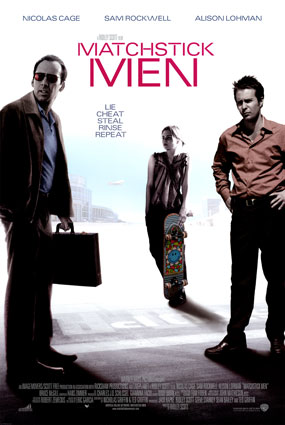
    MATCHSTICK MEN

    Scammers of the elderly

    From IMDB “Roy’s private life, however, is not so successful. An obsessive-compulsive agoraphobe with no personal relationships to call his own, Roy is barely hanging on to his wits, and when his idiosyncrasies begin to threaten his criminal productivity he’s forced to seek the help of a psychoanalyst just to keep him in working order. While Roy is looking for a quick fix, his therapy begets more than he bargained for: the revelation that he has a teenage daughter–a child whose existence he suspected but never dared confirm. What’s more troubling, 14-year-old Angela wants to meet the father she never knew. At first, Angela’s appearance disrupts her neurotic father’s carefully ordered routine. Soon, however, with his own unique spin on parenthood, Roy begins to enjoy a relationship he never dreamed of having with his daughter.”

    1. Context. Much of the time is spent his on his loneliness and issues with his estranged daughter.
    2. Whole person. He steals, but we never see huge suffering from it. We see all the other issues he deals and have sympathy for him.
    3. Processing. We’re focused on the threats to him, not the consequences of his one negative trait.
    4. Fascination. I was fascinated by the scam and this pulled me along through the first.

    CONCLUSION

    What happened in all these stories as I experienced them was that the story carefully managed my view of the hero. He was always on the better side of the antagonists. He was always more good than bad, even if only by a little. And the story focused my attention most of the time on the bad/threats/consequences flowing from the antagonists, not the bad from the hero’s deeds.

    What this shows is that you could write a story about a villain and make him the hero. In some instances it might be exceedingly difficult. For example, I think Hitler would be a hard sell as a hero, someone we’d root for. But the Neo-Nazis prove it’s not too hard a sell for some people. 

    I don’t think recognizing the fact that we can make “bad” people sympathetic means authors are “simply being clever” or “pushing buttons.” After all, to write well you must believe and care about what you’re writing about. YOU have to believe it. Nor do I think it undercuts the notion that we root for people based on a moral stance. It just recognizes the fact that moral judgments, in fact, the vast majority of appraisals of situations, happen quickly with the facts at hand, which are the ones in our working memories. The ones the authors are controlling.

    Share
  • What Comes Next?

    At the UAA conference in Springville, Utah this Saturday, I’m going to be sharing two tools I use that help me figure out where to start my stories and what comes next.

    The first is simply a quick and dirty method for figuring out a ballpark estimate of how long my story will be. But the length is not stated in words or pages for the simple reason that stories aren’t made up of words or pages.

    The second is what I call The Story Cycle.

    WhatComesNextbyJohnDBrown

    Everyone always wants a copy of the presentation. So here’s the PDF of “What Comes Next?”: WhatComesNextbyJohnDBrown_Print

    Enjoy!

    Share
  • Why stories follow patterns

    There is a lively discussion on The Passive Voice about Kris Rusch’s recent blog post which challenges the use of the term “churn out” to describe writers who write quickly. In the comments, someone said that folks also use “formula” or “formulaic” as a pejorative. Another commenter said that in computer design, they use design patterns, and suggested that’s probably a better word. Here’s my response.

    Design pattern is right.

    The people who decry familiar patterns are those that completely misunderstand one of the main purposes of fiction.

    Readers go to fiction to have an emotional experience–thrill, horror, dread, falling in love, mirth, wonder, wish-fulfillment, etc.

    Those emotions are not created out of nothing.

    They’re not created haphazardly.

    They are generated by a specific . . . pattern.

    1. You receive some stimulus–from your environment or your own thoughts or something you’re lead to think, such as via a book.

    2. You make an assessment about what’s going on and what might happen in the future and how that impacts you or someone else. There are two assessment systems. One is incredibly quick. Almost subconscious. The other is a bit slower. You can read about them in Daniel Kahneman’s Thinking, Fast and Slow and Jenefer Robinson’s Deeper Than Reason. Robinson even relates the science to fiction.

    3. If the assessment says it’s something that will affect you or someone you can sympathize with, you feel an emotion. The emotion focuses your attention. For example, if there’s a mountain lion stalking you, you don’t want to forget she’s there. It also prepares you to act–to pursue something desirable, avoid something that’s not, etc. It also writes that emotion on the face to communicate it to others to solicit help or warn (we are social animals).

    Okay, so certain cues or assessments are required to produce certain emotions. If the cues aren’t there, the emotion doesn’t arise.

    Certain stimuli lead to an assessment that there’s a threat. Other stimuli lead to assessments that there’s an opportunity, for love, money, sex, security, etc.

    Suspense, surprise, and curiosity have all been studied in experiments. There’s a certain structure required for each. If you take the same story, but simply change the structure, you end up with different reader effects. See more here.

    This means that a reader who wants to feel the experience of falling in love is going to have to be guided through the pattern of cues that produce the assessments that lead to the emotion.

    There are lots of variations in the pattern that will work. But we can’t give a reader the pattern for horror and expect them to feel romance.

    Duh.

    You can’t give a reader a downer ending and expect her to feel joy.

    Again, there are certain delights readers are going to certain genres for. Folks read romance after romance precisely because those romances do specific things to them. And they want to experience them again and again.

    For example, one thing romance readers love is the joy of a happily-ever-after (HEA) ending. So if that’s what they’re looking for, then that’s what the product must provide for them to be satisfied. We follow patterns, but change them enough so that the reader doesn’t get bored.

    So, yeah. Patterns. It’s like the very essence of what we’re doing.

    We are all working with patterns, whether we know it or know. And the sooner we learn what the general patterns are for the type of story we’re trying to tell, which could also be called the type of experience we’re trying to provide, the quicker we gain control over our writing.

    Share
  • How to get and develop killer story ideas – recording

    The recording of the session with Larry Correia at LTUE is up on YouTube. I really enjoyed this session, and it’s always fun to work with Larry. A few additonal points.

    First, you might think, well, heck, they didn’t finish a story idea. No, we didn’t. The purpose wasn’t to wow the audience. It was to show them the process of generating ideas. But . . . that doesn’t mean we weren’t close.

    The big thing we’re missing from the story at the end is the situation, the problem. So if you want to extend this, ask yourself a question to help you identify that story core. For example, you might say, let’s narrow this down by genre. What genres could we use? Romance, political thriller, crime, horror, humor, scifi, western, paranormal, etc. If we select paranormal thriller, we limit our options (a good thing), and can start to generate ideas around a question like, what’s going on, what’s the problem? Potential answers:

    • There’s some gateway to the spirit world in Wyoming
    • Maybe there’s an oilrigger roughneck involved
    • Maybe something with the drilling disturbed something
    • Maybe a crime has been committed (I know, I know, but what did I say in the video about crap, cliche?)
    • Maybe that Japanese tourist has a way to capture the spirits and use them in some magic. Is he a wizard? Is he there to trap the spirits of the dead to fuel his magic? Did he get a nagging ghost that drives him nuts?
    • Did someone call him in?
    • Or is he possessed? An innocent bystander?
    • Is there some ghost there that knows something about a political figure, some information?  
    • Maybe someone who can project her spirit, has some power, has been kidnapped and is being held in Wyoming. Or tries to make her escape when her kidnappers stop in Rock Springs. And the guy to help her is the Japanese Tourist.
    • Maybe these aren’t ghosts, but some kind of alien symbiote? There was a crash somewhere and the locals were infected?
    • Or should I ask: what could go wrong with ghosts? Or what is the nature of ghost magic?  

    Do you see? If we had more time, we’d have delved more into the situation with creative Q&A. Sooner or later as we generated ideas around character, setting, and problem a story idea would have come to life.

    And (thank you, Mike Barker) here’s a transcript.

    Share

2 Comments

  1. This is so freaking awesome. I was already planning on pre-sketching, but this takes it to the next level and will help make sure I don’t leave out critical components of each scene. Thanks so much!

  2. Ben, glad to hear it sounds useful to you. But be careful not to use it as a checklist. It’s there to stimulate your imagination.

Comments are closed.