What changed in the author’s cut of SERVANT?

Because a number of folks have emailed or posted asking this question, I figured I should address it in a post.

This edit of SERVANT was signficant, but it involved mostly line edits, copy edits, resequencing, and one important adjustment and addition.

Line edits are things that make individual sentences or paragraphs read more clearly. I made line edits to almost every page. I think most readers won’t notice these. But then that’s the point.

Copy edits catch small things like typos and misspellings. There were a number of maddening copy issues that were introduced into the manuscript in the publisher’s version and others that weren’t flagged. I fixed a number of these and then had two copy editors read over the manuscript to find more. No book is perfect. I’m sure there are still some gremlins lurking in the text. But we caught a lot of the little buggers. 

Resequencing is moving chapters or sections around and does affect the experience. The biggest resequence was switching the first eight chapters back to the original order I intended. This is an important change and will have a large effect on the reader for the first quarter of the book. Then there were three other smaller sections inside the story that needed to be moved around to make the chronology clearer and improve the suspense.

The line, copy, and resequencing edits make up the bulk of the edits. But I did adjust and add a short section to the ending immediately after the climax to clarify a few things that should have been revealed in the first version and that lead into book two.

What does this all mean?

It means that while this is a superior version of the tale, the base story remains the same. I care about the stories of Sugar, Talen, Argoth, Hunger, and the dilemmas they face. So I did not change their tales. However, I did significantly change the experience of those tales for the reader.

If you have already read SERVANT, you know everything that happens. However, you will want to get a hold of a copy of the new version to review the updated ending for the new information it includes.  To avoid spoilers and confusion, I will not be releasing the ending in a separate document. But if you sign up for my release notification, I’ll let you know when I have my release sale so you can get it cheap. 

One final note. Because I feel this is a superior version of the story, and because I do not want readers to be confused about which version to read, I’m releasing it with a different title and different cover art. It will be called “Servant” and include the series label “The Dark God Book 1.” 

I think readers are going to be very pleased with this version. I know I am. And then we can move on to “Curse,” the next in the series, followed by “Glory.”

Share

Similar Posts

  • Faithful Readers, Nominate Awful Intent for the Whitneys before Dec 31st!

    Awful-Intent-originalSend Frank, Sheriff Hood, and the Knitters of Death club to kick some award patootie!
    Here’s how: go to: http://whitneyawards.com/ and click “Nominate” at the top.

    Enter a bit of info and boom! But this needs to happen before December 31st.

    The Whitney Awards are open for the public to nominate books they think are great and which are written by LDS authors (this is where your voice is heard, Faithful Reader). Those books that get at least 5 nominations are read and rated by a panel of judges. The judges then send on the finalists in each category to the Academy for voting.

    Servant won an award in 2009. Awful Intent is doing well, and if the reviews piling up are any indication, it could win another.

    Please take a few moments to send Frank to kick some award patootie.

    It’s time for Frank to bring home a trophy.

    Share
  • Curse of a Dark God is Finished!

    I finished the 10% edit, going from 205,000 words to 185,000, this morning and emailed the finished manuscript to Super Agent Caitlin who will perform various incantations before sending it off to ye Editors for review. 

    While that’s happening, I will be switching gears and starting the thriller. I’m looking forward to this.  Not only am I having fun developing the ideas, but unlike these epic fantasies I’m writing with a gajillion story lines, this is going to have one story line (okay, with maybe, maybe two subplots), one point of view (instead of three or four), and a limited cast of characters like six (as opposed to close to twenty). I’m preparing to reach  escape velocity. I’ll tell you what jupiter looks like when I get back.

    Share
  • Map for Servant of a Dark God by Isaac Stewart

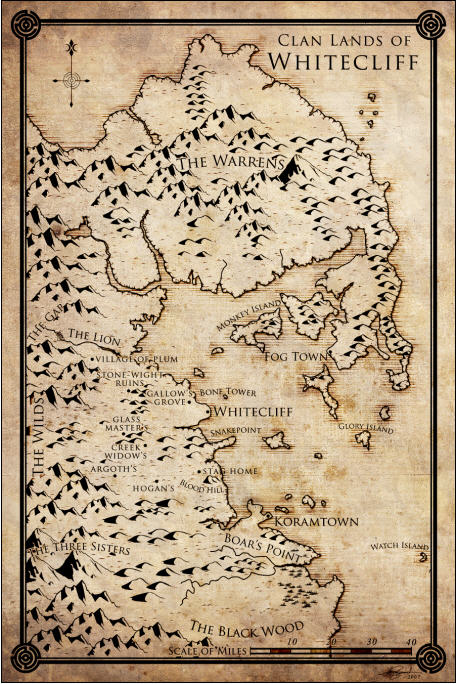
    Check it out.  “The Clan Lands of Whitecliff” by Isaac Stewart. I think he’s done a great job.  Here’s the full PDF. BTW, this is not the map that will appear in the book. That one’s being done by another artist selected by Tor. This is one I commissioned when I got my book contract.

    sodg_map_old_v5_isaacstewart

    Share
  • Send Frank to kick some award patootie!

    Awful-Intent-originalThe Whitney Awards are open for the public to nominate books they think are great and which are written by LDS authors. Those books that get at least 5 nominations are read and rated by a panel of judges. The judges then send on the finalists in each category to the Academy for voting.

    Servant won an award in 2009. Awful Intent is doing well, and if the reviews piling up are any indication, it could win another.

    If you liked the story, please take a few moments to nominate Frank, Sheriff Hood, and the Knitters of Death club.

    1. Go to: http://whitneyawards.com/
    2. Click “Nominate” in the menu at the top
    3. Fill in the form

    Let’s hope Frank can use some guns legally this time.

    Share
  • NEWS: Finished line edit of Servant

    It took me 33 hours, but I just finished reading through SERVANT and marking the manuscript up with the line edits I need to make.

    Holy smokes, folks, but it’s going to be a bigger edit than I originally thought. I knew I wanted to resequence chapters 1-8 back to the way I originally intended them. I knew there were some typos. And I knew I needed to add some content surrounding Purity’s story. But as I read I found that I was making line edits on almost every page.  For those unfamiliar with the term, you have basically four edits.

    • Content or story edit
    • Line edit
    • Copy edit
    • Proof edit

    The story edit is just what it says: you’re looking at plot and character. In this edit, you might add or cut whole chapters or story lines.

    Once the story is good, you do a line edit. In this edit you’re looking for how well the actual words on the page flow. You’re looking for parts where what you’re trying to say isn’t clear, where sentences or paragraphs are awkward, or where you haven’t been consistent. In this edit, you rewrite sentences and paragraphs. 

    Next, there’s the copy edit. Back in the old days, you had essentially three versions of the work. You had the original manuscript, which might go through many edits for the story and flow. Once it was good, the manuscript would be given to an editor who created a “copy” that could be used by the typesetters.  Of course, before you handed that over to the folks setting the type, you wanted to make sure it was clean because making changes in type is a pain in the butt. So in this edit, you’d go over it one more time, looking for typos and grammar issues. At this level, you fix words within sentences, although many times this edit will be combined with a line edit.

    Finally, there’s the proof edit. A proof was a copy of the work that had been set into type and printed. The typesetters would look at the their typesetters copy and then physically take metal sorts and mount them in a press to match it. To print it, they would ink the sorts and make an impression onto blank paper. That’s how stuff was printed. 

    Nowadays, you don’t need to manually set the type–you just print directly from document on your computer.  So you don’t have to worry about errors introduced into the text because of the typesetting. However, as many writers will attest, you simply do not see things on the computer screen that are obvious on the printed page. And so you always want to print out a proof and then edit it one last time for any errors in formatting or for small copy or line edits.

    So this last read was more or less a line edit. I did make some content-sized changes. And I did mark it up for typos and grammar stuff. But the bulk of the changes were line-level stuff, and I have to say I’m amazed at how many there are. I guess this simply means I’ve grown as a writer. But it is going to take some time to finish. I’ll then give the manuscript to my wife who is great with copy editing. And do another revision.

    I have to say I enjoyed reading the stories of Talen, Sugar, Argoth, and Hunger again. Some of the events had dimmed with time, and I was delighted to read them again. Parts of this book just make me so happy. With a couple of them I was all, dang, this story is awesome!

    ***

    Still working on the cover design for the Dark God books. Hope to finalize the basic structure this week and commission an artist. I’ll post the process and get your feedback as we go.

    Share
  • |

    You’re invited to join the novel writing workshop pilot

    I am developing an online novel writing course and am looking for folks to pilot it with me and give me feedback. I’m thinking I want to limit it to 10-12 folks.

    It’s free and will probably take two or three months to complete. If you join, your job will be to do the work. And there will be work. I’m thinking 10-15 hours of work per week. Please don’t ask to join if you don’t want to make this commitment. I only want folks who are serious and ready to give this a shot. In addition to the work, you’ll need to report your experience with the course as we go, sharing with me where you get stuck, what’s confusing, what’s helpful, what does and doesn’t advance your skill. In fact, if at some point the course just isn’t providing you any value, you are welcome to drop. That’s good feedback too.

    It’s going to be a blended format that includes self-paced work and some type of weekly online meeting. I will be guiding the class. At the very least, we’ll meet and chat at my site. I don’t know if we’ll do a live meeting or not. Still working that out.

    I struggled for many years, trying to figure this stuff out, then had a number of epiphanies during Orson Card’s boot camp and continued from there. Of course I still have lots to learn. But I want to share what I have.

    I love teaching and have been teaching in one form or another for the last 20 years. I’m currently an education program manager at a large software firm. What this is all means is that I’m trying to build a course that guides folks through a process that will help them learn to WRITE novels. Not just talk about them.

    So this is not a series of lectures with quizzes that test your ability to recall, although I will quiz you.

    It’s not a course with an end goal of teaching you what I’ve learned about the concepts and principles of plot, character, and setting, although you will need to learn that.

    This is about increasing your ability to get ideas, develop them, and then write.

    It’s about doing the work. It’s about production. It’s about finishing product. And having a good time doing it.

    If you already feel comfortable with your ability to finish novels, this is NOT the course for you.

    You can learn more about the course here by clicking The Path in the On Writing menu.

    Probably the only other thing you need to know is that the class is a PG-13’ish class. While the stories can deal with intense and adult themes, as the teacher, I’m not interested in working with stories with explicit or detailed sex or lots of language of the sort that would earn a movie rating more restrictive than PG-13.

    Remember, this is a pilot. Even though I’ve taught about writing for a number of years to various audiences, there might be some rough spots. We might find we need to change the work requirements or activities or any number of things.

    If you’re interested, click on the Contact link on the menu of my site, and shoot me an email.

    Edit 1/30/15: I’m getting a number of excellent questions about the time commitment and schedule. Let me answer them here.

    The gap I’m trying to fill

    First, you have to understand that I am not interested in talking about novels and writing novels. I’m interested in helping folks finish novels. That’s a big gap I see in most writing instruction. It’s the gap I had. There was nobody to help me move from the theory to the writing, and writing all the way to the end. So this isn’t a class about novels. It’s a class where I hope to help you learn a number of techniques for developing and finishing one. And to learn those techniques, you have to actually use them. Which means you have to develop and finish a novel 🙂

    So why 10 hours as a minimum?

    If you’re a slower writer, it’s going to take you around 50 hours to develop and write a novel of 25,000 words. That’s the size of one of Louis L’Amour’s smaller novels (which we call sometimes call “novellas” today). It’s the size of some smaller romances. A lot of indies are writing serials around this size. If you want to write a 50k book, it’s probably 100 hours, maybe more. A 75k novel? 150-200 hours. The development and first draft of a 100k novel? 200-300 hours.

    These are not exact times. Some writers are faster. But you get the picture. Writing a novel is a big project. And I’ve found that it’s just too hard to get any traction on less than 10 hours per week. When you spend much less time than that, you spend most of your time just trying to remember what the story is about. I’ve found it’s best to keep your writing engine hot, or at least warm.

    So will these 10 hours be in meetings?

    No. I don’t want to have a lot of meetings. That’s the beauty of online. We will have deadlines. But you should be able to complete you work during the times that suit you best.

    What’s the course schedule?

    I can’t give you an exact schedule. I haven’t timed everything. Figuring that out is part of what we’re doing in this course. But I do know what I want you to learn and how I hope to help you learn it. We’ll just have to see how far we get with each weekly 10-hour chunk.

    Share

5 Comments

  1. I just reread your Calendar section, and it has this line:

    “CURSE (The Dark God book 2) – Late November, 2013 (I’d like to make it Halloween for the fun of it, but we’ll see)”

    Am I correct to assume that Halloween comment no longer applies? There is almost a one-month gap between Halloween and “Late November”.

  2. Yes, Halloween no longer applies. Thanks for the catch. And the CURSE edit is indeed at 2%.

  3. CURSE is now at 15% I see progress! (I’ve been waiting a long, long time for that book…)

    By the way, at one time (a long time ago) you posted that CURSE was done, but then you were told you needed to shorten it and I guess you worked on that.

    Which version are you working on now that you are self-publishing? Is it closer to the first, longer version (I hope)?

  4. John,

    So glad to hear you’re chomping at the bit 🙂

    The edit is at 22% now.

    Three versions of CURSE were written. The first two were 230k and 245k words long. This version is currently 185k long and will probably end up being closer to 190-195k. For reference, SERVANT is 184k. Normal novels are anywhere from 80k-120k. So it’s still a BIG book.

    The neat thing now is that after book 3, if I want, we can still explore more in this world.

Comments are closed.