
Similar Posts
What’s driving the rise in school shootings?
Homicide rates are down in America, but school shootings are up. What’s going on? What’s driving this?
Some say it’s guns.
I have an hunch that I think deserves some study.
Back in the 1970s we had 30 school shootings with a population of about 216 million.
Today we have a population of 320 million. If we had the same ratio of shootings to population today, we’d have 44 shootings total in the decade between 2010 and 2020. But from 2000 – 2010, we had 60. And since 2010 (if my data is correct, and it appears that’s a big if–see Edit 2 at bottom) we’ve had 146. That’s a 300% increase!
If we want to solve the school shooting problem in the long term, we need to figure out what’s fueling it. One way to get at this is to ask what’s changed since the 1970s and 80s when the rates were lower.
Are we killing at a higher rate in general? Is that what’s changed?
No. FiveThirtyEight reports homicide rates have dropped. Here’s their chart.
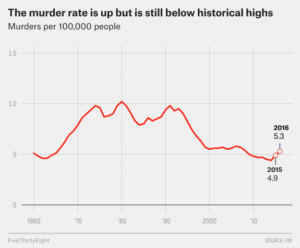
We’re down.
But school shootings are up. Way up!
Clearly, what’s driving school shootings doesn’t seem to be the same thing that’s driving general homicide rates. Otherwise, the rates would be moving in the same direction, but they’re not.
Is it gun ownership rates?
According to the Washington Post, ownership rates are at their lowest in quite some time. Here’s their chart.
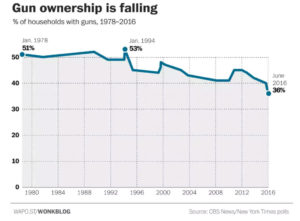
This means that if general gun ownership rates were a major factor, then we’d be seeing school shooting rates fall. We’re not.
Furthermore, some of the US states with the highest gun ownership rates have the lowest murder and school shooting rates. (For those wanting to know more about guns, magazines, the definition of an assault rifle, gun control, etc. see Larry Correia’s informational post below.)
Now, it could be that while overall gun ownership rates have fallen, ownership in certain population segments has risen. That’s something to look at. But when looking at the overall ownership rate, we don’t find an answer.
Is there anything else to study? Anything else that might be different now?
Here’s my hunch–it’s the internet. My hunch is that an unintended consequence of social media and the ease of finding certain types of content have facilitated the development of the mindset and ability of certain youth to commit these crimes.
We do things when we are prompted to take a specific action and we have both the ability and desire necessary to take that action. So action requires three things:
- A prompt
- The ability
- The desire
If the rates are going up, then one or more of those things have changed. Either more kids are being prompted to take this specific action, we’ve made it easier for them to do it, or we’ve increased their desire to do it. Or some combination of those three.
Let’s see if the internet might be a factor.
First, from what I’ve read, it seems a lot of these kids feel like outcasts and seem to be seeking some kind of revenge. Does social media foster and facilitate more bullying and isolation and, therefore, more resentment? Has it increased the desire to conduct such attacks?
Second, it is dramatically easier for kids to learn how to do all sorts of stuff now. Back in the 70s and 80s, it was hard to learn about the methods and tactics of crime, firearms, etc. Now, if you want to learn how to shoot, scope a place out, plan an attack, do all sorts of things, you can watch YouTube videos on it. Has the easy accessibility of how-to instruction facilitated the ability to plan and carry out these attacks?
Third, back in the 70s and 80s you had limited programming. Gilligan’s Island, Brady Bunch, The Love Boat, The Donny and Marie Show, Lawrence Welk, etc. They all fostered good-citizen values. Today, kids have easy access to all sorts of crap. Violent rape porn. Evil games like Blue Whale that give challenges to the player, and the last is to kill yourself. Are there certain types of programming on the internet that foster a violent mindset? That prompt these very actions and makes them seem like a good alternative?
Fourth, look at how well political conversations go on Facebook. Chat rooms, blogs, etc.–we all know they foster more incivility than when you talk in person. Does our social media, by its very structure, anonymity, etc. foster a more anger-filled approach to disagreements? Has it prompted, even trained, more kids to behave this way?
Is one of the unintended consequences of the internet and social media a rise in school shootings?
I’m not saying it’s the only part of the puzzle. But I do think it’s worth studying. We need a long-term solution.
At the same time, we need something now while that long-term solution is being researched and implemented. One of the best ideas I’ve seen so far to stop the killings is the one mentioned here.
Such people are screened, trained, and on-site. They can respond immediately. Plus it’s voluntary. If you’re a teacher that doesn’t want to do this, you don’t have to. Plus this doesn’t add security guards to schools. Nothing changes at the school until the shooter shows up, and suddenly there are half a dozen, dozen, two dozen deputies immediately there.
I think at our tiny 1A middle school, there are probably 6-8 people who would do this, including my wife. The teachers know the kids, know where other teachers are likely to be, know the place like the back of their hands. We know security deters threats. I can’t see anything but positives.
I don’t like the fact that we have to contemplate this. I want to go back to my youth in Bountiful, Utah where this never happened. Maybe we can get back to that type of a society. Until then we need an immediate, practical, and effective solution. This seems like a good part of a multi-approach solution.
But what’s the long-term solution?
I wonder if has to do with the internet.
Is any organization seriously studying this?
Do you see anything else that might have increased the prompts for this specific action, the ability to plan and conduct attacks, or the motivation to do so?
Edit 1 – gun retention
On Facebook today, a former deputy sheriff I know and respect was asked “Should teachers carry guns?” His answer: “No. Weapon retention is never even considered when politicians and others come up with that. Imagine some big, unfriendly student disarming a teacher during some classroom issue. Instant problem.”
This is a good point to raise.
I didn’t think of it. It’s clear none of the teacher defense plans are complete without it.
But is it a show stopper?
First of all, how big a risk is this? How many student-teacher scuffles do we have in grades 1-6 where the teacher is overpowered by a third-grader? How about in middle school? I’m sure the risk is higher in high school.
But just because there’s a risk doesn’t always mean you shouldn’t do something. Male and female agents and officers are trained in retention. My question is whether such retention training is ineffective? Should officers not carry guns because of this?
If it is effective, then it seems to me that if you’re trained, you’re trained. A big senior boy has just as much chance to disarm a trained cop as a trained non-cop of the same size and strength.
This is another reason I like the suggestion of the sheriff above. It’s not just any teacher that would do this. They need to be screened and trained. They’re deputized. I could see them doing training on a frequent basis. Something goes down at at school, and you immediately have 6-8 trained deputies on site. Maybe a dozen or more. Is that not a game changer?
It’s good to identify risks. But what would reduce the risks identified? Could we reduce them to acceptable levels? It’s a question that needs answering.
Edit 2 – is the “rise” due to bad data?
Just saw this. Is the “rise in school shootings” even real? Or is it bad data? Here’s an opinion on USA Today, suggesting it might not be as bad as we think. One of the things that’s maddening about all of this is what seems to be a lack of good data!Sources
- FiveThirtyEight reports on homicide rates
- The Washington Post on gun ownership rates
- The Atlantic on how hard it is to get good stats on these things (frustrating!)
- The Washington Post on the variety we see in mass shootings.
- Wikipedia on school shootings
- Wikipedia on murder rates by state in the USA
- Wikipedia on murder rates by country–however, it appears how the data is reported by country and what’s counted, even between countries like the UK and USA, make is almost impossible to get apples to apples.
- B.J. Fogg’s model of what’s required for a behavior to occur
- Larry Correia’s informational post on guns and gun control
LTUE 2024 Writing Presentations

Yesterday, I gave two presentations at Life, The Universe, and Everything, a SFF writers conference in Provo, Utah. A number of the attendees wanted copies of the presentations. I’ve linked to them below.
The Two Types of Plots Every Writer Should Know
There are two types of plots that power almost all successful commercial fiction. Are you using them in your stories? Do you know how they work? In this class, you learn both plot types, their key beats, the 3 big mistakes writers make, how to generate scenes, and much, much more. Come learn how to make plotting easier and deliver the ride your readers are looking for.
My lecture notes.How to Banish Writer’s Block, Fear, and Doubt and Unleash Your Awesome Power
The #1 thing that slays more writing dreams than anything else is the writer’s own head games. In 2005 I fiddled with death. Cognitive therapy (and God and a good counselor) saved me. And gave me an explosion of insights about writing stories and the distortions that sabotage so many of us writers. In this class, you learn the distortions, the truth, and a tried-and-true technique for removing the distortions that anyone can follow. You don’t need to struggle anymore. Banish your writer’s block, fear, imposter’s syndrome, comparisonitis, and more. Come learn how to unleash your awesome creativity and have a blast writing.
PDF of presentation slides.Good Stuff! Just Mercy
In other countries, the government can throw you in jail for no cause. It can keep you there indefinitely awaiting trial. And it can manipulate the trial to prevent you from mounting a defense.
In other countries, there is no trial by your peers. Instead the government is prosecutor, judge, and jury.
Our criminal legal system has so many wonderful protections in it. But there are times, as good as it is, when it convicts people of wrongs they didn’t do. Including murders they did not commit.
I can’t imagine being in that position. One day I’m pursing my dreams, enjoying my family, going to the movies, walking my dog, hiking. The next I’m hauled off to jail, convicted, and put on death row. And nobody will listen to me.
Luckily this doesn’t happen in the vast majority of cases. But it does happen. And if it happens to you, wouldn’t it be nice to have someone show up one day and say, “I’m going to work like a dog to reveal the truth and get you out of here.”
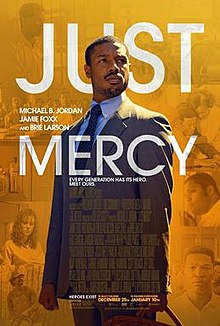
The movie Just Mercy tells the true story of just such a case. Walter McMillian is on death row for a murder he did not commit. And then one day a young defense attorney shows up and says he’s come to help.
This movie will have you on the edge of your seat and make you think. There are two or three moments where some crass language is used. So check it to make sure it meets your requirements. If you end up watching, I think you’ll really enjoy this tale. We did.
30 books you should read before you die
An avid reader friend of mine began reading through the books in a list called “100 books you must read before you die.”
She got to Jack Kerouac’s On The Road and went to Facebook and posted the following: “I don’t get the appeal. It’s about a group of boys/men who are irresponsible, drunks, whoring around taking advantage of others and being enabled by their women. Why is this a classic and why should I have wasted my time on it? Can some of my literary friends explain? I hated a brave new world and the handmaid’s tale too.”
Is the book a classic?
Should she read it before she dies?
Is it really that important?
Let me share an edited version of my response and then provide my list of 30 books you should read before you die.
*
Annette, the unfortunate truth is that these lists of “classics” are a sham because there is no objective criteria for determining literary excellence.
Or maybe I should say that measuring quality in the arts isn’t like measuring the unambiguous, objective score of a baseball game. After books exhibit a certain level of proficiency, it becomes increasingly difficult to distinguish the quality of one book from another, especially because much of this depends on a reader’s interests and subjective experience of the story.
When it becomes hard to rank performances, people rely on other measures. One of the most powerful is social networks.
So if two readers find two different books that blow them away, one of the books might get all the attention because the one book gets picked up by a news service (The New York Times) or a platform (the Oprah Book Club effect) or some other social network of influence. A lot of the so-called literary classics only appear on various lists because they tapped into the academic network, which kept them alive far longer than they would have lasted otherwise.
On The Road is simply a book that made a stir among some circles in the 1950s. That’s it.
Was it more important or of higher quality than Exodus? The Chronicles of Narnia? Lord of the Rings? A Town Like Alice? All published in the 1950s as well.
It depends.
If you’re wanting to understand the 1950s beat culture, it would be an important book.
But if you’re wanting to understand fantasy writing of the time, it wouldn’t.
If you’re wanting to read a book that’s had a huge impact on popular culture, well, LOTR beats On The Road like a dog.
Some people have the feeling that the so-called classics have some inherent medicinal value because someone put them on a list and called them classics.
Nope. They’re just stories. Some of which can shed light on the issues and interests of a part of the culture in a given period. But if you’re not interested in that specific sub-culture, who cares?
And if you’re reading to be entertained, moved, uplifted, or educated—which ones do that best for Annette is for you to decide.
So all that to say I wouldn’t devalue your reaction to the book

*
I’m now going to give you my list.
But it’s not going to be a list of titles. Nor will it focus on a book’s impact on some sub-culture of a given period.
It’s going to be a real list. One that focuses on what so many of us go to stories for.
- The one that makes you weep.
- The one that makes you giggle and snort.
- The one that reminds you of what it’s like to fall in love.
- The one that gives you hope.
- The one that you begin to read more and more slowly because you don’t want it to end.
- The one that scares the soup out of you.
- The one that you can’t put down, even though you need to wake up early in the morning.
- The one that makes you wish you lived there.
- The one that’s so good that when you close it, you immediately start to read it a second time.
- The one that gives you and your child hours of pleasure together.
- The one that gives you a sacred, spiritual experience.
- The one that makes you reread some of the lines because the turns of phrase are just so delicious.
- The one that gives you courage.
- The one that takes you on an awesome adventure.
- The one that makes you want to be a better person.
- The one that bores you to tears (just so know you how good the others are).
- The one that introduces you to a different culture that delights you.
- The one that makes you think.
- The one that lingers with you for days.
- The one that gives you lovely insights.
- The one that inspires you to love your spouse more.
- The one that introduces you to the sorts of people you normally don’t like and makes you actually like them.
- The one that delights you with its characters.
- The one that whisks you away to a different historical period.
- The one that inspires you to give your children a hug.
- The one that gets your adrenaline pumping.
- The one that sparks all sorts of ideas in your head.
- The one that makes you wonder and start imagining what it would be like to be there.
- The one that blows your freaking mind.
- The one that makes you stand up in your living room and cheer.
We could do more than 30, couldn’t we?
Like the one that makes you think people from a different time period are just like us. And the one that makes you think people from that same period are completely alien.
But I think we’ll stop. That there above is a list.
Those are 30 books I think everyone will want to read before they die.
Impeachment might not be what you think it is
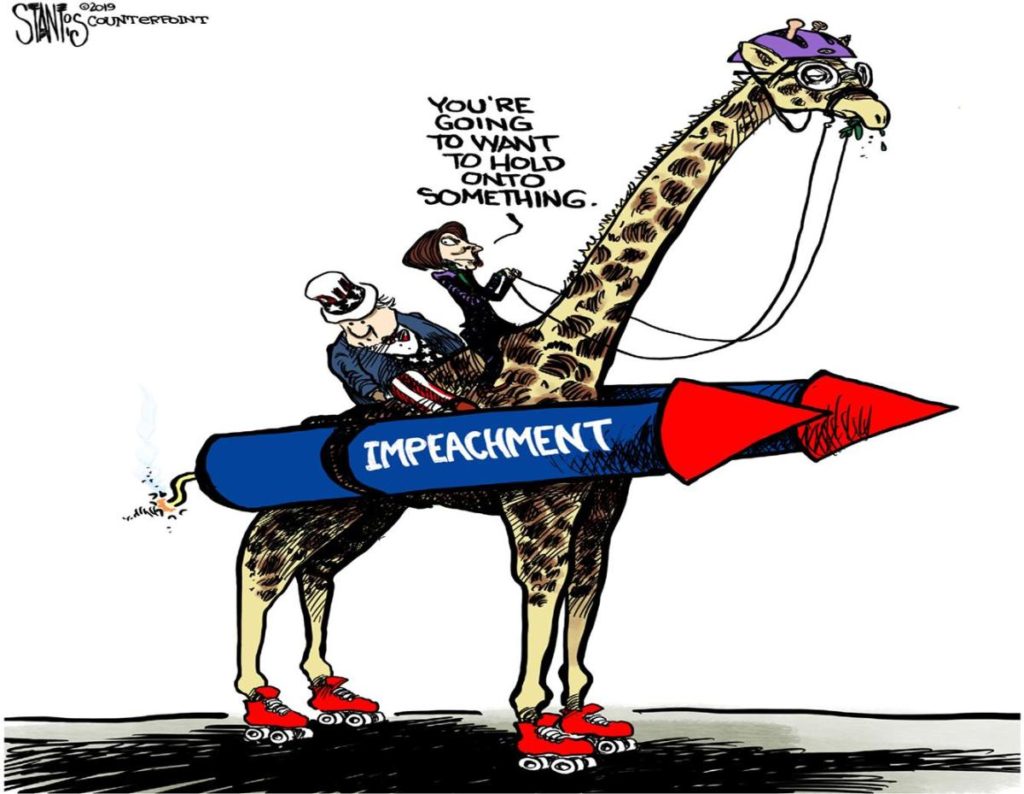
I’ve come to realize I didn’t understand the process of impeachment and the standards by which it is conducted. Here are a few key things I’m betting most of us didn’t know. Some of them will surprise you.
First, the process has three steps:
- The Congress starts an investigation, which can be conducted by any part of that body—the House, Senate, a special counsel, etc.
- The House leadership decides on whether to vote on “articles of impeachment.” The articles need only a simple majority to pass. If they do pass, the person is impeached. However, the articles of impeachment are not a conviction; they are a formal allegation of wrongdoing. The analog to this in the criminal justice system is an indictment.
- The Senate then holds a trial to decide if the allegations are true with both sides bringing witnesses, evidence, cross-examination, etc. The chief justice presides when the president is impeached. If two-thirds of the senators deem the allegations true, then the person is convicted and removed from office and may be barred from holding future positions. If the super majority isn’t reached, the person is acquitted of the charges.
There are two big questions in all of this. First, what standard of proof is used for passing the articles and then convicting the person of the allegations?
It appears that the standard of proof required for impeachment and conviction is left to the discretion of each individual representative and senator. There is no standard defined. So while some may use the standard of beyond a reasonable doubt, others may not.
Second, what can someone be impeached for?
According to the constitution they can be impeached for “Treason, Bribery, or other high Crimes and Misdemeanors.” However, the phrase “high Crimes and Misdemeanors” is not defined in the Constitution itself.
The most authoritative explanation of what “high crimes and misdemeanors” are appears to be a document written by the staff of the House Judiciary Committee. The latest version of this was written in 2015 and is called “Impeachment and Removal.”
According to the Wikipedia article on impeachment, “While this document is only staff recommendation, as a practical matter, today it is probably the single most influential definition of “high Crimes and Misdemeanors.””
A key take away from that house committee report is that not all crimes are impeachable offenses and not all impeachable offenses are crimes. So what are grounds for impeachment? Well, it’s a bit vague.
In 1788, Alexander Hamilton argued in the Federalist Paper 65 that impeachment was for “the misconduct of public men, or in other words from the abuse or violation of some public trust.” The House Committee report expounds on that, including the following general grounds:
- “Constitutional wrongs that subvert the structure of government, or undermine the integrity of office and even the Constitution itself”
- “Abuse of the particular powers of government office or a violation of the “public trust””
The report goes on to say the following.
“Congressional materials have cautioned that the grounds for impeachment “do not all fit neatly and logically into categories” because the remedy of impeachment is intended to “reach a broad variety of conduct by officers that is both serious and incompatible with the duties of the office.” Nonetheless, congressional precedents reflect three broad types of conduct thought to constitute grounds for impeachment, although they should not be understood as exhaustive or binding: (1) improperly exceeding or abusing the powers of the office; (2) behavior incompatible with the function and purpose of the office; and (3) misusing the office for an improper purpose or for personal gain.”
But the report doesn’t give much definition beyond this, just a few examples of what individuals have been impeached for since the founding of the country. What does all of this mean?
I think the Wikipedia article sums it up well.
“Several commentators have suggested that Congress alone may decide for itself what constitutes a “high Crime or Misdemeanor”, especially since the Supreme Court decided in Nixon v. United States that it did not have the authority to determine whether the Senate properly “tried” a defendant. In 1970, then-House Minority Leader Gerald R. Ford defined the criterion as he saw it: “An impeachable offense is whatever a majority of the House of Representatives considers it to be at a given moment in history.””
Impeachment is a political remedy, not a criminal justice or civil justice one. And given the vague definition of grounds for impeachment and the lack of any required standard of proof, what this all means, unfortunately, is that the process, especially in our current climate, is going to be rife, not with objectivity, but partisan politics. On both sides.
Here’s more for the curious.
Obama, Romney, Rich People, Roasts, and A Good Cause
Every year the Alfred E. Smith Foundation hosts a millionaires-only fundraising dinner for Catholic charities. It’s a custom to have the two main candidates speak in election years. President Barack Obama and Governor Mitt Romney roasted themselves and each other this week, just two days after their brouhaha second debate.
Not only are both talks funny, but the fact that these two men came together for this purpose says a lot about both of them. Go Obama and Romney! It’s the perfect antidote to bitter political rancor.
Enjoy.
President Obama’s Speech
Transcript: http://blogs.suntimes.com/politics/2012/10/transcript_president_obama_at_the_alfred_w_smith_dinner.html
Mitt Romney’s Speech
Transcript: http://blogs.suntimes.com/politics/2012/10/transcript_mitt_romney_at_the_alfred_w_smith_dinner.html