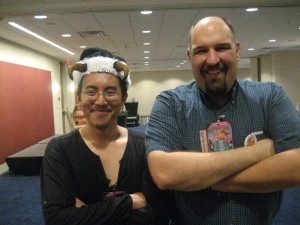
Yesterday, I gave two presentations at Life, The Universe, and Everything, a SFF writers conference in Provo, Utah. A number of the attendees wanted copies of the presentations. I’ve linked to them below.
There are two types of plots that power almost all successful commercial fiction. Are you using them in your stories? Do you know how they work? In this class, you learn both plot types, their key beats, the 3 big mistakes writers make, how to generate scenes, and much, much more. Come learn how to make plotting easier and deliver the ride your readers are looking for.
The #1 thing that slays more writing dreams than anything else is the writer’s own head games. In 2005 I fiddled with death. Cognitive therapy (and God and a good counselor) saved me. And gave me an explosion of insights about writing stories and the distortions that sabotage so many of us writers. In this class, you learn the distortions, the truth, and a tried-and-true technique for removing the distortions that anyone can follow. You don’t need to struggle anymore. Banish your writer’s block, fear, imposter’s syndrome, comparisonitis, and more. Come learn how to unleash your awesome creativity and have a blast writing.
The best way to change someone’s mind: use the skills you learned writing fiction.
John Scalzi recently wrote a post about White Privilege. You know: the idea that Straight White Males (SWMs) have all the cards stacked in their favor. It’s called “Straight White Male: The Lowest Difficulty Setting There Is.” I assume he wrote it to help SWMs have more sympathy for those who aren’t SWM.
It’s a noble cause. Not as noble as true love, but that’s so rare–not one couple in a century has a chance at true love (at least when you live in Guilder).
The problem is that Scalzi’s post is a great 101 on how To NOT Win Friends and Influence People. Actually, that’s not right. He will win new friends and increase his influence among those who are like-minded. But if he was hoping to win over those who didn’t already see things his way, I don’t think he’s going to be very successful.
His posts generated hundreds of comments. When you look at the comments, you’ll see that the vast majority of them are folks arguing Scalzi’s side with smug condescension and other folks arguing points against Scalzi with an equal lack of tact.
In short, it’s a classic online bring-your-guns-to-the-party event.
Alas.
Except I must admit such events can be a lot of fun if you’re on the side with greater numbers. Furthermore, there is sometimes a tremendous pleasure to be had in being provocative. Sometimes we simply must publish something with teeth in it. And maybe that’s what Scalzi was trying to do.
But if not, here’s where Scalzi’s post went admirably wrong. And it has everything to do with principles that underlie influence as well as writing fiction. You see, when you’re writing fiction and you want someone to root for your character, you do not turn to the reader and insult him. Insults don’t bring readers into your world.
Equally as important, telling, or demanding someone feel a certain way towards someone else, will fail every time you try it. You cannot demand (or whine) that a reader must feel sympathy and admiration for the character. Why? Because emotions don’t respond to demands. They just don’t. It’s like trying to freeze water by seasoning it with pepper.
The advice “Show, don’t tell” works in real life as well as it works in fiction.
Emotions are automatic. If someone presents the right stimulus, we WILL feel the desired emotion in response. We don’t experience a sympathetic change of heart when someone gets in our face and demands we feel sympathy. We do feel that change when we see the antecedents which prompt the emotional response in us. Show me. Make me believe. And the response is automatic.
This is what happened with Uncle Tom’s Cabin and the movie Ghandi and the TV series Roots and the more recent movie Believe in Me and the novel Les Miserables and thousands of others. It’s what happens every day when someone in one group meets someone in another group they feel some distrust for and begins to build a friendship.
Show the antecedents, help folks identify, and you’ll move millions. Get up and rant at someone, and all you’ll get is the bird. And applause from the true believers.
Scalzi claims that if you feel offended by his post then you’re hypersensitive because all he was doing is pointing out the facts. Um, no. Jim Hines is trying to establish potential facts. You could try to verify those. You could try to separate out causation from correlation. But Scalzi is not doing that. He’s telling all SWM that they are playing on the kiddy version of the life video game. Your life is so easy. Everything is rigged for you. You’re playing the baby version. And because of that everyone else’s life is so much harder.
No, he didn’t say those words exactly. But there is this thing call connotation. There is this thing called tone. And no matter how hard you try, you’re can’t separate the non-verbal communication from the message.
Everyone knows that some people have it harder in life and some have it easier. Like, duh. I think we all learn that when we showed up to the first grade. So what’s the point of telling all the SWM’s reading his blog that they are playing the dweeb version of life, the one with training wheels?
Furthermore, instead of helping all of us pampered SWMs identify with our brothers and sisters, he tries to erect more boundaries that would push us apart by giving all of us another way to discriminate and another reason to be resentful.
Lowly, pampered SWMs at the bottom. Gays, people of color, and women farther up.
So now we’re going to go around with a My Life’s Harder Than Yours number? The opinions of those with low numbers will have less weight. How could they have anything as worthwhile to say when their life has been so easy? Those with higher numbers will have more weight.
A whole new group calculus will have to be developed and standardized. And it will have to go beyond which shade of brown your skin is (yes, White people really are just a lighter shade of brown), your gender, and sexual orientation. Because those who are handicapped, by birth or by accident have it really rough too. We’d have to figure out if they had it more or less rough that someone who was gay, and would that change if that gay person lived in San Francisco versus Laramie, Wyoming? A geographical element! And what about those with idiot parents who teach their kids to take meth and don’t get them to school or beat them in alcoholic rages or who are never around? I wonder what score that would bring. And what about the kids who grow up with grandpa molesting them? And what about the short, the fat, the plain? What about those with glasses? Those who are runty bully targets? Or those with a minority religion. What about those born with AIDS?
Are we sure it’s a good idea to start ranking ourselves, using color, gender, and sexual preference to tag our status?
Wait, haven’t we already tried that?
When someone comes up to you at a party and condescends, when they’re always one-upping you with a “you think you’ve got it hard you haven’t seen squat” line, what is your response? Even if it is legit. What about when they get in your face for someone else? Does that change your default response?
It’s the same at internet parties and gatherings.
So.
Lesson 1: If you want to influence someone, don’t start by insulting them and continue by talking down to them. If you want to have a good time with like-minded friends, then, by all means, skewer.
Lesson 2: Remember “show, don’t tell” to win someone’s affection. Present the person’s story, and the reader will feel respect, trust, sympathy, sorrow, regret, and admiration automatically (okay, you’re right, some of that depends on the reader). Tell or demand, and none of that will occur.
Lesson 3: Don’t raise barriers between two groups when you want members of one group to identify with members of another.
Here’s a better way.
Tell me a story about a real gay black woman. Make me love her. Make me care. Tell me a story about her I can sympathize with. Just show me the woman. Make it about her, not her group category. Or tell me a story about a Mexican man who is just trying to provide for his children in America. Or tell me about a sympathetic SWM who goes to Asia or Polynesia and finds the cards stacked against him. Stories like this abound.
In fact, why don’t you drop the whole “SWM” business. If you want me to identify, to experience-take (yes, that official jargon), it’s probably best not to slap SWM on me and set me in one corner and slap GBM on someone else and set them in another. Help me identify. Focus on how we are alike. When you do discuss the differences, magnify those things that are wonderful and unique, or eccentric and unique, or goofy and unique, or weird and unique, or whatever, but make it positive. And when you must talk about old or continuing grievances between two groups, do so with respect, with a desire to calm, not enflame.
Lest you think I don’t know what I’m talking about, I grew up working in a family business where employees were White, Black, Hispanic, Tongan, and Japanese. Male, female, homosexual, heterosexual. And we were a big family. My father and mother held out big welcoming arms. I have Whites and Blacks in my biological family. I hope my daughters find great men to be their husbands. And if they happen to also be Indian or Puerto Rican or Black or Asian or Maori or Scottish or Southern or whatever, I would think it was grand. It’s possible I might experience some of that mild “other group” anxiety that sometimes comes when you meet someone that’s not just like you. But I know it’s possible to get beyond that by seeing what’s common, building friendships, and celebrating and laughing at and with the differences.
My father, God rest his soul, liked to quote Edwin Markam. I thought it fitting.
He drew a circle to keep me out,
A thing of scorn, and a thing to flout.
But love and I had the wit to win:
We drew a circle that took him in.
You want to laugh with the like-minded? Draw the first kind of circle. You want to win hearts and minds? Draw the bigger one.
T. Colin Campbell grew up on a dairy farm, loved milk, loved meat, and started his career as a nutrition scientist thinking the cornerstone of good nutrition was high-quality animal protein—meat, milk, and eggs.
One of his first projects was for MIT, trying to help the
chicken industry. Millions of chickens were dying each year from something
toxic in their feed. What was the mystery killer? Campbell was responsible for
isolating and determining the structure of the chemical. Through his work, he
helped discover dioxin, one of the most toxic chemicals ever found.
After helping with that, he began work helping malnourished
children in the Philippines. He wanted to find ways to help them get more
protein in their diets, because, again, protein was supposed to be the
cornerstone of health. Part of the project was remedying an unusually high
incidence of liver cancer in children, which is normally an adult disease. At
the time, they thought a lack of protein was leaving the children vulnerable to
aflatoxin in their diet.
But as they began their scientific investigation, Campbell discovered the kids who ate the most protein had the highest rates of liver cancer.
But that just couldn’t be right.
And then he came across a study of rats and aflatoxin. The
scientists in the study administered the cancer-causing aflatoxin to all of the
animals. Half of the animals were then fed a diet with 5% protein. The other
half were fed a diet with 20% protein. All of the animals fed a diet with 20%
protein developed liver cancer. None of the animals fed a diet with 5% protein
developed the cancer.
Again, that couldn’t be right. Protein was good for you. A respected colleague suggested surely the researchers must have mislabeled the animal cages. Campbell decided to run his own studies and find out. Back at Cornell, he and his research assistants ran the experiment multiple times and in various ways. And all of the experiments confirmed that protein promoted cancer growth. In fact, they could turn cancer growth on and off by the amount of protein they fed the animals.
But it wasn’t all protein. It was animal-based protein. The plant-based protein didn’t promote cancer growth.
Campbell was astounded. The findings rocked his world, but
he was determined to follow the facts wherever they led. This began decades of
research into diet and nutrition. The culmination was what’s called The China
Study. It is the most comprehensive study of nutrition ever conducted. And what
all of his decades of research demonstrated was that “People who ate the most
animal-based foods got the most chronic disease. Even relatively small intakes
of animal-based food were associated with adverse effects. People who ate the
most plant-based foods were the healthiest and tended to avoid chronic disease.”
Campbell didn’t rest there. He sought out the findings of
other researchers and clinicians. And what he found all demonstrates that “The
same diet that is good for the prevention of cancer is also good for the
prevention of heart disease, as well as obesity, diabetes, cataracts, macular
degeneration, Alzheimer’s, cognitive dysfunction, multiple sclerosis,
osteoporosis and other diseases.”
What was the diet that showed such important results? A whole
food plant-based diet. It’s a diet rich in legumes, whole grains, vegetables,
and fruits with little or no meat, milk, and eggs.
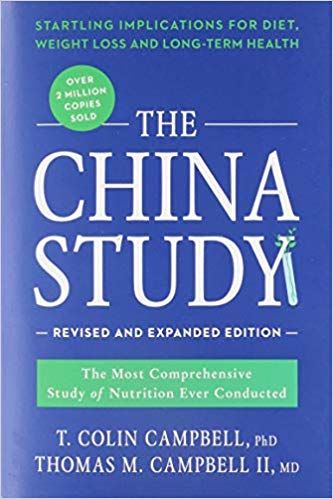
Campbell has written a book for lay people like you and me that explains the science and findings called The China Study: Revised and Expanded Edition.
The book is a fascinating masterwork of clarity. In it, he not only explains the research but also how and why various groups have tried to suppress and discredit the information.
Campbell is not some crazy quack. He isn’t someone selling
pills and supplement drinks on the internet. He has no financial interest in
you believing him. He is one of the foremost researchers on nutrition, a
renowned scientist at Cornell University, who has worked as a senior science
adviser to the American Institute for Cancer Research, sat on government nutrition
panels, and is on the advisory board of the Physicians Committee for Responsible
Medicine.
If you or someone you love are worried about any of the
following:
Heart disease
Cancer (breast, prostate, colon, liver, and
others)
Type 1 Diabetes
Type 2 Diabetes
Erectile dysfunction
Multiple sclerosis
Cataracts
Macular degeneration
Osteoporosis
Alzheimer’s
I think you will be interested in hearing what he has to report. Of course, you’ll have to make up your own mind about the evidence he provides. But I think you owe it to yourself to hear what he has to say.
I think this was taken when someone stole the ILOH’s Cheetoes
Seven days.
San Diego, Phoenix, and a wild trip through Wyoming, around Denver, and back to Utah.
Seven days.
Five nights.
In Arizona, I was told by a wild-eyed denizen of the Barnes & Noble we were signing at that my epic fantasy book was true–we are ruled by lizard people!
Imagine how shocking it was to learn that. I mean it doesn’t have anything to do with my book, but lizard people? A hollow earth? Is the CIA in on it? I don’t think I’ve recovered yet.
In San Diego, we rode around with Dave Farland in his old four-door sedan. A Lincoln? All I remember is that it was big and floated like a dream. After some narrow misses, Dave asked me to drive. Two big guys up front. One older, rough-looking guy being chauffeured in the back. At one point we walked to a restaurant during the day like some made man and his two goons. The restaurant was empty except for three rough characters sitting around a table on the far side. They looked at us, sized us up, then looked away. We sat at a table on our side.
In Wyoming we drove in high winds that sent streams of snow across the highway like multitudes of slithering snakes. At one point we passed one semi that was on fire, winds howling about. About an hour later, we passed a truck driver out in the median, thigh-deep in snow, a huge knife in his hand. He was trying to saw off the frozen antlers of an elk that had been hit. I looked up at his rig as we passed and did not see anyone behind the wheel. I swear the thing was rolling slowly down the highway, unmanned.
On the way back from Denver, we rode along a wintery, icy highway with trucks and cars littering the sides. Larry white-knuckled the steering wheel, but we made it. Two big guys, one 6’4″ the other 6’2″, in a tiny Ford Focus.
Did the very road fear the Lord of Hate? I cannot tell.
On this trip, Larry, that man of hate, brought a bag of Walmart beef jerky that smelled like, well, a particular kind of flatulence. What kind of person does that to beef? But we ate it. Because you do such things on epic journeys.
Now, here’s the thing. If you spend any amount of time with me, you will eventually tell me your life story.
You will.
Not because I’m a prier. But because I’m simply and sincerely interested. In people. If you work for the sanitation department, I’m going to want to know about garbage trucks. If you bowl, I’m going to want to know about bowling. If you’re some kind of wackadoo, I’m going to want to hear your wackadooness. Sooner or later, you’re going to talk. And, yes, there will be things along the way that I just might put in my zing file. That’s not why I’m talking to you. But sometimes the slices of life are too good not to capture.
So you put Larry Correia, International Lord of Hate, into a car with me, and he’s going to spill his guts.
Let me tell you what I found. Oh yeah, wait until you hear this.
Larry loves Bridget, his wife. No, do not turn away in horror. You must hear the rest of the tale.
He doesn’t like taxes, which is outrageous. Simply beyond the pale.
He’s a strong advocate of the right to bear arms. He figures people are safer with guns than without. And he was loaded. I remember getting to the hotel in Denver and seeing he draw his guns and put them on the table. A Kimber/Bul Poly .45 from his waist and a little Kahr MK9 on the ankle. Frightening. Of course, I never worried about going anywhere with him, but the guns had nothing to do with that.
He doesn’t like the idea of a small group of people in Washington telling folks what they need to do. He’s not anti-government. He just likes a minimal amount of government. This too is outrageous. Government is the source of all good in the world.
He doesn’t like a lot of what Franklin Delano Roosevelt did. One of those things he doesn’t like is the rounding up of Japanese Americans and putting them in war camps. Another was Roosevelt’s attempt to pack the Supreme Court with justices who would rule his way, essentially eliminating that branch’s check on the presidency. Nor does he like Roosevelt for being the first president to explicitly embrace deficit spending. The list with Roosevelt could go on. Of course, we all know that wise people everywhere thought Roosevelt made the right choice on these things.
Larry honors the folks who serve in our military and law enforcement. Big time. Guys and gals who put their lives on the line or support those who do. I roll my eyes.
Larry’s a big believer in pulling yourself up by your boot straps and getting to work. He worked on his father’s dairy farm milking cows early in life. Busted his chops in school. Busted his chops at work. Busted his chops writing novel after novel. And now he lives on Yard Moose Mountain. A supposed example of can-do economic mobility, which all smart people know is a farce.
I mean, work? Come on. Do you see how unreasonable the man is?
He’s an accountant and pretty good with numbers. Ergo he doesn’t like a lot of bureaucratic waste. It stinks to his accountant soul. And he saw a lot of that as a military contractor. I’m really for a lot of waste of taxpayer dollars, but I let him have his say.
Larry was once a bouncer.
He’s a big guy, but got his trash kicked in some early amateur MMA. But he still loved it.
The International Lord of Hate in multiple colors
In a friendly wrestling match, he broke his roommate’s toe, and said roommate responded by breaking the International Lord of Hate’s nose. Yes, the nose, Ladies and Gentlemen.
Larry is funny.
Larry has a lot of friends because, shocker, he’s a friendly guy.
There’s more. But let me tell you what I never heard. I never heard him make a racist remark. Not even when he told me about growing up in California’s Central Valley, or when some idiot kids who had been tasked with beating someone up to to join a Hispanic gang targeted him. Never heard him make a misogynistic remark.
I did hear how he loved to argue with folks on the internets. And then saw that later when I started reading his blog. It’s clear Larry likes a good fight. He’s a barbarian with big boots. But, in truth, he’s a friendly barbarian.
That’s the expose. I know. Shocking, isn’t it.
Now he’s gone and done this Hugo thing and calls people names and uses four-letter words on his blog posts.
I’ve found that Larry in person is not quite the same as Larry online when you disagree with him. In person he’s usually very conversational when you disagree.
Some might say he needs to be more polite online. Use more class.
They might have a point. Sometimes I think he steps over the line. Then again, they might not. He does get people to listen. And some of the things he has to say are insightful and worthwhile. Others are just plain funny.
Whatever your opinion, all I know is that if you’re wanting Abraham Lincoln, you’re going to have to look elsewhere. If you come out swinging, he’s not going to regale you with Kumbaya.
The International Lord of Hate radiating fearsome hate
And because he fights the way he does as Internet Larry, his posts seem to push some folks buttons to the point that they actually miss his intent.
For example, when Larry responded to Alex MacFarlane’s call for “an end to the default of binary gender in science fiction stories,” he never once suggested that we should discriminate against the folks MacFarlane wants to read stories about. He never suggested there shouldn’t be any such stories. Nor did he ever suggest folks who are discriminated against never have a case. His point was that the best way to write an entertaining story was to put the entertainment first, not some political agenda. His point was also that he’s sick of folks trying to foist their interests on him and everyone else. If you want to write about certain types of characters, do it. But don’t tell everyone else they must.
That was lost on some people. All they saw was someone who disagreed “rudely,” and they saw red. I’d be seeing red too if I felt ruded upon. At the same time, they still missed his point. A lot have missed his point about the Hugos as well.
But whatever happens with this latest kerfluffle, I had to tell my tale. Because I spent seven days with Larry Correia, International Lord of Hate. It was nip and tuck the whole time, but I survived his horrible onslaught. And then we enjoyed some ice creams and tropical trail mix, which I can happily report smelled a lot better than the beef jerky.
Are we all wearing Coke bottle glasses with this government shut down?
First, it seems silly to me when reporters ask Americans who is causing the shut down. It’s like, duh, if either party just gave into the other party’s demands, we wouldn’t have the issue. Which means that BOTH parties are causing the shut down.
Second, it seems a lot of folks have forgotten that this is precisely what should happen.
What?
Yes, our government is designed to allow these types of things.
But, John, isn’t that just asinine?
No. It’s not an oversight. I think it’s smart. Even if it causes some pain.
Let me explain what it seems some in the media and elsewhere are forgetting.
This is not a nation that belongs to a government. It’s not a nation owned by some lord or entity. This is a nation of individuals who decided to band together because we thought that banding together would allow us to protect our lives, liberty, and pursuit of happiness better than if we stood alone individually.
This is a nation of individuals who said, you know, we think we can figure things out better together ourselves than having someone dictating to us what we’re going to do. We’ll get together and talk. We’ll argue. We’ll persuade. We’ll try to convince each other of our individual ways of thinking. And when enough of us are convinced that we should do something, we’ll act.
We’ll set up a process for talking and making decisions that ensures everyone can be heard. It would be great if we could get 100% agreement on everything, but we know that’s not realistic. At the same time, we don’t like the idea of forcing our will on others. So we’ll make a compromise; we’ll set up the rules for making decisions so it requires that a good majority of us are in agreement before we can take action, especially on matters that are important to a lot of us.
Finally, we’ll make sure no individual or group can take control and deprive us of this way of living. We did the monarch thing, and we’re done with that. We will not bow to any king ever again. We’re going to be very careful about this one item because a lot of bad things begin to happen when any one person or group gets too much power.
So we set up the rules and started working together this way. And the basic premise under all of this is that we would respect each other’s free will. We’re a land of liberty. We’re a land where we get together and agree on a course of action. Not one where we impose our will on others.
One of the main methods we used to ensure that no individual or group could take control of the rest of us and that a good majority of us must agree before taking a course of governmental action was to distribute the power to make and enforce rules. We did this in a wide variety of ways. We did this because power’s a slippery thing and easily abused. Furthermore, because we knew no system is perfect, we also set up a system of checks and balances so that if one person or group abused their power, we could stop them and force them to remember to respect the freewill that the rest of us have.
So what has caused this shutdown?
It’s very simple.
A lot of Americans do not agree with Obamacare. By most polls, it’s a majority of Americans. They were not listened to when it was being developed. They were not listened to when it was made law. They feel it was passed, not with open discussion, but a lot of chicanery. They feel it’s not some minor regulation, but a very big thing that will infringe on their rights to live how they want to live.
Now, it might be that all their fears are unfounded. It might be that Obamacare is going to usher in utopia. Many signs suggest it’s not going to do anything of the sort. But let’s just say it is the finest piece of legislation ever. Let’s say is a celestial piece of governing.
That isn’t enough.
It’s not nearly enough.
Because this is not a nation that belongs to any group. We are a nation of individuals who have banded together, agreeing that we will talk things out amongst ourselves and only act when a good majority of us agree on a course of action. This is a nation that tries to tread lightly on each other’s liberty.
But many of the folks in Washington back in 2009-2010 forgot this and forced this thing called Obamacare upon the rest of us; in doing so, they violated one of the basic agreements of our compact. If they had followed the underlying intent of our union, they would not have done what they did. They would have crafted legislation that a good majority of us could get behind.
In 2010, those of us who protested this use of power voted in new folks into the House of Representatives to deal with the matter. In fact, when given the chance, Americans (both Republican and Democrat) in the heavily Democratic state of Massachusetts voted Republican Scott Brown into office, hoping to stop this legislation in the Senate before it became law. But Harry Reid didn’t listen. He didn’t care. He and Pelosi and Obama weren’t interested in allowing a full national discussion. He and the others were more concerned with getting their way. And so he used a parliamentary trick to force it through.
This shut down is about one group of people forcing their will on the rest of us. It’s about using the checks and balances designed into the system to correct such errors. It’s about the chickens of some poor decisions coming home to roost.
I know the shut down has caused issues. It’s a partial shutdown; 13% of the government. I think 87% is still funded and running. Still, I know it’s causing some pain.
But none of that pain needs to occur. Everyone wants to fund cancer research. Everyone wants to help poor single mothers. Those things aren’t the issue. The issue is that not everyone agrees with Obamacare.
If you’re a supporter of Obamacare, let me ask you this: if the tables were turned, what would you do?
Would you not stare at the folks trying to force their will on you and say, hey, come on. We’re adults here. We all agreed that we wouldn’t do anything unless a good majority of us were convinced it was the right course of action. Let’s get together and come up with something a good majority of us can get behind.
If you’re an opponent of Obamacare, you too should recognize that a good portion of your fellow citizens are clamoring to change the way things are. They’ve been clamoring for some time. Should you force your will on them? Or should you sit down and listen and try to come up with something that addresses the points we can agree on?
I don’t know if the folks many of us voted to go to Washington will stick to their guns and correct this. I hope they do. And I hope that those on both sides who have forgotten one of the basic tenets of our social compact will wake up and remember we are banded together, not to game the system to get what we want, but to act on only what a good majority of us want.