Indie Thoughts: The Kind of Competition Publishers Want

David Gaughran puts it all into perspective.

Since the huge shift to online purchasing and e-books, a common meme is that there is some kind of “discoverability” problem in publishing.

The funny thing is readers don’t seem to have any problem finding books they love. Any readers I talk to have a time problem – reading lists a mile long and never enough hours in the day to read all the great books they are discovering.

The real discoverability problem in publishing is that readers are discovering (and enjoying) books that don’t come from the large publishers. What these publishers have is a competition problem not a discoverability problem.

They have reason to. I had a stab last year at estimating how much of the e-book market self-publishers have grabbed in the US, pegging it at around 25%. The much more rigorous Author Earnings reports have confirmed that estimate, showing that self-publishers had captured 30% of the unit sales on Amazon and Barnes & Noble.

* * * *

So when large publishers say that the discoverability puzzle hasn’t been solved online, they are really expressing despair at retailers recommending books not published by them.

And when large publishers say that online retailers haven’t matched the experience of buying in physical stores, they mean that they wish there was some way to relegate all that stuff from small publishers and self-publishers to the warehouse, and have tables piled high with James Patterson and Snooki.

* * * *

The fear-mongers always forget Amazon’s core philosophy: recommend the product the customer is most likely to purchase. It’s interesting to note that this is the exact opposite of traditional co-op: recommending the book that the publisher wants purchased.

While it’s revealing to look at sites like Bookish and consider what Big Publishing would do with retail or discovery, we already know what it does with self-publishing. Exploitative vanity press Author Solutions runs self-publishing companies for HarperCollins, Simon & Schuster, Harlequin, is owned by Penguin Random House, and is now recommended by Publishers Weekly.

Large publishers want to decide what gets published, what gets distributed, what gets recommended, what gets discovered, and what gets sold.

Amazon – and the digital revolution it instigated – has made that impossible.

Anyone can publish. Distribution has been blown wide open. Large publishers have lost power over what books get recommended and discovered too, with the agnostic approach of sites like Amazon, Goodreads, and BookBub. And large publishers have definitely lost control of what is getting sold: self-publishers have grabbed a huge chunk of the market, and more and more writers are beginning to realize they don’t need a publisher to reach readers and make money.

This is the real reason why Big Publishing hates Amazon. Large publishers face real competition for the first time and they don’t like it one bit.

More at Let’s Get Visible.

Publishers have lost the barriers to entry that used to keep most of the competition out. Amazon set up a totally new distribution channel that has grabbed at least 41% of the book market.

Forty freaking one percent!

And of that 41% percent, it appears self-publishers have about as much of that channel as traditional publishers do.

Think about that for a second.

Almost half of book distribution is now out of publisher control. With no barriers, the hordes are running in to sell their books, pushing publisher books out of the good spots. The number of competitors is growing. And the publishers can’t get Amazon to relegate the riffraff to the back rooms. Can’t get them to feature only their books.

Worse still, it appears lots of readers don’t mind that at all.

Share

Similar Posts

  • Generating Story 7: Creative Q&A

    Filling up your mind with wonderful things by hunting zing is a writer’s bread and butter.  But guess what?  You can’t develop a killer story by waiting to stumble across great story ideas.  So while you must deploy your drag net and hunt with a purpose, you must also learn how to develop your own zing.  And I haven’t found anything more productive for helping me do that than the process of creative question and answer.

    If you refer back to the Story Development Framework download, you’ll see that Creative Q&A is one of the key tools used to develop every part of story.  So how does it work?

    Do you remember my first and second posts where I talked about Ed Smiley and the folks at NASA who helped save Apollo 13?  They used this technique.  Here’s how it went down.

    They had a problem: the astronauts were running out of oxygen because the CO2 scrubbers weren’t working in the module they were in.

    The problem led to an objective: figure out a way to get the CO2 scrubbers working.

    The objective led to a question: what are some options for getting those CO2 scrubbers working?

    Then they began to generate possible answers.  Two days later they had one that would work.  Ed and his team saved the three astronauts aboard.

    This same thing happens over and over again in any situation that requires some new solution.  Do you remember all those redneck solutions I shared in the first post?  They were practicing creative Q&A.

    You know all those accountants generating various ways to do your taxes?  They’re practicing creative Q&A.  Mine did that this year; he figured out one legal way do our taxes that saved us some money, then figured out another legal way to do our taxes that saved us more than $1,500.  I’m so glad he looked for that second, actually third, right answer.

    You see all those mothers and fathers generating ways to make ends meet?  They’re practicing creative Q&A.

    It happens all the time.  It’s a key tool when trying to develop a story, and I’ve found a couple of guidelines when using this technique that seem to help quite a bit:

    1. Clearly identify the objective.
    2. Turn the objective into a “what” question.  For example, “I need a more interesting character” becomes “What are some things that would make my character more interesting?”  Likewise, “This scene is stupid, nobody would do that” becomes  “What would make this scene more believable?” When I’m stuck with plot, “My character isn’t facing any real problems” becomes “What are some killer troubles the character can run into?”
    3. Generate a list of good, dumb, and wacky options.  It seems the more ideas I generate, the better chance I have to come up with something really good, especially if I cherish the dumb and wacky ones by writing them down.
    4. Don’t hesitate to steal other ideas I’ve seen and modify them to make them my own.  Or to go search for how others dealt with issue.
    5. Try to generate more than one good or right answer.


    I use creative Q&A to help me develop my key objectives all the time.  I state a question and use the principles to guide me in the options I generate.  For example, in the thriller I’m writing I started with a character, an ex-con trying to go straight.  I asked myself “What are some threats to his happiness?” and “What could go wrong?”  I started to generate options.  Some were mildly interesting; some were dumb.  One was that “some old associates come back, old prison buddies, and try to drag him back into the life he’s trying to escape.”  That one tingled my zing meter, and I started to generate more information about that.  “What would they drag him back into?”  “What kinds of crimes?”  “Who are they?” (Okay, not every objective can be turned into a “what” question.)

    There are also ad hoc objectives, i.e. objectives that arise only in a particular situation that I can’t plan for.  I can use this with them as well.  For example, in Servant of a Dark God I wanted a henchman to have a cool weapon, something that I hadn’t seen before.  My question for that was “what are some cool new weapons for this henchman?”  I listed out some that were stupid and had been done before like “a big knife” and others that were wacky like “a chain.”  I generated a big old list.  As I generated options I suddenly generated the idea of “spikes.”  And then “spikes that were alive.”  That tickled my zing meter, and I followed that path and came up with the Ravelers, which I think are just awesome.

    For more information about creative Q&A, I recommend you read Creative Problem Solving: An Introduction, Fourth Edition by Donald Treffinger.  It’s one of the most practical books on creativity around.

    While you’re waiting for that to come in the mail or to get it from your library, I want you to watch something.  Dewitt Jones, a photographer for National Geographic, uses creative Q&A.  He made an incredible twenty-minute video explaining the principles of generating options.  Please watch Everyday Creativity .  It says “Preview,” but it’s the whole wonderful video.  Then go here and watch that same last bit plus some material not on the other one.  These are two versions of the same presentation.  Everyday Creativity is the commercial version used for training.  Clear Vision is the personal use one that includes some extra material.  Let me recommend you purchase the Clear Vision version. You will not regret the $45 dollars.  I promise you.

    All of what he says applies to generating answers for our writing.

    GO WATCH IT NOW.

    Note what he says about these principles about generating options:

    1. Try different perspectives for stating a problem.
    2. Follow your zing, what you care about; figure out what’s exciting you about the thing.
    3. Look for more than one right answer.  Believe there IS more than one right answer.
    4. Don’t be afraid to make mistakes—you often must make them to get the good stuff!
    5. Try breaking a pattern, do something different.
    6. Train your technique.
    7. Put yourself in the place of most potential.
    8. Be patient, persevere.
    9. Relax and goof around.

    One last thought on creative Q&A.  There are certain questions that seem to be more productive than others.  I find that those focused on the key objectives are usually very productive for me.  So give those a try, but there are others.  Furthermore, what might work for me might not work so well for you.  Don’t get stuck on using a specific question because someone else does.  The goal is not to use a specific tool, which in this case is a specific question.  The goal is to make the different parts of the story come to life in your mind.  Whatever question helps YOU do that best is the one to use.

    Because creative Q&A is such a powerful tool, I want to make sure you see plenty of examples of authors using it in their writing.  To start, read chapter 2 of Orson Card’s Characters & Viewpoint and see what questions he finds useful and an example of  how he uses them.  Then come back here.  I’ve asked some other published authors to share how they use questions to help them generate story.  I’m going to start with Ian Creasey whose short fiction has appeared in magazines such as Asimov’s, Realms of Fantasy and Weird Tales, and has been reprinted in several Year’s Best SF anthologies.  He’s written a wonderful essay that I’ll use for the next post in the series.

    For more in this series, see How to Get and Develop Story Ideas

    Share
  • Villainous Heroes

    If we root against villains based on moral judgments, then how is it possible to root for heroes who are not just bad boys but down right criminal, e.g. hitmen, mobsters, thieves?

    It’s a wonderful question that has a simple and revealing explanation.  We root for these bad guys because they’re really good.

    What?!

    When talking about bad heroes, what we often do is:

    1. Take them out of their context.
    2. Focus on one or two negative traits, not the person as a whole.
    3. Abstract them and miss what’s happening in real time as we process the story. We only have so much working memory and usually can only think about what’s being presented versus what we think about when we’re out of the story. What’s being presented in the story is mostly the threats to these heroes, not the consequences of their evil deeds. And if the consequences are show, it’s always modified by context (#1 and #2 above).
    4. Confuse fascination with rooting.

    When we actually look at what’s happening with the hero in the context of the story, what we find is that rooting is still based on moral judgments of who is good/right and who is not. We root for people we think are in the right (given their context) or are getting, undeservedly, the short end of the stick; we root against people who we think are in the wrong.

    Here are some examples.

    DISNEY’S ALADDIN

    Thief. This one’s easy, I grant it. But it’s illustrative. I never once didn’t root for the boy. But I also never saw him as a true bad boy. He was nice. He shared the bread he stole with kids less fortunate. The guards were mean brutes. Jaffar was wicked and threatened the sultan and Jasmine who were good and innocent. was in a situation that provided some leeway for his behavior (alone, penniless).

    1. Context. He’s fighting a much greater evil, someone we are rooting against.
    2. Whole Person. He is a thief, but he’s also kind. Given his whole person, he falls on the side of good.
    3. Processing. As we process the story we’re never shown awful consequnces of his theiving. Mostly just the good and courageous things he does. And the threats to his welfare.

    THE ITALIAN JOB

    Thieves.

    1. Context. The movie starts with a heist and then a betrayal and murders by a traitor. Yes they’re theives, but we wittness a greater evil. The people they fight against are worse than they are.
    2. Whole person. Except for the thieving, he’s a likeable guy.
    3. Processing. We see few negative consequences of their actions to others, but we are constantly being presented with threats to them by guys who are committing greater crimes.
    4. Fascination. I was incredibly interested in the scam–the plans, tech, everything.

    THE PROFESSIONAL

    Mob Hit Man

    1. Context. He’s protecting a girl from other hit men. He’s fighting a bigger evil. He’s also taken advantage of by his boss.
    2. Whole Person. He’s a hitman, but more time is spent on his kindness.
    3. Processing. We see very little of the effect his hits have on others. Instead we are presented with threats to the girl and him.

    DIRTY HARRY

    Murdering vigilante

    1. Context. He’s stopping guys who are doing terrible things.
    3. Processing. We don’t focus on negative consequences of his vigilantism, but the threats from these really bad guys.

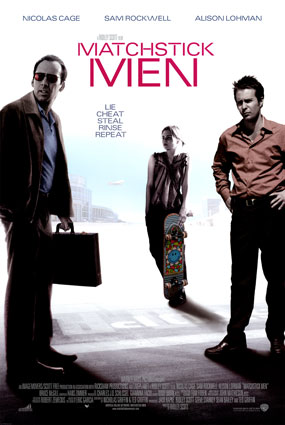
    MATCHSTICK MEN

    Scammers of the elderly

    From IMDB “Roy’s private life, however, is not so successful. An obsessive-compulsive agoraphobe with no personal relationships to call his own, Roy is barely hanging on to his wits, and when his idiosyncrasies begin to threaten his criminal productivity he’s forced to seek the help of a psychoanalyst just to keep him in working order. While Roy is looking for a quick fix, his therapy begets more than he bargained for: the revelation that he has a teenage daughter–a child whose existence he suspected but never dared confirm. What’s more troubling, 14-year-old Angela wants to meet the father she never knew. At first, Angela’s appearance disrupts her neurotic father’s carefully ordered routine. Soon, however, with his own unique spin on parenthood, Roy begins to enjoy a relationship he never dreamed of having with his daughter.”

    1. Context. Much of the time is spent his on his loneliness and issues with his estranged daughter.
    2. Whole person. He steals, but we never see huge suffering from it. We see all the other issues he deals and have sympathy for him.
    3. Processing. We’re focused on the threats to him, not the consequences of his one negative trait.
    4. Fascination. I was fascinated by the scam and this pulled me along through the first.

    CONCLUSION

    What happened in all these stories as I experienced them was that the story carefully managed my view of the hero. He was always on the better side of the antagonists. He was always more good than bad, even if only by a little. And the story focused my attention most of the time on the bad/threats/consequences flowing from the antagonists, not the bad from the hero’s deeds.

    What this shows is that you could write a story about a villain and make him the hero. In some instances it might be exceedingly difficult. For example, I think Hitler would be a hard sell as a hero, someone we’d root for. But the Neo-Nazis prove it’s not too hard a sell for some people. 

    I don’t think recognizing the fact that we can make “bad” people sympathetic means authors are “simply being clever” or “pushing buttons.” After all, to write well you must believe and care about what you’re writing about. YOU have to believe it. Nor do I think it undercuts the notion that we root for people based on a moral stance. It just recognizes the fact that moral judgments, in fact, the vast majority of appraisals of situations, happen quickly with the facts at hand, which are the ones in our working memories. The ones the authors are controlling.

    Share
  • |

    Learn plot, character, scene, and more this Saturday, Oct 9!

    All you Utah and mountain area writers & teachers, or those close enough to travel, I will be presenting and conducting workshops from 9:00 am until 4:30 pm this Saturday, Oct 9th as part of the Autumn Writers Conference sponsored by the American Fork Arts Council and the National Endowment for the Arts.

    The sessions I’ll conduct include:

    • Finding and Working With an Agent
    • How to Write a Story That Rocks: First Principles & Story Concept
    • Creating Characters that Rock
    • Plot
    • Writing Scenes: The Basic Units of a Novel

    There are four other tracks. Find all the details, including cost and contact info, on the organizer’s site: CalebWarnock.blogspot.com. I’m totally stoked for this. I’ll be sharing what I think are the Pareto factors in each of these areas — things I wish I would have known when I started and would have shaved years off my journey to publication.

    A number of other authors will be there including:

    • Annette Lyon (women’s fiction and a new cook book called Chocolate Never Faileth)
    • Josi Kilpack (mystery and suspense)
    • LeAnne Tolley (health and wellness)
    • Scott Livingston (poetry)
    • Caleb Warnock (self-sufficiency)
    • Loraine Scott (mystery)
    Share
  • |

    Watch The Secret to Making Plotting Easier Now

    For those that struggle with plotting your novels, you can now watch The Secret to Making Plotting Easier.

    It’s a recording of the hour-long lecture of goodness I delivered to an audience of over 140 writers at Life, The Universe and Everything last week.

    I’m happy to report that when it was over, a number of those in audience gushed quite profusely about how helpful it was.

    Enjoy!

    Share
  • Will Kindle save Asimov’s, F&SF, and Analog?

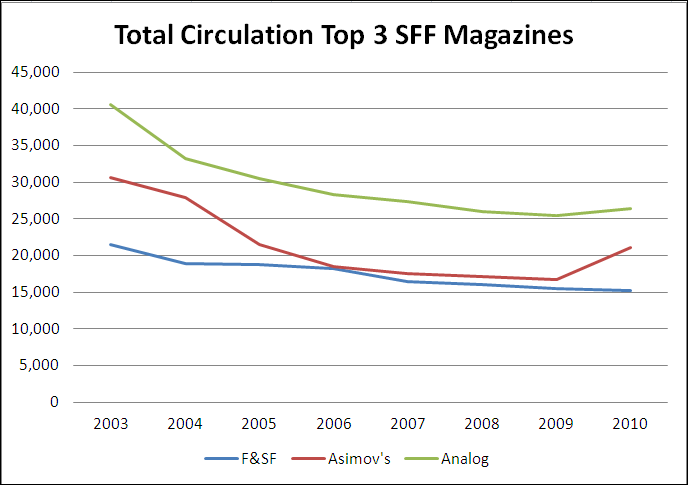
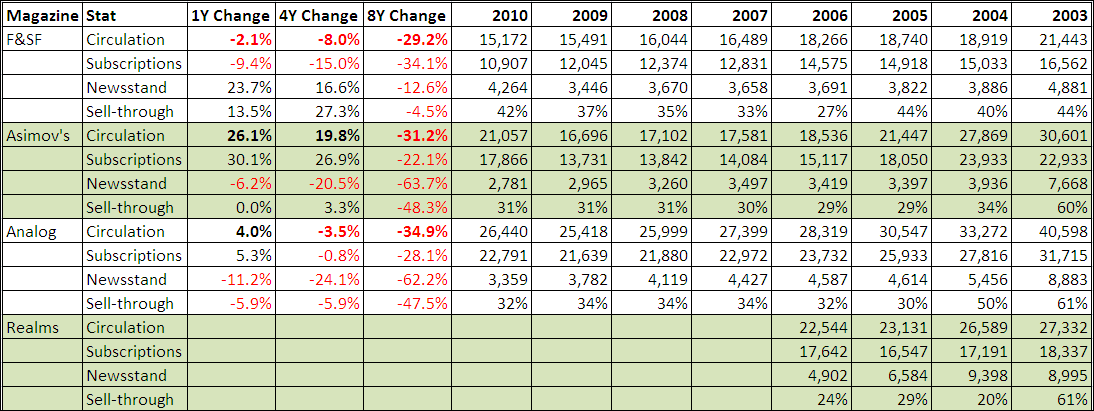
    It’s widely known that total circulation (sales) numbers for the main science fiction and fantasy magazines have been dropping for years. For example, in 1983 Analog’s circulation was around 115,000. Asimov’s and Magazine of Fantasy and Science Fiction, while not that high, were in the same general ball park. A lot has changed since then. Sales took a huge hit in the early 1990’s and continued to drop almost every year. However, last year something wonderful happened. Numbers went up.  


    Gardner Dozois, in his summation of the SFF industry for 2010, found in The Year’s Best Science Fiction Vol 28, from which 2010 and 2009 numbers were taken, mentions that the growth numbers for Asimov’s subscriptions were driven in large part by “digital copies sold for e-readers through devices such as the Kindle,” and that Analog’s increase in subscriptions was “also largely because of digital sales.”

    We all know that ebook took off last year. It will be very interesting to see the increase in total circulation continues for these magazines in 2011. Here is the supporting data that was collected from the reports in The Year’s Best Science Fiction volumes 20 – 28. Total circulation is made up of subscriptions and newsstand sales. Sell-through is a measurement of the % of the copies displayed in newsstands (at Barnes & Noble etc.) which sold. I added the Realms of Fantasy figures just so we could see, with the magazine recently dying its third death, just how big it once was.


    Of course, a fascinating question is: what are the chief factors that led to such a drastic decline in the first place? But I don’t know anyone who has been able to provide data to suggest what the chief cause(s) are. If anyone knows of one, please post in the comments.

    Wikipedia: Analog Science Fiction and Fact,

    Share
  • What does an author earn per book?

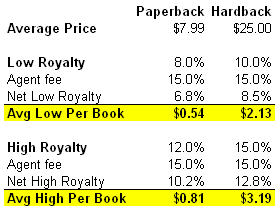
    People are always curious about this, so I thought I’d post it and refer to my previous post about what kind of sales numbers it takes to make a living as a fiction author in the US. Of course, the royalty rates depend on what’s in your contract. Many contracts have sales volume break points. For example, an 8% royalty on the first 50,000 paperbacks sold, 10% on anything above that. But this should give you a good feel.

    Earnings per book

    Share