Why capture zing if you don’t use most of it?

I agree that the ability to develop and finish a story is more important, and rare, than coming up with or capturing random ideas, especially since “ideas” can be something as small as a two word sentence from your daughter or the colors on some weird bug that you found hiding out in a teacup in your cupboard. Finding one of those is like finding one brick for a 50,000 brick house. Big whoop.

I also agree that ideas captured in a journal or file of some sort is NOT the only way to start developing a story. Getting a prompt or story parameters, writing to specifications, is obviously a perfect spot to begin as well (e.g. get me a SF story no longer than 6,000 words by Dec 15th that includes a bug). It is, if you think about it, just another type of starter idea. Going from image to story parameters or from parameters to story images–I don’t think the order matters. They’re both aspects of the story that need to be eventually developed. And we all know that stories can start from seeds of all types–character, image, line, issue, setting, problem, technology, AND parameters. What makes a prompt for a real gig powerful is that it pushes you farther down the path from one brick to house. It does this because a huge part of getting a story written depends on making decisions, getting specific. And on getting the motivation to buckle down and finish the thing.

I’m also going to bet that for all writers MOST of the elements (dialog, plot, character, setting) of any story are generated during the pre-draft planning (including research) and drafting–during the actual writing. Not by continually ransacking idea files like some people do their closets, trying to find pants, shirts, and shoes that will make an outfit. Like most anything else, we generate things (ideas in this case) only when they’re needed.

It’s true we have to care about and believe in what we’re writing. But I don’t think how any story gets started is significant. Partially because no matter how big the initial idea, it’s still small compared to everything else that must be generated. But more importantly because I think just starting is the key, whether that’s motivated by shot of zing or a deadline or whatever. I say this because I’ve found that zing strikes me more when I’m on the move working.

So if the vast majority of captured ideas are never used, why observe and capture at all?

Here are my personal reasons.

1) Because when I fail to consume new sights, people, ideas, and experiences, I tend to keep using the same things over and over in stories–lines, descriptions, plot turns, etc. Doing this actually helps me see new possibilities and go beyond my current ken.

2) While I forget most of what goes into the file, I don’t forget everything. When I’m working, the context of the story often evokes memories of some of these things I’ve captured.

3) Because when I’m on the lookout, I tend to see more. And current idea captures are a great source for random juxtaposition for the current project. I’m writing a story, go on a walk, and see in the snow a raccoon splayed out spead eagle on the side of the road like it’s been sacrificed, its belly torn open, the cavity completely hollow, four thin, almost translucent, ribs rising to the sky. There is some blood, but not much, and where it has fallen the snow is Valentine pink. There’s nothing else around the animal but a multitude of bird tracks and a few dark strings of disconnected and frozen gut. Because this signals story idea to me, I stop and pause to get more details. I write them up, look a bit closer, sketch it. And the impossible to imagine random detail goes into the current story to work its magic.

4) Because being on the lookout just brings more zest to my life. The universe offers up a small wonder or dread to me, and if I’m trying to be alert, I’m more apt to see it, cherish it, if only for a moment, and go my way rejoicing.

Share

Similar Posts

  • |

    Indie Thoughts: Publishers know profit, but haven’t tapped best seller lists

    In The Business Rusch: Generational Divide Kris Rusch points out that the new on-demand and long-tail market for books has changed the duration of the opportunity a book has to be successful, but that it seems the industry still isn’t recognizing this in how they measure success.

    The problems come from the fact that those of us who run things—people in our forties, fifties, and sixties—use metrics that were developed by our parents for their world, that tightly controlled Mad Men world where everyone was expected to be the same, not just in what they wore or bought but in what they listened to or watched or read as well.

    The bestseller list?

    It measures velocity. (A good essay on this topic, “The Meaningless Metrics of Fame,”  came from Mike Briggs, husband of Patricia Briggs, earlier this week. I’ve also dealt with it.)

    Reviews?

    They only want new books, and then only at the time of release.

    Brick and mortar bookstores?

    They only have room for the latest releases, and then only the ones that are the most popular with their customers (whoever those folks might be).

    Books have come late to this fight. Books have been available on demand for only about four years now, in the U.S. In other countries, there’s been even less time.

    And we’re all still fighting over meaningless metrics, to use Mike Briggs’ term, because those metrics only measure things that were important around the water cooler, not things which are important now.

    What’s important now?

    She goes on to say:

    The publishing industry isn’t even talking about new metrics. That idea hasn’t occurred to traditional publishing, and indie (or self) published writers are constantly seeking validation from the old system—trying to figure out ways to game the bestseller lists or to get a fantastic review from somewhere that has old-world prestige . . . But at some point, traditional publishers are going to have to develop new ways to figure out which products sell well and which ones don’t. All of their systems—from sales figures (which measure books shipped not books sold) to bestseller lists to critical acclaim—are based on the old models.

    Kris is a very experienced with publishing, but her last point conflates internal accounting with marketing. Publishers DO know which products sell.

    The primary measure of success in a financial enterprise s not new. It’s been around for 100’s of years. And on demand and long-tail markets don’t change it.

    The measure is how much a product or service contributes in profit to the bottom line. You take revenues, minus expenses, and that’s the contribution that product (a book in this instance) makes to your total profit. Or to covering your fixed costs.

    Booksellers have measured the success of their books with actual or estimated profits for quite some time. Publishers already know which books sell well and which don’t. No accountant in the world is going to report books shipped as the measure of success. And they don’t. The very fact that publishers have a profit and loss statement and show returns on royalty statements demonstrate that. They look very closely at actual and estimated profits. And to they do this by channel, which is reflected in a small way when they break out ebooks on royalty reports. This is all basic accounting.

    Here’s an example. Until Ender’s Game the movie, Ender’s Game the book hadn’t appeared on any best seller list since it was first released. And its release was 30 years ago! Yet over the years Tom Doherty touted its sales numbers many times. Tom knew that book was gold. Of course, he did. Because he doesn’t use best seller lists to tell him what’s selling well. He knows those lists are marketing devices. He has the real data in house. Why would he need a list to tell him anything?

    And Tom isn’t going to use books shipped either. Tor may report those numbers to Publishers Weekly for marketing purposes, but he will always multiply that number by an expected return rate to estimate sales. He wants to do that. Because books shipped is meaningless to the bottom line and everyone knows it, including the auditors.

    Publishers are well aware of the long tail. They see it with books that have been rotated out of the brick and mortar channels but are still selling in the online ones. They report it in their annual statements. They know the online channels work differently from the brick & mortar ones.

    The measure of success is still the same as it ever was—how much profit is this property contributing to our bottom line?

    Marketing, however, is a whole other ball of wax.

    What the long tail and on-demand allow are marketing campaigns that are impossible in the brick & mortar channel. In brick & mortar you have a limited time to advertise (roughly 8-15 weeks). After that period, most books are rotated out of the store. This means that any marketing for those brick & mortar buyers MUST coincide with the period when the books are in the stores.

    But the online channels open up all sorts of other opportunities. You can market forever. And the contribution margin is always positive. The online and POD costs are easily recouped with each sale. (Publishers are well aware of this profit potential; this is why we have so many making grabs for backlists.)

    And I see publishers taking advantage of these new marketing methods. This last week I saw publisher books not currently stocked by brick & mortar retailers on BookBub, BargainBooksy, and Book Sends. And the industry isn’t totally focused on new books for reviews. I just had a large newspaper agree to look at my book that was published four months ago. Still, Rusch is right when she says that the publishers haven’t adapted one of their biggest marketing tools to take advantage of the new opportunities–they haven’t done anything with the best seller lists.

    Amazon has lead the way in creating new ways of marketing books to different types of readers with their best seller lists. These lists create the excitement of discovery.

    But every one else is still reporting weekly sales on the big lists.

    If I were a publisher, I’d be asking USA Today to provide more than just the weekly view of the top 150 books. And USA Today is THE list to watch because their numbers are not based on units shipped to a sample of stores, but actual sales. Here are some lists that readers would be interested in.

    1. Most anticipated this week: based on pre-order totals
    2. Most anticipated this month: based on pre-order totals
    3. Hot new releases: based on weekly numbers
    4. Hot new releases for the month: based on monthly numbers
    5. Books with legs: last 3 months; I know it needs a different name (grin)
    6. Best sellers of the last 12 months: annual total of units sold
    7. Best sellers of the last 18 months: total units
    8. Contenders: for each of the lists above show the next 150 books (I always want to see the next 100 books after the top 100 on Amazon’s lists; why not show readers the top 300?)
    9. Movers: for each of the lists above show those that have the biggest rise in percentage sales and meet some unit minimum (you don’t want to feature books with 2,000% increase because they went from selling 1 unit to 20), even if they don’t break the best seller lists
    10. Genre: allow all of this to be sliced by genre.

    Let the reader select the view they want to see!

    Avid readers will gravitate towards the shorter time periods. Those that read fewer books will gravitate towards the longer periods. Everyone who wants to discover something new will go to the contender and mover lists.

    This is about marketing. Not publishers measuring success.

    And then armed with those numbers guess what the publishers will do? They will go back to the brick & mortar venues and pitch to have some of these same books carried in the stores for the first time (some publisher books are printed digital first) or carried again.

    Share
  • What does an author earn per book?

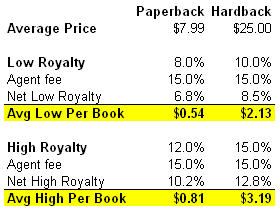
    People are always curious about this, so I thought I’d post it and refer to my previous post about what kind of sales numbers it takes to make a living as a fiction author in the US. Of course, the royalty rates depend on what’s in your contract. Many contracts have sales volume break points. For example, an 8% royalty on the first 50,000 paperbacks sold, 10% on anything above that. But this should give you a good feel.

    Earnings per book

    Share
  • LTUE 2016 presentation materials

    I promised you I’d post my materials. Here they are.

    Succeeding as a Storyteller 2016-02-13 HANDOUT

    Vivid and Clear 2016-02-11

    What Comes Next 2016-02-12 PRINT

    Also, at the end of my and LL Muir’s presentation of Succeeding as a Writer, I offered some of my books, the ones I authored, for free in the back. I would like to ask whoever accidentally got caught up in the mad rush (it was like Black Friday) and took my copy of Cheree Alsop’s Daybreak: Girl from the Stars Book 1 to please mail it to me. It looks like this:

    Daybreak-Amazon-Kindle-196x300

    It is dedicated to “Mrs. Brown’s Class” and was a present for her. You may mail it to John D. Brown, PO Box 157, Laketown, UT 84038.

    Share
  • Advice to new writers

    Recently a fellow writer brought up this post by author Kameron Hurley. He has a lot of interesting things to say (and some cool covers in his sidebar). A Steve Martin quote features prominently: “Be so good they can’t ignore you.”

    That sounds like excellent advice, doesn’t it?

    Until you start to think about it.

    Are there authors out there who strive to be just okay? That set goals to be mediocre?

    “Marge, keep the kids away! Bring me no lunch. Because today, do or die, I am determined to write a middling tale about lukewarm characters with a so-so plot!”

    !?

    I believe our writer of measley aspirations just might just be a strawman.

    Be good enough they can’t ignore you, Martin says.

    Wow, sounds good. Except let’s test it out. Let’s take some of the least-ignored authors of our day.

    For millions of readers J. K. Rowling is NOT a great writer. And neither is Harper Lee. Or Steven King. Or Orson Card. Or Brandon Sanderson. Or Lee Child. Or Nora Roberts. Or whomever. Insert whom you will–the vast majority of the reading public ignores or eschews them.

    The vast majority of the reading public is not moved by them in the least.

    Stephenie Meyer is a great writer for some. She gave them such a moving experience they dress up and relive it all at balls. She’s a horrible writer for others. Most people haven’t read her or gone to see her movies.

    The Bible is THE most life-changing, most moving book that millions have read. For others it’s a piece of trash.

    It seems that following Martin’s advice is a really good way to lose a lot of time galavanting after shrubberies only to then have your throat ripped out by the Rabbit of Caerbannog.

    Woe is me, for I should have stayed home with my lovely wench and lovely children and eaten more peas and read about sparrows. Zounds, but the blood my mother gavest me, at nine-month cost, now flows silently onto the sterile rocks. . .

    You can create great product, stuff made with extraordinary skill, and still not be Great because you’re earth-shattering stuff speaks to and shatters only a small portion of readers.

    I say forget greatness!

    Just sing. And revel in the singing. And the new songs your voice can carry as your skill grows. And share that reveling with all who enjoy such singing.

    Because it’s not about greatness. It’s about the song.

    And then go home and enjoy the laughter and coversation of the woman/man at your hearth, the children/cats at your feet, and the lovely taste of the fresh green peas.

    (Dear me, I believe I just equated children with cats. And yet, does it not sound just right?)

    John, you ask, what about goals? What about being all you can be? Are you saying it’s okay to schlub your way through life and writing?

    You must choose your own path. But I would never say don’t have goals. Nor would I say don’t try to write the best book possible . . . for the particular type of story you’re trying to tell.

    I think we all benefit by singing our types of songs to the very best of our ability and then trying to enlarge that ability as much as we can.

    That generates more joy in the giver and the receiver.

    But the quest to be Great so some amorphous “they” (who is they?) can’t ignore you seems foolish. It disregards the idea that it’s impossible to write great books for all audiences. But that’s not its only problem. It also seems to be all about the writer, and not the sharing. Me-me-me is, ultimately, such a hollow prize.

    It seems to me that it’s so much better to quest after singing, not to be noticed, but to deliver a service that I and the reciever can both rejoice in together. And then to increase that joy.

    Share
  • Indie Thoughts: Your First 1000 Copies by Tim Grahl

    Your First 1000 copies by Tim GrahlDo you know what’s awesome about Your First 1,000 Copies by Tim Grahl?

    He bases his advice on tests. Tests he’s performed with other authors and tests he’s performed with his own book.

    For example, what’s more effective: advertising and posting our on places like Facebook and Twitter or a mailing list? Do authors really need to have a social presence? Or is that a bunch of bunk?

    Tim has tested this question and shares what he’s found.

    What about marketing? What’s the best approach to take to win new customers?

    I think you’ll find his answer surprising. As a side note, I have to say I find his definition of marketing more insightful and practical than any I’ve come across. And I got a business degree!

    How do you set up mailing lists and which ones should you use?

    Tim tells you.

    What should you blog about?

    Tim shares his front-line insights.

    What’s the quickest way to find new customers?

    Tim discusses that as well. And it’s all put together in his framework or system he calls “Permission, Content, Outreach, Sell.”

    If you’re an indie author, I think you’ll want to hear what Tim has to say. There are three books on indie publishing that I’ve found super useful. Your First 1,000 Copies by Tim Grahl is one of them.

    Share
  • |

    The Little Secret that Propels So Many Blockbuster Plots

    I was invited to present a master class at the 2022 StoryMakers conference in Provo, Utah.

    We all want to develop plots that delight readers. Maybe we have ideas for the characters. Maybe we have ideas for the setting. Maybe we even have a couple of scenes.

    But a novel needs 40, 50, 60 or more scenes.

    How do you figure out what happens next, and do it in a way readers love?

    There’s one tool that can help.

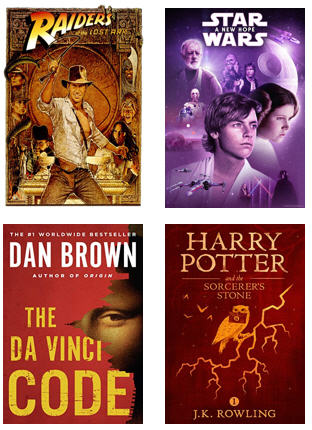
    Harry Potter, Lord of the Rings, and The Da Vinci Code all had it. So did Star Wars, Raider of the Lost Ark (1, 2, and 3), Taken, James Bond, The Wheel of Time, and thousands of other stories, TV episodes, and films.

    It’s what I call the wanted object, sometimes known as the MacGuffin.

    A good MacGuffin will not only make your plotting easier, it can also inject a wow factor into your story that readers love.

    In this session, the writers learned what a MacGuffin really is and how you can use it to propel the plot and keep readers turning the page.

    Here’s a PDF of the presentation.

    2022 john brown – the secret that propels so many blockbuster plots2

    And here’s the PDF of the handout.

    2022 john brown – the secret that propels so many blockbuster plots handout

    Enjoy!

    Share