J.R.R. Tolkien: A Biography by Humphrey Carpenter

Why I didn’t read Humphrey Carpenter’s J.R.R. Tolkien: A Biography long ago is a mystery. I owned the book when I was a teen (and stupidly gave it away in my 20’s). But maybe the long wait was inevitable. Back then I wanted more hobbits and sweeping saga, not biography. Luckily, that’s not the case today. 

Folks, this is a marvelous read. I’m sure part of the reason I have not read a biography with more interest is because I love The Lord of the Rings so much. But I think there much more to it than that.

Tolkien had a story life as a child and young man. Not story as in wonderful and easy, but as in hard. He was orphaned early, forbidden to see his love when he found her. So Tolkien’s life is compelling on its own, not just because he’s famous.

Furthermore, Carpenter writes, not a dry list of facts,  but a narrative full of particular and interesting details, transporting you back to the very times and places Tolkien lived in. He also transports you, if only lightly, into the mind of the man and some of his opinions. You’ll learn why Mordor is not Nazi Germany. How the batmen of WW1 found their way into his work. And that Frodo was originally named Bingo (can you imagine?). Carpenter also attempts to point out cause and effect as he sees it, to sum up key factors in Tolkien’s life, but without being glib. Carpenter writes all this with such clarity and grace I found myself carried along.

If you’re a fan of Tolkien’s work, don’t miss this book. Get a copy. Find a favorite tree, if you can. And then read.

Share

Similar Posts

  • Some 101 for Congress and the President

    It’s not really rocket science.

    1. If you have loans outstanding and the payment is due, you owe the creditors a payment. Payables for Idiots 101.
    2. If you have received goods and services, then you owe your vendors a payment. Payables for Idiots 102.
    3. You pay your bills. End of story. That’s what grown ups do. If you have to float some debt for a few months, you do it. And you staple a note to your head to stop spending like a slot machine junkie. Payables for Idiots 103.

    The debts we have are for goods and services we’ve already received. So increase the debt limit and pay your damn bills. What about spending?

    1. You do not spend more than you take in year after year. If you do, that’s called running your business into the ground. In the case of the Congress (primarily Harry Reid’s Senate at this point, although many, but not all, of the Republicans were happy to go along with dumb spending earlier) and the President, it’s the country they’re running into the ground. Spending for Idiots 101.
    2. If you’ve got all sorts of cool things planned like Acorn subsidies for pimps and Antarctica Jell-O wrestling grants for scientists, but you can’t afford them—i.e. you have to go into debt to get them–you cancel those plans. Spending for Idiots 102.
    3. The problem is that Congress and the President buy all sorts of crap and expect to put it on a credit card when it comes due. And there’s nothing to prevent them from doing it.
    4. They’re like irresponsible teenagers. They need controls that won’t allow them to overspend. Kind of like putting limits on a teenager’s cell phone minutes. Or forcing them to use a debit card. When they’re out of cash, they get a card denied response from their vendors.
    5. So you set spending limits, debt limits, and force them to balance the budget each year, except in extreme emergencies like when space aliens try to wipe out humanity. Spending for Idiots 103.

    This means you pass Cut, Cap, and Balance and quit spending money you don’t have. Really difficult stuff. What about getting out of debt?

    1. You eat rice and beans until you’re debt is gone or down to a manageable level. That means you cancel crap you can’t pay for. Sorry earmarks, you’re gone. Sorry grants for nude artists in trees, you’re gone. Sorry subsidies for PBS, you’re gone.  Finances 200: How to Not Be A Money Moron.
    2. You figure out how to reduce your current cost structure. This means you figure out a way to reduce the costs of Medicare, Medicaid, Social Security, and every other service or product you provide, cutting those that aren’t essential. You hire someone like Mitt Romney who knows how to go through every line in a budget and turn a bloated ship around.  Finances 300: No, You Can’t Pay For Your Sister’s Hair Implants with My Money.
    3. You remind people this is the freaking U S of A. A place where a man or woman can make themselves. Not where the government changes your diapers and feeds you mush three times a day. Communism and socialism have failed. They were badly conceived utopias, much like multi-level soap and vitamin marketing schemes that are supposed to usher in the Second Coming.  Finances 400: The USA Buried the USSR for a Reason.
    4. You increase your revenues.
    5. However, if you raise taxes, you’re actually going to depress your revenues. Think about this. Which car company has bigger revenues–Lamborgini or Honda? Who is going to put out, if they’ve got Louie the Fingers and his buddy Jockstrap taking increasing amounts of their money in a protection racket? Don’t be a thug. Be an enabler.  Do what Wal-Mart does and go for volume.  Do what Ebay does–create the environment that entices tons of commerce, entices people to dramatically increase their transactions. Transactions go through the roof; you take only a tiny cut, and, shazam, you increase your revenues.  Finances 500: Um, Do You Want People to Work to Become Rich or Do You Want Them To Pick Up Torches and Burn the Houses of the Rich Down?

    Cut spending, reduce cost structure, and increase your revenues. That’s getting out of debt.

    Is this really that hard?

    EDIT: 8/1 Seems that “wacky” Ron Paul actually has a simple commonsense approach that doesn’t sound crazy. Why couldn’t we do this?

    Share
  • No. I’m Fine by Howard and Sandra Tayler

    Robison_Wells____Green_Hills_Photography_0-201x300Sometimes it’s the small things that make the most difference.

    Like sharing an issue you might be dealing with.

    I was once at a writer’s retreat at a home above the Sundance ski resort. I’d be asked to present to some of the other writers there. Robison Wells, who writes awesome YA,  was also presenting. He talked about marketing and plot, but the presentation that was probably most memorable was the one he gave on the obsessive compulsive disorder he deals with.

    He started off by telling us folks really didn’t know what they were talking about when they talked about obsessive compulsive disorder. He described it this way. He said he and his wife were sitting on the couch watching TV one evening. She said she was craving some ice cream, orangesicles, I think. He replied that he was craving banging his head into the wall. She anticipated some delicious ice cream. He anticipated some delicious head whacking. He then pointed at the wall behind all of us and said that it would feel so good to bang his head on the corner of the wall behind us. Needless to say, he had our attention.

    He went on to explain more about this condition and mental illness in general and urged us, when we wrote about it, to get it right. To be accurate. To not turn such conditions into happy-happy super powers, nor to make them into things to be feared.

    By the way, Robison had a fine little dog with him. Not some yapper to carry about in a purse, but a nice little companion. I keep wanting to call her Abby, but I know that’s not its name. We learned that his dog was trained to watch him and remind him to take his meds. It appeared that Robison would sometimes rationalize away doing that.

    Robison isn’t crazy. We didn’t have a dangerous wild man among us. He’s just a guy who has to deal with some kinks in his hoses.

    HowardTayler2So what happened next? Well, nothing. We had a great retreat and went home. But the story doesn’t end there. See, if an issue is taboo, it becomes very difficult to deal with it. As an individual, a couple, a family, a community. In fact, hiding something like this only creates more problems. For example, if Robison ever says he’s going out to pick up some hammers, we  now know that we probably ought to have someone go with him (grin). So Robison not only wanted to educate us, he also wanted to help bring mental illness out of the dark. And he’s talked about this issue in a number of different places.

    Howard Tayler, the cartoonist, heard him talk about the self-harm once. He saw the good being open did and decided to write a bit about some things he has to deal with. Howard’s got a tricky bit of depression he has to manage. Sandra, Howard’s wife, decided to add to it what it was like being married to someone with such an issue.

    Now, I didn’t know the Taylers had written anything up until last week at Comic Con. During the event a woman talked to me. In our conversation she indicated that she’d been wrangling with some mental crap, but that Howard’s comments about his had helped her. We continued with our discussion, and she left. On Friday evening after the expo for the Salt Lake City Comic Con had closed, I walked around the event floor, chatting with some folks I hadn’t had time to visit during the event. I stopped at Howard’s booth and said hello to him and Sandra. They were busy, and I didn’t stay long, but as I went to walk away, I thought I should pass on what the woman had said. So I did. I didn’t know what comments she was talking about. All I knew was that Howard had helped her. And I wanted to make sure he knew it.

    SandraTaylerWe talked some more as they tried to clean up their booth before Howard had to run off to a panel. Then Howard handed me “No. I’m Fine”.  It’s a little 15-page booklet that contains the title story, written by Howard, plus the essay “Married to Depression” by Sandra, his wife.

    The story is an excellent short that gives you the feeling of what’s it like to be dealing with one form of the bugger. The essay reveals a bit of what it’s like as the spouse and recommends some action. But the thing I found so wonderful about both the story and the essay was the example of tender love in the midst of adversity.

    I’m a writer. I can’t help but be drawn to potential characters and stories. The view we get of these two in this booklet is good stuff to build some characters on. Of course, that’s not the reason to read the booklet. The reason is because what they share is fascinating and tender—it’s good drama—and, if you or someone you know is dealing with these issues, it just might help.

    Go read “No. I’m Fine” and “Married to Depression”. You’ll be glad you did.

    While we’re talking about this, those of you who have been following this blog know that I’ve had a few dust-ups with depression myself. I wrote about it and the tools I used to deal with it then and when it tries to come back to town. After reading the Tayler’s stuff, you’ll want to look at it as well.

    Edit 9/14: Addeded links to “Married to Depression”

    Share
  • |

    Since when did young adult fiction become the cure for cancer?

    Meghan Cox Gurdon wrote an opinion piece for the Wall Stree Journal called “Darkness Too Visible” in which she complained that it was hard to find young adult fiction these days that isn’t filled with coarse, dark material–profanity, pederasty, mutilation, etc. She claims that “contemporary fiction for teens is rife with explicit abuse, violence and depravity” and wonders “why is this considered a good idea?” She concludes by saying:

    So it may be that the book industry’s ever-more-appalling offerings for adolescent readers spring from a desperate desire to keep books relevant for the young. Still, everyone does not share the same objectives. The book business exists to sell books; parents exist to rear children, and oughtn’t be daunted by cries of censorship. No family is obliged to acquiesce when publishers use the vehicle of fundamental free-expression principles to try to bulldoze coarseness or misery into their children’s lives.

    This, of course, sent hordes of folks into a frenzy of posts sneering at Gurdon’s so-called prissy sensibilities, decrying censorship, and extolling the virtues of young adult literature and dark material in particular. For example, Mary Elizabeth Williams in a Salon piece called “Has young adult fiction become too dark?” rolls her eyes, then deigns to wade into what’s she thinks is an obviously juvenile argument to apparently show Gourdon how “stupid” she really is. Williams concludes:

    One of the terrific side effects of an obviously click-baiting piece of editorial twaddle like Gurdon’s is that it reminds people how many fellow passionate readers there are in the world. That incendiary WSJ piece promptly sparked a tear-jerkingly beautiful twitter #YA saves trend full of heartfelt reactions and links to outstandingly reasoned, article responses from well-read adults and teens on the value within so much of YA literature and its downright lifesaving effects.

    Williams suggests fiction doesn’t have the power to lead people into bad behaviors. After all, she assures us, “an entire generation of women managed to devour the ‘Flowers in the Attic’ series without having sex with their brothers.” No, according to Williams (and all the #YAsaves folks), YA fiction only saves lives. And she provides a link to prove it.

    But Williams misses the mark. Completely. This isn’t about whether fiction has power to influence us in good and bad ways. There’s a huge body of research on media effects which clearly proves fiction’s power for both. Nor is it about the theraputic uses of dark material.

    The heart of the matter revolves around a rather mundane thing–customer service and marketing.

    Gurdon and those parents she describes in her article want a certain type of entertainment. For years, YA fiction has provided that type of entertainment. But things have changed, and the YA label isn’t reliable to them any more. It’s like someone who has purchased steel cut oatmeal for years is now suddenly bringing the bags home to find them filled with sardines or, horrors, Twinkies.

    We can argue the merits of sardines and Twinkies. And a hundred other foods. We can argue the merits of certain types of stories for certain types of readers. And my metaphor above–maybe you think using Twinkies is unfair; maybe you would have wanted me to use something like Triscuts or Wheat Thins. But that’s all beside the point.

    The real problem here is that the publishers have ignored a significant segment of the market who want to buy books but can’t find the types they’re interested in. Either the covers and blurb material don’t help them find what they’re looking for, sometimes misleading them, or the publishers have simply made the mistake of not thinking about this segment of the reading market.

    The fix is easy. (1) Produce more books for these folks. (2) Label your books in a way that makes it easy for the consumer to find what they want. They’re not asking for censorship. They’re asking for a nutrition label that lets them know what they’re getting. Publishers can do what the movie and gaming industries have done with rating systems that prominently display on the cover. Or use some other method. This isn’t a moral issue, it’s simply a matter of helping the right customers find your good or service. It’s a matter of good marketing and branding.

    And I would think, with the upheavals in the book industry today, that publishers and booksellers would want to do whatever they could to boost sales. Surely it doesn’t help to turn customers away because your package is confusing them.

    In the meantime, the battle will rage and this simple practical core of the issue will be lost in the fires and clouds of smoke produced by the arguments extolling and excoriating the virtues and vices of fiction.

    Share
  • 1491, 1493, and Greek Gods

    New Revelations About America
    A common idea taught about the Indians (and, yes, it appears when you can’t simply refer to their tribe, most prefer that term to “American Indian,” especially those in South and Central America) is that they lived in such harmony with the land, that they trod so lightly upon it, that the landscape showed hardly any sign of their passing. This is, after all, what we were shown in Disney’s Pocahontas and James Cameron’s more recent Avatar, isn’t it?  

    Many of us were also brought up to believe that there really weren’t that many Indians around anyway.  They were subsistence societies. There certainly were no cities comparable to those in Europe at the time. And especially not in places like the Amazon or Boliva.

    We were taught that the Indians traveled here by walking to America across the Bering Strait land bridge that stretched from Russia to Alaska during the ice age around 10,000 BC. When they arrived, the proceeded to eat a tremendous amount of meat, killing off all the mega fauna like mammoths.

    We were taught other things. But it appears that many of these things have recently been shown to be false. Sometimes dramatically so.

    For example, the Indians transformed their landscapes, tens of thousands of square miles of it, very often through burning, but also through other ingenious ways.

    There were far more Indians in 1491 than most folks know. Recent research suggests that Central Mexico was the most densely populated place on earth at the time, “with more than twice as many people per square mile than China or India.” The total population of the Americas in 1491, by some estimates, was between 90-112 million people, meaning that MORE people lived in the Americas than in Europe.
    Finally, it appears that the Indians were here twenty to thirty thousand years ago. They were here when Europe north of Paris was still uninhabitable and mostly covered by glaciers!

    Charles Mann describes these and a number of other fascinating findings in his book 1491: New Revelations of the Americas Before Columbus. He relays the information in such an engaging style that I found myself picking the book up at every chance. When I was finished, I wanted more.

    Luckily, in 1493: Uncovering The New World Columbus Created Mann continues his history lesson. Except instead of focusing on the surprising things we’ve learned about the Indians in the last two decades, he focuses on the surprising impacts, both biological and financial, of linking the Western and Eastern hemispheres together. It’s the biggest event in the world, Mann suggests, since the dinosaurs died. Mann suggests that Columbus didn’t discover a new world–his voyage created one.

    The first part of the book examines the effect of the exchanges across the Atlantic (microbes  and tobacco). The next part focuses on the effect of the exchanges across the Pacific (silk, corn, and pirates). The third part shows the role of the exchange in the Agricultural and Industrial revolutions (potatoes, guano, and rubber).  The final part examines the consequences of the huge shift in populations caused by the Atlantic slave trade (Maroons, mixed-marriages, and freedom). As with 1492, the insights are both surprising and fascinating.

    If you like history, if you liked Guns, Germs, & Steel, then I think you will love these two books.

    EDIT: I just ran across a fabulous Doug Fabrizio Radio West interview with Charles Mann about 1493 called  The World Columbus Created.  Listen and enjoy!

    Divine Yogurt
    For years eating a serving of sweetened yogurt was like eating a box of Milk Duds (20 grams of sugar) or a Milky Way candy bar (35 grams of sugar). Yes, the sweetened yogurts have that much sugar. The only way to avoid eating literally like a kid in a candy store was to purchase plain yogurt and add some fruit or a squirt of honey. And, no, I will not consider eating yogurt sweetened with Splenda or Nutrasweet.  Artificial sweeteners make me gag. As far as I’m concerned, they are abominations that ruin the taste of everything they touch.

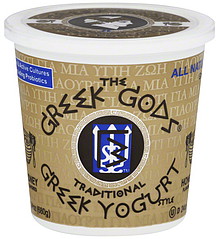
    So for many years I enjoyed my mix of plain yogurt and various add-ins. However, to my joy, I recently discovered a sweetened yogurt with only 15 grams of sugar (about as much as you find in a large banana) that tastes divine. It’s sweetened with real sugar and honey. And the mouth feel is sooooooo smooth. I’m sure this is because, unlike all the other yogurt manufacturers, these guys realized that, duh, fat actually makes things taste good and isn’t the  evil thing we’ve made it out to be. In just two bites it became my favorite sweetened yogurt. It’s called The Greek Gods Traditional Greek Yogurt. I’ve found another version—the vanilla honey—that only has 5 grams of sugar.

    Be aware that despite its name, this yogurt does NOT have the high protein content of other Greek style yogurts such as Brown Cow Greek Yogurt with 23 grams. Furthermore, not all the flavors have the low sugar content. Their blueberry and strawberry flavors, for example, have 35 grams. So check the labels first, and then treat yourself to yogurt that will have you savoring every bite.

    When I eat yogurt, it will still mostly be the plain Greek style with mixers. But when I want a special treat, you know I’ll be getting some from The Greek Gods.

    EDIT: 9/6/12 I now feel like Jerry Seinfeld in the episode when they found out the fat free frozen yogurt really wasn’t fat free. All the other yogurts I was looking at had serving sizes of 1 cup. The Greek Gods folks thought 1/2 a cup was the right size. That means that this super amazing low sugar yogurt had 30 grams of sugar per serving! It’s like eating a Snickers! I’m so disillusioned. Alas.

    Share
  • Merry Halloween!

    Poetry is a species of literature that struggles to flourish in written and spoken environments.  We forward the occasional insightful, funny, or sentimental poem in our emails. Once in a while speakers will quote a few verses. But we don’t share that form of poetry like we do the poetry in songs. Music is the environment in which poetry thrives.  People say you can’t make money writing poetry—tell that to lyricists and song writers.  I have three poems (songs) that I think you’ll enjoy.

    First is “God Rest Ye Merry Gentlemen / We Three Kings” by Barenaked Ladies and Sarah McLachlan. This is one of the Brown family’s most favorite Christmas songs. It’s such a favorite that we can’t help but listen and sing along all year round. The Bare Naked Ladies put a mix of these two classics to a punchy beat with an acoustic guitar, but then they change the mood part way in by bringing in McLachlan’s haunting, beautiful voice. It is an upbeat, wonderful arrangement.

    The next song is another remake of a classic: “I Heard the Bells on Christmas Day” by Casting Crows.  While the song is updated with modern instruments (drums, piano, guitar), this isn’t a raucous arrangement. It starts with a simple lovely melody and a solo male voice. It moves into a swell with a sweet child chorus that repeats the most important refrain in the song: “peace on earth, good will to men.” There are no bells in the song, but it makes me wish I was back in Europe so that when the bells in the towns there did peal, I would think of the message of this song.

    Now, I know some of you are thinking, “Christmas. In October? Are you kidding me?” So to appease these strict seasonalists, I present “Calling All The Monsters” by China Anne McClain. The perfect groove Halloween song–upbeat and catchy. And you simply must watch the music video that goes with it. It’s good fun that hearkens back to the Michael Jackson “Thriller” music video but is much more playful.  

    All of these songs can be purchased on Amazon for less than a buck each. If you want to preview them, you can on YouTube. Links below. Merry Halloween!

    So what are some of your favorites?

    Share
  • |

    Slush I Read by Jim C. Hines

    Laughs are lovely. I just came across this wonderful parody by novelist Jim C. Hines which will give you a few for free. Enjoy!

    Slush I Read
    by Jim C. Hines

    (Apologies to Seuss)

    I read slush.
    Slush I read.

    That slush I read.
    That slush I read!
    I do not like that slush I read.

    Do you like fanfic with vamps?

    I do not like them Mary Sue.
    Why do these vamps all worship you?

    Here’s a tale from D & D!

    I do not want your D & D.
    I do not like your elf PC.
    I can not stand your purple prose.
    I want to punch you in the nose!

    Would you like a hot sex scene?
    I wrote it for my online ‘zine!

    Go to Hines’ site and read the rest right now

    Share