No, You Did Not Get a Mandate

“Mandate” is one of the stupidest words used in politics today.
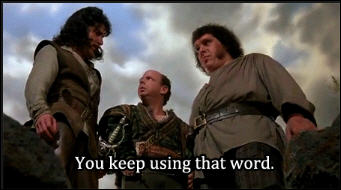
You keep using that word

A mandate is an order, a command from the boss. A requirement.

Some restaurant owners mandate their employees wash their hands after using the bathroom. I personally like restaurant owners who mandate that.

States mandate that people who drive cars have car insurance. I like that mandate as well.

But do political representatives receive mandates?

When a politician wins an election, does he or she receive a mandate from the people?

For example, when Obama spanked John McCain in 2008, and the Democrats swept into power, did they have a mandate from the American people to enact certain legislation?

Obama had 52.9% of the voters behind him. McCain had 45.7% of them.

Many Democrats at the time claimed a mandate from “the American people.” But if you know some elementary school maths, you’ll quickly recognize that 52.9% is nowhere close to 100%. Or 90%. Or even 70%.

52.9% is close to, well, 50%. That’s half. As in half a pizza. Here’s a visual for the maths-impaired.

Half a pizza

Clearly, 52.9% is nowhere close to “the American people” or “voters.”

But this was lost on politicians who had the brain capacities of gerbils. They thought the elections magically evaporated the will of 45.7% of the people. They though the other half had suddenly disappeared. They thought government by and for the people meant government by and for half the people.

Hold on, John. In the Senate, Democrats won 57 seats, Republicans 41. In the House it was 257 to 178, or 59% to 41%.

Yeah, like I said. About half.

But such maths were beyond them. And so they began to push through legislation that only half the country wanted. Sometimes much less than half, as in the case of Obamacare.

They weren’t governing America. They weren’t leading America. They were leading half and oppressing the other half because they had “won the election.”

So, my fellow Americans, should winning an election give you the right to force something onto the other half of the populace they don’t want?

Is this what America is all about? Is that the freedom from tyranny we celebrate every fourth of July?

The Republicans won a great victory in this year’s election, taking back the Senate and expanding their seats in the House. In the Senate, it will probably be 53 to 45. In the House, 244 to 184.

But does this mean the American people have clearly given them a mandate to enact certain legislation? Does it mean they’re supposed to ignore the other half of the country and ram legislation down their throats they don’t agree with?

I’m a true blue conservative. Or true red, or whatever the color is. After the last six years, I never want to have legislation rammed down my throat again. And I’ve also come to the realization that I never want to do that to the other guy.

America hasn’t given the Republicans a mandate. Nor, as President Obama recently claimed, have they given Washington a mandate to “get stuff done.”

Getting stuff done is exactly the problem.

We don’t want you to get stuff done.

We want you to get stuff done that the vast majority of us agree on!

But, John, does that mean you want us to compromise on our principles?

No. I don’t want to compromise. I’m not interested in going along to get along. But I’m also not interested in a representative government that fails to represent HALF of us.

Here’s my proposal. Let’s go back and start over.

Let’s get rid of Obamacare and put something in its place that at least 60-65% of us can agree on. Maybe 70% of us. It won’t be a liberal weed dream. It won’t be a right wing vision of glory. But whatever gets enacted will be something all of us agree are good things.

And it will force us to win others to our way of thinking if we want to get the rest of the stuff we think is so splendid.

But, John, what if folks can’t agree?

Then we don’t enact. This forces us to use persuasion. It forces is to think win-win. It forces us to behave like a nation that loves freedom.

Immigration. Do we want an American where the president acts like a tyrant and forces something down half of our throats? Or do we want to enact something 65-70% of us can agree on?

The budget. Let’s roll back all the nonsense and get a spending plan that 65-70% of us can agree on.

What about the 30%? I don’t want to oppress them, but 100% ain’t never gonna happen. Let’s be practical. Besides, requiring a large majority means Washington will be at least by and for most of the people. And that’s better than what we have today.

So, do we have a mandate? If anything, I would hope the mandate would be to do stuff that represents America, not one party.

Edit 11/10/2014

And today I find this–an explicit example of the gerbil-brain thinking I reference above. This fine fellow is one of the architects of Obamacare, explaining that the law was written in a way to bamboozle the American voter. What we need in Washington is honest debate and persuasion. Not duplicity and lies. I’m appalled. This is the get-stuff-done-I-have-a-mandate mentality. Not the get stuff done that most of us agree on approach. These folks have completely misunderstood the purpose of government.


Share

Similar Posts

  • LTUE 2026 Presentations

    I always enjoy presenting at the Life, the Universe and Everything writers conference. This year they asked me to present the following.

    The 3 Little Secrets that Make Plotting So Much Easier

    No, the secrets don’t have anything to do with the hero’s journey; 3, 7, 8, or 9 acts; Lester Dent; or cat-saving beats. An average novel has around 40 to 70 scenes. If you’re like me, those abstract plot structures spark an idea or three, then dump you in front of a blank wall. So where in the heck do all the other scenes come from? Well, a whole heap of them stand up and present themselves when you use these 3 little secrets. If you struggle with plotting, this is your chance to put that behind you for good and start generating fun and exciting plots with ease. Come learn the 3 little secrets that make plotting so much easier. 

    Here’s the handout.

    Vivid And Clear

    Despite the oft-repeated 11th commandment for writers—show, don’t tell—writers never show. They can’t. It’s all tell, tell, tell. The trick is to tell in a way that helps your readers imagine with such vividness and clarity that your story triggers an emotional response.  In this session learn the five critical prose techniques that help you do just that. 

    Here are the presentation slides.

    Share
  • Gun Runner submitted!

    Gun Runner, the action-packed, science fiction novel Larry Correia and I have been working on, has been delivered to Toni Weisskopf at Baen Books.

    It was a blast to write.

    This song was played, as was appropriate, in celebration.

    The seed came from Larry’s eleven-year-old son. When we sat down to develop an idea for a sci-fi con presentation a number of years ago, Larry asked: “Joe, what’s cool?”

    The answer: “Giant robots, bandits, and murderers.”

    We looked at each other and said, “That IS cool.”

    And thus was a story born.

    The current description Baen has goes like this.

    “Once, Jackson Rook was a war hero. Raised from boyhood to pilot an exosuit mech, he’d fought gallantly for the rebellion against the Collectivists. But that was a long time ago, on a world very far away.

    Now, Jackson Rook is a criminal, a smuggler on board the Multipurpose Supply Vehicle Tar Heel. His latest mission: steal a top-of-the-line mech called the Citadel and deliver it to the far-flung planet Swindle, a world so hostile even the air will kill you. The client: a man known only as the Warlord. Rook has been in the smuggling business long enough to know that it’s best to take the money and not ask questions. But Rook cannot stand by and watch as the Warlord runs roughshod over the citizens of Swindle, the way the Collectivists did on his homeworld. For all his mercenary ways, Rook is not a pirate. And deep within the smuggler, the heart of a warrior still beats.”

    The book should be available February, 2021.

    Share
  • Gun Runner a finalist for the Dragon Award

    I’m happy to report that GUN RUNNER, the science fiction, action adventure novel that Larry Correia and I wrote, is a finalist for this year’s Dragon Award for Best Military Science Fiction or Fantasy Novel.

    The award is part of Dragon Con, the massive multimedia convention held annually in Atlanta, Georgia. The winners will be announced at the con which takes place over Labor Day weekend.

    Lots of great books on the list.

    You can see all the finalists here .

    Share
  • Good Stuff! The Chosen

    Nellie and I stumbled onto a new TV series that we are really enjoying. It’s made us laugh, think, and feel. It’s called The Chosen and is based on the life of Jesus Christ, but it’s not like any Jesus series I’ve seen before.

    Now I have to admit that when I first saw ads for this, I wasn’t interested. It’s not that I don’t like videos about scriptures. There are some I love. It’s just that the purpose of so many of them is to illustrate a scripture instead of tell a story. And there’s nothing wrong with that. It’s just that when I’m looking for a drama, I want to watch a drama.

    But this series is different. They have taken a historical fiction approach, which means that while they adhere as closely to the facts as we know them, they don’t limit the story to those facts. And so they imagine people, events, and motives that are plausible, and then tell a story. A great example of this type of storytelling is Gerald N. Lund’s bestselling The Work and The Glory series about a family in the early 1800s who join The Church of Jesus Christ of Latter-day Saints. Or Michael Shaara’s bestselling The Killer Angels about the battle of Gettysburg in the United States Civil War.

    The Chosen focuses on stories about characters surrounding Jesus and those who plausibly could have met him. It also imagines Jesus as more than a sober Lord. He laughs, jokes, engages with children. It is a reimagining of the familiar that makes the story fresh again and leaves you wondering and pondering.

    It’s created by Dallas Jenkins, an evangelical Christian, and produced and distributed by VidAngel Studios, run by Latter-day Saints. And their love of and delight in the subject show. I can’t wait to see the next episode. You can watch it right now for free. Go to the VidAngel site or to https://studios.vidangel.com/the-chosen/. Or you can watch it on YouTube with ads.

    If you like religious fiction, if you like a good drama, if you’re interested in knowing more about the life and times of Jesus Christ, then I think you’ll love this.

    Share
  • Indie Thoughts: Authors, We Are Not Amazon

    Sometimes I think some of us indies get this weird attachment syndrome and start thinking we’re Amazon.

    Joe Konrath recently hosted a blog-conversation with Lee Child about the whole Amazon vs. traditional publishers thing. The Passive Voice had an active discussion about it as well.  Kudos to Lee Child for yet again showing up and injecting a new perspective into the conversation. It can indeed become something of an echo chamber in the main indie blogs, which I love, but which nevertheless do still tend to sometimes echo. Having someone with his experience come engage and share his two cents was helpful.

    One thing his comments reiterated to me is that neither Amazon nor the publishers are in this as the author’s let’s-get-pinky-rings BFF.

    I’m not going to carry an ounce of water for Amazon in their fight with Hachette. I’m not going to carry an ounce for the trad publishers either.

    I think it’s helpful for all of us to try to understand the truth about the business, and spread that to other authors, but that’s very different from this knee-jerk Defender of Amazon thing that goes on, which seems so very much like Republicans and Democrats turning a blind eye to their own candidates and fixating a hyper-critical one the others.

    Case in point: here’s a link to a description of Amazon’s Gazelle Project.

    Why do indie authors care? Because we’re Amazon vendors as well.

    Look, I love what Amazon has enabled me to do. I love that Nook and Apple are helping enable it as well. But was this Gazelle Project a good thing? A bad thing? If we stand by and cheer Amazon in such tactics, are we essentially standing by and cheering as Germany takes Austria, France, and Poland? Or are we like England cheering the USA coming in with their troops and bombers?

    I’m NOT a traditional publisher. And I’m NOT Amazon, or any other retailer. Even when I contract with them. None of us are. I sometimes wonder if some of us have gotten a bit confused about this.

    Konrath says don’t worry about the tiger (Amazon) when a wolf (traditional publishers) is gnawing on your leg. But if you’re an indie writer, you have no wolf gnawing on your leg. That’s someone else’s problem. But we are indeed in bed with the tiger.

    Why haven’t we seen more posts about the Gazelle Project on the big indie blogs? Lee Child, darling of the traditional publishers, has to point me in its direction? Why haven’t we been more curious about this tiger’s behavior?

    Let’s make hay while the sun shines. The tiger seems to be fairly decent right now. He’s not perfect. For example, eBay strangely enough only charges 15% to sell via their site while Amazon charges 30%. But let’s not forget that as decent as he is, he’s still a tiger. And he’s probably not like those poor guys being made to do tricks by Ringling Brothers.

    Ringling_brothers_over_the_top_tiger

    Share
  • Good Stuff! La Brea, Bingham’s, Aggie Lemon Custard

    I have cut my consumption of bread to almost nothing. And so when I want a slice, I’m not going to waste it on run-of-the-mill sandwich bread. I want something delicious. And the best bread we’ve found is the La Brea Bakery bread that’s sold at Smith’s and other Kroger food stores.

    Our favorites are the cranberry walnut loaf, the toasted sunflower honey loaf, and the pecan raisin loaf. These breads are made the old-fashioned way with a substantial crumb and a crackly, chewy crust that’s a joy to eat. And unlike the bread from a chain bread company that will remain unnamed, these loaves are actually fully cooked.

    We just got two loaves today on our trip to Logan. We came back home, cut a few slices, popped them in the toaster, buttered, and ate with some chicken noodle soup. Pure bread heaven.

    #

    With that bread you might want some bratwurst. Not grocery store brats. Real brats. If so, I found the spot to get them (thank you, Larry Correia). There’s a gem of a butcher’s shop in Morgan, Utah called Bingham’s Custom Meats. It’s clean, well-lit, and nice-smelling. The people there are friendly. And they have over thirty different flavors of brats.

    Bratwurst, by the way, comes from German. It’s made up of two words. “Brat,” which means finely chopped meat, and “wurst,” which means sausage. At Bingham’s they don’t add nitrates or any other preservatives. Their recipes are pork mixed with various sets of spices.

    So far I’ve tried nine of their flavors, and they’ve all been delicious. They’re great for a low-carb diet. A Bingham’s brat and a bunch of cooked vegetables makes an awesome lunch. If you want, you can also just slit the casing and cook the sausage patty or stir fry style.

    #

    I’ve also cut my consumption of sweets. Which means if I eat something, I want it to be worth it. And so it gives me great pleasure to report my discovery of a wonderful flavor of Aggie ice cream at the USU Creamery—it’s called lemon custard.

    I know. Lemon ice cream?

    And when I say ice cream, I mean ice cream. This is not a sherbet. And let me tell you right now, this ice cream is amazing. It’s amazing all by itself. It’s amazing with a banana, which they sell at the creamery. Furthermore, for a little fun, if you combine it with the regular Aggie chocolate, the two together taste like a Tootsie Roll. No lie.

    I had it last month, and the month before, and I can’t wait for another date with the wife to go enjoy another scoop.

    Share