When I was in 7th grade I read Tolkien’s The Lord of the Rings trilogy. Of course, I wasn’t the sharpest literary tack back then, and so great sections of The Two Towers and The Return of the King went over my head and, therefore, bored me. But, with the help of the Hildenbrant calendars, enough came through to thrill. I wept at the events in the mines of Moria with Gandalf, geeked out over the elves, orcs, and Nazgul, was fascinated with the Ents and wizards, and generally wanted to stay in that world forever.
When I finished the trilogy, I mourned–the dream was over. I read Smith of Wootton Major and Farmer Giles of Ham. Both were delightful, but neither was the same as LOTR. Then I saw The Silmarillion. It had a cool cover, a map.
Oh, joy! I bought it and took it home.
Alas, that book was about as much fun as reading a ten-pounder on the history of baroque cornices. I tried mightily to push through, but I don’t think I was able to finish more than 15 pages total from all the sections. So I mourned again, and then, still feeling the loss, went looking for something else that might whisk me away.
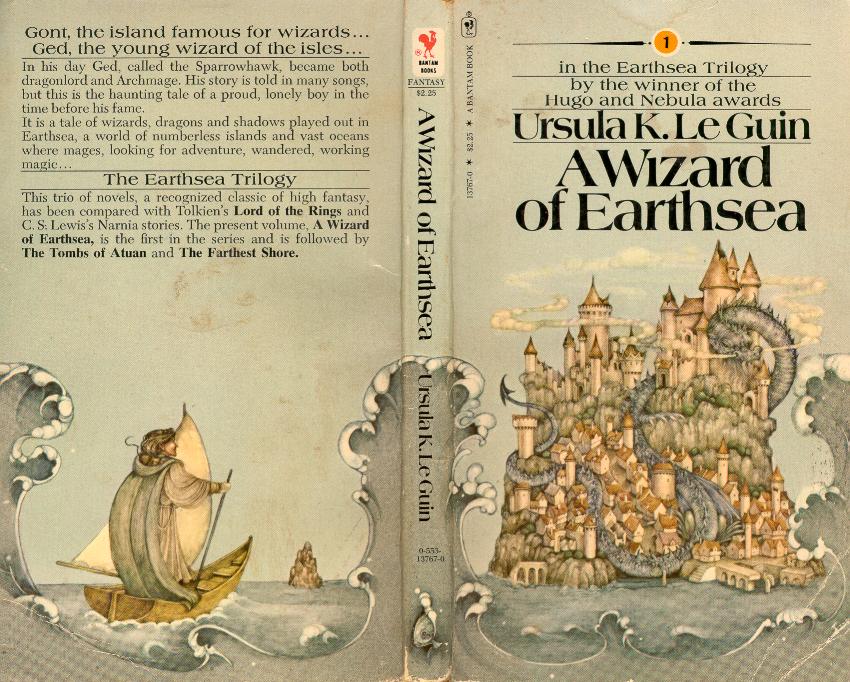
One of those whisking stories was Ursula LeGuin’s A Wizard of Earthsea. Of course, the fact that there was a wizard in it was important, but as equally delightful to my then puny literary prowess, was that the story was a slim thing. As were its two companions The Tombs of Atuan and The Farthest Shore.
Here’s the cover the drew me in so long ago.
I relished all three and moved on to other stories.
Time passed and I forgot about LeGuin. Almost 10 years later I was newly married. My wonderful new wife started reading to me as we’d drive. And on one of the three-hour drives to her parents, she pulled out this little book and began to read.
It was A Wizard of Earthsea! And it was just as marvelous the second time with a bigger brain as it was the first time with a smaller one. In fact, Nellie’s reading to me was so enjoyable I slowed down to 40 mph so I could extend the 3-hour drive. Of course, she quickly caught on to my scheme, shut the book, and told me she wouldn’t read another word unless I drove 65 mph, at the very least.
What can a guy do? I kept it at 65 (well, 60) and joyed in the wonderfulness of a new wife who would read aloud to me (you mean this model reads, too?!), the night and the stars spread above those lonely Utah and Wyoming roads, and the amazing story unfolding before me.
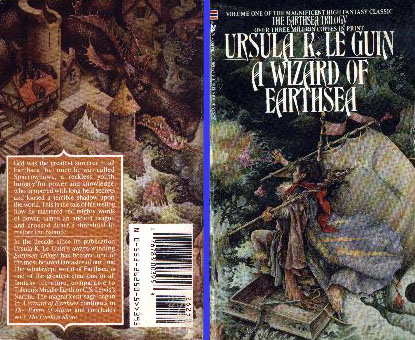
And this is the cover of the one my wife read to me.
We read all three to each other and moved onto other stories.
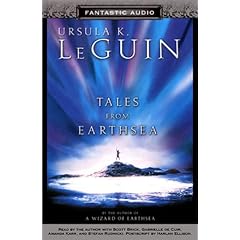
More than 15 years passed and I’d mostly forgotten LeGuin (I really never could get into her Hainish stuff). I was in the library looking for some good audio. And there on the shelf stood Tales from Earthsea by Ursual LeGuin.
Just a little slim container of cassettes. Why not? I thought.
Holy heroes, Batman—it was gold. LeGuin’s a master of building that feel: the wonder of fantasy, the mystery of things long forgotten or rumored to exist, the pull of learning arcane powers. I loved every minute of it (well, except for the slogging first four pages of backstory, but get through that, which isn’t too bad with Karr’s reading, and you’re into the kingdom). The first story, “The Finder,” read by Amanda Karr was incredible. It takes us back to how Roke became was it was in the first trilogy. But the delights do not end there. Four more stories follow.
I liked them all so much, I just checked the audiobook out again so I could listen a second time. And, it appears, LeGuin was busy in my absence because she has more Earthsea than this.
• A Wizard of Earthsea, 1968
• The Tombs of Atuan, 1971
• The Farthest Shore, 1972 (Winner of the National Book Award)
• Tehanu: The Last Book of Earthsea, 1990 (Winner of the Nebula Award)
• Tales From Eathersea, 2001 (a collection of short stories)
• The Other Wind, 2001
I just got the last two from Amazon. I can’t wait to enter into LeGuin’s magic spell yet again.
More cool Earthsea stuff.




The sword pushing is really bad. Most sword arts I know are based on wrestling or some other “hand” martial art. As close as they are, if it was “realistic”, one party or the other would have grabbed the other’s sword arm or sword, then gutted him.
One other thing is that close makes your face real vulnerable to the other’s guard. Doesn’t take much to adjust, getting the guard in line for a strike.
Modern perceptions on swordsmanship make me shake my head.
Ooh, true. Are you a practitioner?
Hi Mr. Brown
I was.
Today, at 63 and having survived a stroke seven years ago, I’m an ex-martial artist and ex-swordmaker.
I think there’s a short post on Wikipedia. Another swordmaker, one Michael Tinker Pearce and I used to spend some time teaching some of the local sword martial artists how to cut with a sword.
In this area, the Seattle area if you will, in the early oughts, there were several “swordsmanship groups”. In the early part of the century most of the western stuff was based on rapier. There are a lot of surviving documents of the arts on rapier………
Over the last few years, there’s been a transition. Now most of the western work is longsword.
Back to the “oughts”, there used to be several Japanese Sword Arts groups here too. I’m not sure what there is today. The thing is that instructors have a “shelf life”, depending on age, condition and what’s going on in one’s life.
Anyway, yeah. I’ve practiced Tai Chi Sword and Italian Rapier. Have had more than a small introduction to Italian and German longsword and Italian Sidesword. My introduction to JSA was fairly small.
Now saying what I did a couple of days ago about sword pushing, Tai Chi has or had an exercise with practice swords that you could consider sword push hands. But the point of the exercise is to gain sensitivity and feel for what the other is doing with his sword. You’re certainly not pushing.
Angus,
That is awesome. Hats off to you. And a sword maker to boot. From what you experienced with the rapier and long sword, did you feel that as a personal arm (as opposed to battlefield arm), the rapier simply had so many pluses over the long sword, that it was inevitable that it eventually dominated? It seems to me the rapier would be fairly useless in a line of battle against armor and shields. And as swords in battle waned, so did the long sword. What do you think?
Hello John
What looks like a simple question but which would require a really long and complex answer if done right. {grin}
Since we’re discussing them as personal arms, I’d say the cultural changes, and the {potential} fact that swords were becoming male jewelry had more to do with it. I don’t know that I would say that the rapier as such had any decisive advantages over the longsword.
One of the things that got beat into my head early in my study of medieval swords was that to understand the weapon, or the sword art, you needed to have an idea of the culture. The culture changed constantly from, say, 1200AD through the present time.
Swords were already in decline as weapons of war in the thirteenth century. You weren’t going to cut your way through a surcoat over maille over padding. missile weapons {crossbows and longbows specifically}, and polearms were far more effective against armor.
Swords in use as civilian arms {as much sense as that makes for the medieval period} go back a ways. I can’t think of where to find my source at the moment, but there was a prohibition on teaching sword and buckler within the city limits of London in the 1290’s. I can’t remember the name of the document, but there is one dated in the same time period from Switzerland that shows sword and buckler as a personal weapon system. The earliest longsword manual I know of is early 14th century, a German named Lichtenaur.
Anyway, I got a little carried away. Facts on the ground on swords in any given period in Europe are rare. There are some tidbits, but you’ll find that there are a lot of opinions that can’t always be backed up by facts. Some of the most respected scholars of medieval weaponry will really caveat an answer. I’ve tried to learn from their example because there’s still a lot to learn, and it’s incredibly easy to be wrong.
Although it seems they made a comeback in the 15th and 16th centuries with the Landsknecht and Reislaufen infantry blocks–pikes supported by powder weapons and men with those massive swords–as the situation on the battlefield changed.
I know that soldiers will often carry whatever is in their kit, but if you weren’t a soldier, and you had the means, it just seems to me that a rapier or small sword with its speed is more suited to personal defense on the streets than some variety of big honking killer of steel 🙂
Yes, fashion and laws and culture would modify the choice. But if you yourself had to choose and base your choice, not on any historical data, but simply on how well you think you could fight other opponents around town and out on the road with small swords, long swords, knives, or clubs, what would you select? I’m assuming most opponents wouldn’t be wearing armor, although a highwaymen waiting for you along a stretch of road might.
And I’m asking you because I think you will have far more insight into this than I, having spent time using them. Angus, your personal choice. What would it be?
Hi John
I could say “the thing about swords”, and lay a line of bs. But I’m not really into that. I will say that there are several perceptions of these weapons that are, maybe a little off. At the end of this, I will give you an opinion.
One of them is that most medieval swords were heavy. Not so much. The “big honking” swords you mention, sometimes also referred to as zhweihanders averaged about 5.5lbs. That would be with a blade/ ricasso length of 42 inches and a total length of 58 to 60.
The 15th century longsword popularized in Germany and Italy in the fifteenth century, averaged 2.75lbs to 3lbs. Blade lengths from 35 to 37 and total lengths between 45 and 49 inches. They vary more than that, but this is where the bulk of the surviving antiques seem to lie. What I’m discussing here are not the “great swords”, which dimensionally are similar but could run up to 5lbs.
Most single hand medieval swords would run about 1.7 to 2.5 lbs. Blade lengths range all over the place, my favorite is 31 to 32 inches.
Depends on the period with rapiers, during the transition, they might be 2.75lbs and have a blade length of 36 inches. During the peak period in England some blade lengths exceeded 50 inches. These were a little unwieldy.
If you consider rapiers for the whole period of their primary use, they averaged around 3lbs. The longer the blade, the more point specific.
Before the stroke, I got to play the “Uneven weapons” sparring. And the one thing I learned is if you know what the other guy needs to do to defeat you, and what you need to do to get to him, and the other guy is clueless, the odds are in your favor, never mind the weapons.
If the other guy has a clue, the weapon can give an advantage.
Not what I would choose, but of those mentioned longsword has a bit of an advantage over rapier, and a healthy advantage of the single hander.
The rapier’s real advantage is the blade length, and the fact a lot of practioners seem to underestimate it.
“In Period”, the rapier masters turned the sword art into a science. Many rapier masters taught their students how to beat swordsmen, what a man with a sword would have to do, and how not to let him.
More shortly
We didn’t touch on the katana or the jian, popular sword types here in America with their own fans.
Down to cases. For my own use, I’d prefer a single hand medieval sword. Today, it doesn’t have the cachet of the others, but its likely more versatile. Reading and trying to guess why you want the “best”, for me it would be that using a baldric and scabbard to carry it, it would be the easiest of the three to carry. Its the easiest to deploy in close quarters. Trying to draw a rapier quickly in close quarters just isn’t going to work. If you opponent closes with you, prevents the draw, and uses a dagger, your toast.
With the longsword, that long hilt gets in the way. If you’re carrying it belted, its difficult to draw fast. If you’re carrying it in a baldric, you can deploy it fairly quickly, but if your opponent manages to get a hand on that long hilt, you’ve got a problem. In Northern Italy, part of the fashion in the early 14th century was to carry it in hand by the scabbard.
I think in a heroic sense, the longsword might have the advantage. Once deployed by a good practioner, it’s the quickest of the three in movement. Cutting limbs off, lopping a head off, thrusting through an opponent’s eye before they can react, yeah, this might be the weapon. It’s also the best weapon to use in a non-lethal fashion, crossing swords and taking the other guy down in a wrestling hold is best done with the longsword {though I’m sure that could draw disagreement}.
The rapier though, is the paramount dueling weapon. If your blade is 42 inches long, and the longsword blade is 36 inches, your measure is at least 6 inches deeper, which means you can penetrate him while he’s still trying to close with you.
That longsword guy is going to have to deal with that point aimed at his eye, and it’s not as easy it sounds. He can slap it aside and try to rush. You take a step back, draw your rapier back towards you bringing the point back on line. If he persists his rush, he walks your blade into himself. On the other hand, if he can get “crossed swords” for a moment, and can grab your blade, your day’s about to go really bad.
I have to admit I played with this in the fantasy series I’ve written. Mainly in book 4 and 5, and the first three take place “in the field”.
I studied rapier for three reasons. I wanted to learn it as a simulator {I was making them at the time}, I wanted to see if you could use Tai Chi principles and techniques with it {you can}, and I wanted to learn how to defeat it with my chosen weapon. The latter depends on the rapierist’s grasp of his art, and his knowledge of what a swordsman needs to do to get to him. It would also help if he’s a bit arrogant.
I probably didn’t answer things how you want. Part of that is caution, “back in the day”, if you answered things publicly, you could wish you didn’t.
But looking at that paragraph again, I’d answer the same, the single hand sword. 31.5 inch blade, 2.2lbs, center of gravity 5.5 to 6 inches in front of the cross. Edge sharpened such that its fairly blunt at the cross, and from thirteen inches from the point to the point its as sharp as I can get it. Everything about the single hand sword is a weapon, the pommel {to pummel with}, the cross, and the blade.
And truthfully, I’d be more concerned about facing the longsword than the rapier. A really good longswordsman scary indeed.