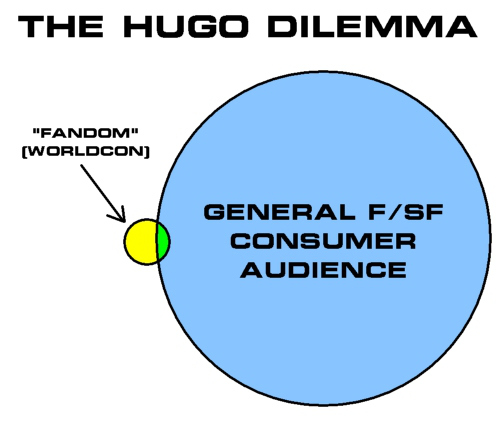
There are a number of great science fiction and fantasy authors who feel that the Hugo awards have become irrelevant because the folks voting–only those who are members of Worldcon–do not represent science fiction and fantasy fandom.
But this is not only about the fact that the voting block is not a statistically valid sample of fandom. It’s also a campaign against what Larry, Brad, and many others see as a politically correct shibboleth in parts of the publishing community that they feel short shrifts authors who do not toe the liberal political line.
Two years ago, Larry Correia decided to give this issue a lot of attention. He did this by asking his fans to purchase a Worldcon membership and then consider a list of authors he thought were very good but didn’t necessarily reflect the prevailing values of the traditional Worldcon audience. Last year he repeated the effort and created a shirt-storm (I like that image so much better than the one that includes flying poops). This year, Brad is carrying the banner. Read Larry’s post Sad Puppies 3: The Slatening? to see this year’s slate of alternative folks and a summary of why these guys are doing this.
I’m friends with Larry and Brad. And I do not like the Should Police coming out and telling me I should or must include more X in my stories and less of Y, whatever that X and Y may be.
But, I’m wondering if storming the Hugos is the right way to do this.
Yes, the Hugo award has a lot of brand equity. But must the Hugo represent fandom?
Is Sad Puppies attempting to storm the castle and force upon Worldcon something Worldcon members don’t care for?
Let’s go back to the original issue that Sad Puppies is trying to shine a light on.
Reader Kim wants more of X and less of Y in his or her books.
But instead of saying, “Geez, where in the crap do I find books with more of X and less of Y?”
Instead of trying to get with a bunch of folks and saying to suppliers, “Hey if someone would write more of X and less of Y, we’d buy it! Look at this market that’s dying for product!”
Instead of developing the More X and Less Y website dedicated to helping readers who like that find their books.
Instead of that, Kim says, “Gosh darn it! All books should have more X and less of Y. And if they don’t, they’re, they’re, they’re bad, and bad for you, and probably make kids smoke! And we should make all stories conform.”
And the mandated “should” is where things get all tangled up. That should is what Sad Puppies is speaking out against.
So instead of trying to stomp out differing opinions or requiring all authors to write stories with some allotted amount of XY content, would it not be more productive to simply work with our wonderful free market to try to create a new silk road (or pave the existing one fit only for camels) that connects readers who like XY stories with authors who are happy to write them?
I think it would.
At the same time, this same argument could be applied to the Hugos. Instead of trying to force Worldcon members to change their ways, why not let them like the stories they like, but create a fresh new award that seeks a broader base? It would require work to build its brand equity, but maybe that’s a more effective long-term strategy.
It’s kind of like the New York Times best seller list. There are many problems with that list, including, but not limited to, the fact that it can be gamed. But instead of trying to change it, USA Today came up with something much better. Yes, “NY Times Best Seller!” still has huge brand equity. But USA Today is gaining on it. And as the market learns more and more about the difference between the lists, USA Today’s will only grow in luster.
I suppose it’s true that you sometimes do indeed need to storm the castle. And maybe this one needed some barbarians to show up and sack it. But I wonder if it’s time to pivot. I’m wondering if in this case the best long-term strategy wouldn’t be to simply build an armored division of M1-Abrams with air and sea support and make the castle irrelevant. Maybe this is something to think about for next year.
Well, from what people have been posting, he seemed like the devil. But I know how the internet can be. Mitt Romney at one time was the devil. Now, I think he’s been degraded in those quarters to janitor of the hot place. Yeah, that one Romney who is out raising tons of money to help fix blindness among the poorest of the poor, that evil son-of-a-gun.
So when I saw there was a new head honcho in town, I decided to see what he was all about.
I did try reading various posts on the internet, but after a dozen or so of those, I realized it would just be easier to go to the source. And so I went to Vox Day’s website and clicked the contact link, which popped up an email.
I asked Day if he’d mind answering a few questions.
He agreed.
What you will read below is our conversation, arranged for easy reading.
Why am I doing this?
Well, who doesn’t want to scoop the devil? But beyond that, I agree with George R. R. Martin: internet conversations that are not moderated to maintain a tone of respectful disagreement are a bane upon us all. Actually, Martin said they were part of the devil’s alimentary canal, but I didn’t want to confuse the topic.
So I’d read a number of posts that Day had made and others folks had made about Day and saw all the bad juju going back and forth. And I wanted to know what this guy actually believed. Once I understood that, if I disagreed, then I could disagree in a way that I think is actually productive.
We talked about some of his views on two subjects—race and women. Are his ideas provocative? Well, you need to know what they are before you decide.
Conversation
Brown
Vox,
I’m following the conversation about the Hugos. Many of the conversations claim you are a racist and misogynist. Knowing how labels and slurs can magically become fact, I wanted to go to the source and understand what it is you truly believe. I’ve done some reading on your site. I’ve seen attack pieces such as this http://rationalwiki.org/wiki/Theodore_Beale#cite_note-real-ass-13.
But it’s all so scattershot and snippets out of context. I’m wondering if you might answer some questions. If so, my first questions are about your views on race.
Do you believe Black Africans have, in general, less genetic potential for intelligence than White Europeans?
Do you believe the same for the darker Asians like those from India or Indonesia?
Which genetic group has the highest genetic potential for intelligence at this time?
My response to those who claim I am racist or misogynist is simple: why do you reject science, history, and logic? It is not hateful to be scientifically literate, historically aware, and logically correct.
Pure Homo sapiens sapiens lack Homo neanderthalus and Homo denisova genes which appear to have modestly increased the base genetic potential for intelligence. These genetic differences may explain the observed IQ gap between various human population groups as well as various differences in average brain weights and skull sizes.
Yes, East Asians have been observed to have considerably higher IQs than Southeast Asians.
The Chinese. Their average IQ is higher than the Ashkenazi Jews, who are genetically a refined group of Semitic-Italian crosses. To be more specific, the highest average IQ is found in Singapore.
No, the genetic groups are the Homo sapiens sapiens/Homo neanderthalus crosses, the Homo sapiens sapiens/Homo neanderthalus/Homo denisova crosses, and the pure Homo sapiens sapiens. These broadly align with Europe, Asia, and Africa, but not exactly.
Let me see if I’ve captured your overall approach. You feel it’s important to examine and conduct science without regard to political correctness. For example, if Vanhanen and Lynn say IQ is genetic, you feel the most appropriate thing to do is not attack them for being racists, but simply examine their data and conclusions dispassionately. It’s important to question it. Argue with it. Try to falsify, as we do with any other scientific claim. But not dismiss it simply on the basis that it doesn’t agree with our what we feel is morally right. Correct?
Day
Yes. Science and history and logic exist regardless of whether we are happy about them or not. We have to take them into account.
Brown
It appears the Lynn & Vanhanen book suggests the genetic IQ differences were caused, not by Homo crosses, but by natural selection operating in colder climates over long periods of time. Can you provide another reference that discusses the DNA tracing and IQ correlation of the various crosses?
Day
There are many articles on the Internet about DNA and IQ, I suggest you simply search them out and read a few. The data is conclusive, the rationale explaining the data is not.
Brown
I’m not sure I understand what you mean when you said the rationale explaining the data is not conclusive. What do you mean by that?
Day
Regarding rationale, the data is beyond dispute. But we cannot explain why the data is the way that it is, we can only construct various explanatory hypotheses. Historical explanations are, for the most part, scientific fairy tales, literal science fiction.
Brown
I read your comment to Jemisin about African exposure to Greco-Roman culture. It seems you’re suggesting societies can’t make large change their culture (values and beliefs) over a few generations, or within one generation. Is that what you’re claiming? It doesn’t seem like you’re making a genetic-intelligence argument since 1,000-2,000 years seems too short for any type of significant evolution. Of course, if it’s a cultural argument, then I don’t see how it’s possible to say it’s impossible for a bunch of Jemisons to accomplish this since she was raised with the Western culture. Confused on your base point here.
Day
Yes, I am claiming that societies are incapable of moving from full primitivism to full civilization within the time frame that primitive African societies have been in contact with what we consider to be civilization. It is a genetic argument. It takes that long to kill off or otherwise suppress the breeding of the excessively violent and short-time preferenced. African-American men are 500 times more likely to possess a gene variant that is linked to violence and aggression than white American men.
Brown
Two more questions. It doesn’t sound like you’re against immigration per se. You just think that if a society wants to continue, they need to breed. Right?
Day
I am against large-scale immigration, particularly population-replacement immigration. Limited immigration, no problem.
Brown
I suspect someone is going to wonder if your ideas on race and IQ and violence mean you favor some type of eugenics program. So let me ask you: do you believe in selective breeding or sterilization? If so, would that be to promote the Homo crosses you think are better? Or just any trait from any group you think is superior?
Day
No, I am not a eugenicist. I oppose forced selective breeding and sterilization. However, I also oppose dysgenic and dyscivic social policies, which is presently what we have across most of the West.
Brown
As much as I want to ask more about what you consider dysgenic and dyscivic policies, I think it would just lead to another topic, which would lead to another. Let’s talk about your views on women. Here are my initial questions.
Do you believe a country is better off when women cannot vote?
Do you believe a country is better off when women are not afforded equal education opportunities as men?
What are the top topics of education do you think would be beneficial for women?
I’ve read this post http://voxday.blogspot.ca/2012/06/scientist-beats-up-pz.html. It sounds like you think the main objective of a country or culture with regards to women should be to reduce female promiscuity (not necessarily male promiscuity) and increase the number of children each female bears. Is that correct?
Referring to that same post, are you saying that genital mutilation and acid burnings are legitimate ways to treat women? Or are you saying that they are bad things, but that the societies that do such things have lower female promiscuity rates and higher fertility rates, and so it’s a small price to pay?
Day
Yes, in a representative democracy. However, note that I favor universal direct democracy and the jury is out there.
It depends. It increasingly appears that a society is improved by widespread female education through high school, and harmed by it beyond that level. If you look at the demographics, a society that sends its women to college stops breeding. How this is supposed to benefit a society, I do not understand.
Again, it depends. If a society is demographically dying, then yes, it had better do something to get its birth rate up or it will cease to exist. This isn’t rocket science. If a society is stable or growing demographically, it has no need to concern itself with such policies.
You appear to have misread the post. PZ Myers claimed that there was no rational case to be made for the Taliban’s activities. I responded by demonstrating that the Taliban’s behavior is entirely rational, it is merely the consequence of different objectives and ruthlessness in pursuing them. But the mere fact that I am capable of observing a logical syllogism does not mean I share the assumptions involved or advocate the conclusion. Considering that the Taliban defeated the Soviets and appear to have outlasted NATO, I think it is remarkably stupid to dismiss them as irrational simply because they are willing to defend their way of life.
Brown
Even though it appears I misread the exchange with PZ Myers, your answers to 2 and 3 suggest you prioritize fertility rates as the main goal a society should have towards women. As long as the population is stable or growing, you feel a society can examine other goals or objectives. But only if those goals or policies do not negatively impact the population rate. Correct?
Day
Yes. The NATIVE population rate. Immigration is used to cover up demographic decline, but it changes the nation.
Brown
Okay, what’s the reason you feel women shouldn’t vote in a representative democracy? And do you think only certain types of males should vote?
Day
The reason women shouldn’t vote in a representative democracy is they are significantly inclined to vote for whomever they would rather f***. Hence the studies about height and hair being relevant to US presidential politics. That’s why women’s suffrage was pushed by the Communists and why it is the first plank of the Fascist Manifesto.
In a representative system, yes, only certain types of males should vote. And before you leap to any silly conclusions, please keep in mind that I have lived most of my life in political systems where I am not allowed to vote. Voting does not equal maximizing freedom and liberty.
Brown
First, what types of males do you think should vote in a representative government and what’s the main reason why?
Second, do you believe large numbers of males will vote based on sexual attractiveness as well when females are running for office?
Day
Men who demonstrate sufficient long-term orientation and a willingness to put the national interest above self-interest.
No, men aren’t wired the same way.
Brown
How would you identify the types of men you mention? Military or law enforcement service? How would you determine who had a long-term view of things?
Day
I have never given any thought to how such men would be identified. Every method is bound to fail in time.
Personally, I’d like to see direct democracy tried. We now have the technology, and it would be MUCH harder to corrupt than representative democracy. At least we don’t know exactly HOW it would fail.
Brown
Vox,
This has been really helpful to me. I think it would be helpful to others wanting to understand you. Agreeing, of course, is a different matter. But that’s a different subject. Would you be okay with me posting this conversation on my site?
Day
Sure, do as you see fit. The usual suspects will have their own hissy fits, but that’s of no concern to me. I find it amusing when people tell me they disagree with some of these things. Do they not understand that it is not me with whom they are disagreeing, but reality? Why people can understand that if pandas don’t breed, they will go extinct, but fail to grasp the same thing is true of nations is beyond me.
Comments
You will notice I wasn’t trying to challenge his ideas. Does that mean I agree with them lock, stock, and barrel?
No. I’m very skeptical about a lot of them.
But as I stated above, before I agree or disagree with someone, I need to understand them. And the best way to understand someone is to ask questions, listen, and verify I’ve understood accurately. The worst way to understand is to start with an attack.
In this stage, the goal is not to trick someone. It’s not to convince them that they’ve contradicted themselves. It’s not to prove any point.
It’s to hear them out. And if there are things that don’t make sense, to ask questions of clarification.
But what do I think about his ideas?
Well, let’s look at them.
Scientific Inquiry
I have to agree with his idea that we should try to look at science dispassionately. I think it’s dumb to reject someone’s science simply because the results offend our sensibilities.
We reject science because there are issues with the data, or the experiments, or conclusions. We reject it because it doesn’t fit with the observations. Or because we can’t replicate the results, or because it fails to predict as it claimed it could. But we only hurt ourselves when we reject it because it doesn’t fit our current political beliefs.
Okay, fine. But what about his views on race and women?
The Rhetoric of Offense
Well, they’re bound to rile feathers. And Day sometimes seems to go out of his way to state them in a way he knows is offensive. I didn’t feel he did that with me. But if you read the links above, you can see he does employ it with others.
Here’s my take on this. The rhetoric of offense is different than the rhetoric of explication. The latter is meant to explain. The former’s goal is to cause injury. It has no interest in sharing ideas. It only has interest in injuring someone, either to try to gain relief from an attack or to beat someone into submission, or because seeing folks get all riled up provides amusement.
A good portion of Day’s posts that I’ve read, admitting it’s nowhere near exhaustive, seem to contain a lot of the rhetoric of offense. And I think this dramatically undermines his ability to get others to consider his ideas, let alone believe them.
Sure, the attacks might bring like-minded folks to his side. But, for the most part, it does not provide the ground in which insight grows. Offense closes both parties off to challenges, biases, and ideas. It closes them off to new information. And new information is such an integral part of learning.
Some people say that tone shouldn’t matter. For example, you may lace the fact that the earth revolves around the sun with expletives, or say it to me sweetly, but the fact remains that the earth revolves around the sun. So asking for a more respectful tone is an ad hominine attack, a logical fallacy. It has nothing to do with the argument.
But here’s where I believe the anti-tone folks go wrong. Offense changes the message. When you call me a jackass, you’ve selected to promote one message over another. It doesn’t matter if you’ve couched your attack in a well-reasoned point because you have decided to no longer communicate your point. You’ve decided to communicate the offense instead.
Can’t we do both?
Not really. It’s like playing a country western tune of reason softly in the background while shoving a 110 decibel speaker blasting an annoying alarm in my face.
It’s like taking the statement “the cow jumped over the moon” and saying “the the the the the the the the the the the the the the” followed by a barely audible statement of the rest. All the receiver hears is “the”. And that’s what they respond to.
This means there’s no fallacy at play because there is no argument being communicated. Instead, you’ve communicated an attack. And invited a response to precisely the same.
If the speaker wants someone to consider his ideas, then he needs to speak in a way that invites consideration. I know, you can do that, and the receiver may still go into what sometimes feels like “a hissy fit.” We see this all the time, don’t we? Communication is indeed a two-way street. However, if the guy who was trying to explain decides to switch and respond with an attack, that’s his choice. But don’t call it explication or reason or conversation.
Day was perfectly polite to me. And I know it’s incredibly difficult sometimes to not attack when being attacked. I know his ideas, even when stated reasonably, will rile some folks. But it’s also true that he sometimes loads his communications with things he knows will offend. Things meant to injure and ridicule. Things which show little regard for others. I find it counterproductive. I think it’s wrong. But I also condemn the same tactic from the other side. And, yes, there is probably a time to use the rhetoric of offense, but that’s for another post.
Okay, but what about his beliefs, John?
Votes for Women
Do you agree it would be better for our nation if women didn’t vote?
No.
I’m not convinced men aren’t affected by charisma. What? When males get in a group, all are equally popular? Or popular only because of their ideas, not their looks, money, power, physical prowess, etc? Nor am I convinced that women can’t be long-term thinkers. I haven’t seen any science that supports that idea. And my personal experience has been just the opposite. The women I know think a lot about the future. Furthermore, when I include women in councils, we usually come up with much better ideas.
Now Day might suggest there’s science to look at. That’s his prerogative. I’m incredibly skeptical. But I think the most productive thing to do in reaction to his claim is to gauge whether you think it merits serious consideration. If it does, or if you’re curious, examine the evidence and report your results. If it doesn’t, just say you haven’t seen anything to suggest its worth looking into further.
Education for Women
What about his idea that the most important thing for a society is to maintain the population, which means the most important thing for a woman is to have babies, and that education undermines this and therefore should be avoided?
In one way, he’s right. If you want to maintain a certain population, you do indeed have to breed.
But if that’s your goal, I don’t see education in general as the determining factor. Mormon women have, as a group, much more education than the average female in the United States AND they have more babies. Lots more. I don’t think it’s education per se. I think it’s the values and beliefs some education fosters.
There are some groups that are taller on average than others, some that are shorter. On the face of it, I don’t see why some groups might not have a genetic disposition to more of one kind of intelligence and other groups less. I haven’t looked into this much. I don’t know anything about Homo sapiens sapiens, Homo neanderthalus, Homo denisova, and the various crosses.
However, I do question if IQ isn’t more about nutrition and early learning. I wonder if IQ tests really measure intelligence or just one type of problem solving. And I’m skeptical that it’s really that big of a difference. Maybe it is. I admit my ignorance and curiosity on this topic openly.
Race and National Success
What about his claim that Homo sapiens sapiens, which he claims are what we find in Sub-Saharan Africa ancestry, have more genes for violence than we do up north and so can’t at the present time build as successful a society?
This one makes no sense to me. I don’t see a difference in violence levels. Like the Romans weren’t violent? Or the Germanic tribes? Hitler and all those that followed him didn’t do violence? Napoleon and his armies? I don’t see how we selected against violence and short-term thinking. I’m incredibly skeptical of these claims.
Now, it could be he needed more space to lay them out. After all, I wasn’t asking for evidence or a full treatise. Only what he believed. But as it stands right now, I’m betting the types of violence he’s looking at are driven more by culture than anything else. And I don’t believe people are genetically predisposed against democracy.
Frankly, the ideas laid out in Guns, Germs, and Steel seem more predictive to me about what makes peoples successful than Homo crosses. But of course I’m always open to new information. However, even if this claim is true, it’s a fallacy to peg each member of a group to the average. People lie along a bell curve for all sorts of things, and it might be that any one person or community or even nation might actually have less of this than another from a different group.
Bottom line
Vox Day wasn’t the devil, dang it.
He is someone who espouses a couple of ideas that I agree with and a number that seem flat out wrong to me. He appears to be someone who enjoys the rhetoric of offense. I may investigate some of his claims. I may not. I am new to the topic of genetics, and am curious. Whatever I do, I found it useful to try to see for myself what the man believes. One thing that he and I agree on is how we should react to claims made with the purpose, not to offend and injure, but to expand our knowledge.
Now, I have no idea what types of comments this post will bring. Please note that I did not ask Day for his sources, or to lay out all the evidence he feels backs up these beliefs. That’s much too big for this post. You can certainly share your ideas and the science you find compelling. But this is my site, and by golly I request that if you post and want to express disagreement, that you disagree respectfully. Name calling, high-octane expletives, etc. will not fly here. Any post that fails to avoid this will be deleted. You can certainly try again, but if any prove unwilling to abide by this rule, I’ll simply block you to save myself some time.
I am much more interested in a discussion here than attack and offense.
As a thank you, those that answer the question will get a seat at a virtual, 1-hour training session I’m putting on where you discover 3 key principles of keeping your readers hooked.
Romney starts the chapter with a quote his dad used to recite to him: “the pursuit of the difficult makes men strong.” Romney states that over the years, he’s come to believe that this idea applies to more than individuals—it applies to businesses and nations as well.
He maintains that America has always faced great challenges. He cites a few examples from America’s history and states that there really hasn’t been a time when we were free of challenges. It seemed, after Reagan and Bush had presided over the fall of the Soviet Union, many thought “peace and prosperity were here to stay—without threat, without sacrifice.” Of course, that proved untrue.
America has faced great challenges in the past and faces huge challenges now. He believes we will “remain the leading nation in the world only if we face our challenges head on.” If we do not face and overcome them, we will become “the France—still a great country, but no longer the world’s leading nation.”
The question is: what’s so bad about that?
The answer is that some other nation or nations would fill the power vacuum. Romney poses the fundamental question: “what nation or nations would rise, and what would be the consequences for our safety, freedom, and prosperity?”
FOUR GLOBAL STRATEGIES FOR WORLD POWER
Romney suggests that there are a number of nations and groups who are “intent on replacing America as the world’s political, economic, and military leader.” He states that there are, in fact, “four major strategies currently being pursued to achieve world leadership.”
The first global strategy to achieve world power is the one represented by the United States. It is a strategy based on two fundamental principles: economic freedom and political freedom. Those nations that follow this strategy have become economic powerhouses and account for more than 60% of the world’s GDP. They are also the countries who have given humankind the most freedom.
The second global strategy is the one pursued by China. Its fundamental principles are free enterprise and authoritarian rule. He spends a couple of pages discussing how well Chinese enterprise is doing. Then he believes China is intent on becoming stronger than the United States.
The third main global strategy is the one pursued by Russia. It’s fundamental principles are authoritarian rule and controlling energy. “By controlling people and energy, Russia aims to reassert itself as a global superpower.” He then explains how this could be possible.
The fourth main strategy for global power is the one pursued by the violent jihadists, who count many foreign leaders in their numbers. Their strategy is based on conquest and compulsion through a variety of tactical means.
Of these four strategies in competition today only one is founded on freedom. Romney then suggests that we can be confident that our children and grandchildren will be free ONLY IF the economic and military strength of America and the West endure. He suggests that our superpower status is not inevitable. “Three other global strategies, each pursued by at least one state or major actor, are aggressively being pursued to surpass us, and in some cases, to suppress us. The proponents of each are convinced they will succeed. And world history offers us no encouragement.”
Because of this, he believes that “our primary objective as a nation must be to keep America strong. I am convinced that every policy, every political initiative, every new law or regulation should be evaluated in large measure by whether it makes us stronger or weaker” because “our freedom, security, and prosperity are at stake.”
OBAMA’S DRAMATIC SHIFT IN FOREIGN POLICY
Romney next maintains that president Obama has introduced a foreign policy that “is a rupture with some of the key assumptions that have undergirded more than six decades of American foreign policy.”
He states that when World War 2 ended, America executed a “dramatic and profoundly meaningful shift in our relationship with the rest of the world.” Previously we had guarded our own hemisphere and attempted to stay isolated from the affairs of Europe and Asia. But we found with WW1 and WW2 that “our vital interests could not be secure in the face of threats to the cause of freedom elsewhere. At the dawn of the nuclear age, a third world war was unthinkable; it would mean the destruction of humankind.” So the president and leaders of both parties “shifted America’s foreign policy. America took on the task of anticipating, containing, and eventually defeating threats to the progress of freedom in the belief that actively protecting others was the best way to protect ourselves.”
This new order had three main pillars:
1. “Active involvement and participation in world affairs”
2. “Active promotion of American and Western values including democracy, free enterprise, and human rights”
3. “A collective security umbrella for America and her allies”
He talks about how all the presidents, Democrat and Republican, followed this new strategy. But President Obama is engineering a dramatic shift away from it based on his own underlying attitudes.
Obama envisions an America that arbitrates disputes rather than advocate ideals. This is one of the reasons why he apologized to countries around the globe for American arrogance, trying to placate our enemies. This is also why it seems he has undercut many allies, including Israel, Poland, and Columbia. To be an arbitrator, you need to be equidistant from both sides. Not advocating for one or the other.
Another one of Obama’s assumptions is that “America is in a state of inevitable decline.” He, therefore, considers it futile to fight it; instead, it’s his job to help us manage our decline. Romney suggests Obama believes maintaining a dominant America is “a bad idea even if it were possible.”
Of course, Romney fundamentally disagrees with that assessment.
GETTING BACK ON TRACK
Romney suggests several things we can do to get back on track:
• Treat our allies like allies
• Strengthen the American economy
• Increase our defense spending
• Remind ourselves that the most attractive thing about us is our ideas—so we should “encourage democracy where we can, give aid and comfort to those who want it, and not undermine those who already have it”
Undergirding all of this, Romney suggests, “must be a certain conception of the goodness and greatness of America.” This “doesn’t mean America is a perfect country. We have made mistakes and committed grave offenses over the centuries.” But we should recognize that “No nation has shed more blood for more noble causes than the United States. Its beneficence and benevolence are unmatched by any nation on earth, and by any nation in history.”
Romney concludes by saying that he believes America is “destined to remain as it has been since the birth of the Republic—the brightest hope of the world” but only IF we face our challenges head on and work to keep America strong.
MY RANDOM COMMENTS
First, I don’t know if I’m going to have the time to capture each chapter in such detail. We’ll see.
Second, I found the discussion of the four strategies insightful. Particularly because it put in explained a number of questions I had about why Putin’s Russia does what it does. It also gave me insight into China, which I thought was still mostly economically socialistic.
I found the explanation of America’s shift in foreign policy in the 20th century interesting. As well as the shift Obama has made. I think I need to understand Obama better. Does he really think this? The actions and speeches Romney cites certainly are suggestive. Has anyone seen the movie 2016? It sounds similar.
It might appear the book will continue allocating space for attacking Obama, but I believe the six pages in this thirty-page chapter form probably the biggest appearance Obama makes in the book.
It’s clear that Romney’s business experience, especially as a consultant, has influenced how he sees things. The whole talk of strategy and challenges and competition reminds me of Michael Porter.
Porter is a Harvard professor and founder of Monitor, a strategy consulting firm that has been hired by corporations and countries. He is claimed to be the most cited author in business and economics. According to Wikipedia “He is generally recognized as the father of the modern strategy field, and his ideas are taught in virtually every business school in the world. His work has also re-defined thinking about competitiveness, economic development, economically distressed urban communities, environmental policy, and the role of corporations in society. . . his main academic objectives focus on how a firm or a region can build a competitive advantage and develop competitive strategy.”
The idea that America is competing with other nations is, of course, true. But I don’t think I’ve ever heard anyone running for president claim that their central goal, the goal any president should have, is to keep America strong because of the competitive threats we face. The talk is usually all focused on this issue or that without the broader picture I found here. I found Romney’s central tenet clarifying and refreshing. The rest of the book is going to be about how to keep our competitive advantages and strength.
Comments, observations, or issues from anyone who has read the chapter?
Are we all wearing Coke bottle glasses with this government shut down?
First, it seems silly to me when reporters ask Americans who is causing the shut down. It’s like, duh, if either party just gave into the other party’s demands, we wouldn’t have the issue. Which means that BOTH parties are causing the shut down.
Second, it seems a lot of folks have forgotten that this is precisely what should happen.
What?
Yes, our government is designed to allow these types of things.
But, John, isn’t that just asinine?
No. It’s not an oversight. I think it’s smart. Even if it causes some pain.
Let me explain what it seems some in the media and elsewhere are forgetting.
This is not a nation that belongs to a government. It’s not a nation owned by some lord or entity. This is a nation of individuals who decided to band together because we thought that banding together would allow us to protect our lives, liberty, and pursuit of happiness better than if we stood alone individually.
This is a nation of individuals who said, you know, we think we can figure things out better together ourselves than having someone dictating to us what we’re going to do. We’ll get together and talk. We’ll argue. We’ll persuade. We’ll try to convince each other of our individual ways of thinking. And when enough of us are convinced that we should do something, we’ll act.
We’ll set up a process for talking and making decisions that ensures everyone can be heard. It would be great if we could get 100% agreement on everything, but we know that’s not realistic. At the same time, we don’t like the idea of forcing our will on others. So we’ll make a compromise; we’ll set up the rules for making decisions so it requires that a good majority of us are in agreement before we can take action, especially on matters that are important to a lot of us.
Finally, we’ll make sure no individual or group can take control and deprive us of this way of living. We did the monarch thing, and we’re done with that. We will not bow to any king ever again. We’re going to be very careful about this one item because a lot of bad things begin to happen when any one person or group gets too much power.
So we set up the rules and started working together this way. And the basic premise under all of this is that we would respect each other’s free will. We’re a land of liberty. We’re a land where we get together and agree on a course of action. Not one where we impose our will on others.
One of the main methods we used to ensure that no individual or group could take control of the rest of us and that a good majority of us must agree before taking a course of governmental action was to distribute the power to make and enforce rules. We did this in a wide variety of ways. We did this because power’s a slippery thing and easily abused. Furthermore, because we knew no system is perfect, we also set up a system of checks and balances so that if one person or group abused their power, we could stop them and force them to remember to respect the freewill that the rest of us have.
So what has caused this shutdown?
It’s very simple.
A lot of Americans do not agree with Obamacare. By most polls, it’s a majority of Americans. They were not listened to when it was being developed. They were not listened to when it was made law. They feel it was passed, not with open discussion, but a lot of chicanery. They feel it’s not some minor regulation, but a very big thing that will infringe on their rights to live how they want to live.
Now, it might be that all their fears are unfounded. It might be that Obamacare is going to usher in utopia. Many signs suggest it’s not going to do anything of the sort. But let’s just say it is the finest piece of legislation ever. Let’s say is a celestial piece of governing.
That isn’t enough.
It’s not nearly enough.
Because this is not a nation that belongs to any group. We are a nation of individuals who have banded together, agreeing that we will talk things out amongst ourselves and only act when a good majority of us agree on a course of action. This is a nation that tries to tread lightly on each other’s liberty.
But many of the folks in Washington back in 2009-2010 forgot this and forced this thing called Obamacare upon the rest of us; in doing so, they violated one of the basic agreements of our compact. If they had followed the underlying intent of our union, they would not have done what they did. They would have crafted legislation that a good majority of us could get behind.
In 2010, those of us who protested this use of power voted in new folks into the House of Representatives to deal with the matter. In fact, when given the chance, Americans (both Republican and Democrat) in the heavily Democratic state of Massachusetts voted Republican Scott Brown into office, hoping to stop this legislation in the Senate before it became law. But Harry Reid didn’t listen. He didn’t care. He and Pelosi and Obama weren’t interested in allowing a full national discussion. He and the others were more concerned with getting their way. And so he used a parliamentary trick to force it through.
This shut down is about one group of people forcing their will on the rest of us. It’s about using the checks and balances designed into the system to correct such errors. It’s about the chickens of some poor decisions coming home to roost.
I know the shut down has caused issues. It’s a partial shutdown; 13% of the government. I think 87% is still funded and running. Still, I know it’s causing some pain.
But none of that pain needs to occur. Everyone wants to fund cancer research. Everyone wants to help poor single mothers. Those things aren’t the issue. The issue is that not everyone agrees with Obamacare.
If you’re a supporter of Obamacare, let me ask you this: if the tables were turned, what would you do?
Would you not stare at the folks trying to force their will on you and say, hey, come on. We’re adults here. We all agreed that we wouldn’t do anything unless a good majority of us were convinced it was the right course of action. Let’s get together and come up with something a good majority of us can get behind.
If you’re an opponent of Obamacare, you too should recognize that a good portion of your fellow citizens are clamoring to change the way things are. They’ve been clamoring for some time. Should you force your will on them? Or should you sit down and listen and try to come up with something that addresses the points we can agree on?
I don’t know if the folks many of us voted to go to Washington will stick to their guns and correct this. I hope they do. And I hope that those on both sides who have forgotten one of the basic tenets of our social compact will wake up and remember we are banded together, not to game the system to get what we want, but to act on only what a good majority of us want.
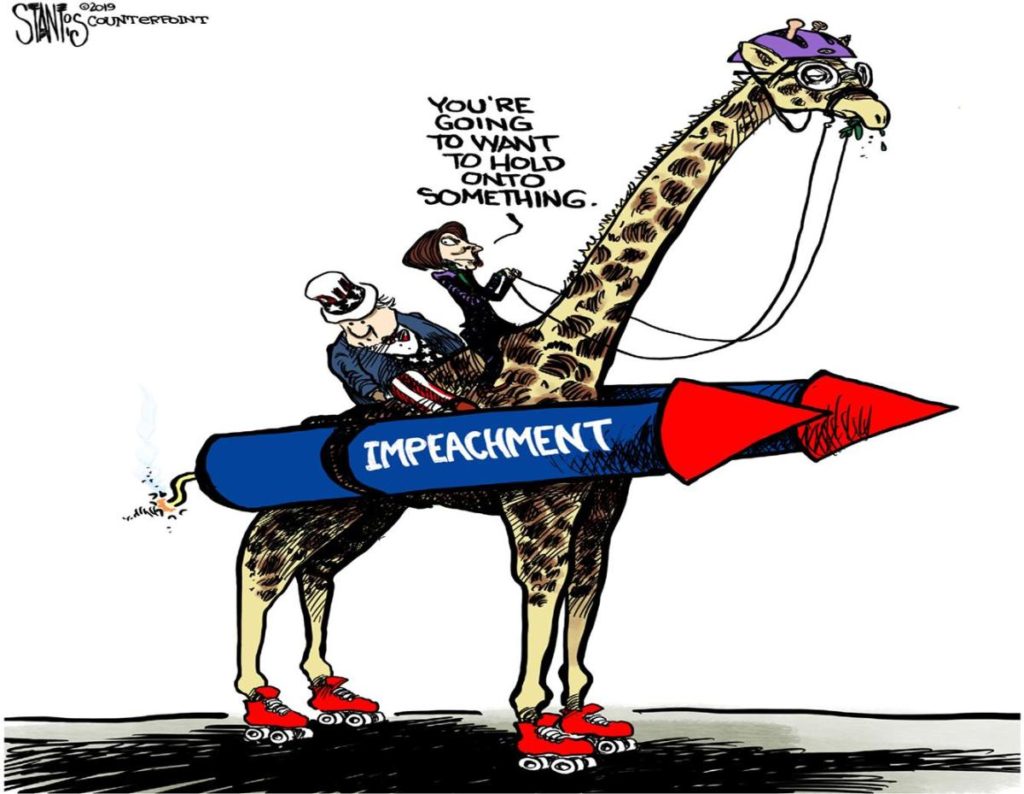
I’ve come to realize I didn’t understand the process of impeachment and the standards by which it is conducted. Here are a few key things I’m betting most of us didn’t know. Some of them will surprise you.
First, the process has three steps:
The Congress starts an investigation, which can be conducted by any part of that body—the House, Senate, a special counsel, etc.
The House leadership decides on whether to vote on “articles of impeachment.” The articles need only a simple majority to pass. If they do pass, the person is impeached. However, the articles of impeachment are not a conviction; they are a formal allegation of wrongdoing. The analog to this in the criminal justice system is an indictment.
The Senate then holds a trial to decide if the allegations are true with both sides bringing witnesses, evidence, cross-examination, etc. The chief justice presides when the president is impeached. If two-thirds of the senators deem the allegations true, then the person is convicted and removed from office and may be barred from holding future positions. If the super majority isn’t reached, the person is acquitted of the charges.
There are two big questions in all of this. First, what standard of proof is used for passing the articles and then convicting the person of the allegations?
It appears that the standard of proof required for impeachment and conviction is left to the discretion of each individual representative and senator. There is no standard defined. So while some may use the standard of beyond a reasonable doubt, others may not.
Second, what can someone be impeached for?
According to the constitution they can be impeached for “Treason, Bribery, or other high Crimes and Misdemeanors.” However, the phrase “high Crimes and Misdemeanors” is not defined in the Constitution itself.
The most authoritative explanation of what “high crimes and misdemeanors” are appears to be a document written by the staff of the House Judiciary Committee. The latest version of this was written in 2015 and is called “Impeachment and Removal.”
According to the Wikipedia article on impeachment, “While this document is only staff recommendation, as a practical matter, today it is probably the single most influential definition of “high Crimes and Misdemeanors.””
A key take away from that house committee report is that not all crimes are impeachable offenses and not all impeachable offenses are crimes. So what are grounds for impeachment? Well, it’s a bit vague.
In 1788, Alexander Hamilton argued in the Federalist Paper 65 that impeachment was for “the misconduct of public men, or in other words from the abuse or violation of some public trust.” The House Committee report expounds on that, including the following general grounds:
“Constitutional wrongs that subvert the structure of government, or undermine the integrity of office and even the Constitution itself”
“Abuse of the particular powers of government office or a violation of the “public trust””
The report goes on to say the following.
“Congressional materials have cautioned that the grounds for impeachment “do not all fit neatly and logically into categories” because the remedy of impeachment is intended to “reach a broad variety of conduct by officers that is both serious and incompatible with the duties of the office.” Nonetheless, congressional precedents reflect three broad types of conduct thought to constitute grounds for impeachment, although they should not be understood as exhaustive or binding: (1) improperly exceeding or abusing the powers of the office; (2) behavior incompatible with the function and purpose of the office; and (3) misusing the office for an improper purpose or for personal gain.”
But the report doesn’t give much definition beyond this, just a few examples of what individuals have been impeached for since the founding of the country. What does all of this mean?
I think the Wikipedia article sums it up well.
“Several commentators have suggested that Congress alone may decide for itself what constitutes a “high Crime or Misdemeanor”, especially since the Supreme Court decided in Nixon v. United States that it did not have the authority to determine whether the Senate properly “tried” a defendant. In 1970, then-House Minority Leader Gerald R. Ford defined the criterion as he saw it: “An impeachable offense is whatever a majority of the House of Representatives considers it to be at a given moment in history.””
Impeachment is a political remedy, not a criminal justice or civil justice one. And given the vague definition of grounds for impeachment and the lack of any required standard of proof, what this all means, unfortunately, is that the process, especially in our current climate, is going to be rife, not with objectivity, but partisan politics. On both sides.
I agree with you on this! Just because Hugos have been the most prestigious Science Fiction award a SciFi author can get doesn’t mean we couldn’t make a new one that gets votes from scifi readres all over the world. 🙂
The Nebula is up there too. It all comes down to what you want to recognize and promote.
So true, John. If you create a new one (I’ll call it The Quantum for the moment) and readers see that the books that they enjoy fill the Hugo list, and the ones they like are in Nebula, but the ones that really turn them around, make them think, make them feel, make them love to read even more are in the Quantum list–then they will begin to give it power. It will become the Second Foundation.
I write YA sci-fi, and one thing that I’ve noticed is that, with no exceptions I can think of off the top of my head, all YA authors treat each other nicely. What is it about adult sci-fi and fantasy tear each other apart, both publicly and harshly?
I don’t know. Is it the infusion of political stances, of crusades for right and wrong, however that’s defined? Do you find that in the YA community?
It may or may not be the right strategy, but it definitely got some attention, and that can’t be a bad thing.
There are an awful lot of folks that read SciFi and Fantasy in the seventies and eighties that don’t read it now. The Hugo conundrum is just the tip of the iceberg. I’ve read several of the blogs on this subject, and there are several ex-readers of these genres that are willing to get their feet wet again, now that they have an inkling that there might be writers of the “old school” out there, albeit either Baen writers or indie.
I think the more attention the better right now.
About awards? I think there ought to some acknowledgement that the genres have splintered, and that the SJW saturated stories should get their due, and the old school stories should get theirs.
Just my auld two and a half pence on it.
Yes, all the magazines seemed to take a weird turn. And the editorial houses seemed to follow, although there were many exceptions. I dropped my subscriptions to Asimov’s and F&SF in the early ’90s because the stories just bored me.
Politics are definitely talked about by the YA community, and the genre definitely leans left. Nine out of ten authors are female, if that has anything to do with it.
So much for my theory. Or, if it all leans left, maybe the minority is too much a minority to care to make waves?
The Sad Puppy campaign has gotten a lot of attention in a couple of interesting places. There’s an article on Breibart that showed a lot of people the issues in SFF, and on Mike Glyver’s blog there’s an interesting conversation going on.
My thought on this is it might not change what’s going on in the Hugos, but the attention appears to be bringing back some old time SFF readers.
Give someone that hasn’t had a good space opera to read in twenty years, something that fits, they might start looking for more of the new stuff to read.
If someone was an avid fantasy reader twenty years ago and more, and couldn’t find anything to read at the end of the nineties and gave up, Larry Correia and the Harry Dresden series might bring them back.
That can’t hurt us, the indies and the aspiring writers.
Very true.
You really nailed it, John. The issue with Brad’s Venn diagram is that his exact diagram is identical to one you would have created when the Hugo Awards were created, and people don’t seem to understand that it was designed that way.
It’s a small group that created an award that represented a small group. The disconnect here is that thanks to those people’s dedication the award is considered prestigious and people are mistaking prestigious with “represents all of fandom,” but at its heart it is still a small group award.
It’s like complaining about the Nebulas because they only represent the opinion of writers. Well, exactly. Replace Nebula with Hugo and writer with con attendee, and the logic still applies.
Right. And I think shining a bright light on it, has been helpful. But I think the best alternative is an award that does what Sad Puppies really wants.
Totally agree with this. Thanks for the well-reasoned post.
I hate it when someone tells someone else that the thing they like is “wrong” or they like it for the “wrong reasons”.
No reason to go take away someone else’s toy; have a good time with your own toy and people will come over to see what you’ve got going on.
Yes. I’m in agreement. It’s time for a new SFF award, of the type that takes into account the tastes of mega-readers.
In other words: It’s not an award for the most high-brow SFF book (that might be the Hugo). And it’s not an award for the most popular SFF book (that might be Goodreads Reader’s Choice). Any reader who’s read at least, say, 30 SFF books that year can nominate candidates. But that’s the requirement–not how much you can pay, not who you know, not what social media you’re on. Just how much you read.
To me the argument loses any credibility when it claims most Hugo voters aren’t part of fandom
That wouldn’t make sense, would it? However, I don’t think they claim they aren’t part of fandom. I think they feel they don’t represent the vast majority of fandom. The Worldcon circle should probably be a smaller circle within the larger one.
I think the award should be tied to SLCC. You can add a comic category to keep it relevant to all the attendees there.
I would name it the “Saltys”
Now that’s an interesting idea.
The disconnect here is that thanks to those people’s dedication the award is considered prestigious and people are mistaking prestigious with “represents all of fandom,” but at its heart it is still a small group award.
The disconnect needs somewhat better explanation. It isn’t that “people” are mistaking prestigious, it’s that the people handing out the award were touting it as “represents all fandom”. “People” is entirely too nebulous, too ambiguous a word to use here. With the Nebulas it’s known that it’s a writer’s award, and in fact a specific group of writers, i.e. the SFWA. Pulling back the curtain on the small group nature of the Hugos is partially what SP has been about.
Is SP the best approach? Perhaps, perhaps not. It is the approach that’s in play now though. One could certainly get a good story out of some alternative approaches. Who knows how the world will look 70 million years from now with Sad Puppies, and without?





I agree with you on this! Just because Hugos have been the most prestigious Science Fiction award a SciFi author can get doesn’t mean we couldn’t make a new one that gets votes from scifi readres all over the world. 🙂
The Nebula is up there too. It all comes down to what you want to recognize and promote.
So true, John. If you create a new one (I’ll call it The Quantum for the moment) and readers see that the books that they enjoy fill the Hugo list, and the ones they like are in Nebula, but the ones that really turn them around, make them think, make them feel, make them love to read even more are in the Quantum list–then they will begin to give it power. It will become the Second Foundation.
I write YA sci-fi, and one thing that I’ve noticed is that, with no exceptions I can think of off the top of my head, all YA authors treat each other nicely. What is it about adult sci-fi and fantasy tear each other apart, both publicly and harshly?
I don’t know. Is it the infusion of political stances, of crusades for right and wrong, however that’s defined? Do you find that in the YA community?
It may or may not be the right strategy, but it definitely got some attention, and that can’t be a bad thing.
There are an awful lot of folks that read SciFi and Fantasy in the seventies and eighties that don’t read it now. The Hugo conundrum is just the tip of the iceberg. I’ve read several of the blogs on this subject, and there are several ex-readers of these genres that are willing to get their feet wet again, now that they have an inkling that there might be writers of the “old school” out there, albeit either Baen writers or indie.
I think the more attention the better right now.
About awards? I think there ought to some acknowledgement that the genres have splintered, and that the SJW saturated stories should get their due, and the old school stories should get theirs.
Just my auld two and a half pence on it.
Yes, all the magazines seemed to take a weird turn. And the editorial houses seemed to follow, although there were many exceptions. I dropped my subscriptions to Asimov’s and F&SF in the early ’90s because the stories just bored me.
Politics are definitely talked about by the YA community, and the genre definitely leans left. Nine out of ten authors are female, if that has anything to do with it.
So much for my theory. Or, if it all leans left, maybe the minority is too much a minority to care to make waves?
The Sad Puppy campaign has gotten a lot of attention in a couple of interesting places. There’s an article on Breibart that showed a lot of people the issues in SFF, and on Mike Glyver’s blog there’s an interesting conversation going on.
My thought on this is it might not change what’s going on in the Hugos, but the attention appears to be bringing back some old time SFF readers.
Give someone that hasn’t had a good space opera to read in twenty years, something that fits, they might start looking for more of the new stuff to read.
If someone was an avid fantasy reader twenty years ago and more, and couldn’t find anything to read at the end of the nineties and gave up, Larry Correia and the Harry Dresden series might bring them back.
That can’t hurt us, the indies and the aspiring writers.
Very true.
You really nailed it, John. The issue with Brad’s Venn diagram is that his exact diagram is identical to one you would have created when the Hugo Awards were created, and people don’t seem to understand that it was designed that way.
It’s a small group that created an award that represented a small group. The disconnect here is that thanks to those people’s dedication the award is considered prestigious and people are mistaking prestigious with “represents all of fandom,” but at its heart it is still a small group award.
It’s like complaining about the Nebulas because they only represent the opinion of writers. Well, exactly. Replace Nebula with Hugo and writer with con attendee, and the logic still applies.
Right. And I think shining a bright light on it, has been helpful. But I think the best alternative is an award that does what Sad Puppies really wants.
Totally agree with this. Thanks for the well-reasoned post.
I hate it when someone tells someone else that the thing they like is “wrong” or they like it for the “wrong reasons”.
No reason to go take away someone else’s toy; have a good time with your own toy and people will come over to see what you’ve got going on.
Yes. I’m in agreement. It’s time for a new SFF award, of the type that takes into account the tastes of mega-readers.
In other words: It’s not an award for the most high-brow SFF book (that might be the Hugo). And it’s not an award for the most popular SFF book (that might be Goodreads Reader’s Choice). Any reader who’s read at least, say, 30 SFF books that year can nominate candidates. But that’s the requirement–not how much you can pay, not who you know, not what social media you’re on. Just how much you read.
To me the argument loses any credibility when it claims most Hugo voters aren’t part of fandom
That wouldn’t make sense, would it? However, I don’t think they claim they aren’t part of fandom. I think they feel they don’t represent the vast majority of fandom. The Worldcon circle should probably be a smaller circle within the larger one.
I think the award should be tied to SLCC. You can add a comic category to keep it relevant to all the attendees there.
I would name it the “Saltys”
Now that’s an interesting idea.
The disconnect here is that thanks to those people’s dedication the award is considered prestigious and people are mistaking prestigious with “represents all of fandom,” but at its heart it is still a small group award.
The disconnect needs somewhat better explanation. It isn’t that “people” are mistaking prestigious, it’s that the people handing out the award were touting it as “represents all fandom”. “People” is entirely too nebulous, too ambiguous a word to use here. With the Nebulas it’s known that it’s a writer’s award, and in fact a specific group of writers, i.e. the SFWA. Pulling back the curtain on the small group nature of the Hugos is partially what SP has been about.
Is SP the best approach? Perhaps, perhaps not. It is the approach that’s in play now though. One could certainly get a good story out of some alternative approaches. Who knows how the world will look 70 million years from now with Sad Puppies, and without?