I know the word ‘atheist’ presumes a lot, but it’s just an easier way of describing someone with a rational mind.
Joe Konrath, a self-avowed atheist, awesome fighter for authors, and leader in the indie author movement, said that almost a year ago in his Konrants post.
My response then was the same as it is now—right, the rest of us run around eating socks and wondering if there really are gerbils under the hoods of our cars.
Shoot, wouldn’t it be great if we could get us one of them rational minds?
In the comments of that post, I had a very interesting conversation with Joe about God, belief, and evidence. Joe brought up a number of valid points about the errors we can make when we formulate beliefs using something other than science.
However, he didn’t point out the errors we can make when we formulate beliefs based on science. He didn’t want to talk about the limits of science. What he wanted to focus on was the claim that if God existed, we should not only be able to observe things about him, her, or it, but we should also be able to subject those observations to the scientific method.
If we couldn’t do that, Joe claimed, then there was no rational basis for believing in God. God did not exist until he was proven to exist. And the only way to do that was by using science.
So here’s the question: is Joe right?
To answer that, we first have to understand what science is. And what it is not.
And I’m happy to report that earlier this year I read probably the best article explaining what science is that I’ve ever read. It’s called “Science as Storytelling” and was written by Barry R. Bickmore, a professor of Geological Sciences at BYU, and David A. Grandy, a professor of Philosophy at BYU with a strong interest in the philosophy of science.
Hold on, John. Is this some anti-science thing?
Not at all.
In fact, it’s just the opposite.
They wrote the first version of this article help students with simplistic views of science and who tended to “dismiss scientific conclusions that challenge their preconceived notions—especially those connected with religious or political views.” They also wrote it to help scientists who are not religious, downplay the supernatural, or “share in certain inaccurate views of the nature of science.”
What they have fashioned is a way to “help science students (and professors) gain a more productive view of both the nature of science and the science-religion interface.” And, as good scientists, they put their theory to the test and found that their approach was indeed effective at both secular and religious colleges.
So, is Joe right? Is science the only way to prove or disprove God?
Let me suggest you read the article. Let me suggest that this is the most productive way of talking about the issue that I’ve found. As you read, you might want to look for the answers to the following questions:
What makes science different from things like astrology?
Does science have any blind spots?
Is science fiction because its stories change?
Is it possible for natural phenomena to exist upon which you can do no science?
Under what circumstances could science prove the existence of a God?
If you’re interested in science or religion, I think you will love this article. Not only because it clarifies and reaffirms science, but it also because it helps us understand its limits.
I would, of course, be interested in your responses to it. And in another post perhaps we can talk about how we’re supposed to proceed about a subject when we can’t do science.
Imagine running and dodging for thirty minutes through dimly lit corridors as kids with guns chase you down and shoot you with glee.
That’s what happened to me recently.
The kids were daughters 1, 2, and 3. On my team were dead-shot Nellie and daughter number 4. The dimly lit corridors were provided by the Cache Valley Fun Park. The guns were lasers.
This was my first time playing laser tag, and I must report that we had an absolute blast. For twenty minutes we dodged and ran and shot with wild abandon. It’s like paintball without any of the pain, unless of course you crash into someone.
Here’s how it works. You divide up into two, three, or four teams. The attendant gives each of you a vest and scans you onto the appropriate team (your laser has a bar code and is attached to the vest with a cord). There are markings on the front and back of each vest. If someone lasers those markings, you lose points. If you shoot someone else’s vest, you earn points. It’s that simple.
All the teams go into the half-lit battle room–cut up with walls, corridors, and windows–and the game begins. You try to kill them. They try to kill you. You try to shoot their bases, but if you linger too long the bases shoot you. It quickly turns into chaos fun. You shoot someone only to have a daughter sneak up behind you and nail you in the back. You flee, waiting to regenerate, only to find that sneaking daughter has followed you through all the twists and curves and kills you the moment you come back to life. But the next time you escape, and you’re the one that’s got them running. It’s like a video game except better.
The system automatically keeps score for each individual and each team so you can have a player on the losing team actually be the high scorer. We could have gone on for another hour.
Of course, me and my exceedingly svelte figure might have had to take a breather. Or not. I don’t think twenty minutes of aerobics has ever passed so quickly. And I didn’t have to follow some gal in a pink leotard to do it.
But you’re not there for the cardio-vascular benefit. Although I can see the ads now—the Laser Tag diet! Featuring Bob, a happy nerd who played laser tag for thirty minutes each day and lost 200 pounds. He could join up with Subway’s Jared so they could be geeky together. Hey, wait a minute. . . I’m smelling moo-lah!
The only negative is that the game isn’t bargain basement cheap–$4/person for 10 minutes of play, $10/person for 30 minutes. So we might not do that every time we take the family to Logan for some fun, but you can bet we’ll be doing it again.
Go shoot somebody. Feel like Captain Kirk. You’ll love it.
We’re going to start with the shovel because it’s been dumping snow this year, and I know there are some folks out there who want a quicker way to clear the snow from their driveways and walks. And, boy, do I have something for them.
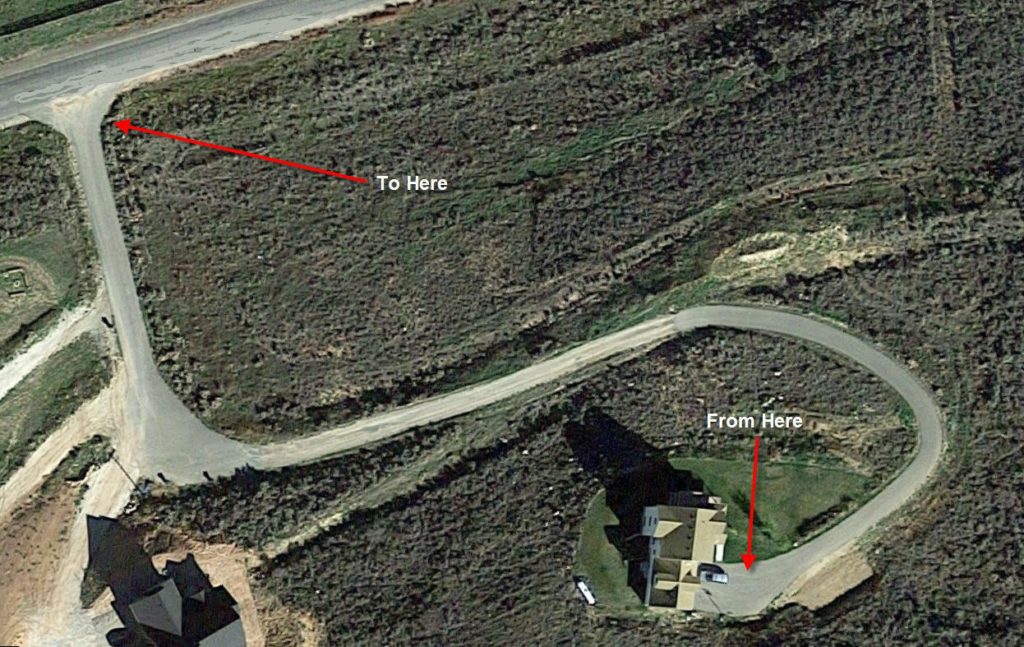
I think it’s safe to say that the Brown family clears more snow by hand than the average American family. We have a driveway and street that together are a little over a tenth of a mile long. Here’s a picture.
We clear that lovely stretch of road by hand with shovels. (Yes, we are crazy; more on that below.) Most of the time we have it cleared long before any city plow shows up. But we love our city plows because they can do the heavy work at the edges on the bottom two-thirds. And they do all the work on that bottom part when it gets really heavy and deep. We love our neighbors with tractors who’ve come to our rescue as well.
Still, we do most of the clearing.
We began our mad shoveling craze for one simple reason: we couldn’t get to our house when it snowed. And it was a pain in the neck to hike that tenth of a mile.
Part of the problem is that we live on a hill, and there are a couple of steep stretches. Another part of the problem was that we had not availed ourselves of this higher technology called snow tires. We thought all-weather tires would do just as fine.
Wrong. Big wrong. They don’t even come close.
With all-weathers, on a hill, you have to keep the road clear. As in to the blacktop. Because once you build up even a small layer of snow, you’ll get slick patches, and then the all-weathers do nothing but spin.
But we didn’t discover that until a few years into it. And by that time, we’d learned that shoveling such a long drive was not only good exercise, but it also was a great way to teach our four girls how to work hard and not fear projects that seemed daunting.
I know some of you are thinking, dude, why not purchase a snow blower, or a pickup or four-wheeler with a plow?
Because snow blowers at the time, much less four wheelers and pickups, were out of our budget. Because I’d much rather spend the money on a family trip somewhere fun. Because why spend the money when you can line up as a family and create your own Brown Family Snow Blade and give your kids stories to tell their kids about living in the Gulag?
Anyway, it’s what we do. Fast forward now to this year. Three of our daughters have grown up and gone off to college. Nellie, my youngest daughter, and I can usually still get it done. But this year’s record snows kicked our butts. Royally.
Now, we’ve tried all sorts of shovels. I can guarantee, if it was at a store for sale, we’ve tried it. We’ve used brooms. We’ve used all sorts of configurations of girl, woman, and dad power. After all that experimentation, we found a standard push shovel to be the best for general snow and a square garden shovel to be the ticket for ice. But this year our trusty tools weren’t cutting it.
So, after one long day on the driveway, I went on line looking for a better shovel. And after looking at quite several contraptions, I found The Snowcaster.
You can see it in action below. It’s basically a plow. One made for a human to push.
When I saw it, I thought this thing had to be better than pushing shovels. So I ordered it and assembled it. The curved blade of incredibly hard plastic rises 9 inches above the ground and is three feet long. Its nifty design allows you to simply flip it to change the direction of the blade.
After using it these last six weeks on multiple snows of everything from ten inches of powder to three inches of watery slush, I will simply say that it’s amazing. It’s so good, I ordered a second unit.
The Snowcaster does have a limit—you’re not going to plow three-feet of snow with it. You’re not going to plow a build-up of two feet. If you’ve got a lot of wet snow over a large area, you will break a sweat. And sometimes you’ll still need a shovel to toss snow at the edges. But for moving large quantities of snow out of the way on asphalt or concrete, it’s the best thing I’ve found to date.
If you are like me and don’t want to purchase a machine just yet, have snow to move, and want to dramatically reduce the time it takes to move it while providing some fun for the kids, I think you’ll love The Snowcaster. I ordered mine directly from the company here: https://thesnowcaster.com/. The model I chose was the 70SNC. I wouldn’t suggest the long model unless you rarely get snows above three inches. I say this because on some days with lots of snow the three-footer was about all I could push.
Okay, onto the movies. I have two excellent ones to recommend. Both of which are based on true-life events.
The first is Denial, a British-American historical drama, that tells the story of how Deborah Lipstadt, a holocaust scholar, was taken to court for libel in Britain by David Irving, a man who claims the Holocaust never happened. In America, you’re always innocent until proven guilty. However, in Britain, with libel, the burden of proof is upon the defendant. So how do you prove you weren’t slandering someone? The movie was thrilling and fascinating. And gave you something to think about afterwards. If you enjoyed Woman in Gold, you’ll enjoy this.
The next is Hidden Figures, an American biographical drama, that tells the story of female African-American mathematicians at NASA. These women were employed as computers—that was their official job title. Of course, this was before electrical computers and calculators, and what they did amazes me. The story is about the USA struggling to catch up to the Russians in the space race, and how four of these women helped while dealing with deep-seated prejudice against Blacks and females. It is full of humor, poignant moments, and surprises. It’s one of the best films I’ve seen these last few years. I don’t know what to compare it to. All I know is that you will laugh, be amazed, become outraged, and cheer.
Lt. General Michael T. Flynn. Flynn is a former director of the Defense Intelligence Agency and Assistant Director of National Intelligence and is now our National Security Advisor. If you want to understand how he is likely to advise the president about our war against radical Islam, let me recommend his book The Field of Fight. In the book, Flynn describes his background as an intelligence officer and how critical good intelligence is in this fight. He then describes his take on who the radical Islamist enemy is and how he thinks we can win the war against them. He shares several surprising insights that only someone with his experience can and reveals as well how good and smart leaders can disagree about strategy. One of his main points is that we will never win the war by killing bodies—this is an ideological war, much like the war we fought against communism. For those wanting to get past news blurbs and hear the man speak for himself at length, I think you’ll find this book interesting.
And because, Dear Reader, you read all the way to the end, I will give you two more movie recommendations. Moana is a great, fun, family film. La La Land is an enjoyable musical romance that will probably break your heart. It did mine.
If you’ve read my article on the Teachers section, you know I think a good portion of what we do in our public schools is a waste of time because it’s not driven by any natural motivation. The result is that students are bored more than they need to be. They develop a distaste for many subjects that could provide them great joy. Finally, when they do learn, it’s for a test, not life. And so when the test is over the promptly forget what they’ve learned.
This is not to say that I’m against testing or teaching to a test. Far from it. A good test demonstrates that you’ve learned what you’re supposed to have learned. A good test focuses on the main things you want to learn. Good tests (and there are many types of tests) are critical. The problem is the objectives the tests are built on. If the objectives are idiotic then teaching to the test becomes idiotic.
Now Nellie just got a job (we’re so happy!) teaching 7th and 8th grade English. For some of you that will elicit groans. The memories of supreme boredom produced by endless grammar lessons and assigned readings with worksheets are still that strong. And Nellie and I had the same feelings. If her job was to teach grammar et al for nine months, she was going to shrivel and die.
Because grammar is bad? No, for heaven’s sake. Because grammar isn’t the point. Nor are assigned readings. Or iambic pentameter, rising action, theme, character, plot, induction, deduction, the six traits and all the rest of the usual suspects. The point is to enjoy writing and reading for the things writing and reading do.
So we’ve been working and disussin how she might still meet all the state requirements yet teach the practical joy. Becasue if she teaches the joy, then the students will become better readers and writers than they ever could be otherwise. Which means they’ll be able to do and enjoy the things that can be enjoyed and done when you know how to write and read. Case in point: our girls. Nellie’s done such a good job teaching the joy of reading that we have to ground them from books every once in a while.
So anyway, I came up with some ideas, a first draft of a curriculum. Of course, starting from scratch is a huge project. There were issues with it. More importantly, would it work? You don’t want to risk your first year on the job. Luckily, Nellie is smarter than I am and found someone who already discovered this wheel. Nellie handed me Nancie Atwell’s In the Middle.
I began to read, and I didn’t stop until almost 1 AM. Everything I’ve learned about teaching in the last 20 years, everything I’ve learned about learning how to write in the last 20 years–it’s all there. The key principles are all there. And the implementation of those principles is simple and proven (they actually test results).
What are the principles? What is the program?
Read the book. Heck, just read the first chapter.
I cannot tell you how excited I am for Nellie. We ordered these books and can’t wait to devour them.
In the Middle: New Understanding About Writing, Reading, and Learning
The Reading Zone: How to Help Kids Become Skilled, Passionate, Habitual, Critical Readers
Lessons That Change Writers
Naming the World: A Year of Poems and Lessons
Side by Side: Essays on Teaching to Learn
Nellie is also going to apply for a four-day intership at the Center for Teaching and Learning in Edgecomb, Maine. I hope she gets in. She’s also going to do a week-long writer’s workshop at BYU.
Stay tuned. I’m going to twist her arm and see if she won’t blog about her experience this first year.
It’s 1990. You’re a housewife, homeschooling your children, and renting a room upstairs to a young man to make ends meet. There are a few odd things about the young man, but you overlook them. Then one day a woman is strangled on a jogging path near your home, and your first thought is that the young man living in your house has something to do with it.
What do you do?
Pat Brown found herself in this exact situation. She voiced her suspicions to her husband, but it was all too farfetched. However, the nagging thought wouldn’t let her go, and she soon uncovered evidence that made the young man a strong suspect.
She took the evidence to the police, but they dismissed her as a bored housewife with an overactive imagination. She evicted the young man, but it would be six years before the authorities would finally bring him in for questioning.
Dismayed and frustrated, Brown started down a path that would lead to her become a professional criminal profiler, assisting police departments and victims’ families by analyzing both physical and behavioral evidence to make the most scientific determination possible about who committed a crime.
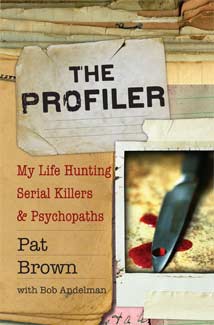
In The Profiler: My Life Hunting Serial Killers and Psychopaths Brown tells about what happened with that young man and her journey to becoming a profiler, then she opens a number of other cases she’s worked on, giving the reader a behind-the-scenes look at how profilers work, and how their methods bring new investigative avenues to light. She also brings home very clearly just how many murders go unsolved. It’s an absolutely fascinating read.
Milk that doesn’t moo
I used to think soy milk was either for the lactose intolerant or hippies. And so I always avoided that milk section of the grocery store. But, having embarked on a new way of eating that I’ll explain in another column, I was induced to approach the alternative milk shelves. I purchased a carton of soy milk, but then I saw cartons of something even more strange: almond milk.
Puzzling. I knew, of course, that almonds did not have udders. So nobody was out there hooking them up to tiny milking machines. And they were nuts, so it’s not like you can squeeze them to make them release their tasty juices. Instead, I learned that almond milk is made by finely grinding almonds together with water. I thought this was something new, invented perhaps by a Californian who’d had too much weed, but it appears many Medieval European recipes called for almond milk, and it has always been a popular beverage in the Middle East. So almond milk has been around for some time.
But I didn’t know any of this. I just knew I loved almonds and that they provide all sorts of goodies for the human body. Besides, I have a hard time resisting adventures. So along with the soy, I picked up a carton of Silk’s PureAlmond regular, vanilla, and chocolate milk.
The soy was okay, but it left a weird zingy taste in my mouth. Furthermore, soy contains estrogen. I’m sure it’s a fine product, but I live with four daughters and don’t need any more estrogen. And I certainly don’t need it mutating me in any, um, feminine ways. So I put the soy aside and gave the almond milk a go.
It was delicious. I love the vanilla and regular flavors the best. In fact, I like it so much I only drink cow’s milk when the last drop of almond milk is gone, and I try to make sure that never happens. Some might worry that I’ll deplete my calcium stores, but not so. Almond milk actually has MORE calcium than cow’s milk along with vitamin D that allows the body to absorb the mineral. It also has 50% of the RDA of vitamin E, of which cow’s milk has none. But that’s all technical vitaminy stuff. It wouldn’t matter if the milk itself didn’t taste so dang good.
The American breakfast
I love cereal. We have our standard favorites as a family, but I also like to get a box of something new when we shop. I recently saw, perched up on the top shelf at Wal-Mart, boxes of Uncle Sam.
What the heck? Was this a Tea Party product? I know Utah is conservative, but come on. And what kind of nut sings “The Stars and Stripes” for breakfast?
Well, I might.
So I promptly snagged a box and read that it’s been around since 1908, thus making it politically neutral. Then I read the ingredients. It’s a simple cereal made of wheat berries that are steamed, rolled, and toasted to provide killer whole grain nutrition. Those wheat flakes are then mixed with flax seeds (omega 3’s anyone?). That’s it.
I purchased a box, felt patriotic, and then gave it a try when we got home. I’ve been buying it regularly ever since. It’s slammed with 10 grams of fiber and 7 grams of protein, and goes great with Silk’s vanilla almond milk and a piece of fruit.
Folks running for office, especially our wonderful citizens running for local county offices, business owners, and any of the rest of us who what to persuade people to listen, I’ve got something for you.
I will bet that most of you aren’t aware that you’re muddling your message and losing votes, sales, and converts to your causes.
Of course, maybe you’re way ahead of me. I thought I knew what I was doing. I have a master’s degree in business, spent a few years in business consulting, have created a few small startups, and currently am a product manager for large software company. Despite all of that, I had somehow missed something vital. Something simple and powerful. Something that has a dramatic effect on sales, votes, and converts. On getting people to even listen to what I had to say.
And I’m not alone. I saw another company struggling with it this weekend.
On Saturday I went and watched the latest Marvel movie at a theater in Logan. One of the pre-movie video ads was for a local company called Conservice. I don’t know how many thousands of dollars they spent on the ad they played. Or how much they spent on the many other ads we’ve seen over the years. But when it finished, I turned to Nellie and said, “I still don’t know what that company does or why I should care.”
“I know,” she said. “I know.”
We were both baffled. After years of seeing their ads, we still have no idea what they do, how it would make our lives better, or what action we should take to use their service.
They have wasted thousands and thousands of dollars on their marketing.
There’s another local company that advertises during those pre-movie slots. It’s called ARS. I saw one of their ads this weekend as well. But it only reminded me of what I already know. I know exactly what they do, how it would make my life better, and what action to take.
If you have a flood, fire, or plumbing backup—whatever—they clean it up. “Got a mess? Call ARS.” That’s their one-liner.
If I ever have a mess, I will call ARS. I will never call Conservice. I have no idea what they do.
What’s the difference here?
Clarity.
And what generates that clarity?
A complete focus on the customer. The ARS ads are all about the customer and their problems and needs.
The Conservice ads, on the other hand, are all about Conservice. We’ve been in business for x years. Here’s what our building looks like. Here’s a worker planting a bush. Blah, blah, blah.
The ARS ads are all about me, the guy in the theater seat, the thing I want and the problem I have. ARS features me as the hero in my own story. They present themselves as the helper—the Yoda or Gandalf or Haymitch who helps the hero get what they want. You got a mess? We’ll help you.
The difference in the power of the two ads is night and day.
Of course this means it’s been verified that I’m a dolt. After all the years in business and education, I should have known this. But the surprising truth is that I’m not alone.
I look at the marketing we do at the billion-dollar company I work for and see this same issue everywhere. Millions of dollars spent on muddles. I look at company websites on the internet and see more muddles. I recently listened to pitches by many of our local citizens running for office and saw the same thing. It seems this communication muddle afflicts a lot of us.
About five years ago, when I began investigating an idea for a new company, I came across the Lean Startup method pioneered by a guy at Stanford and began to see the light. But a few months ago, the curtains were completely pulled aside to let in the sunshine. And wow! What a revelation.
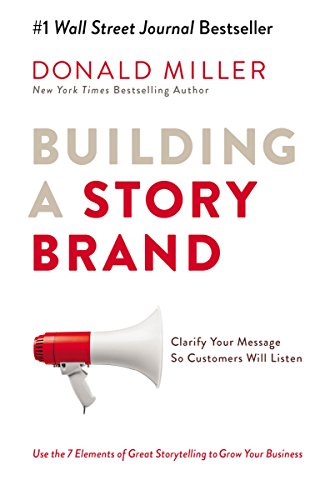
If you want to get people to listen, you have got to hear what Donald Miller has to say. He’s consulted with thousands of companies on how to clarify their message so people will listen. His framework and method make clarifying your message so easy.
He calls it the StoryBrand framework, and it’s brilliant. What it does is help you clarify your message so that a customer or voter or whoever will know within three seconds:
What you offer
How it will make their life better
And what action they should take if they are interested
But it goes beyond that. It helps you actually define what you should be offering in the first place. It’s a powerful product development tool. I’ve started using this in all my business efforts. And in my training and presentations.
For example, I just used it to develop a presentation I delivered at a huge writer’s conference last week. The results were that after the presentation, I had a line of people wanting to thank me. I had people telling me I made them cry. Others wanted to give me a hug. They were grateful. I had people tell me it was the best presentation of the conference.
This was not because I’m brilliant. I’m a dolt, remember. It’s because I used the StoryBrand framework to focus on those people. Their needs. Their problems. Their aspirations.
If you’re running for office, if you have a business, if you want to persuade anyone to do anything, then let me recommend you listen to this guy and learn about this framework.
Get the revelation. Get out of the muddle. And get people to listen.
And when you’ve finished the Miller stuff above, read How to Write Copy That Sells by Ray Edwards, the guy who has partnered with Miller. It’s all about clarifying your message as well.
You can indeed learn things about the candidates from watching the ads and debates. But fifteen and thirty second snippets of information really don’t give you the full picture. And sometimes they actually hide the facts, producing nothing more than informational smog.
Recently, I decided I wanted to really know what Mitt Romney thought. What he was about. What he hopes to accomplish if he wins the presidency. If Mitt was someone in my neighborhood, I’d go visit the man, and we’d have a chat.
I’d ask him about his ideas and past. I’d ask him to give me examples. Because of the nature of the issues at stake and the number of them, I imagine our chat would probably last a few hours. It might stretch over a number of evenings.
Of course, I’d want time to consider our chat and determine where I did and didn’t agree with him. I’d want to hear what others thought. And I’d want to look into his history, his successes and failures.
But the first step would be to go to the man himself and hear him out.
I hate it when people put words in my mouth. I’m sure Romney, or anyone else running, hates that same thing. If I were running, I’d would hope folks would take the time to hear me out. They may ultimately disagree with me on many or a few things. But I’d hope, as they are gathering information, that they would take the time to actually go to the source and listen to what I myself had to say.
Unfortunately, I can’t walk around the corner and knock on Mitt’s door. But he did write a book that was published in 2010, and it’s probably the next best thing to talking to Romney at his kitchen table. The book is called No Apology: The Case for American Greatness.
I’ll admit I thought it was going to be a dry guide book explaining his position on every hot political issue. It’s not a guide book. In fact, he leaves a number of topics out. Nor was it dry.
I also suspected it might be a scathing attack piece on the Obama administration. It’s not that either. Not even close. He does criticize some things where he and Obama differ, but he also commends him on a few things. Either way, Obama is a very small part of the book.
So what IS this book?
Romney states its purpose in the introduction: it’s “about what I believe should be our primary national objective: to keep America strong and to preserve its place as the world’s leading nation” and “the course I believe we must take to strengthen the nation in order to remain prosperous, secure, and free” (2). It’s about his ideas on how to make sure America does not falter as so many nations have, but remains wealthy, happy, and productive.
I finished the book yesterday. I found it interesting, personable, sometimes surprising, and insightful.
I found Mitt Romney to be a man self-deprecating humor. He’s also a thinking man, one who likes to look at data to see what it shows. It’s clear he’s a man who does NOT think he knows everything or has a monopoly on every good idea, but he’s also a man who demands evidence. I also saw a man who is kind. He doesn’t talk much about his 14 years of service as a lay minister in his church in this book, but you can see how those years changed him as he discusses helping the unemployed, out-of-wedlock births, and single-parent families. Finally, I saw a man who loves, LOVES, America and is convinced she can remain the hope of the earth, but only if we do things that foster our strength.
This book outlines what he thinks those things are.
The book is written in a conversational and easy style with many examples from his personal experience, studies, and history. Romney’s record of accomplishments demonstrates his skills and hard work ethic. This book explains to what end he would apply that skill and work.
If you’re planning on voting this November for the president of the United States, I think you’ll find this book very useful. You may end up agreeing with many things he says. You may end up disagreeing with him on many points. But before you can do either, you need to understand what Romney’s position actually is. And the first step in doing so is to fully hear the man out, in his own words, from his own lips.
As a result, whether you end up deciding he’s your candidate or not, you WILL come away with important insights into the issues discussed.
What’s Next
I want you to know that I do not worship George, Ben, Tom, Adam or any of the other guys who formed our constitution and started this nation.
They put their lives and fortunes on the line for what they believed in. And I am immensely grateful for what they did. I enjoy tremendous freedoms because of their courage, determination, and sacrifice. Those guys, by-and-large, rock!
But I do NOT believe that their words are scripture nor that their ideas are sacrosanct—merely to be accepted and not to be considered and questioned and disagreed with.
Even so, these guys were gutsy and brilliant. They attempted something everyone thought would fail. Something that HAD failed every time it had been attempted in their recorded history. But they pulled it off and changed the world.
These guys believed in the common man. They believed that the educated common man was the best person to hold the reins of government. Thomas Jefferson thought up a rhyme to make the idea easy to remember. He said, “If a nation expects to be ignorant and free in a state of civilization, it expects what never was and never will be.”
I can’t argue with that.
Of course, we’re not going to become experts on every policy issue. But we certainly can become informed on the broad principles and issues. And we can certainly become informed about the candidates.
Because I found No Apology so useful, over the next few days I’m going to summarize Romney’s main points, chapter by chapter, here. I’ll also point out interesting ideas and facts he shares as well as share any questions, quibbles, or disagreements I have.
I hope you find it useful. More importantly, I hope you read the book and join in the conversation.