New Writer’s Lesson: The Writer’s Trance & The Four Trance Breakers
The Sequel to Spiderman, Peter Parker, & The Gift of Writer’s Block.
The Sequel to Spiderman, Peter Parker, & The Gift of Writer’s Block.
All the lectures from Brandon’s 2012 winter semester science fiction and fantasy novel writing class at BYU. If you want to learn how to write novels, you MUST watch them. His approach and insights are excellent. Enjoy!
From Russell Blake.
I get a lot of emails from authors who are just starting out, or who are on the road but frustrated at the level of success they’ve seen thus far. I wish I had more time to correspond with everyone, but the truth is I’m usually slammed with writing/publishing related tasks, and don’t have a lot of opportunity to do more than offer a brief sentence or two.
But the last few missives I received got me thinking about what I wish someone had explained to me before I started self-publishing in June, 2011. So here’s my top 10 list, such as it is:
1) There are lots of talented writers out there. Lots. And it seems like everyone’s now got a book, or books, on Amazon. Being good isn’t enough to guarantee you anything but satisfaction for a job well done. It should, but it doesn’t. Don’t take it personally.
2) There are lots of crap writers out there. Lots. And while many sink to the bottom of the swamp with nary a whimper, some sell well, and some even become bestsellers. This is because the world’s unfair and, depending upon the genre, oftentimes readers don’t care much whether they suck or not, as long as the story entertains or reaffirms some conviction or bias the readers have. These authors succeed in spite of their abilities, rather than because of them. Don’t take it personally.
3) The internet is filled with gurus who know nothing. It’s hard to turn around without bumping into a writing or self-publishing expert. Most of them are completely full of shit, and don’t sell many books – but that doesn’t stop them from trying to get you to part with your money to hear them tell you what you need to do to sell well. Whenever you hear advice, consider the source. If it’s a million selling author, that means more than from someone whose work ranks slightly lower on Amazon than the collected love poems of Adolf Hitler in original German. Seems like everybody but me is selling seminars, courses, or how to books that promise much and deliver nothing. Must be a good business there, but I prefer labeling my fiction as such and putting in a car chase or gunfight rather than trying to trick the dim or desperate out of a few bucks.
4) You need to be able to put out books at a decent clip. Sure, you might hit huge off one, but probably not. You’ll be building your readership the hard way, which means one reader at a time, and the more quality books you have on your virtual bookshelf the more likely one will catch someone’s eye. This doesn’t appeal to a lot of authors’ wish that they could write a book every year or two and have a nice living. Sorry. I have yet to see that happen. But it’s a seductive siren song, so lots of newbies listen to it like it’s still a viable way to go. In self-publishing, not so much.
More at “10 Things I Wish I’d Been Told”.
I know, I know. Stop making blog posts, John, and finish CURSE.

Another great podcast by the Writing Excuses team, this time on style and voice: http://www.writingexcuses.com/2008/10/06/writing-excuses-episode-35-voice-tone-and-style/
Quesion: is it dangerous as a writer to try to improve your style?
A lot of respected authors say it’s foolishness to focus on style. Because story is what people want. Story is the thing. Put all the lipstick you want on a pig, it’s never going to be anything but a pig.
I agree with them. Why fiddle with the words when the content oinks? If you have to focus on something, focus on delivering killer stories.
However, story content is not everything. There is a feeling that comes with how the story is written. You can serve prime rib on fine china in a $100 / plate restaurant, or you can serve it in a cardboard box out on the back lawn by the shed. Same beef, but not quite the same experience.
Orson Card is one of those who cautions against thinking about trying to improve your style. I want you to read this.
Question 5:
I would like to use the discussion in Lesson One as a springboard to my own inquiry. I understand that obsessively analyzing the style in which one writes can lead to bigger problems. However, my problem is not with an overall stylistic deficiency, but a very specific one. Through dialogue, the voices of the characters speak with one another. Are there any techniques you can offer which make the process of composing dialogue any easier? (I don’t expect a wonder formula, just some methods which would help me organize my thoughts a little better.)
— Submitted by Jennifer Dittrich
OSC Replies:
Composing Dialogue
The secret is not to think about dialogue as a separate task. You aren’t writing dialogue, you’re writing an encounter between characters. Part of the encounter is what they say, but part of it is how they react to each other, what they want from each other, what has happened between them in the past, who else is watching and the impression they want to make, and so on. When the characters speak, therefore, they aren’t “speaking dialogue,” they’re using words to do something to the other person — sometimes to try to get the other person to understand some information, but more often to get the other person to do something or feel something or reveal something. That’s what you concentrate on, and then come up with words you might use to accomplish that character’s purpose. Sometimes you’ll try many different opening lines as a conversation begins, and see where they go; sometimes you’ll erase long passages because they don’t feel right to you. But the solution to dialogue problems is rarely to “write better dialogue.” It’s almost always to clarify or change what the character wants or feels or thinks.
Most often, bad dialogue is bad because it’s “clunky.” The usual cause is that you’re trying to “write well,” and your idea of writing well comes from the horrible essays you were forced to write in high school and college. Forget all that! But don’t forget it just when you’re writing dialogue — that’s bad writing even in the essays and papers produced by those very same teachers! Good writing sounds like a person talking. Your narrative sections should be written in fluid language that can easily be read aloud. In other words, your narrative should sound like dialogue spoken by a good storyteller!
So if you worry about your writing style, especially your dialogue writing, chances are that the problem you have is that you are worrying about your writing style instead of worrying about what happens and why in the story! Bad style is almost invariably the result of trying for “good style,” because “good style” is invariably defined by writing teachers and the students who believe them as “writing like someone else who writes better than you.” But you can’t write like them, because you’re not them and their voice isn’t your voice. You can only write well when you write the way you talk, only more clearly and precisely. If you are laboriously constructing your sentences, searching in the thesaurus for “just the right word,” you are almost certainly writing unreadably; and, while you might only notice it in your dialogue, chances are you are writing badly all the time.
How do you cure this destructive habit? Let me give you a parallel example. When I was a child, I had a lyric boy-soprano voice, complete with vibrato. I sang high and sweetly, and that ability to sing was an important part of who I was. But when my voice changed, the “high” was gone and so was the sweet. Grimly determined to get my voice back, I forced a vibrato using very bad technique — a strained, rapid diaphragmatic vibrato rather than one that arises from a relaxed throat. It made my voice sound eccentric and unpleasant — and the tightness that resulted severely limited my range. I went through my college career with that voice, even though I knew it didn’t sound all that good, because I didn’t know how to do it better.
Then I went to Brazil as a missionary. Nobody there knew me as a performer. No one cared how I sang. I stripped away the old pretense and sang “straight,” with clear tone, no vibrato at all. I learned to relax my throat. I sounded like nothing; and then, to my surprise, a genuine, relaxed vibrato began to enter my voice on sustained notes. And my singing range increased, both higher and lower. When I came home, my singing voice was a far more versatile and powerful instrument than it had ever been before. During my forced-vibrato years, I couldn’t “do voices” — I could only sing the one way. Now I could take my relaxed voice and shape it to sound like an old man singing, or a child, or an untrained singer, or an operatic buffoon. I could sing conversationally; I could sing formally. I had my voice at last.
But I had to stop trying to force my voice and just relax, concentrating on the song and not the singer. Before I could sing well, I had to stop trying to sing well and concentrate on singing clearly, singing to the audience.
And if you don’t understand how this applies to writing style, I’m not a good enough writer to explain it to you any better.
You can read it on his site here: http://www.hatrack.com/writingclass/lessons/1998-08-14-5.shtml
Lots of great insights there. How many ways can you say, “Please, focus on the content of the story!”
But did you notice this line: ” Your narrative sections should be written in fluid language that can easily be read aloud. In other words, your narrative should sound like dialogue spoken by a good storyteller! ”
And this one: “You can only write well when you write the way you talk, only more clearly and precisely.”
Card is talking about improving your style to make it more clear and fluid and authentic to you. Even while warning this questioner as strongly as possible to avoid trying to improve your style, Card prescribes improving your style.
So style matters, even to Card. It just doesn’t matter nearly as much, in most cases, as content does. And I agree with him on his priorities.
However, I still think Card is throwing the baby out with the bath water. Maybe because he’s seen too many wretched stories that had great style. Nevertheless, there IS a way that each of us talks. We talk that way out of habit, but also because we like some of those turns of phrases. Because certain sounds, words, and rhythms appeal to us at some level. Because they feel right.
So what if you’re reading TC Boyle and love the rhythm of his prose? What if you figure out some of what drives that rhythm? What if you begin to use it in your writing? Is that bad?
Or what if you notice how David Farland always puts movement into descriptive passages? Or that you use “really” and “very” really a lot in very many places? What if you like how Dean Koontz stops to paint his characters? His use of metaphor to evoke an image of a person? What if you notice how some of Card’s prose works poetically?
What if your editor notices something you do that jars him so much it sets his teeth to rattling, and when he points it out you agree?
What if you pick up new stylistic elements and options and try them? Are you then going to write excrement?
No. You’re not. Because it’s natural to pick up words, phrases, manners of speaking. It’s natural to try them on. In fact, trying to AVOID this is what’s unnatural.
I used to work with a guy named Rick Jendro. He looks like a young Sylvester Stallone. One thing I loved about him was that he is a wonderful water cooler story teller. Rick used his hands and voice and face when telling his water cooler stories. He wasn’t Acting with a capital A, but he was acting. He was evoking the story. He reminded me of another friend, Jeff Cuthbert, who did the same thing.
I loved listening to both of them. LOVED IT. Partly because of this acting they did.
So I noticed what Rick was doing and Jeff had been doing. The next time I told a story I let myself be a bit more free with my hand motions and actions. I didn’t study movements or anything like that. Didn’t rehearse. I found they just came when I reminded myself to let them come. I tell a better story today than I did before because of this.
Was I wrong to delight in what they did and try it? I don’t think so. There’s nothing wrong with imitation. Good gravy, that’s how we learned language in the first place.
My advice, lowly writer that I am, is to read and imitate. Notice things. Notice every thing that sings. Every thing that clunks. From character to plot to punctuation to paragraphing to dialogue to whatever. Then try things on. Try on structures and plot twists and dilemmas. Try on paragraphing and poetical devices like simile and metaphor. Try on everything that strikes your fancy. Get a whole closet of outfits that feel wonderful on your bones.
And when you write, just write. Don’t worry about the style because all these new outfits you’ve got: the ones that feel most natural for the task at hand will present themselves to you when the time is right. I promise.
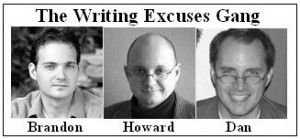 A while ago the Writing Excuses team asked me to record with them, and last Friday I got to do it and had a blast.
We recorded three episodes. In the first podcast we talk about putting and not putting ourselves in our writing and making characters who don’t all sound like the author. As usual, the guys had some great insights. Check it out: The Anti-Mary Sue Episode.
 One of the most basic way of coming up with story ideas is to take a familiar story or thing, list out what’s commonly associated with it, then start changing some of those elements.
For example, you list out all the normal things for vampires–the coffins, black, bats, sucking blood, etc.–then you begin to twist. What if the vampire wears, instead of black, some styling plaid? What if it isn’t a person but a rabbit (whoops, that one’s been done)? What if instead of gothic places like catherals you find him in a trailer park? What if instead of being dangerously suave, he’s a drunk?
Do you see? You can do this with anything.
In this interview, Matthew Sturges talks about how he did just that with the movie The Dirty Dozen and ended up with with Midwinter, a novel about prisoners given another chance. According to Sturges, “In the case of Midwinter, the beginning of the story was, ‘What is prison like in Faery?'”
Read the whole interview. I think you’ll find it enlightening.

The RWA conference was a blast. It was a wonderful time to hook up with writing friends, to make new ones, and to listen to insights and advice from folks who are selling tons of books.
Brenda Novak, whose latest book hit #48 on the USA Today list, gave a great presentation on generating emotion in the reader.
RaeAnne Thayne, whose book is currently the #5 best selling book in the USA this week, shared lots of helpful tips on ways to make this your most productive year ever.
Kristan Higgins, whose latest book hit #20 on the USA Today list, gave a presentation on the role and delights of secondary characters and how to use them. She also gave a humorous and insightful keynote speech about one of the most satisfying reasons to tell stories–to help others.
Lynn Kurland’s presentation on world building was short, but sometimes short is more powerful. I came away remembering that one key to great world building is remembering that nobody will care much about the world if they don’t care for the characters!
There were others presenting, but I wasn’t able to attend. I’m sure they were equally good. I had a great time.
I promised those that attended my presentations that I would post the PDFs here. Enjoy!
