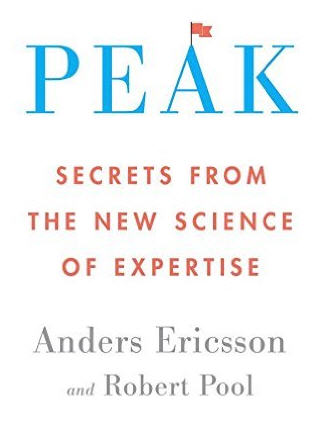
Peak

peakbyandersericssonHow many pushups can you do in a row?

10, 20? Could you do 100?

And you’d have to be a freak if you could do 500 in a row, right?

Well, no.

You’d just be human.

In 1980 Minoru Yoshida of Japan did 10,057 pushups nonstop.

In 1993 Charles Servizio of the good old USA did 46,001 pushups in 21 hours and 21 minutes.

In 2016 David Escojido of the USA did 2,298 pushup in 1 hour.

You might think that these folks must be oddities. They must be gifted. They must have some weird thing in their DNA allowing them to do these things.

But you’d be wrong.

None of these people were born that way. In fact, what researchers are finding is that most of the folks that we think are prodigies—folks like Mozart, Tiger Woods, chess masters who can play 20 games at once without even looking at a board—the biggest thing that separates them from the rest of us isn’t DNA.

Anders Ericsson, a researcher at Florida State University, has spent the last 30 years studying what gives experts their edge. And he reveals in Peak: The New Science of Expertise that he and other researchers have found that while there are some physical traits like height and size that definitely make a difference in some physical activities (notice how all the top gymnasts are short), what really sets people apart is how much of a certain type of practice they’ve done.

Not just practice, but a certain type of practice.

Practicing “hard” doesn’t do much for you. Putting in a lot of hours doesn’t do much either. Instead, you need to practice in a way that has been shown to lead people to actually improve their performance. You still have to put in a lot of time practicing—there is no shortcut—but only the type of practice he explains in the book seems to lead to the increase of performance.

Is he saying that anyone can do anything?

No. When I first looked into his research, one of my big issues was that it seemed he was claiming anyone could do anything with 10,000 hours of practice.
But he’s not saying that.

Is he saying genetics has no influence?

It can, but what he’s found is that it doesn’t have the role we normally think of when we think of top performance. And, most importantly, we place artificial limits on ourselves by thinking people are born to this or that activity.

There is far too much to post here. What you need to know is that what he shares in this book is fascinating, compelling, and surprising. I’ve been training people for over thirty years. And I found myself enlightened. If you’re at all interested in education, or getting better at some activity (from parenting to golf), or helping your kids get better, you’ll want to read this book. Highly recommended.

Share

Similar Posts

  • For those whole love ENDER’S GAME

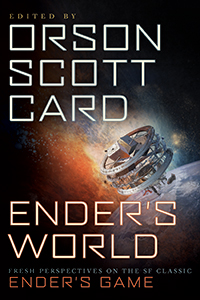
    Enders World Essays SmartPopThere’s a special joy in sharing a wonderful experience with someone else. There’s a delight in reliving the experience afterwards, in recalling key moments and quoting funny or cool lines. This is especially true of books. One of my favorite book experiences is Ender’s Game. Which is why I’m so happy to announce that Smart Pop is about to release a collection of articles written by folks sharing their experience with that book.

    You get to hear from Eric James Stone about how the book should have ended. You get to hear from Matt Nix (creator and producer of Burn Notice) how the book was a guide to his life. You get to hear from Colonel Tom Ruby why he made the book mandatory reading for the Air Force’s Air Command and Staff College.

    There are 11 other articles from Neal Shusterman, Captain John F. Schmitt U.S.M.C., Mary Robinette Kowal, Hilari Bell, Ken Scholes, Mette Ivie Harrison, and many others. There are Q&A sections. And there is Card’s own introduction in which he explains what Ender’s Game is really about for him. All of these articles are wonderful reads.

    If you loved Ender’s Game like I did, you’re going to enjoy this book. You can get a free PDF excerpt from the book that includes a few of the Q&As from Card along with the full version of my essay “The Monster’s Heart.” To download the PDF, just scroll down to where it says “Sign Up for Free Chapters & Book Updates”: http://www.smartpopbooks.com/book/enders-world.


    Share
  • The Veggie from Outer Space & The Mentalist

    I’ve been trying to increase my intake of vegetables and fruits because you are what you eat, and I think I’d like to look like a broccoli—long, sturdy, and with a lot of bushiness on top. So we’ve enjoyed our weekly box of fruits and veggies from the Bountiful Baskets co-op that we pick up in Garden City each Saturday.

    And we’ve enjoyed the surprises. Because someone else orders the produce, we never know quite what we’re going to get. Of course, this also means we sometimes get things we don’t normally seek out. Take cauliflower, for instance. We received a number of heads three or four weeks in a row back in October.

    Cauliflower?

    Who eats cauliflower? You ever hear anyone say: “Cauliflower’s on—let’s make a run to Brigham City to get some,” or “LaVern, I believe I’m going to knock back another floret,” or “It’s a party! You bring the chips and soda, I’ll bring the cauliflower?”

    No. We don’t hear those things because cauliflower is just weird. It’s the stuff that nobody eats on the vegetable tray. It looks like some growth spore from the planet Xenon. In fact, I want to know who started the rumor that aliens had big eyes and spindly limbs. That’s all propaganda. The aliens are already living among us, and cauliflower is their freaky pupal metamorphosis growth stage!

    Or, at least, that’s what I thought. Then I ate a serving of creamy mashed cauliflower at Ruby Tuesday’s and gained a testimony of both Ruby Tuesday’s and the weird white cousin of cabbage.  

    So when we received our surprise veggie, did I despair or use it for target practice on the idiot orange tom cat that comes around our house? No. I went to search for that Ruby Tuesday’s recipe. And through the miracle of the internets, I found it. Or something close enough for government work.

    Here it is. Enjoy.

    CREAMY MASHED CAULIFLOWER

    • 1 head cauliflower
    • ¾ C water
    • 1 T corn starch
    • 1/3 C heavy cream
    • 1 t granulated sugar
    • ¾ t salt
    • Pepper to taste
    • 1/8 t garlic powder
    • 1/8 t onion powder
    1. Divide the head of cauliflower into florets that are all roughly the same size. Steam or microwave until cauliflower is tender (we pressure cook it). Drain and toss it into a bowl of ice water to bring the cooking process to a screeching halt.
    2. Put florets into a food processor along with ½ C water. Puree on high speed until smooth, but with some small bits for texture. Or you can simply mash it like you do potatoes.
    3. Pour all the puree into a medium sauce pan. Dissolve the corn starch in the remaining ¼ cup of water and add to the puree.
    4. Add the cream, salt, pepper, garlic powder, and onion powder to the mixture and stir. Set the saucepan over medium heat and cook, stirring often, for 5-10 minutes, or until thick.

     You can experiment and switch the water for milk if you’d like, or if you don’t have cream. Leftovers are delicious. Of course, if I end up lumpy and round, you know it’s the cauliflower’s fault, or the alien’s that has set up shop in my chest cavity, whichever’s the truth. 

    For those who haven’t tried Bountiful Baskets, go to bountifulbaskets.org for more info. For those who wonder if cauliflower has any nutritional value at all, here’s the wikipedia on its goodness:

    “Cauliflower is low in fat, high in dietary fiber, folate, water and vitamin C, possessing a very high nutritional density. As a member of the brassica family, cauliflower shares with broccoli and cabbage several phytochemicals which are beneficial to human health, including sulforaphane, an anti-cancer compound released when cauliflower is chopped or chewed. Boiling reduces the levels of anti-cancer compounds, with losses of 20–30% after five minutes, 40–50% after ten minutes, and 75% after thirty minutes. However, other preparation methods such as steaming, microwaving, and stir frying had no significant effect on the compounds.

    Along with other brassica vegetables, cauliflower is a source of indole-3-carbinol, a chemical which boosts DNA repair in cells and appears to block the growth of cancer cells. The compound also appears to work as an anti-estrogen, appearing to slow or prevent the growth of tumors of the breast and prostate. Cauliflower also contains other glucosinolates besides sulfurophane, substances which may improve the liver’s ability to detoxify carcinogenic substances. A high intake of cauliflower has been found to reduce the risk of aggressive prostate cancer. Cauliflower is also a good source of carotenoids.”

    I guess the short version of all that is blah blah blah science says it’s good.

    ***

    Nellie and I have been enjoying The Mentalist for two years now. It’s a CBS crime thriller mystery series about a “mentalist,” a guy named Patrick Jane, played wonderfully by Simon Baker, who used to be a professional mind-reader and psychic, and a very good one at that, but gave it up and came clean. All psychics, he says in the pilot episode, are either fakes or deluded.

    But he was so good at it and made so much money–why would he give it up?

    Because a serial killer named Red John murdered his wife and daughter. So Jane has dedicated his life to hunting down and killing the murderer. To do that, he becomes a consultant to the California Bureau of Investigation (CBI) and works with a team of investigators.

    Some of the episodes are about the hunt for Red John. Many more are about other cases the team has to solve.

    Patrick Jane is the main attraction of the series. His outrageous behavior, acute observation skills, and keen wit all fascinate and delight. As the series progresses, the other characters take on their own interesting personalities as well. Agent Cho, for example, provides many moments of laugh-out-loud deadpan humor.

    The series is into its third season, but with the miracle of Netflix you can start at the beginning and watch them all commercial free at your own leisure.

    Share
  • Buck, America the Vulnerable

    Buck

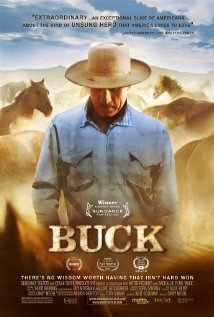
    About two years ago I was walking out in Round Valley and saw a rider on a horse coming down a hill through the brush.  I got to him just as he moved onto the road. Right away, I noticed that there was something a bit off with the horse’s gear—the rider was not using a bridle. The rider, Wayne Batty, was using nothing more than a rope harness that went around the horse’s head. I was amazed; how did you steer the horse without a bit in its mouth?

    I asked Wayne if I might walk alongside as he rode. He agreed, and then began to talk about training and riding horses. I stuck with him for little over a mile before I had to turn back. I learned in that short period that Wayne was able to communicate with that horse with small nudges. The horse also communicated to him many things with its stance, ears, the cock of its head. Most importantly, I learned they both had built up a trust of each other. Wayne’s methods were not based on fear, it seemed, but something else.

    It reminded me a lot of the fascinating and compelling The Man Who Listens to Horses, the autobiography of Monty Roberts, that shares Roberts’ life and his development of natural horsemanship methods. Unlike many training approaches which seek to break a horse’s will through harsh punishment-based methods that often veer into abuse, natural horsemanship employs methods that are much gentler and seek to build trust in the handler. Roberts can join up with (he doesn’t “break” horses) a wild or un-ridden horse, be up on the saddle calmly riding the animal, in an incredibly short period of time.

    But Batty and Roberts aren’t the only ones practicing this. These methods have been around some time. One of the most famous practitioners and teachers is Buck Brannaman, who found his years of being severely physically abused by his father actually provided some insight into training horses.

    Says Brannaman: “I’ve started horses since I was twelve years old and have been bit, kicked, bucked off and run over. I’ve tried every physical means to contain my horse in an effort to keep from getting myself killed. I started to realize that things would come much easier for me once I learned why a horse does what he does. This method works well for me because of the kinship that develops between horse and rider.”

    Recently, a film was produced that looks at Brannaman’s life and methods. It’s called Buck and is worth every minute. If you love horses, you’ll love this movie. If you have a horse and think you might want to learn these methods, or just want to watch and listen, you might want to check out Brannaman’s teaching schedule at his site brannaman.com. He travels all over the country and is likely to hold a class within driving distance.

    America The Vulnerable

    A few years ago I received an email from my bank. At least, it looked legit to me. I opened it. It said it needed me to update some parts of my account and provided a link to the bank’s website. I clicked on the link, which took me to my bank’s website. At least, it looked exactly like my bank’s website. I entered my account number, login, and password. I made the requested changes and logged out.

    Two days later, somebody in Spain cleared every penny out of my account—thousands of dollars stolen.

    That email was a phishing (fishing) scam. The website had been a fake. I had willingly handed over my account number, login, and password to thieves.

    Luckily, the bank insures such thefts. But the problem of information security remains. Thieves living in Spain, or Russia, or LA, or China, can rob me blind from their bedrooms in their pajamas. They can do this because our information processing nowadays is increasingly tied to the internet.

    And they don’t just rob dopes like me, because it’s not just individual criminals who are in the business. Corporations and governments are in this business as well.

    They steal billions of dollars of trade secrets, engineering designs, and other intellectual property from American companies through computer hacking. They steal military secrets. For example, the US Navy spent years and about $5 billion dollars to develop a quiet electric motor for submarines that would make them incredibly hard to find and track. Chinese spies stole that technology. The Navy then spent billions more to develop a new radar for their top-of-the-line Aegis Cruiser. Chinese spies stole that, too.

    And they not only steal. Terrorists, crime organizations, and foreign governments can now insert malicious software into the computers that control, among other things, our electrical grid. They can use this in an attack, not just to shut the grid down for a while, but to destroy power generators. They can insert such software into our air traffic control system. Our train transportation systems. Our banks. They have already done this. They have already breached some of our most secure government systems.

    It sounds too far-fetched to be true, but it’s reality. Joel Brenner, who has served as the former senior counsel at the National Security Agency (NSA), the national counterintelligence executive in the office of the director of National Intelligence, and as the NSA’s inspector general writes about what he’s seen in America The Vulnerable: Inside the New Threat Matrix of Digial Espionage, Crime, and Warfare. In the book, he explains the cyber threats to individuals, corporations, and the country and what we can do about it. If you want a fascinating look into the next phase of crime, espionage, and warfare, and an introduction to some of the things you need to do to protect yourself and your company, and what we need to do as a nation, you’ll want to read this book.

    Share
  • My Most Favorite Movies of the Decade: 2000 – 2009

    I was bummed after seeing Clash of the Titans because the movie just didn’t work for me (although Medusa was cool). It was a total thumbs down. After expressing my disappointment, my wife said it seemed I never liked any movie we saw in a theater. To defend myself against this heinous accusation I shall list all my favorite movies of the last decade.  My only question is: where are all the love stories? I haven’t seen a great love story since Sabrina and Far and Away.

    Of course, I haven’t had time to see all the movies made in the last ten years. So if you have some favorites not listed here, post them.

    Top 10 Movies: 2000 – 2009

    10. A Beautiful Mind (2001, PG-13)

    John Forbes Nash, a mathematician, thinks he’s broken the code for a terrible Soviet conspiracy plot, but the real truth turns his world upside down. It’s full of mystery, suspense, and love.  Russell Crowe gives a brilliant performance as Nash. Furthermore, the film is based on the the true story of John Forbes Nash, Jr., a Nobel Laureate in Economics.

    9. Pirates of the Caribbean: The Curse of the Black Pearl (2003, PG-13)

    Swashbuckling adventure, a curse, and lots of humor. Probably the best pirate movie ever made. The next two movies fell flat for me, but this one was simply amazing.

    8. Gladiator (2000, R)

    Another Russell Crowe film. A corrupt prince betrays a Roman general and murders his family. They general is captured and made a slave to fight as a Gladiator. I was so drawn into the story that at one point in the movie theater I had to restrain myself from shouting out at a suspenseful moment.

    7. The Last Samurai (2003, R)

    Nathan Algren, a former US soldier in America’s west, drowns his regrets in alcohol. He becomes a military advisor in Japan, but is captured by the enemy. He learns from the enemy samurai, but does he become a new, better man? This one has Tom Cruise in it. I enjoyed it immensely.

    6. We Were Soldiers (2002, R)

    From the IMDB: “In a place soon to be known as The Valley of Death, in a small clearing called landing zone X-Ray, Lt. Colonel Hal Moore and 400 young fathers, husbands, brothers, and sons, all troopers from an elite American combat division, were surrounded by 2,000 North Vietnamese soldiers. The ensuing battle was one of the most savage in U.S. history. We Were Soldiers Once And Young is a tribute to the nobility of those men under fire, their common acts of uncommon valor, and their loyalty to and love for one another. The story of the first major battle of the American phase of the Vietnam War and the soldiers on both sides that fought it.” This is an incredible story. Mel Gibson and the others give an outstanding performance. I wept at their courage.

    5. Spiderman-2 (2004, PG-13)

    The first Spiderman stank. Sorry. It stank because the villain was too cartoonish. The third one stank as well. This one, however, oh baby. Peter Parker’s personal life is falling apart, he’s losing the one thing in life that would make him happy (yes, a girl). Furthermore, he begins to lose his powers just as he has to battle a brilliant scientist named Doctor Otto Octavius, who becomes Doctor Octopus (aka Doc Ock), after an accident causes him to bond psychically with mechanical tentacles that do his bidding. Loved this. Drama, gosh wow super-heroism, and a heart.

    4. Ice Age (2002, G)

    Another hilarious animated tale with heart. Set during the Ice Age, a saber tooth tiger, a sloth, and a wooly mammoth find a lost human infant and try to return him to his tribe. Of course, the saber tooth tiger was sent to lead the others into a trap. Sid the sloth is one of the best characters to come along in a long time. You’ll love this show. Again, another show I can watch over and over again.

    3. The Emperor’s New Groove (2000, G)

    I saw the previews to this and thought D-U-M-B. But it is one of the best films ever. Animated. Hilarious. Emperor Kuzco’s ex-administrator Yzma wants to kill him and rule. She turns him into a llama instead, and her not too bright side-kick doesn’t quite finish him off. Now the selfish emperor is on the run and needs to regain his throne. But the only person who can help him is the guy whose home he’s going to bulldoze. But that doesn’t capture the half of it. The characters are wonderful. Me and the kids watch this three or four times a year and still don’t tire of it.

    2. The Incredibles (2004, PG)

    A family of undercover superheroes tries to live a normal suburban life but is forced into action to save the world. This is Pixar’s best film. Every one of these characters is interesting. The family dynamics are real and often hilarious. There’s suspense, drama, and gosh-wow. Imagine James Bond as a family man. I LOVE this movie.

    1. The Lord of the Rings trilogy: Lord of the Rings (2001, PG-13), The Two Towers (2002, PG-13), The Return of the King (2003, PG-13)

    For those readers who aren’t familiar with this, J.R.R. Tolkien’s Lord of the Rings is one of the most popular series written in the last 50 years. His three books spawned a whole new genre. It is, in fact, the genre I currently write in. Peter Jackson and Fran Walsh did an amazing job bringing the beloved epic fantasy to the screen. There’s heroism, suspense, and wonder galore. These movies transport you to another world, immerse you in it, and leave you wanting more.

    Runners Up

    Casino Royale (2006, PG-13)

    I gave up on James Bond years ago. This is Bond like you’ve never seen him. Loved this. The next Bond, The Quantum of Solace, fell totally on its face. But Casino Royale is the real deal–action, spy, and poignant love story all wrapped up in one.

    Luther (2003, PG-13)

    The story of the early 16th century German monk Martin Luther who, sick of Church materialism, begins the Protestant Reformation. I knew very little about Luther. This movie was an eye-opener.

    Matchstick Men (2003, PG-13)

    Nicolas Cage is a phobic con man who learns he has a teenage daughter. He plans another con, but things start to fall apart. In the end, well, let’s just say it was a heart-breaking, then absolutely satisfying.

    Seabiscuit (2003, PG-13)

    Based on the true story of the undersized Depression-era racehorse whose victories lifted the spirits of the nation. This story is full of heartbreak and redemption. About not giving up on broken things. Loved it.

    Slumdog Millionaire (2008, R)

    A Mumbai teen who grew up in the slums, becomes a contestant on the Indian version of “Who Wants To Be A Millionaire?” He is arrested under suspicion of cheating, and while being interrogated, events from his life history are shown which explain why he knows the answers.

    Walk the Line (2005, PG-13)

    This tells the story of country music legend Johnny Cash. It starts from his early days on an Arkansas cotton farm to his rise to fame with Sun Records in Memphis. It shows how he fell to drugs, and how he climbed back out again. Marvelous performances and story.

    A Better Way to Rate Movies

    Life is too short to waste it on movies that offend instead of uplift.

    I have found over the years that the MPAA movie ratings are lousy at helping me avoid dreck. They’re okay as a rough guide, but they don’t give me enough information to make a good choice. Furthermore, the MPAA often rates a movie mature for elements I don’t find offensive and not for others I do. Luckily, there are other places that rate movies. The one that I’ve found most helpful is KidsInMind.com.

    The folks there give movies separate ratings on three things: sex/nudity, violence/gore, and profanity. But they don’t just present some mysterious number. They also list exactly what’s in the movie. What this does is give you the information you need to make a wise decision. By looking at movies that made me uncomfortable in each of those three areas and comparing scores, I soon pegged my acceptable KidsInMind levels.

    KidsInMind doesn’t tell me anything about the quality of the story or movie-making. But I can look at other reviews for that kind of stuff. What it does well is help me avoid movies with content I know I will find objectionable. Of course, I still look at the MPAA rating, but before I go see a movie or order it on Netflix, I check the KidsInMind ratings. It’s not perfect, but in almost every case it works like a charm. The only downside to the site is its five gazillion popup ads. But it’s a small price to pay for good information.
    Share
  • Best Buy, Samsung, and Sony

    I am not an early adopter. I do not rush out to buy the latest and greatest of anything. If I have something that works, then I keep using it until it absolutely won’t work anymore.

    For example, Nellie and I bought a Honda Accord when we were first married. Fourteen years later, we had put almost 300,000 miles on that car and would have tried to put on another 300,000. Unfortunately, it met an early demise when it encountered a herd of black Angus cattle on a very dark country road at one a.m. in the morning. So long, brave companion.

    We have a computer we purchased thirteen years ago which is still running Windows 98. Computers evolve about as quickly as fruit flies, which means that in human years our computer is like 450 years old. This is like going to war with first-generation muskets while everyone else is using Predator drones. And we’re okay with that, even though it appears we’re going to have to retire the old fellow this year.  Alas.

    I have these fine olive green dress pants that are fifteen years old. When the rise finally wore out, I had Nellie fix it.  She put in a bright Kermit-The-Frog green patch, which draws a lot of attention to an area that’s been down-played ever since the codpiece went out of fashion in the late 1500’s. Was this sweet revenge for eating her stash of chocolate? Or a cleverly planned source of constant enjoyment? I do not know. But as a result, I do not wear these pants to church and important business meetings. I wear them hiking. They protect me from bushes and mosquitoes, yet breathe with perfection. Why would I ever get rid of them?

    As you can see, I’m not a buy buy buy guy. Which means that when I get something it better darn well be a fine product because I know I’m likely to be using it for a very long time. And this brings me to our recent television and blu-ray player purchase. Two years ago some friends who had just purchased a big flat screen TV saw that we were still using our twenty-three year old 15″ RCA, took pity on us and gave us the 21″ TV they were replacing. It is one of those big suckers that weighs 475 pounds, but still a fine TV, and we watched it with joy.

    However, a few weeks ago our antenna converter box broke. Our church’s semi-annual worldwide conference was coming up, which is a feast we love to watch, and so we were faced with choice: buy another converter box or pay a few more dollars and move into the twenty-first century with a flat screen. Now, while it’s true I’m not a buy buy buy guy, it is also true that I have been longing for a manly TV lo these many years. This was my chance. When Nellie agreed we should look for a new TV, I went into immediate action.

    We started our search at Best Buy. The sales guys there were incredibly helpful. But we wanted to shop a bit more. So we went to a discount club, and thinking we’d save thirty bucks, purchased our TV there. We took it home, and I did not like it. I looked up the reviews on Consumer Reports and liked it even less. So I took it back. Sam’s has a great return policy, and gave us a full refund. Good bye, piece of crap.

    I went to Best Buy again. After talking with the floor guy there for some time, I purchased a 32″ Samsung LN32D Series 4. No, it’s not 60 inches of gorilla manliness, but a 32″ TV does have a bit of hair on its chest. And it was bigger than what we’d been using. And it was only a few hundred bucks. I found this TV’s picture much better. Excellent, in fact, with the TV stations. However, my DVDs didn’t play so well on it.

    I took it back to Best Buy. The folks there spent an hour testing other TVs and demonstrating that the issue was not the TV but my old Sony DVD player which could only use RCA cables. I needed a new player with the new HDMI cable, which is able to deliver much better quality. So I purchased one, a blu-ray player, brought it home, and found that the picture was indeed much better, but I hated the player’s remote controls. For example, I want to push one button to bring up the disc menu. I do not want to click options, over, down, down, down to do this each time.

    I took it back. The folks at Best Buy were as friendly and helpful as ever. There was no hassle returning it. We spent another thirty minutes test driving different players and their remotes. I finally settled on a Sony BDP-5390 which is fabulous, not only because the remote and on-screen controls were helpful and it remembers where I was with movies I don’t finish, but also because it has a number of apps that allow me to connect to my wi-fi and watch things like YouTube, listen to internet radio, and pipe music all through my house.  There are so many cool features that I’m going to be enjoying discovering them all for a number of weeks. In all of this, the folks at Best Buy were cheerful, helpful, knowledgeable, and willing to work with someone who was very particular in what he wanted. I am now a Best Buy believer. If you want excellent customer service and good prices, go to Best Buy. I’ll be going back there for my next TV . . . when this one has racked up two gajillion viewing hours and at last gives up the ghost.

    Share
  • Diary of a Wimpy Kid by Jeff Kinney

    I had business in Vegas and decided it was time to take the family to Zion’s National Park. We could drive down from the northern tip of Utah (Laketown) to the southern tip (St. George) together. Then I’d take a rental to Vegas, do my business, and hook up again with the fam to hike the canyons for two-days. (Hiking Kolob, folks, was incredible, but that’s another post.)

    So I ask Nellie what she’s got to read to me as we drive down. She pulls out Diary of a Wimpy Kid by Jeff Kinney and says all the kids in her classes said she had to read it. 

    I think, hey, it’s got pictures. Any book with pictures gets one shot at the very least.

    I’m happy to say I can’t tell you how many times she had to wait so I could stop laughing. We almost wrecked only once. And if I’m going to wreck I’d rather do it while laughing than asleep. Kenny has written and illustrated a wonderful, fun book. And now we have a new word in the family vocabulary–“Fregley.”

    What is that? You’ll have to read to find out.

    Share

2 Comments

  1. This book has been a great listen. Thanks for the recommendation. Have you found ways ta writer can incorporate deliberate practice. I could see using this to learn to type faster. (I am a painfully slow typist)

  2. I don’t know that you can do deliberate practice as he describes it for writing. But even that’s not accurate because I don’t think what you want to focus on is writing.

    I mean, if you want to type faster, there are all sorts of programs that have been proven to work. And lots of people have learned to type fast, but that doesn’t mean they can develop and tell stories.

    What we want are great stories. What you’re trying to learn is how to develop and tell stories that entertain, provoke, and move.

    But what would prevent us from doing deliberate practice of story development and telling?

    Ericsson divides practice up into three types:

    1. Naive practice

    2. Purposeful practice

    3. Deliberate practice

    He says that “Deliberate practice develops skills that other people have already figured out how to do and for which effective training techniques have been established. The practice regimen should be designed and overseen by a teacher or coach who is familiar with the abilities of expert performers and with how those abilities can best be developed” (p99).

    He states further that “You need a teacher or coach who assigns practice techniques designed to help you improve on very specific skills. That teacher or coach must draw from a highly developed body of knowledge about the best way to teach these skills. And the field itself must have a highly developed set of skills that are available to be taught” (p100).

    It’s not that there are no teachers and coaches. It’s that I don’t think there’s a highly developed body of knowledge about the best way, or even more effective ways, to teach story development and telling.

    If you think about how pianists and Olympians train, they are put through programs that measure progress. They know that this type of practice leads to these gains.

    When you look at storytelling, I don’t see any of that. I don’t see anyone measuring methods of training against performance goals.

    Furthermore, a lot of the training that takes place isn’t about what top performers DO. It’s about concepts–what is plot, what makes characters interesting, what is the three act structure, etc.

    Those concepts are all important. But deliberate practice is about DOING something.

    And that doing isn’t really typing. Yes, you’ve got to type. But its the development of the story that matters. That’s the goal. And the way the story is told so that it’s clear, believable, and interesting, triggering the emotional reactions that we love.

    The only person I’ve taken a class from that really did this to any noticeable degree was Orson Card in his boot camp. There may be other programs, but I haven’t seen them personally.

    So I don’t know that we have a lot of deliberate practice options in the strict sense of the term.

    However, we do have lots of purposeful practice opportunities. And the key, Ericsson says, is to try to get it as close to deliberate practice as possible.

    And to do that you would:

    1. Identify the expert performers.

    2. Figure out what they DO that makes them so good. And remember that we’re talking about being good at DEVELOPING stories (identifying and developing ideas) and TELLING stories.

    3. Come up with training techniques that allow you to do it too.

    Yes, you’ll need to learn concepts and principles along the way, but we want to focus on what these folks DO.

    I have some ideas on that, but no time right now to make suggestions other than:

    1. Identify 1-3 books you just love. That give you a great experience.

    2. Identify what in those books triggers your interest and pleasure, whatever that is. What parts do you savor and anticipate? What was it that you think triggered that response in you? What about the experience as a whole–what do you think made it so satisfying?

    3. What did they do in the telling that made it clear?

    4. What did they do in the telling that made it believable?

    5. What did they do that transported you to the scenes? And that transported you into the character’s head?

    6. Break the books down. Analyze them. The sequence of things told to the reader and the effect. The content included.

    7. Identify how they generate the ideas. This is mental work. How do they do it? What are ways that will work to help you generate the ideas and develop them into a story?

Comments are closed.