Similar Posts

  • Apologies to commenters

    Back at the beginning of February my site was targeted for a spam attack. So I turned on Askimet which helps deal with that. Being new to Askimet and some of the wordpress setting changes I made, I didn’t know that a number of comments were being put into a pending queue. So a number of you posted comments and never saw them appear or received a reply. For example, a couple of people took issue with my review of Basic Economics because I said Obama has made a statement in good Marxist fashion. I didn’t refuse to post your comments because you disagreed. I just didn’t see them. Another person asked about LTUE, etc. I’ve approved the comments and replied. Hopefully, you’ll get a more timely response in the future. 🙂

    Share
  • |

    Writing Update: 6/13/11 – reviewing the beginning

    I’ve finished chapter 17 of CURSE. I’m up to 50,000 words and have moved from the presentation phase into the struggle. And I’m stopping at this point to review the what I’ve got. I’ve learned that if the foundations of the story–the presentation phase–has fundamental flaws in it, you’re only going to create a HUGE rewrite mess if you push on.

    I know this from experience. When writing the first draft of CURSE back in 2009 (oh my heck, it feels like forever ago), I ignored my Spideysenses and told myself I could fix anything that was wrong in post production.  And it IS possible to fix many things afterwards–you can change scenes, improve clarity and transport, remove continuity errors, layer in character tags and things like that.

    And it IS true that sometimes you do just have to write to the end to figure out the story.  Sometimes you have to just write to the end, and do it in a substandard way, because if you don’t you’ll never finish anything. Sort of like sketching first and then painting. But if there’s something wrong with the basic premise of a story line, and you keep writing, then that story line affects everything it touches. The fractures ripple out all the way to the end of the book. And you might end up, like I did, having to toss a huge amount of what you’d written.

    Which is not all bad. I learned a lot and invented a lot of cool stuff while writing that. But when you’re on a deadline, it can be a killer.  And I’m not doing that this time. I worked out the big issues in my chapter outline.

    So I’m pulling back and reviewing. I’m delighted with everything but the villain. He’s still not right. I love his chapters, the scenes. I love the name I’ve given him–Endless. But the structure isn’t right. I’ve inadvertantly created two main villains. And that’s not useful. Having two “main” villains doesn’t double the power of the opposition. It splits it. The villain/henchman model works well. But I don’t have that either. Over the next few days I’ll be rectifying the setup. Then moving forward.

    For those of you who are writers, I thought you’d be interested to know that there were a few times these last two weeks when I dreaded the writing. I had a large problem before me or had to invent a new chapter (as opposed to using something from the previous draft), and a dread filled me. But I sketch/drafted my way to the end, and soon found the writing a joy again. 

    I can’t say enough about the sketch/draft method. I’ve found it works in creative activities OUTSIDE writing as well. When working up a lesson plan for my day job, designing landscaping for our house, developing a talking script for a sales call, writing a technical manual, or a hundred other things I’ve had to do–it’s always easier to work from something than create everything all from scratch.

    Sketching allows me to create that first draft. And it allows me to do this without having to worry about quality. Sketches can be silly. Weird. Full of crap. They can be all this because I can throw them away. They’re not meant to be permanent. And so there’s no pressure to perform. There’s no staring at a blank screen or page. Sketching is a free-wheeling joy. It fills me up with ideas. And then, when I’ve got the general idea of what I want to do, I can start in on the “real” draft knowing WHAT I want to accomplish which leaves me free to think about the HOW. And if I run into problems and realize the draft isn’t going to work, or I run into something better, I just call the current draft a sketch (or “take” as used in the movie business) and move on to the real one.

    Sometimes a chapter or section requires 1 sketch or take, sometimes I’ve run up into the 20’s. Sometimes I haven’t needed any at all. It’s not the number that’s important, it’s the process that has really freed me.

    Share
  • “Would I be more excited about this book if I…”

    As new writers we want to do our best but because we haven’t yet internalized all the principles, we often want to create checklists of rules. We want to list out all the the aspects of a golden story and make sure we include them.  And these lists can help.

    Everything I’ve learned about building expertise suggests that experts have internalized guidelines, patterns, and concepts. But in the beginning we don’t have those internal constructs. And so we often are benefited by exetrnal support in the form of diagrams, lists, etc. Sooner or later we internalize. And what used to be conscious becomes automatic.

    Case in point: Dean Koontz. In his book on how to write best sellers he states in so many words that you’d be in idiot not to have an outline. That was back in the late 1970’s. In an interview almost 30 years later about his Odd Thomas books, he says he never outlines. I suspect he’s so familiar with the form outlines are redundant for him now.

    So lists can be good. But lists can also hinder us if we’re not careful.

    For example, James Maxey, a great author, likes characters with dark secrets. He states: “One of my tricks for making my characters interesting is that the primary characters are usually motivated by a dark secret. Vendevorex in Bitterwood desperately does not want Jandra to learn that he killed her parents. Rail Blade in Nobody Gets the Girl doesn’t want anyone to know that she killed her brother with her superpowers in a moment of anger when she was still young. The key revelation for me is that the thing that the world most wants to know about a person is often the thing that a person least wants anyone to know.”

    Dark secrets are kind of cool, right?

    But if we then said, okay, a great story must have a character with a dark secret, and we put that on our list, that’s when we start to work against ourselves. The “must” is the problem.

    Not because we don’t have tests and guidelines. Tests assume objectives. And I, for one, certainly do have objectives for my books as a whole an in their various parts. For example, I sure as heck want to make sure my opening chapter starts with a strong draw. I sure as heck want an ending that leaves me feeling some poignancy, cosolation, and a telescoping of possibilities. I most definitely want characters that intrigue me. I have some definite musts.

    But any one of the techniques or elements we might list (dark secrets, 3 acts, 7 acts, the players in Campbell’s “Hero’s Journey,” characters with an internal problem, etc. and ad infinitum) are nothing more than options that might or might not serve any given objective. They’re not necessary (of course, monkeys may be necessary). And I don’t mean that in an anomaly way.

    I’m not suggesting it’s counterproductive to say, well, I love characters [fill in the blank] or plots that [fill in the blank] and I want one in this novel. I’m saying if we begin to think that all (or most) good novels must have these elements, then I think we’ll end up limiting ourselves.

    So when you find something that works, when you hear about a technique, or some writerly rule, put it on your list of option prompts. Not on your list of must haves. And then ask this creative question, which I got from another great author, Luc Reid: “Would I be more excited about this book if I…”

    Another version might be: “Would I care about and believe in this story/character/scene/etc. more if I…”

    Would I care about and believe in this story more if had a character with this [insert option]? Would I care more if this plot line had [insert option]? Would I believe the story more if there were monkeys hiding in the attic?

    If the answer is yes, then add it. If the answer is no or maybe, then put it aside. That option can go back on the shelf for another time.

    Share
  • |

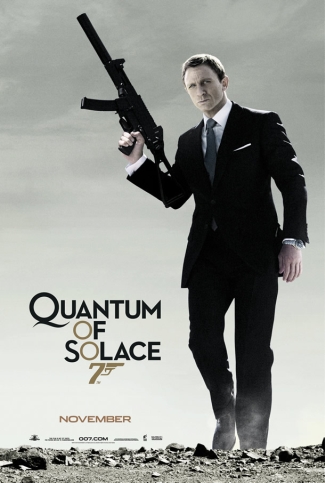
    Diagnosing Quantum of Solace

    ***SPOILERS***

    Last night I went out with my wife and some friends to watch QUANTUM OF SOLACE. I was so excited. But when the movie ended, I was totally unsatisfied. There was no release. Nothing. It just ended.

    There was lots of great stuff in it. Love the character and style of this new bond. Loved CASINO ROYALE, but this just didn’t work for me. My diagnosis has two parts.

    MINOR ISSUE: clarity in story. The chase scenes were so choppy I couldn’t get a feel for what was going on so I could worry for Bond. All I did was get sick to my stomach. Part of the way through I told my wife I was going to write death threats to the freaking director. Who in the world thought that was a good idea? It doesn’t mimic battle etc. In battle you are HYPER alert and focused. Your world doesn’t turn into chaos.

    But it was more than the chase scenes. There were times when I did not know what was going on. Why was Bond going to his friend from movie 1, why was he watching that guy pick up a bag at the play, why was he going to the party, etc.?

    If he’d shared any of his plans, I could have gotten worried when antagonistic forces thwarted him. As it was, I was just watching him do stuff and only realizing at the end what the goal was.

    The basic principle of suspense is to let me know what they need to do and why they need to do it, then let me worry as I see the operation fall apart. Or let me know the danger and see them walking into it. But time and again they didn’t provider the viewer with the necessary information in this movie. 

    MAJOR ISSUE: ineffective story structure. I think for a film to build to a huge climax and release, the hero has to find himself in more and more desperate circumstances. His situation has to become darker and darker until we see no way out for him. By the end of act 2 his plans etc. should all be in shambles. He’s out of options.

    In this Bond I rarely felt he was in danger. Yes, there were some fight sequences which were tense, but he never ended up in worse shape afterwards. We got messages that he was being framed for murders, but I never really felt the screws tightening on him. So it never got darker and darker for him.

    His plans seemed to only be delayed, not destroyed. In Casino Royale, his car is wrecked and he’s taken captive and is going to die. He loses. In this one, nothing. Even when his plane is shot down going out to the desert, it’s just a delay. They walk to the bustop and are soon back on track.

    There might be another point about something being at stake. The water grab is a great idea, but we’re talking a 50 year plot. It’s not THAT urgent.

    A FIX?

    I think they could have done more by playing up the revenge/mystery of the last one. Yes, have the water grab, but make this personal to him. He’s searching for the answers to who was behind his lover’s death. Why not?

    Then get the villain, the US CIA, and the British hunting him down with real resources. He evaded everyone fairly easily in this one. He’s running FROM all these forces, barely one step ahead, until he gets caught by them. And it’s one of Green’s guys in the CIA or something like that who captures him. So he’s totally screwed. Then have the Black CIA officer do something to spring him. He’d probably have to die for it.

    I’m sure there are more and better options. But do something so that Bond is running for his life, FAILS, then pulls it out. Not chasing down the bad guys one by one with relative ease.

    Just one option. Thoughts?

    Share
  • Servant of a Dark God Tour & Release Updates

    I will be doing a book tour this Fall. Many of the events will be with David Farland (Runelords) and Larry Correia (Monster Hunters International). Here’s the list so far. I will be making updates as we get closer.

    Trade Show: Friday & Saturday, September 25-26, Denver, CO

    Mountains & Plains Independent Booksellers Association Trade Show at the Crowne Plaza Hotel, Denver International Airport More

    Book Signing & Panel Discussion: Saturday, October 10, Salt Lake City, UT

    Sugarhouse Barnes & Noble, will include panel and multiple  SF/Fantasy authors.

    Official Book Release Day: Tuesday, October 13, North America & UK

    Yea!

    In truth it’s not a firm, fast day. The books will begin shipping from the warehouses in late September, so your bookstore may have the books a bit earlier.

    Book Signing: Thursday, October 15, Seattle, WA

    University Books, Seattle, WA
    4326 University Way N.E.
    Seattle, WA 98105
    206.634.3400

    Book Signing: Friday, October 16, Redmond, WA

    Borders, Redmond, WA
    Redmond Town Center
    16549 N.E. 74th St.
    Redmond, WA, 98052
    425.869.1907 (Near Microsoft Campus)

    Book Signing: Saturday, October 17, Beaverton, OR

    Powell’s Books, Beaverton, OR
    3415 SW Cedar Hills Blvd.
    Beaverton, OR 97005
    503.228.4651

    X96 radio and book giveaways: Monday – Saturday, October 19-24, Utah and streaming online

    Starting on Monday, October 19th and running all week long, X96 will be doing book giveaways of Servant of a Dark God. Listen to the morning Radio From Hell program (Gina, Bill, & Kerry), Kerry Jackson’s Geek Show, and Todd Nuke ‘Ems afternoon shows.

    Book Signing: Thursday, October 22, Logan, UT

    Logan Borders, 6-8pm
    435-787-0678

    Book Signing: Friday, October 23, Orem, UT

    Orem Barnes and Noble, 4-6pm

    Book Signing: Saturday, October 24, Layton, UT

    Layton Barnes & Noble, 12-2pm

    Book Signing: Saturday, October 24, West Jordan, UT

    West Jordan Barnes & Noble, 3-5pm

    Book Signing: Thursday, October 29, Mountain View, CA

    Books Inc., Mountain View, CA
    301 Castro St.
    Mountain View, CA 94041
    650.428.1234

    Book Signing: Friday, October 30, Fairfield or Half-Moon Bay, CA

    Bay Book Company in Half-Moon Bay

    Or

    Barnes & Noble, Fairfield, CA
    1600 Gateway Boulevard
    Fairfield, CA 94533
    707.435.0484

     We’ll also be hooking up with editors at World Fantasy in San Jose.

    Book Signing: Thursday, November 12, San Diego, CA

    Mysterious Galaxy, San Diego, CA
    7051 Clairemont Mesa Blvd.
    Suite #302
    San Diego, CA 92111
    858.268.4747

    Book Signing: Friday, November 13, Torrance, CA

    Borders
    3700 Torrance Blvd
    Torrance, CA 90503
    Phone: 310.540.7000

    Book Signing: Saturday, November 14, Los Angeles, CA area

    Locations TBD

    Book Signings & Possible School Visits: Thursday – Saturday, November 19 –  21, Phoenix-Mesa, AZ area

    Locations TBD

    Book Signings & Possible School Visits: Thursday – Saturday, December 3-5, Denver, CO area

    Locations TBD (this one is still iffy with my schedule)

    Share