 As of 5 PM this last Saturday I have finished 15,000 words of the climax of Curse of a Dark God. I think I have another 10,000 to go and the book will be done. I’m so close to the end of this draft! So don’t let the progress bars fool you. The ending is coming together fabulously–lots of spectacle, big reveals, and major heroics. At least, I think so.
While working on this, I had to spend a number of hours finding out how strong a wind must be to pick up humans and stones. I also needed to know the destructive forces of various classes of tornados and hurricanes. Why would I need to know such things? I write fantasy, for Leroy’s sake!
(Yes, that’s good English; I’m a writer, and one of my prerogatives is to make up silly versions of common expletives using the names of friends and enemies.)
Here’s why: I just can’t write if I don’t believe in what I’m writing. And when I’ve got monsters (skir) that can generate winds that will be used in a siege, well, I had to know the terminal velocities of what these creatures could throw, and what that might mean for fortress defense. I had to know the limitations and ramifications.
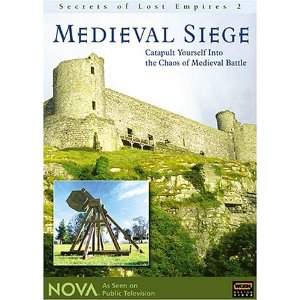
I won’t rehearse all the fascinating details (and it WAS fascinating), but all that research did lead me to a wonderful documentary. It’s called Secrets of Lost Empires 2: Medieval Siege and was produced by Nova in 2000. You can get it on Netflix or Amazon. In the film, fifty carpenters worked day and night to create and test what they dubbed “the fourteenth century version of the atom bomb”–the trebuchet (tre-byou-SHAY). The trebuchet as the most popular throwing machine in Europe during the middle ages. If you love the history of medieval war, you’ll love this film. You might want to add to it a reading of the excellent Ancient and Medieval Siege Weapons by Konstantin Nossov, which you can get via the inter-library loan program.
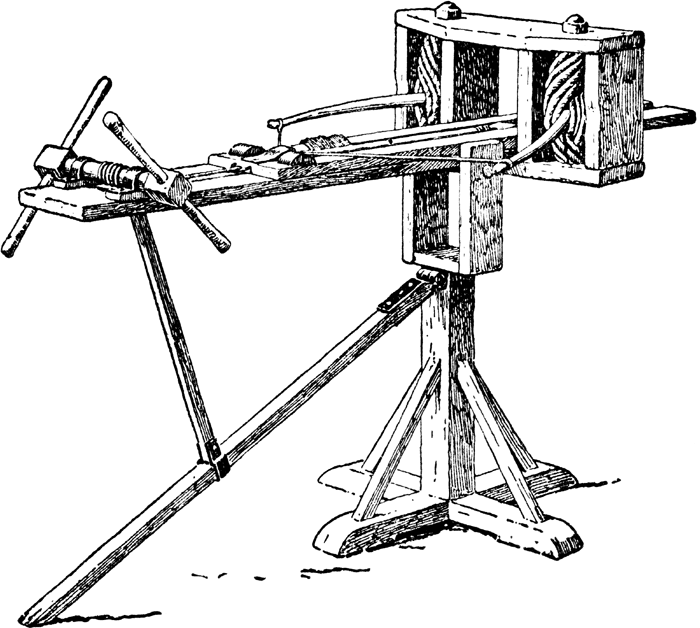
I’ll share two cool factoids for you history fans. “Catapult” means “shield-breaker,” “cata” meaning break or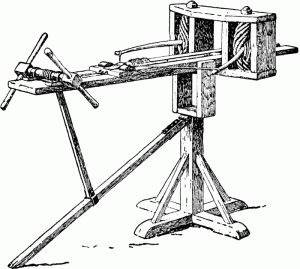 penetrate and “pelta” being the name of the shield used by the Greek light infantry. The original catapults were NOT big spoons–they sped arrows and balls along a track like a crossbow. However, instead of using the spring force of a bow, they used torsion-springs, which is what you get when you twist fibers that want to be straight. In the case of catapults the fibers were ropes made out of animal sinews or hair (horse or human, a woman’s hair being considered the best) and soaked in oil. Click on the image to see a larger picture.
A modern example of a torsion-spring are those balsa wood airplanes with propellers attached to a rubber band that’s hooked to the belly of the plane. To fly them, you rotate the propeller round and round, twisting the rubber band. Then you let the propeller go. Because the rubber wants to be straight, it reverses the twist, spinning the propeller the opposite way you twisted it.
You might think these torsion-spring engines were weak. But one catapult was reported as being powerful enough that an arrow shot from it broke through a shield, and the armored warrior standing behind it, at a distance of 400 yards! Hence, the name.
The other factoid is that “trebuchet” comes from the French term meaning to overthrow. If you saw Return of the King, you’ll recognize them as the engines used on the towers of Minas Tirith. Trebuchets are simply an evolution of the staff sling. When it came to breaking castle walls, there was nothing more effective until the cannon appeared. Of course, in my book I use them a bit differently. You’ll see.
One funny thing. I watched the movie with my oldest who was just as fascinated with the engines as I was. When she was telling my wife about the film, she kept referring to trech-uh-butts. Which, I guess, is as fair an attempt at “trebuchet” as any. However, my wife kept picturing buttocks and couldn’t figure out what the heck my daughter was talking about–“You were watching what with your father?!”
The French make things so hard . . .
***
The Monday after CONduit I left for work in Mexico and then Vegas. I didn’t get back until this week. So I just wanted to say I had a great time at the con. Loved chatting with all the folks there.
It was great to see the Larry Correia, Paul Genesse, Jessica Day George, Isaac Stewart (and his brother Dan), Mette Harrison, Eric James Stone, Darren Egget, Julie Frost, Sandra Tayler, LE Modesitt, Josh Perkey, Nicole (whose husband is an Orem cop and I lost his number), Daniel Who-I-Sacrificed-to-My-Editor, and the Dungeon Crawlers Radio guys.
It was also nice to speak with Julie Wright who was one of the initial judges for the Whitney Awards. She’s always nice to chat with, but this time it was especially nice since she said reading Servant of a Dark God was like eating chocolate. I’ll take chocolate praise any day.
I also met new author Janci Patterson who just sold a YA with a great premise. It’s called SKIP and is about a young girl whose parents are divorced. The girl has to go stay with her dad who lives in a trailer and is a bounty hunter. I’m a sucker for bounty hunter stories. Especially this one, because she goes out with him and falls in love with one of the guys her dad has to haul in. I’ve slaughtered the pitch, but I got that good old writer’s envy when she told me about it. Can’t wait to read it.
I also got to see Barbara Hambly. I was at LTUE when she was there like 20 years ago. We loved her stuff. She suddenly dropped out of the writing scene in the early 90’s and now I know why–it appears Del Rey dropped all their midlist authors except for Anne McCaffery and someone else. Hambly was one of the causalities.
***
After Hambly’s main address, I sat with a few authors and had a brief discussion about the book industry where it was suggested the industry was shrinking–fewer readers, fewer sales, doom, doom, doom. But that is exactly opposite all the data I’ve seen.
- Book sales have an annual average growth over the last seven years of 1.1%, adult paperbacks are growing 2.9% http://www.publishers.org/main/IndustryStats/indStats_02.htm or http://www.publishers.org/main/IndustryStats/documents/S12009Final.pdf . Now, this doesn’t show units sold. So it could be that they sold fewer units for more money per unit. Still, it shows at the very least that $$$ aren’t shrinking.
- The New Book Titles report here shows an increase in the number of titles: http://www.bowker.com/index.php/book-industry-statistics — 80% increase from 2002 to 2009.
- Reading rates are actually on the rise: http://johndbrown.com/2009/03/literary-reading-rates-on-the-rise/
- Finally, I contacted Bookscan for their numbers for an ALA conference I did last summer. This is just juvenile fiction, but the numbers are in units. Now, I don’t know if they added more sources to their database and so that caused a rise, but I explained to them what I was trying to do—see trends over time—and this is the data they provided. According to their numbers, more juvenile books are being sold now than in 2004. Click on the graphic below. This means we have more and more readers rising up through the ranks! One author asked how much of that was Rowling and Meyer. During that period books by those authors accounted for an average of 7-10% of all juvenile fiction. Bookscan categorizes “juvenile” as everything for kids. That means from Go, Dog Go up through what we consider Young Adult. R&M accounted for an average of 33-36% of what Bookscan categorizes as science fiction, fantasy, or magic within the juvenile mega-category. What all that means is the growth is across the whole category, not just with their books.

So I’m very sanguine about the book industry’s prospects. Today’s youth seem to be able to play computer games AND read in great quantities.
***
Finally, one last bit of news. Robinson Wells was the one of the main ones to start the Whitney Academy and the Whitney Awards. Well, he just got some fabulous news. Here’s the announcement from Publishers Marketplace: “Robison Wells’ YA debut dystopian thriller VARIANT, a modern-day LORD OF THE FLIES, set at a boarding school where not everything is as it seems and every day is a fight for survival, in a significant deal, in a three-book deal, to Erica Sussman at Harper Children’s.”
For those of you who don’t know, here are the PM deal categories.
- “nice deal” $1 – $49,000
- “very nice deal” $50,000 – $99,000
- “good deal” $100,000 – $250,000
- “significant deal” $251,000 – $499,000
- “major deal” $500,000 and up
Oh, baby. Someday. Someday. Of course, I’m nothing but happy for Mr. Wells!
Links


 Folks, the first tentative schedule for