Good Stuff: 8 Awesome Movies

Summer is a great time to catch up on great movies you haven’t seen because sometimes the movies that are released to the theaters during this time are contenders for the dud award.

I shall leave films such as Transformers: The Franchise Could Have Been So Cool or Pirates of the Caribbean: Johnny Depp Is Now Acting Really Weird nameless.

Instead of watching duds, try a couple of these fantastic movies, all of which are based on true stories.

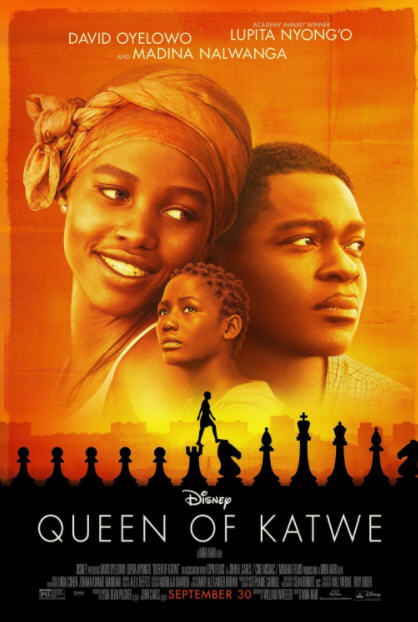
Queen of Katwe. A tremendous film based on the true story of depicts Phiona Mutesi, a girl growing up in the slums of Katwe, a city in Uganda, who gets a chance to break out of that life with chess. You will come away having laughed and cheered and been touched in a poignant way. Highly recommended.
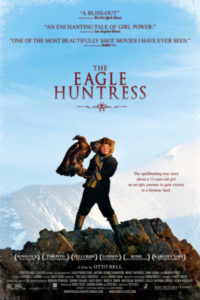
The Eagle Huntress. A fascinating documentary about the first girl in Mongolia to compete as an eagle hunter—these are folks who capture and train golden eagles to hunt game like fox or rabbit. You’ll be introduced into a new and interesting culture that triggers you to think about your own.
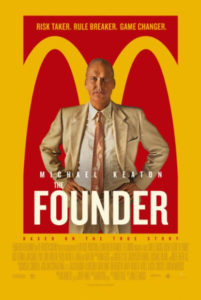
The Founder. Ever wonder how McDonald’s got started? No, neither had I. Who cares, as long as the food is good, right? Well, if you’re like me, you’re in for an eye-opener. This tells the story of how Ray Kroc started McDonald’s, except, hint, he didn’t. Kroc is played by Michael Keaton. He’s one of my favorite actors, and I loved his performance. This story will fascinate you, and then make you think, and then make you really appreciate folks like Dave Thomas of Wendy’s.
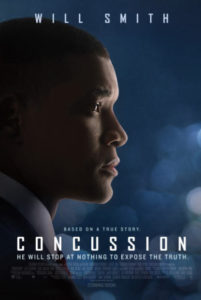
Concussion. An engrossing, suspenseful film about the true story of Dr. Bennet Omalu and the tie between football and brain degeneration. Omalu was working as a forensic pathologist (one who figures out the cause of death) in Pittsburg, Pennsylvania. In 2002, Omalu performed an autopsy on Mike Webster, a former NFL star who played for the Pittsburg Steelers and is considered by some to be one of the best centers in NFL history. And his worked opened up a can of worms the NFL wanted to quash. I loved this film.
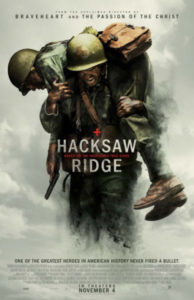
Hacksaw Ridge. This one is based on the true story of Desmond Doss, a Seventh-day Adventist who did not believe in killing, but wanted to support his country and all those going to war. So he goes into World War 2 as a medic and is sent to the Pacific theater. His first engagement is the Battle of Okinawa. And, oh my holy heck, what he did during that battle is nothing short of amazing. There’s one part of the film in boot camp that seemed out of place. Really, some dude back in the 1940s was going to do pull ups in the barracks naked (nothing but a bum is shown in the film)? But then I recall that growing up in the 70s and 80s that we guys showered in communal showers. And that wasn’t a big deal. And earlier than that, swimming at the swimming hole often meant shucking your clothes and jumping in. So who knows? We have a similar funny scene in Mulan, but for some reason that one felt more organic. This one felt tacked on. It was a gag for humor and then, thankfully, Mel Gibson, who directed this, got on with the awesome story of Doss.
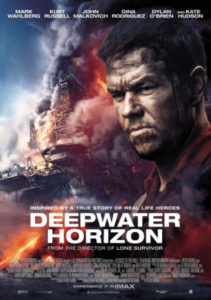
Deepwater Horizon. This one is based on the true story of the Deepwater Horizon, an oil rig in the Gulf of Mexico that encounters a catastrophe. The details of how such rigs work and the issues involved are fascinating. But what will really get you is the heroism of the captain and crew.
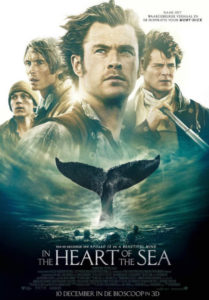
In the Heart of the Sea. This is based on the true story of the whaleship Essex that was sunk in the Pacific in 1820 by a sperm whale and what the few that survived did to remain alive. Back in the 1700s and early 1800s, sperm whale oil, which was contained in the whale’s large head, was highly prized for lamps because it burned bright and odorless. It was also a great lubricant. Later the oil was replaced with kerosene and other and petroleum-based lubricants, but in those days there was a whole industry dedicated to harvesting it. I watched this with my teenage daughter, and we both found it a powerful tale.
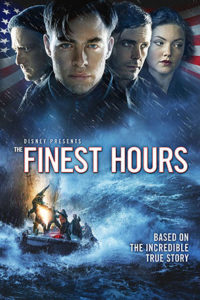
The Finest Hours. This last one is based the book The Finest Hours: The True Story of the U.S. Coast Guard’s Most Daring Sea Rescue by Michael J. Tougias and Casey Sherman. It chronicles the 1952 United States Coast Guard rescue, in a dinky boat, of the crew of the SS Pendleton, a big tanker, after the ship split apart during a nor’easter off the New England coast. The movie was thrilling and heroic.
And after you watch all of those, if you want some more great films based on true stories, well, you won’t go wrong with Tom Hanks in Sully or Captain Phillips or Bridge of Spies.

Share

Similar Posts

  • |

    Since when did young adult fiction become the cure for cancer?

    Meghan Cox Gurdon wrote an opinion piece for the Wall Stree Journal called “Darkness Too Visible” in which she complained that it was hard to find young adult fiction these days that isn’t filled with coarse, dark material–profanity, pederasty, mutilation, etc. She claims that “contemporary fiction for teens is rife with explicit abuse, violence and depravity” and wonders “why is this considered a good idea?” She concludes by saying:

    So it may be that the book industry’s ever-more-appalling offerings for adolescent readers spring from a desperate desire to keep books relevant for the young. Still, everyone does not share the same objectives. The book business exists to sell books; parents exist to rear children, and oughtn’t be daunted by cries of censorship. No family is obliged to acquiesce when publishers use the vehicle of fundamental free-expression principles to try to bulldoze coarseness or misery into their children’s lives.

    This, of course, sent hordes of folks into a frenzy of posts sneering at Gurdon’s so-called prissy sensibilities, decrying censorship, and extolling the virtues of young adult literature and dark material in particular. For example, Mary Elizabeth Williams in a Salon piece called “Has young adult fiction become too dark?” rolls her eyes, then deigns to wade into what’s she thinks is an obviously juvenile argument to apparently show Gourdon how “stupid” she really is. Williams concludes:

    One of the terrific side effects of an obviously click-baiting piece of editorial twaddle like Gurdon’s is that it reminds people how many fellow passionate readers there are in the world. That incendiary WSJ piece promptly sparked a tear-jerkingly beautiful twitter #YA saves trend full of heartfelt reactions and links to outstandingly reasoned, article responses from well-read adults and teens on the value within so much of YA literature and its downright lifesaving effects.

    Williams suggests fiction doesn’t have the power to lead people into bad behaviors. After all, she assures us, “an entire generation of women managed to devour the ‘Flowers in the Attic’ series without having sex with their brothers.” No, according to Williams (and all the #YAsaves folks), YA fiction only saves lives. And she provides a link to prove it.

    But Williams misses the mark. Completely. This isn’t about whether fiction has power to influence us in good and bad ways. There’s a huge body of research on media effects which clearly proves fiction’s power for both. Nor is it about the theraputic uses of dark material.

    The heart of the matter revolves around a rather mundane thing–customer service and marketing.

    Gurdon and those parents she describes in her article want a certain type of entertainment. For years, YA fiction has provided that type of entertainment. But things have changed, and the YA label isn’t reliable to them any more. It’s like someone who has purchased steel cut oatmeal for years is now suddenly bringing the bags home to find them filled with sardines or, horrors, Twinkies.

    We can argue the merits of sardines and Twinkies. And a hundred other foods. We can argue the merits of certain types of stories for certain types of readers. And my metaphor above–maybe you think using Twinkies is unfair; maybe you would have wanted me to use something like Triscuts or Wheat Thins. But that’s all beside the point.

    The real problem here is that the publishers have ignored a significant segment of the market who want to buy books but can’t find the types they’re interested in. Either the covers and blurb material don’t help them find what they’re looking for, sometimes misleading them, or the publishers have simply made the mistake of not thinking about this segment of the reading market.

    The fix is easy. (1) Produce more books for these folks. (2) Label your books in a way that makes it easy for the consumer to find what they want. They’re not asking for censorship. They’re asking for a nutrition label that lets them know what they’re getting. Publishers can do what the movie and gaming industries have done with rating systems that prominently display on the cover. Or use some other method. This isn’t a moral issue, it’s simply a matter of helping the right customers find your good or service. It’s a matter of good marketing and branding.

    And I would think, with the upheavals in the book industry today, that publishers and booksellers would want to do whatever they could to boost sales. Surely it doesn’t help to turn customers away because your package is confusing them.

    In the meantime, the battle will rage and this simple practical core of the issue will be lost in the fires and clouds of smoke produced by the arguments extolling and excoriating the virtues and vices of fiction.

    Share
  • Good Stuff! The Man Who Invented Christmas

    If you love funny, feel-good movies, today’s you’re lucky day.

    Because I’m going to tell you about one that will help brighten your Christmas season.

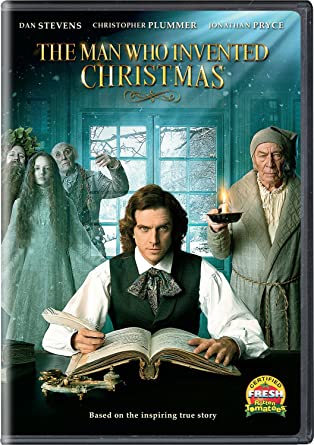
    The movie is The Man Who Invented Christmas.

    It’s about Charles Dickens, the author of A Christmas Carol.

    Now some of you might already be groaning. Please, no, not another story about Scrooge.

    I felt the same way. I haven’t enjoyed a movie about Scrooge for a long time. No, not even the one featuring Scrooge McDuck.

    So I didn’t want to watch this, but I kept hearing so many good reviews, I finally caved and gave it a shot. I’m so happy I did.

    This delightful movie reinvigorates the story with a whole new twist because it’s not about Scrooge. Not directly.

    Instead, it’s about Charles Dickens. It’s 1843 and Dickens is suffering financial hardship because his last three books bombed in the marketplace. He determines to write a new book and publish it himself to restore his finances. That book is A Christmas Carol.

    Dickens needs to finish it in six weeks so it can be ready for Christmas. That’s difficult enough, but will anyone read it? His friends and publishers keep telling him that the book will be a failure because, at the time, many thought Christmas irrelevant and didn’t celebrate it. Furthermore, the story isn’t developing as it should.

    Now the movie does take some dramatic license, but, by the end, I think you’ll agree the message of Scrooge is never more poignant. I watched the final scene with Scrooge multiple times and thought about it for days afterwards.

    If you want to laugh, be inspired, and feel the spirit of Christmas, I think you’ll love this movie.

    Share
  • |

    This American Life: Superpowers

    What superpower would you rather have–flight or invisibility? What do others choose? Why? What does it say about you?

    Want to hear about a gal named Zora who, as a teen, made a list of everything that a superhero would have to know how to do, things like flying helicopters and diffusing bombs, and then set out to do it. Zora finished her list, btw. She’s a bounty hunter now.

    You can hear this right now on  This American Life episode 178: Superpowers .

    It’s a fabulous hour-long program.

    Share
  • Buck, America the Vulnerable

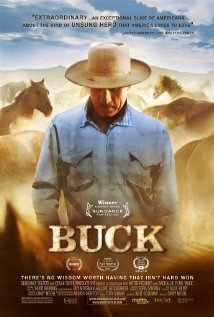
    Buck

    About two years ago I was walking out in Round Valley and saw a rider on a horse coming down a hill through the brush.  I got to him just as he moved onto the road. Right away, I noticed that there was something a bit off with the horse’s gear—the rider was not using a bridle. The rider, Wayne Batty, was using nothing more than a rope harness that went around the horse’s head. I was amazed; how did you steer the horse without a bit in its mouth?

    I asked Wayne if I might walk alongside as he rode. He agreed, and then began to talk about training and riding horses. I stuck with him for little over a mile before I had to turn back. I learned in that short period that Wayne was able to communicate with that horse with small nudges. The horse also communicated to him many things with its stance, ears, the cock of its head. Most importantly, I learned they both had built up a trust of each other. Wayne’s methods were not based on fear, it seemed, but something else.

    It reminded me a lot of the fascinating and compelling The Man Who Listens to Horses, the autobiography of Monty Roberts, that shares Roberts’ life and his development of natural horsemanship methods. Unlike many training approaches which seek to break a horse’s will through harsh punishment-based methods that often veer into abuse, natural horsemanship employs methods that are much gentler and seek to build trust in the handler. Roberts can join up with (he doesn’t “break” horses) a wild or un-ridden horse, be up on the saddle calmly riding the animal, in an incredibly short period of time.

    But Batty and Roberts aren’t the only ones practicing this. These methods have been around some time. One of the most famous practitioners and teachers is Buck Brannaman, who found his years of being severely physically abused by his father actually provided some insight into training horses.

    Says Brannaman: “I’ve started horses since I was twelve years old and have been bit, kicked, bucked off and run over. I’ve tried every physical means to contain my horse in an effort to keep from getting myself killed. I started to realize that things would come much easier for me once I learned why a horse does what he does. This method works well for me because of the kinship that develops between horse and rider.”

    Recently, a film was produced that looks at Brannaman’s life and methods. It’s called Buck and is worth every minute. If you love horses, you’ll love this movie. If you have a horse and think you might want to learn these methods, or just want to watch and listen, you might want to check out Brannaman’s teaching schedule at his site brannaman.com. He travels all over the country and is likely to hold a class within driving distance.

    America The Vulnerable

    A few years ago I received an email from my bank. At least, it looked legit to me. I opened it. It said it needed me to update some parts of my account and provided a link to the bank’s website. I clicked on the link, which took me to my bank’s website. At least, it looked exactly like my bank’s website. I entered my account number, login, and password. I made the requested changes and logged out.

    Two days later, somebody in Spain cleared every penny out of my account—thousands of dollars stolen.

    That email was a phishing (fishing) scam. The website had been a fake. I had willingly handed over my account number, login, and password to thieves.

    Luckily, the bank insures such thefts. But the problem of information security remains. Thieves living in Spain, or Russia, or LA, or China, can rob me blind from their bedrooms in their pajamas. They can do this because our information processing nowadays is increasingly tied to the internet.

    And they don’t just rob dopes like me, because it’s not just individual criminals who are in the business. Corporations and governments are in this business as well.

    They steal billions of dollars of trade secrets, engineering designs, and other intellectual property from American companies through computer hacking. They steal military secrets. For example, the US Navy spent years and about $5 billion dollars to develop a quiet electric motor for submarines that would make them incredibly hard to find and track. Chinese spies stole that technology. The Navy then spent billions more to develop a new radar for their top-of-the-line Aegis Cruiser. Chinese spies stole that, too.

    And they not only steal. Terrorists, crime organizations, and foreign governments can now insert malicious software into the computers that control, among other things, our electrical grid. They can use this in an attack, not just to shut the grid down for a while, but to destroy power generators. They can insert such software into our air traffic control system. Our train transportation systems. Our banks. They have already done this. They have already breached some of our most secure government systems.

    It sounds too far-fetched to be true, but it’s reality. Joel Brenner, who has served as the former senior counsel at the National Security Agency (NSA), the national counterintelligence executive in the office of the director of National Intelligence, and as the NSA’s inspector general writes about what he’s seen in America The Vulnerable: Inside the New Threat Matrix of Digial Espionage, Crime, and Warfare. In the book, he explains the cyber threats to individuals, corporations, and the country and what we can do about it. If you want a fascinating look into the next phase of crime, espionage, and warfare, and an introduction to some of the things you need to do to protect yourself and your company, and what we need to do as a nation, you’ll want to read this book.

    Share
  • Thai Crystal, Rothfuss, Daily Life in the Middle Ages, Perot Charts

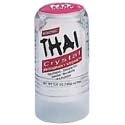
    Thai Crystal Stick - Large, 4.2 ozI don’t like anti-perspirants because they gob up in the underarms of my undershirts. Which means I eventually go walking about with pebbles in my pits. And, yes, we do have a washing machine and use it regularly. There’s something in there that defies anything less than hydro-chloric acid.


    I don’t like deodorants because they wimp out on me. I’ll put on my bracing Speedstick in the morning and be sniffing myself by lunch. And if I put some industrial perfume on it only leads to rashes.

    Someone might be saying that I should just be a real man and smell like a real man smells. But how about I be a real, smart man. See, if you’ve got dog poo in your carpet, you wouldn’t spray it with cologne, hoping to deal with the smell. No, you go to the source. Clean up the stuff and forego all the scents. In fact, if you keep the dog from pooping in the first place, you’re ahead of the game. So why not do the same with underarm odors? Just get rid of the stinkers.

    Well, that’s what I did. Many years ago I found out that natural mineral salts kill underarm bacteria. If the underarm bacteria can’t exist, let alone breed and excrete, then you don’t get underarm odor. What’s more, you can get those mineral salts in “rock” form. Just wet and wipe under your arms and you’re done. It works just like regular anti-perspirant and deodorant, it’s just that you’re delivery bacteria killers instead of perfumes.

    Another good thing about mineral salt deodrant rocks is that they last a LONG time. And I mean looooong. My last rock took about 4 years to use up (heads up all you one-year’s supply people). The problem with them is that you can’t find the rocks in the grocery store next to the big brands. But you CAN find them in health stories. I got my latest from Shangri-lah in Logan. The brand is Thai Crystal (named after the location where the US companies discovered this method of deodorizing).

    Folks, it’s 3:09 PM. I just did the sniff test–aah, the sweet smell of nothing!

    *

    The Name of the Wind (The Kingkiller Chronicle, Day 1)I heard all the hype about Rothfuss and picked up his The Name of the Wind  in a Hastings book shop. The first few pages didn’t grab me and so I put it back. But then I kept hearing the hype. I finally decided, okay, okay, I’ll give it a go.

    By “go” I mean something like five pages. See, I’m impatient with books. If you can’t grab me by the bottom of page one, I’m outta there. I read too many stories in my undergrad program that bored me to the very last page. Sometime after I graduated (why did I wait so long?) I realized that I could increase the odds of reading something interesting me if I only read things that interested me. (You only arrive at this level of brilliance after many years in college.)

    I’m not going to overview the plot here. Just know it’s a fabulous read. For you writers, note that what drives the reader’s suspense is not an overarching plot, but his situation of being alone and destitute. So while there are villains, that really isn’t what keeps the reader going. It’s the wonder of a new place and our hope for this kid.

    *

    Daily Life in the Middle AgesI read more non-fiction than I do fiction each year. I need to so that I have something to say in my writing. And I will tell you that I haven’t found a finer source of cool ideas to huck into stories than Paul Newman’s (no, not the actor cum cookie man) Daily Life in the Middle Ages.

    He breaks up medieval life into topics like Eating and Cooking, Building and Housing, Clothing and Dressing, etc. It’s full of wonderful stuff.

    Did you know that they played football back in old England? Not sissy European style, but hog style, like rugby or American football. Except it was often between two towns and the playing field was miles long.

    Did you know that respectable women wore hats? Those who let their hair go free were young girls and prostitutes. And that if a man knocked a woman’s headdress off it was tantamount to accusing her of prostitution and might result in the woman’s husband or family taking the man to court to exhonorate her. 

    Did you know that the word “curfew” came from the old French “covre feu,” meaning “cover the fire.” Since open flames were such a fire hazard in the old cities, many towns had regulations that required people to douse their lights and carefully bank their fires at a certain time in the evening which was often marked by the tolling of bells.

    I pulled these beauties out just randomly flipping through the pages. The book is full of such delights and you can be sure many of these will be finding their way into my stories.

    *

    I didn’t vote for Ross Perot the first time. I certainly wouldn’t vote for him now. But James Maxey just pointed me to an excellent on-line explanation of the current government budget. It’s worth your time to check this out to be able to understand what folks are talking about when it comes to our money and how Congress spends it. The charts are narrated, compelling, non-partisan, and incredibly easy to follow. Here are more Perot Chart presentations.  

    Share
  • |

    Update and Fage

    I passed the 90% mark today on SERVANT. It’s been wonderful going back through this story, remembering why I loved these characters so much. The cover too is coming along. I’m looking forward to revealing it in the near future. Right now everything looks like it will release on target, although that may change.

    While you’re here, you know I have been on a quest for delicious low-sugar yogurt for some time. I have found it at last. Behold.

    Fage 2 percent yogurt

    No Greek yogurt has a better taste or texture. And there’s no added sugar. Add some fruit and it’s heaven.

    It’s pronounced “fa-yeh.” Except, how do you pronounce that? Who comes up with product names nobody can pronounce? 

    But it doesn’t matter how you pronounce it. We luvs it, Precious.


    Share

One Comment

  1. Wife and I watched :The Finest Hours” (on Netflix) last night. Great movie and great story!

    If you have a big screen, you almost need Dramamine! Recommended!

Comments are closed.