Good Stuff: Books Worth Multiple Readings Part 2

What’s your typical response when someone shares a frustration, problem, or issue with you? Or when they state an opinion or desire you disagree with?

Sometimes we get impatient, exasperated, or annoyed with them and simply don’t want to hear it.

Sometimes we get mad. Or defensive. And want to line them out.

Sometimes, however, we want to help.

And wouldn’t you know it, but we sometimes cause as many problems with that last reaction as the first two.

How can this be?

Your teenage daughter comes home and expresses disappointment about something that happened at school, and you want to help. How in the world could that be wrong?

Your spouse shares a frustration about something that happened with a friend, and you don’t want him or her to be sad. This is a bad thing?

Your coworker expresses annoyance with a program management is trying to implement, and you know exactly what will fix the problem and want to share it. This is going to cause problems?

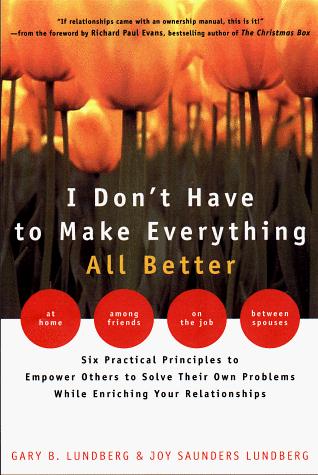
In their fabulous book, I Don’t Have to Make Everything All Better: Six Practical Principles that Empower Others to Solve Their Own Problems While Enriching Your Relationships, Gary and Joy Lundberg show two different ways of acting on the desire to help others that have dramatically different results. If we try to help using the first method, we actually create more issues. We will make the person less willing to talk to us, introduce strain into the relationship, and create a lot of stress for ourselves. On the other hand, if we try to help using the second method, we’ll find the person more willing to talk. There will be more friendliness in the relationship. And our own stress will go way down. Furthermore, we’ll end up helping the person far more than we ever could with the first method.

Gary is a licensed marriage and family therapist. His wife Joy is a writer and lyricist, and they have held marriage retreats, firesides, and seminars throughout the country. And the six principles they share in the book for using the second method all revolve around accepting this one statement: “I do not have the power to make anything all better for anyone else. I can offer my help, but I cannot make it all better.”

Accepting this view has a dramatic impact on how we approach helping others.

So when the teenage daughter comes in and expresses disappointment, instead of trying get her to buck up or tell her she just needs to do xyz with her friends, or do 123 in sports practice, we listen, validate her emotions, leave the responsibility for the problem where it belongs—with her!—and then, when it’s all out, offer to help in a way that empowers her, not have us take over.

When the spouse shares frustration, it’s the same. When the coworker expresses annoyance, the same. When someone comes in to complain to us, it’s the same.

What the Lungbergs do in this book is show exactly what this looks like with tons and tons of examples. They even have a whole chapter (a short one) which gives a list of validating phrases and questions. The first six chapters of the book explain the principles. The last eight each apply them to a different group: young children, teenagers, adult children, spouses, parents and parents-in-law, friends, and coworkers.

Folks, this book is a gem. It’s loaded with wisdom and insight. Every time I practice what’s in here, my interactions go better. This stuff produces immediate results. I just wished I’d studied and practiced it more. But it’s never too late. And that’s why I’m rereading it now.

And why I wanted to share it here. If you want to improve your interactions with others and enrich your relationships, do yourself a favor and immediately go get this book.

Share

Similar Posts

  • Ninja Master Prep, Bountiful Baskets, and Feeling Good

    Kung Fu Your Food

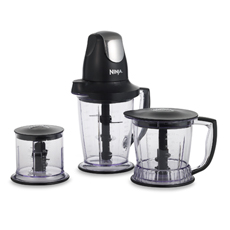
    It sounds like something off of a bad infomercial—black-clad ninjas, blenders, and, if you order now, a zirconium ruby that can withstand the pressure of a full elephant’s weight! But we didn’t get the Ninja Master Prep Professional—a six-cup pitcher and three two-cup prep bowls–from an infomercial. Santa’s up to his old tricks again. The dirty dog one-upped me and gave it to my wife for Christmas.

    Most blenders and food-processors use a single blade at the bottom of the container. When you make thicker smoothies, this means you have to stir and poke the chunks to the bottom. When you chop vegetables, it means that sometimes the stuff on the bottom turns to soup while larger chunks whirl around on top. And when it’s time to serve or remove the contents, you have to deal with the blades.

    But the Ninja Master Prep turns all that on its head. It uses multiple blades–one each at the bottom, middle, and top. You hold the motor in your hand. This configuration processes the food quickly and evenly. For example, we had 48 ounces of thick, perfectly-blended smoothies made from frozen strawberries in thirty seconds. And serving was a breeze because we simply set the motor aside, pulled the blade column out, and were left with a normal pitcher.   

    If you’re looking for a new blender or food processor, give the Ninja Master Prep Professional a try. You can find it at Sam’s Club, Target, Kohl’s, and many places online, including Amazon.com.

    Now, Grasshopper. You must learn respect–Hee-yah!

    Easy Eating

    One of the best changes we can make in our diets is to include more fruits and vegetables. I’ve found one of the easiest ways to do this is to order a weekly boxful from Bountiful Baskets (BountifulBaskets.org), a co-op which has hundreds of pickup locations in ten western states.

    The produce is cheap. And because you don’t choose what you’re going to get, you’re introduced to vegetables and fruits you might not otherwise try. Some might think that leads to eating less produce, but we’ve found it’s actually the reverse.

    One of the biggest headaches of cooking is planning the meals. In fact, I think having a menu is most of the battle. Bountiful Baskets eliminates a good portion of that planning and required shopping. Instead of trying to figure out what to cook, we know what we have to cook. It’s right there in the basket. All we need to do is build a number of the week’s meals around the produce. A few clicks on allrecipes.com and we’re ready to go.

    If you want to eat a more healthy and delicious diet, give Bountiful Baskets a go.  

    Be Happy

    It’s the holiday season and a joyous time for many people. But it’s also the worst time of year for others. We recently had another suicide in our little county. Some people might prefer we sweep such things under the rug. But it breaks my heart. Especially since such tragedy is avoidable. And I’m not talking about removing the problem with medication, although sometimes people do need to treat chemical imbalances. For many, much, if not all, of their depression is fueled by specific types of thoughts.

    These thoughts are not wacky, crazy things. In fact, they may seem innocuous or normal to some. But they are deadly all the same. Identifying and shining the truth on these thoughts takes some work, but the liberation is worth every ounce of effort.

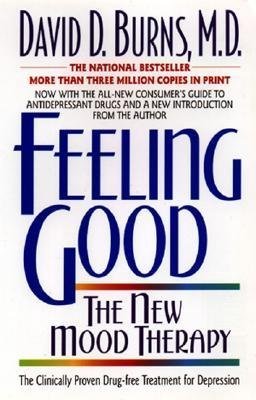
    It’s unrealistic to expect to be full of joy every minute of our lives. But it’s also not necessary, nor is it normal, to live a life dominated by feelings of worthlessness, hopelessness, pain, and self-loathing. If you or someone you know seems to feel these things on a regular basis, please, get a copy of Feeling Good by David Burns. Just read the first hundred pages and perform the techniques found there. And if you need some help being consistent, find a counselor to help you.

    Along with the jolts and pains, life provides an abundance of joys. Don’t let yourself, or those close to you, miss them.

    Share
  • “Wally” by Aslyn

    My daughter was playing this song on her internet list. The tune and singer’s voice grabbed me. I downloaded it based on that. Then I really listened.

    Oh, man.

    I cannot tell you how much I love this song. I love the melody and phrasing, Aslyn’s voice. I love the lyrics. I love the true story behind them. Gracious Lord, this is what it’s all about.

    This youtube is of a live performance. She gives a great into to the song. She tells how her grandfather Wally, who was in the Coast Guard when he young, met his wife Fae. They were married for 55 years. Then Aslyn tells how she found Wally, a few days after Grandma Fae died, sitting in his rocking chair holding a black and white picture of his wife, his eyes wet with tears. Fae had written on the picture: “to sweetest boy I’ve ever known.” You gotta listen to that intro. Then you have to get the Lemon Love album version of the song. It’s 99 cents on Amazon.

    Here are the lyrics. I’ve added the little spoken part you get on the Lemon Love version that’s not in the live performance.

    “Wally”

    [Aslyn’s grandfather]

    Hello, I’m Wally. I’m the man that had the good fortune of one day of finding a companion that would live with me for more than 55 years. No man could have ever asked for a better wife, or better friend, than the one I found across the dance floor at the USO.

    [Song begins]  

    Dear Wally, I’m writing this letter sincerely.
    To tell you you’re the “sweetest boy I’ve ever known.”
    Remember that USO when we met.
    You almost didnt go.
    Well, me and your two sons are very glad you did.
    Cause when your eyes found me I could hardly breathe.
    I wanted you.
    Glad you wanted me.

    I never stopped falling in love with you, Wally.
    From the first day I saw you
    I was sailor-bound, I just knew.
    You had me, I was yours.
    We danced out on the floor.
    And with each passing day.
    I only loved you more.

    That night was pure magic.
    Who would have imagined.
    It would become 55 loving wonderful years.
    Your job was not all easy.
    Those last years I could hardly speak.
    But when I looked at you I knew nothing had changed.
    And when I was leaving.
    I could feel you hurting.
    But then I saw those angels and I knew your love would want this for me.

    I never stopped falling in love with you, Wally.
    From the first day I saw you
    I was sailor-bound, I just knew.
    You had me, I was yours.
    We danced out on the floor.
    And with each passing day.
    I only loved you more…more… more…more… more

    So while you’re waiting
    Know that I’m saying I love you
    I love you………

    I never stopped falling in love with you, Wally.
    From the first day I saw you
    I was sailor-bound, I just knew.
    You had me, I was yours.
    We danced out on the floor.
    And with each passing day.
    I only loved you

    You had me, I was yours.
    We danced out on the floor.
    And with each passing day.
    I only loved you more..

    Dear Wally…

    Share
  • Taggart’s and a Secret

    taggartsgrillMost of the time when you go to hole-in-the-wall restaurant, it’s a hole-in-the-wall.

    But sometimes you strike gold.

    And my youngest daughter and I struck big-time gold last week two miles east of Morgan, Utah, in the canyon between Morgan and Henefer off of exit 108. I’ve driven that stretch many times and never knew anything was off that exit. Literally, if you blink, you’ll think nothing is there.

    But if you do, you will miss out on Taggart’s Grill.

    It’s nestled in some trees up against the northern slope. The first thing that strikes you when you get out of the car is the delicious aroma. Then you notice the peacocks running about. And then you enter the diner and see a display case of tantalizing, large desserts such as cheesecake, carrot cake, and huge pink-frosted cookies.

    The diner itself has a wonderful airy feeling with a high ceiling and lots of windows that offer views of the grove and garden surrounding the diner. There are seats outside in an area with a small waterfall. But we sat inside with the walls of log-cabin wood and the stained glass panels hanging in the windows.

    They serve a variety of dishes from sandwiches and soups to pizza, burgers, and fancy plates of salmon or tenderloin. And while the views and setting is awesome, the food is where they really shine.

    The beef stew was thick and amazing. The battered fries perfect. The sandwiches were wrapped in thick and soft flat bread that was delicious. And speaking of bread, they asked if I wanted a roll with the stew. I said yes. They didn’t bring out a roll–they brought out a small loaf of what appeared to be freshly baked bread. We of course had to try one of the desserts and opted for the
    carrot cake. It was lovely with a hint of almond in the cream cheese frosting.

    The portions were huge and so we took enough home for another meal for three.

    We’re going back.

    I want to try one of their burgers, the halibut, and the BLT.

    If you like great food at a great price and are anywhere near Morgan, don’t blink at exit 108. Just pull off and enjoy an awesome meal.

    *

    Parents of Rich Middle School students, what if I told you that researchers have uncovered a secret activity that teens enjoy that has the side benefit of actually raising their grades in all of their classes.

    But that’s not all. This one secret thing will help them get better jobs years in the future.

    It will help them make more money.

    And they won’t even know that it’s doing this for them. They won’t care. Because they won’t be doing it for the grades or money. They’ll be doing it for the enjoyment it brings. They’ll be doing it just because they like to do it.

    One little surprising thing.

    And it’s backed up by lots and lots of research.

    Do you want to know what this activity is?

    Do you want to open up opportunities for your child?

    If you do, come to the meeting Mrs. Brown is having at 7:00 p.m. on Wednesday, October 12 at the Rich Middle School.

    We will reveal all there.

    Share
  • The Last Apprentice, Path Finder

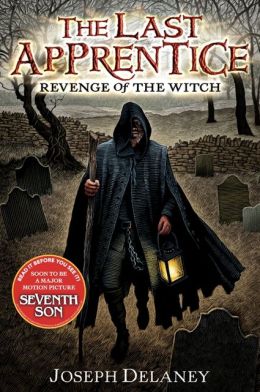
    The Last Apprentice

    Revenge of the Witch by Joseph DelaneyMy wife is always telling me I need to write a young adult or middle grade adventure series. One that’s directed at boys.

    Not because we have something against girls. We have four daughters, and my wife is adamantly pro-woman. But she finds very few books for her sixth-, seventh-, and eighth- grade male readers. I haven’t done a count, but I’m pretty sure that most YA is targeted at females. And this isn’t just me. I remember visiting a Barnes & Noble in Arizona with my voracious-reader nieces a few years ago and riding the escalator to the YA section. They told me that they called it the “girl-book section” because they figured that basically 90% of it was indeed for girls.

    Anyway, I think writing such an adventure would be a blast. I can already think of a number of near future or fantasy settings that would rock. But the time constraints I have right now just won’t allow me to start another series. Nevertheless, we sat down the other day and listed out all of the authors and books we knew that had a more male focus.

    For about the twentieth time she told me about Joseph Delaney’s The Last Apprentice series. It’s about a boy who apprenticed to the county Spook who is someone that takes care of witches, ghasts, ghosts, etc.  Her students love the stories. She loves them. She has bought the first ten volumes for her classroom. Why the heck wasn’t I reading them?

    Well, for starters, I just don’t like books about witches. And the first book in the series is called Revenge of the Witch. I don’t know what it is. Witches aren’t as bad a zombies–I am SO bored with zombies; I just don’t get the appeal. But even if they’re better than creatures that make no sense at all to me, I just don’t like spooky horror all that much. I loved to be scared, startled, and filled with dread. But not with witches.

    Witches? The gals with pointy hats?

    No.

    But this was, as I said, like the twentieth time she’d brought it up. We were driving over to Logan (that’s the big city for us), and stopped at the library, and we went over to the YA section. Unfortunately, they didn’t have volume one. But I did see many other volumes on the shelf and figured I needed to see what the competition was doing. So I perused. A few night later we went to her classroom, and there was volume one. The one about the witch.

    I sighed and opened it and began to read. And when I finished chapter one, I realized I kind of liked it. It was like the old Life cereal commercials—hey, Mikey!—and I wanted to read more. And so I took it home, read the whole book, and was delighted with the story. I liked it so much I promptly borrowed volume two, Curse of the Bane, from my wife’s classroom and read it as well. And I liked that one so much I checked out the third.

    The story is about Thomas Ward, the aforementioned apprentice. In book one, he is forced to face down some witches. But it’s Alice, the girl with pointy shoes, who made the story for me. Adding her as a character transformed it from a run-of-the-mill booger man story, into something special. No, I’m not going to give you a peek at the plot. Just know that this is the book where Thomas starts his apprentice, has to deal with that new life (and I thought Delaney captured that so well), and makes some apprentice mistakes that he then has to fix.

    In book two, we get to meet Alice and Thomas again, but this time they have to face down a different creature. And again, while the adventure is all cool, it’s the interactions with Alice that put it over the top.

    Having praised the books, I will say that I think Delaney has something against priests and religion in general because he paints it all with a negative broad brush. It’s too bad. Not only is such a view inaccurate, but showing the good and bad could add so many delicious dimensions to the tale. Maybe we’ll see that in later books. But even if we don’t, book two was still a great read.

    I’m looking forward to book three. If you’re in the mood to try something new, something about a young man and young girl that doesn’t revolve around romantic smoldering, something that a guy would like to read, let me recommend you join me in reading the volumes of The Last Apprentice.

    Pathfinder
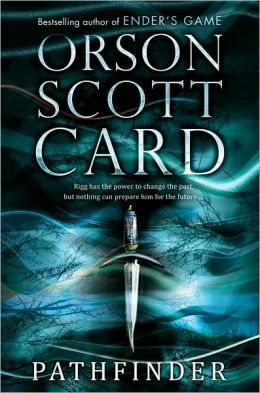
    Pathfinder by Orson Scott CardI was once in a discussion about religion with a friend who happens to be an atheist and fellow science fiction and fantasy writer. He’s a great guy. The blog posts he wrote about the passing of the woman he loved who was lost to cancer were poignant and wonderful–full of beauty. I read them and wanted to be a better man. Still, he and I disagree about God.

    I remember telling him that science fiction is the one genre that makes God more plausible than any other. At least, it makes my view of God more plausible.  Now, I do not want to talk religion in this essay. But it’s just hard for science fiction to leave the idea of creation and Adam and Eve alone. Witness the many stories over the years about these very things.

    Heck, even the recent movie Oblivion has references—are not Jack and Victoria much like Adam and Eve? Just think about it. Their paradise together as a team, the knowledge, the fall. The echoes are simply marvelous.

    Well, I just read another science fiction tale that provided a wonderful opportunity to think about these things. It’s Orson Scott Card’s novel Pathfinder. Now, the story isn’t about God. It’s not a biblical allegory. It’s not dressed-up doctrine. It’s a tale about a boy named Rigg with special abilities on a quest to find his real family and who he is. Along the way we meet some interesting people, especially one character named Loaf who leavened the whole tale. So there’s an interesting adventure and speculations about faster-than-light travel. But one of the chief delights for me was the questions and ideas this story raised in my mind about the creation of our own world—“Garden,” the name of the world, just begged for it.

    For example, a long-time staple of science fiction is the idea of terraforming—changing face of the flora, fauna, atmosphere, and climate of the planet to be hospitable to your species. If you believe in a God that is more a being of advanced technology than one of unknowable fantasy, doesn’t that present a new and interesting way of viewing the creation story? It does for me, and Pathfinder sparked ideas about this.

    The book also led me to think about life. First, Card has these characters called “Expendables.” They’re robots, but not really. They’re artificial intelligence. But not really. The way Card presents the expendables, you don’t think of silicon and steel and gears. You think of biology.

    You think of mosquitoes.

    You think about the fact that if we humans use intelligent machines, surely God must use intelligent machinery. So what kind of intelligent machinery does God employ? (Dude, that idea is just pregnant with stories!)

    Are viruses and bacteria machines? Are mosquitoes and beetles (please, let there be no mosquitoes in heaven)?

    The book prompts me to wonder. It prompts me to look at the life about me on our wonderful world with new eyes. It prompts me to think differently about some of my core definitions. In fact, there are some exchanges between a character and an expendable where they talk about the difference between humans and expendables and the definition of what it means to be human, especially given evolution.

    This is a book about an adventure, but also a book about ideas, which is as it should be. Science fiction is the one genre, more than any other, that marries character and plot with exploration of ideas. If you’re looking for an interesting tale that will make you think about our world differently, give Pathfinder a try.
    Share
  • Good Stuff! La Brea, Bingham’s, Aggie Lemon Custard

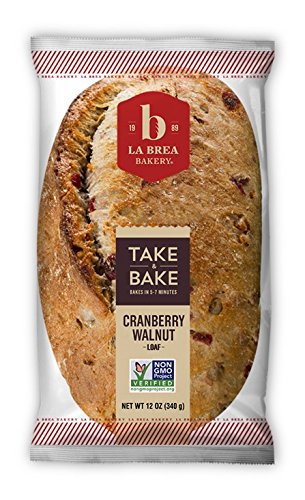
    I have cut my consumption of bread to almost nothing. And so when I want a slice, I’m not going to waste it on run-of-the-mill sandwich bread. I want something delicious. And the best bread we’ve found is the La Brea Bakery bread that’s sold at Smith’s and other Kroger food stores.

    Our favorites are the cranberry walnut loaf, the toasted sunflower honey loaf, and the pecan raisin loaf. These breads are made the old-fashioned way with a substantial crumb and a crackly, chewy crust that’s a joy to eat. And unlike the bread from a chain bread company that will remain unnamed, these loaves are actually fully cooked.

    We just got two loaves today on our trip to Logan. We came back home, cut a few slices, popped them in the toaster, buttered, and ate with some chicken noodle soup. Pure bread heaven.

    #

    With that bread you might want some bratwurst. Not grocery store brats. Real brats. If so, I found the spot to get them (thank you, Larry Correia). There’s a gem of a butcher’s shop in Morgan, Utah called Bingham’s Custom Meats. It’s clean, well-lit, and nice-smelling. The people there are friendly. And they have over thirty different flavors of brats.

    Bratwurst, by the way, comes from German. It’s made up of two words. “Brat,” which means finely chopped meat, and “wurst,” which means sausage. At Bingham’s they don’t add nitrates or any other preservatives. Their recipes are pork mixed with various sets of spices.

    So far I’ve tried nine of their flavors, and they’ve all been delicious. They’re great for a low-carb diet. A Bingham’s brat and a bunch of cooked vegetables makes an awesome lunch. If you want, you can also just slit the casing and cook the sausage patty or stir fry style.

    #

    I’ve also cut my consumption of sweets. Which means if I eat something, I want it to be worth it. And so it gives me great pleasure to report my discovery of a wonderful flavor of Aggie ice cream at the USU Creamery—it’s called lemon custard.

    I know. Lemon ice cream?

    And when I say ice cream, I mean ice cream. This is not a sherbet. And let me tell you right now, this ice cream is amazing. It’s amazing all by itself. It’s amazing with a banana, which they sell at the creamery. Furthermore, for a little fun, if you combine it with the regular Aggie chocolate, the two together taste like a Tootsie Roll. No lie.

    I had it last month, and the month before, and I can’t wait for another date with the wife to go enjoy another scoop.

    Share
  • Stonefather by Orson Scott Card

    stonefather_72dpi“When Runnel was born, he was given a water name even though there had never been a wetwizard in the family.

    In the old days such names were given only to those babies as would be sacrificed to Yeggut, the water god. Later, such names were given to those whould would live to serve as priests to Yeggut. Still later, wetnames went to children of families thath pretended they once had a watermage in their ancestry.

    But now, in the village o Farzibeck, wetnames were given because the mother was fond of a nearby brooklet or because the father had a freind with such a name.”

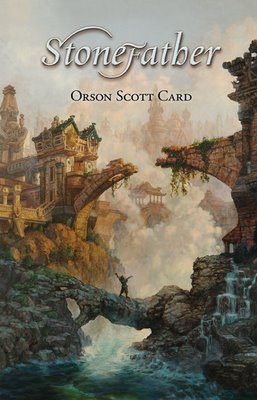
    So begins Stonefather by Orson Scott Card. It tells the tale of Runnel who is the ninth son and fifteenth child of a farmwife who likes all her children well enough but calls them all “by each other’s names and didn’t know enough numbers to take a census and notice when one or two were missing.”  He’s also the son a man who beats him. Eventually, Runnel leaves home and seeks his fortunes in Mitherhome, the big city far to the south.

    This isn’t a full novel, but a novella of 112 pages. However, the Subterranean Press edition has a glorious cover and ink illustrations inside. More importantly, the story tells a tale that’s full of wonder, humor, and a number of delightful characters. It reminded me of the best of Card’s Hatrack books. But, of course, this world is very different. It’s strange, and I was happy to explore it with Runnel as my guide. Take an hour to read this. You won’t be disappointed. Then you can look forward, as I do, to the first of the Mithermage novels based on this world.

    Share

2 Comments

  1. Thanks, John. Food for thought. And addresses learning points i am facing at work with colleagues at this exact moment. Regards.

Comments are closed.