Ninja Master Prep, Bountiful Baskets, and Feeling Good
Kung Fu Your Food

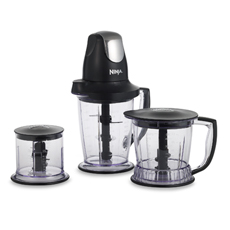
It sounds like something off of a bad infomercial—black-clad ninjas, blenders, and, if you order now, a zirconium ruby that can withstand the pressure of a full elephant’s weight! But we didn’t get the Ninja Master Prep Professional—a six-cup pitcher and three two-cup prep bowls–from an infomercial. Santa’s up to his old tricks again. The dirty dog one-upped me and gave it to my wife for Christmas.

Most blenders and food-processors use a single blade at the bottom of the container. When you make thicker smoothies, this means you have to stir and poke the chunks to the bottom. When you chop vegetables, it means that sometimes the stuff on the bottom turns to soup while larger chunks whirl around on top. And when it’s time to serve or remove the contents, you have to deal with the blades.

But the Ninja Master Prep turns all that on its head. It uses multiple blades–one each at the bottom, middle, and top. You hold the motor in your hand. This configuration processes the food quickly and evenly. For example, we had 48 ounces of thick, perfectly-blended smoothies made from frozen strawberries in thirty seconds. And serving was a breeze because we simply set the motor aside, pulled the blade column out, and were left with a normal pitcher.   

If you’re looking for a new blender or food processor, give the Ninja Master Prep Professional a try. You can find it at Sam’s Club, Target, Kohl’s, and many places online, including Amazon.com.

Now, Grasshopper. You must learn respect–Hee-yah!

Easy Eating

One of the best changes we can make in our diets is to include more fruits and vegetables. I’ve found one of the easiest ways to do this is to order a weekly boxful from Bountiful Baskets (BountifulBaskets.org), a co-op which has hundreds of pickup locations in ten western states.

The produce is cheap. And because you don’t choose what you’re going to get, you’re introduced to vegetables and fruits you might not otherwise try. Some might think that leads to eating less produce, but we’ve found it’s actually the reverse.

One of the biggest headaches of cooking is planning the meals. In fact, I think having a menu is most of the battle. Bountiful Baskets eliminates a good portion of that planning and required shopping. Instead of trying to figure out what to cook, we know what we have to cook. It’s right there in the basket. All we need to do is build a number of the week’s meals around the produce. A few clicks on allrecipes.com and we’re ready to go.

If you want to eat a more healthy and delicious diet, give Bountiful Baskets a go.  

Be Happy
It’s the holiday season and a joyous time for many people. But it’s also the worst time of year for others. We recently had another suicide in our little county. Some people might prefer we sweep such things under the rug. But it breaks my heart. Especially since such tragedy is avoidable. And I’m not talking about removing the problem with medication, although sometimes people do need to treat chemical imbalances. For many, much, if not all, of their depression is fueled by specific types of thoughts.

These thoughts are not wacky, crazy things. In fact, they may seem innocuous or normal to some. But they are deadly all the same. Identifying and shining the truth on these thoughts takes some work, but the liberation is worth every ounce of effort.

It’s unrealistic to expect to be full of joy every minute of our lives. But it’s also not necessary, nor is it normal, to live a life dominated by feelings of worthlessness, hopelessness, pain, and self-loathing. If you or someone you know seems to feel these things on a regular basis, please, get a copy of Feeling Good by David Burns. Just read the first hundred pages and perform the techniques found there. And if you need some help being consistent, find a counselor to help you.

Along with the jolts and pains, life provides an abundance of joys. Don’t let yourself, or those close to you, miss them.

Share

Similar Posts

  • Bartimaeus & The Time Traveler’s Guide to Medieval England

    Pure Delight

    One of the most delightful literary characters to appear in the last decade is the cheeky Bartimaeus–a five-thousand-year-old djinni (“genie”) who plays the lead role in Jonathan Stroud’s trilogy The Amulet of Samarkand, The Golem’s Eye, and Ptolemy’s Gate.

    In Stroud’s world, magicians have no magic in themselves, but they do have the lore to summon and enslave demons, who can work magic. There are demons of various levels and powers. The lowest regularly summoned and enslaved are Imps, who can be crude and like to tell outright whoppers, but are good for standing watch and carrying messages. Next come Foliots, which Bartimaeus describes as “cut price djinn.” In the middle of the great chain of beings are the Djinn themselves, whose clever intelligence Bartimaeus extols, followed by Afrits, and finally Marids, who are rarely summoned because they are too strong for any but the most powerful magicians to control. Of Marids, Bartimaeus insightfully reveals that they are “dreadfully full of themselves.”

    In the trilogy, Bartimaeus is summoned and enslaved to do the bidding of a sometimes jerkish young magician who learns to be a better person, despite himself. Of course, along the way the magician sends Bartimaeus in great peril, which he eludes with cunning, sardonic wit, and many good one-liners. I read the first book, loved it, then listened to all three read by Simon Jones, who makes these stories even better. The sad news is that I finished them. I simply wasn’t ready to let Bartimaeus go.

    Which is why I was so happy to find that Stroud recently released a fourth book: The Ring of Solomon, which is a stand-alone prequel to the trilogy. The family and I just finished listening to it, and it is every bit as good, if not better, than the first three.

    This story is set in biblical times where King Solomon has risen to uncontested power because of his possession of an all-powerful ring which allows him to summon hordes of powerful demons in a blink. Bartimaeus is enslaved to one of Solomon’s magicians.  A mean man, who Bartimaeus catches in a mistake and escapes, principally by devouring him. But Solomon doesn’t take kindly to that, and orders Khaba, a sinister and cruel magician, to summon him back to make an example for the other demons.

    Meanwhile, the Queen of Sheba, having denied Solomon’s marriage proposal three times, is sent an extortion threat.  Angry and frightened, she sends Asmira, a young woman and loyal captain of the guard, to Jerusalem to assassinate Solomon.

    Bartimaeus and Asmira hook up and find themselves in quite a pickle as they attempt to solve their problems. The story provides lots of humor, adventure, peril for both Bartimaeus and Asmira, and a number of surprising turnarounds. It also, in its own way, makes a comment on leadership, loyalty, and zealotry.

    You’ll find it in the middle-grade section of your bookstore, but don’t let the placement fool you into thinking it’s not for adults. Like the best stories, it offers something for everyone. It’s a perfect blend of insight and entertainment and had my whole family, oldest to youngest, spellbound for the duration as we listened to it riding in the car. This is one of my favorite books this year. And if you want to really indulge yourself, listen to the audio book read by Simon Jones.

    Travel to Medieval England

    I love learning new things about places and peoples, even if it’s a place I’ve “been” to before, which is why Ian Mortimer’s The Time Traveler’s Guide to Medieval England intrigued me. The first page convinced me to buy to book. And I’m so happy I did.

    I’ve read my fair share of interesting and well-written texts on this subject, including, among others, Life in a Medieval City and Life in a Medieval Village by Frances and Joseph Gies, Standards of Living in the later Middle Ages by Christopher Dyer, The Medieval Castle by Philip Warner, Daily Life in the Middle Ages by Paul B. Newman, and Power and Profit: The Merchant In Medieval Europe by Peter Spufford. All engrossing reads. What sets Mortimer’s book apart is that he not only approaches the topic as a travel guide that leads to you interesting sights and shares fascinating tidbits about the place, but he also helps you imagine how it would be, as a 21st century person, to actually travel there.

    For example, where would you go if you got sick? What happens if you’re robbed, where do you report the crime, and should you? Where might you get food and would it be something you’d find palatable? How will you get from place to place? Why kind of entertainment can you expect? And what can you wear without offending your hosts?

    Mortimer focuses on the fourteenth century England, since this period comes closest to the popular idea of the medieval times. He tackles the topics of the landscape, people, the Medieval character, basic essentials, what to wear, traveling, where to stay, what to eat and drink, health and hygiene, the law, and what to do. And he does it all in a chatty, clear, and informative manner, with a bit of humor thrown in for spice.

    Each page was a delight, and I found myself feeling like I was there. Furthermore, I learned a number of things that I hadn’t picked up in my previous readings. I’m tempted to quote all sorts of interesting tidbits he shares about the age, but I’ll refrain. If you are at all interested in the Middle Ages, I think you’ll love this book.

    Share
  • Good Stuff! The Highwayman by Alfred Noyes

    Alfred Noyes (1880-1958) wrote poetry that thundered and sang. It’s the kind of stuff that begs to be read aloud. And I want to share with you one of my favorites–“The Highwayman.” I love it for the sound, the story, and the awesome images (note all the color).

    All you need to know is that back in the 1600s and 1700s, a highwayman was a robber, often on horseback, who held up travelers. And that when it mentions “priming,” it’s talking about the charge of powder used to ignite a musket.

    For maximum pleasure, let me suggest you start Loreena McKennitt’s killer ballad version I’ve embedded at the end, then scroll back up and read along as she sings.

    THE HIGHWAYMAN
    By Alfred Noyes

    The wind was a torrent of darkness among the gusty trees.
    The moon was a ghostly galleon tossed upon cloudy seas.
    The road was a ribbon of moonlight over the purple moor,
    And the highwayman came riding—
    Riding—riding—
    The highwayman came riding, up to the old inn-door.

    He’d a French cocked-hat on his forehead, a bunch of lace at his chin,
    A coat of the claret velvet, and breeches of brown doe-skin.
    They fitted with never a wrinkle. His boots were up to the thigh.
    And he rode with a jewelled twinkle,
    His pistol butts a-twinkle,
    His rapier hilt a-twinkle, under the jewelled sky.

    Over the cobbles he clattered and clashed in the dark inn-yard.
    He tapped with his whip on the shutters, but all was locked and barred.
    He whistled a tune to the window, and who should be waiting there
    But the landlord’s black-eyed daughter,
    Bess, the landlord’s daughter,
    Plaiting a dark red love-knot into her long black hair.

    And dark in the dark old inn-yard a stable-wicket creaked
    Where Tim the ostler listened. His face was white and peaked.
    His eyes were hollows of madness, his hair like mouldy hay,
    But he loved the landlord’s daughter,
    The landlord’s red-lipped daughter.
    Dumb as a dog he listened, and he heard the robber say—

    “One kiss, my bonny sweetheart, I’m after a prize to-night,
    But I shall be back with the yellow gold before the morning light;
    Yet, if they press me sharply, and harry me through the day,
    Then look for me by moonlight,
    Watch for me by moonlight,
    I’ll come to thee by moonlight, though hell should bar the way.”

    He rose upright in the stirrups. He scarce could reach her hand,
    But she loosened her hair in the casement. His face burnt like a brand
    As the black cascade of perfume came tumbling over his breast;
    And he kissed its waves in the moonlight,
    (O, sweet black waves in the moonlight!)
    Then he tugged at his rein in the moonlight, and galloped away to the west.

    He did not come in the dawning. He did not come at noon;
    And out of the tawny sunset, before the rise of the moon,
    When the road was a gypsy’s ribbon, looping the purple moor,
    A red-coat troop came marching—
    Marching—marching—
    King George’s men came marching, up to the old inn-door.

    They said no word to the landlord. They drank his ale instead.
    But they gagged his daughter, and bound her, to the foot of her narrow bed.
    Two of them knelt at her casement, with muskets at their side!
    There was death at every window;
    And hell at one dark window;
    For Bess could see, through her casement, the road that he would ride.

    They had tied her up to attention, with many a sniggering jest.
    They had bound a musket beside her, with the muzzle beneath her breast!
    “Now, keep good watch!” and they kissed her. She heard the doomed man say—
    Look for me by moonlight;
    Watch for me by moonlight;
    I’ll come to thee by moonlight, though hell should bar the way!

    She twisted her hands behind her; but all the knots held good!
    She writhed her hands till her fingers were wet with sweat or blood!
    They stretched and strained in the darkness, and the hours crawled by like years
    Till, now, on the stroke of midnight,
    Cold, on the stroke of midnight,
    The tip of one finger touched it! The trigger at least was hers!

    The tip of one finger touched it. She strove no more for the rest.
    Up, she stood up to attention, with the muzzle beneath her breast.
    She would not risk their hearing; she would not strive again;
    For the road lay bare in the moonlight;
    Blank and bare in the moonlight;
    And the blood of her veins, in the moonlight, throbbed to her love’s refrain.

    Tlot-tlot; tlot-tlot! Had they heard it? The horsehoofs ringing clear;
    Tlot-tlot; tlot-tlot, in the distance? Were they deaf that they did not hear?
    Down the ribbon of moonlight, over the brow of the hill,
    The highwayman came riding—
    Riding—riding—
    The red coats looked to their priming! She stood up, straight and still.

    Tlot-tlot, in the frosty silence! Tlot-tlot, in the echoing night!
    Nearer he came and nearer. Her face was like a light.
    Her eyes grew wide for a moment; she drew one last deep breath,
    Then her finger moved in the moonlight,
    Her musket shattered the moonlight,
    Shattered her breast in the moonlight and warned him—with her death.

    He turned. He spurred to the west; he did not know who stood
    Bowed, with her head o’er the musket, drenched with her own blood!
    Not till the dawn he heard it, and his face grew grey to hear
    How Bess, the landlord’s daughter,
    The landlord’s black-eyed daughter,
    Had watched for her love in the moonlight, and died in the darkness there.

    Back, he spurred like a madman, shouting a curse to the sky,
    With the white road smoking behind him and his rapier brandished high.
    Blood red were his spurs in the golden noon; wine-red was his velvet coat;
    When they shot him down on the highway,
    Down like a dog on the highway,
    And he lay in his blood on the highway, with a bunch of lace at his throat.

    . . .

    And still of a winter’s night, they say, when the wind is in the trees,
    When the moon is a ghostly galleon tossed upon cloudy seas,
    When the road is a ribbon of moonlight over the purple moor,
    A highwayman comes riding—
    Riding—riding—
    A highwayman comes riding, up to the old inn-door.

    Over the cobbles he clatters and clangs in the dark inn-yard.
    He taps with his whip on the shutters, but all is locked and barred.
    He whistles a tune to the window, and who should be waiting there
    But the landlord’s black-eyed daughter,
    Bess, the landlord’s daughter,
    Plaiting a dark red love-knot into her long black hair.


    Share
  • Good Stuff! Woman in Gold

    Woman in GoldI recently watch Woman in Gold with my family, and we loved it. It has delightful characters, a suspenseful plot, and moments of both humor and deep poignancy.

    The movie is based on the true story of Maria Altmann, an elderly Jew living in Los Angeles. When she was a young woman, the Nazis took over Austria. She fled, narrowly escaping. In addition to all the horrors committed against her people and family that couldn’t get out, the Nazis stole artwork and other precious items. The problem is that after the war, many of these items were then appropriated by individuals or the countries of Europe and not returned to their original owners.

    The movie is about Maria and her young lawyer who fight the Austrian government to have a famous painting called Woman in Gold that was legally and rightfully hers returned. It’s a legal battle that went all the way to the Supreme Court of the United States in 2004. But this isn’t about someone wanting a painting. It’s about so much more.

    If you enjoyed Mr. Holmes, Saving Mr. Banks, or Bridge of Spies, I think you will love this movie. You will love the dynamic between the frank-speaking Maria and her lawyer. And you will be moved.

    Share
  • Flaming Gorge, Ticket to Ride, Thai Evergreen

    I want to tell you about a river that is emerald green, clear enough to see the rocks on the bottom sixteen feet below as well as the trout, and provides a wonderful family getaway. I’m talking about the Green River just below the Flaming Gorge dam in north-eastern Utah. 

    Yes, that picture’s of the Green River. Yes, it’s that beautiful and that clear in the calmer parts, of which there are many.

    We just ran the seven mile stretch that starts just below the dam and goes down to the Little Hole campground with our four girls (ages 6 – 15) and had a ball. During our trip we saw otters swimming  up the river not more than six feet from our raft, a herd of mountain sheep off the side of the road, fish and more fish, a snake a long as a man with a light silvery skin mottled with black rectangles, and two osprey (one that dove under the water to get a fish and a second flying about twelve feet over our raft with a fish in its clutches). We ran some class II rapids. This time of year they weren’t scary to me, but provided plenty of thrills and stress for the kids. The water was warm enough to swim in, but cold enough to give you a shock. And it was so CLEAR.  Of course, there were spots too deep to see the bottom. But there were plenty where you could see the river plants, rocks, and aquatic life. And all of it in that emerald hue.

    The girls were in the water inbetween every set of rapids. We packed a cooler and so stopped a number of times. Once to check out a waterfall, another time to snack, another to play on a sandbar, yet another to chase those otters, a bathroom break (outhouses provided by the park service), another time to swim.  

    The Flaming Gorge area features the beautiful landscape seen in Southern Utah–red rock, pines, junipers. People come from all over to run the river and fish. We didn’t fish this time, but there were plenty of anglers who had rented boats. Still, it didn’t feel crowded at all. There were long stretches where we had the gorge to ourselves. Next time I think I’m going to bring a book (in a waterproof ziplocok) and we’ll spend a little more time on one of our stops to sit and relax.

    Some tips:

    • Bring a cooler. You’ll want to put in along the river and enjoy the gorge. There’s no hurry to finish.
    • Bring good water shoes that have a sole with traction and netting to keep gravel out. (I got a pair at Wal-Mart that made the whole ride wonderful.) Also bring a hat and sunscreen. If you wear a cotten tee-shirt and quick drying shorts you’ll enjoy the ride even more.
    • We stayed at the Flaming Gorge Resort the night before our run. It’s been around a while and the condos showed it, but it wasn’t bad. The condos had a kitchen. And the restaurant had large servings of good food.
    • You might also want to bring a way to transport the raft inflated. We put ours on top of the minivan and had no problem taking it to and from the rental shop. However, I wished I had learned the trucker’s knot. The knots I tied cinched up into nasty snags that proved very difficult to untie.
    • Bring two vehicles or a bicycle. The businesses there charge close to $50 to shuttle your car the 9+ miles between the launch below the dam and Little Hole. That was outrageous to me. Next time we’ll bring a bike, lock it up by Little Hole, and have one of us bike back for the car. Or you can park half way inbetween at Dutch John after you’ve launched your raft and make the hour walk down. Of course, if you’re an early riser, the rental shop in Dutch John offers a $20 shuttle from Little Hole to the Dam, but only at 8:30 AM and 9:30 AM.

    *

    While in Provo this year for the Freedom Festival I purchased Ticket to Ride (European version). I wanted to do more than walk around or swim at the pool with the family. It was an excellent purchase and recommendation from the folks at Games People Play in the Orem mall. Of course, the kid at the store had played everything in the store and knew just where to steer us. It only took a few minutes to figure out how to play and everyone from the 6 year old to both Nellie and I had fun. It’s so fun we’ve played it a number of times since we got back.

    *

    Both Nellie and I learned to love Indonesian food during the years we spent in the Netherlands. Alas, not many Indonesian restaurants around. In search of something similar while living the in the San Francisco area, we found Thai food.

    Ah, that dream within a dream.

    And now we found yet another Thai restaurant in Utah with excellent food. So good my two oldest daughters get cravings to go back. The first is Thai Evergreen in Orem, Utah. It looks like a family owned operation and is. And their food is delicious. Four family’s went while at this year’s Freedom Festival, which meant we ordered quite a variety of food. Everything I tasted was delicious.

    The next is Kamin in Logan, UT. Again, wonderful. Nellie and I have eaten there a number of times and never leave unsatisfied.

    Share
  • Interview with Edmund Schubert, editor of IGMS

    I recently had the wonderful opportunity to interview Edmund Schubert, the editor for Orson Scott Card’s Intergalactic Medicine Show, about How To Write Magical Works: A Writer’s Companion, a collection of essays about the craft and the business of writing that he edited. Ed’s someone to listen to. But so are the authors whose essays fill the book: Faith Hunter, David Coe, C.E. Murphy, Misty Massey, A.J. Hartley, and Stuart Jaffe. Here’s what he had to say about this book.

    John: Edmund, you recently edited How To Write Magical Words: A Writer’s Companion. It’s chock full of advice from some pretty successful fiction authors, and an editor who, having purchased one of my stories, has shown exceptional taste (grin). But there are a lot of how-to’s by successful authors out there. What makes this book different, do you think? What’s the special value this book brings to the table?

    Edmund: I think the biggest thing that differentiates this book from others on the subject is its diversity of opinions. Most how-to books are written by one person, giving on perspective, but the truth is that there are many paths to success in this business. The Magical Words book was intentionally designed to replicate the give-and-take that exists on the MW blog. Sometime the MW writers agree, sometimes they don’t. The other thing that makes this book different is that it also includes some of the follow-up questions asked by readers of the blog, and the accompanying reply. That makes this book feel/read more like a writer’s conference than your basic info-dump book.

    John: I think the concept is great. And the contributors have quite a bit of experience. I know you can’t comment on every essay in the collection, but are there one or two that stood out to you while editing?

    Edmund: There were a few that stood out to me. One by Catie and one by David, both on the subject of money/advances. Those stood out to me because of how very blunt and honest they were about finances, and it’s information I think more people need to be aware of.

    The other one that stood out for me did so for personal reason. Catie’s essay about Visualizing The Story made me feel so much better about myself as a writer and my chances of success, because for years I’ve been hearing all these other writers at conventions talk about how their stories are like movies in their heads and all they have to do is record the action and the dialogue, and I used to hear that really worry because at best I might see a slide show of of bits and pieces of the action, but I’m totally making the rest up. Hearing Catie say that she didn’t/couldn’t visualize the story that way either gave me hope.

    John: I’m sure aspiring authors are going to be very interested in what Catie and David say about money. It’s also interesting that sometimes we writers hear other successful writers talk about how the invention process works for them, compare our process with theirs, and assume we’re lacking. In reality, the way we approach it might be just as effective. That’s one of the things I like about this book—it has multiple contributors. Let me ask one more question. You see a lot of stories as editor of Intergalactic Medicine Show. What are some of the topics addressed in this book that, based on the biggest issues you encounter in submissions, authors would be wise to carefully consider?

    Edmund: Magical Words as a group have two mantras: the first is that there is no one right way to do this crazy thing called writing, and the second is the exception that proves the rule: the one and only true answer to everything is BIC. Butt In Chair. You put your butt in the chair and you write. You figure it out as you go along. And the more you write, the more the other advice you hear will make sense. You want to be a writer? Write. The rest is details.

    ***

    John sez, amen to that. And amen to this book. I really enjoyed the format and the insights shared. I never tire talking about craft and business with other writers. With over 100 essays and 313 pages, this book has lots to share. If you want to hear what some very smart and a few very published authors have to say about writing, you’ll want to pick up your own copy.

    Share
  • Last Word & Park City Peaks

    LastWordGameMy youngest’s birthday fell on Thanksgiving this year. We asked her what she wanted to do. She said she wanted to go to a hotel to swim and then play a game as a family, so Nellie and I went to work. Nellie got the game. I got the hotel. Both were great.

    The game was Last Word by Buffalo Games Inc. It’s fairly simple. There are subject cards with categories on them like “vegetables,” “breeds of dogs,” or “places you find water.”  Then there are letter cards. Each player gets a subject card.

    The round starts when someone flips over a letter card. If you can think of a word that starts with that letter in your category, you shout it out, slam your subject card down, and then everyone else tries to come up with words that start with that letter and fit the category.  Or you try to think of words in someone else’s category if they beat you to it.  There’s no order to it–you just shout out the words as they come to your head.  The last one to come up with a word before the timer buzzes wins that round. The twist that makes it so fun, however, is that the timer is random.

    You can play individually, in teams, or some mix (our youngest and I teamed up). Because of the random timer, anyone who can think up a word can play, which means our daughter who is eight could compete with the one that was seventeen.

    We had a great time. One of the funniest things about it is that everyone is desperately trying to come up with words. Some fit, some don’t. Some don’t even exist. For example, when we did the category “male names,” number 3 shouted out “Mancake.” We couldn’t stop laughing. I think that one is going to enter the family vocabulary.

    ParkCityPeaksHotelWe also had a great time at the Park City Peaks hotel. As far as rooms go, they were good rooms. The bed was a bit too soft for me, but perfect for my wife. We got them for $65 a night, which isn’t bad at all. But it was the pool that made the experience. 

    The pool is an actual pool, not the big bathtubs some newer hotels offer. For example, the deep end is six feet deep. But the cool thing is that half of it is indoors and half of it is out. And the outdoor portion is heated. There’s also a large heated hot tub outside as well. In the picture it’s the thing producing the long row of steam in the back.

    It helped that we didn’t have much snow so the place wasn’t crawling with skiers. In fact, we had the pool mostly to ourselves. So imagine: there we were on a November night in this alpine setting, the steam rising off the water, swimming and horsing around underneath the winter stars. It was marvelous. You can be sure we’re going back.

    BTW, we had Thanksgiving dinner at a restaurant. Let me recommend this to you. It makes the day a breeze. You can still have your homemade turkey dinner, but picking up the turkey  a few days after the holiday allows you to get them for cheap, cheap, cheap.

    Share

2 Comments

  1. We love Bountiful Baskets. They are fairly new to our area (Boise) but are growing fast. Some areas sell out in less than 30 min.

    I have enjoyed your posts for a while, and subscribe to this blog via google reader, but did not want to register in order to comment. You win.

Comments are closed.