Author: John Brown

  • Believe In Me, Cyber War

    A Man and a Team of Girls
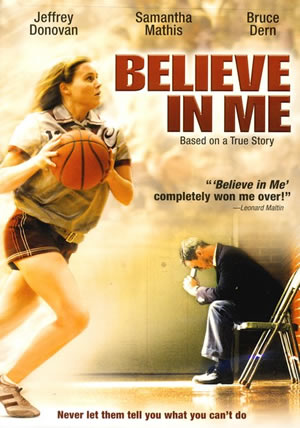
    Back in 1964, Jim Keith took a job at an Oklahoma high school to coach boy’s basketball.  But when he arrived, the administrators changed their minds and gave his job to someone else.  Keith’s contract didn’t specify which gender he’d coach, just that he’d coach.  So they switched him to the girls.  Keith was extremely disappointed.  Who wanted to coach girls when it was the boys who played real ball?  Especially when Keith was supposed to be head coach.  Keith tried to get the promised position back, except the girls he coached had other things in store for him.  Harold Keith, Jim’s brother, wrote a novel based on what happened.  That novel was made into a movie in 2006 called Believe In Me.  

    Now, we all know the plot line of sports movies: a losing underdog of a team rises up to win.  It’s predictable, right?  But we could say that of all crime shows as well—in this episode investigators discover a crime and figure out who did it!  Wow, what a shocker.  We could say it of all romantic comedies as well—in this movie a couple at odds gets together.  No way!  We could say it of lots of stories.  And yet we love these stories anyway.  Why?  

    Because the characters suck us in.  Because the story tellers do such a good job with the particular details we forget we’re watching a movie or reading a book.  We forget to think about the ending.  Furthermore, the stories are often about more than just winning games.  And so we worry about these people who have become real to us and focus on their immediate situation.  At least, that’s what happens when the story tellers do a good job.

    And Robert Collector, who both wrote and directed the film, did a great job with Believe In Me.  Now, I don’t know how accurate the film’s depiction of five-on-five play is; I believe the girl basketball teams of that era played six-on-six.  But that’s a niggling technical detail.  Besides, the movie isn’t about technique anyway.  It’s about a man and a group of country girls who have to face difficult obstacles, not so much on the court, but off it.  If you have girls or like sports at all, I think you’ll love this movie. 

    Cyber War
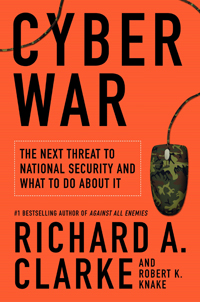
    I recently reviewed America The Vulnerable which explained how exposed we are as individuals, corporations, and a country to cyber crime, cyber espionage (both state and corporate), and cyber attacks.  Of all the cyber threats we face as individuals and a nation, the least likely is an all out cyber war.  But just because it’s less likely that doesn’t mean the threat isn’t real.  Especially since cyber warfare has been in use since the 1990’s.  We used cyber weapons openly in the gulf war in 2003, knocking out Iraqi air defenses.  Israel used them to own Syria’s air defenses when bombing their clandestine nuclear site in 2007.  Russia used them against Estonia in 2008 and Georgia in 2009 on a variety of targets, bringing many critical systems to a halt.  In 2010, somebody, most likely the US or Israel, developed the Stuxnet worm to sabotage the uranium enrichment facility at Natanz in Iran.  China has already conducted trial runs of cyber attacks on the US and has planted logic bombs and trap doors to activate in the future.

    In Cyber War, Richard Clarke shares his insights into what cyber war is, how cyber weapons work, and how vulnerable we are as a nation.  He discusses the cyber warriors (hackers) we now employ in the US military, and how a cyber war is like and unlike other wars.  In the second half of the book, he discusses the factors that have created our current vulnerability, how to set up a defense, and what we need to think about when conducting a cyber war. 

    And Clarke knows his stuff.  He worked for the State Department during the presidency of Ronald Reagan.  In 1992, President George H.W. Bush appointed him to chair the Counter-terrorism Security Group and to a seat on the United States National Security Council.  President Bill Clinton retained Clarke and in 1998 promoted him to be the national coordinator for security, infrastructure protection, and counterterrorism, the chief counterterrorism adviser on the National Security Council.  President George W. Bush kept him in the same position and later made him special adviser to the president on cyber security.    

    The thing I liked most about the book is that in addition to describing cool cyber war weapons, threats, and incidents, Clarke examines answers to many critical questions.  For example, how can we set up a defense without the government becoming a 1984 nightmare?  Would arms agreements work in cyber space?  (No.)  How do you prevent a cyber war from turning into a kinetic (guns and troops) war?  How do you attack your enemy when it’s sometimes hard to know who launched the attack in the first place?  He discusses these and many more questions.

    The book does have one fault.  Clarke has an obvious axe to grind with the Bush administration, and can’t help but make snide and irritating comments whenever he brings them up.  The good news is that those spots are few and far between.  If you want an excellent introduction into how cyber weapons are used and will likely be used in the future, you’ll want to read this book.
  • Nameless Thriller Started

    Those who check the progress bars, will notice that I’ve started the first draft of the thriller, which remains nameless.  Poor thing. You’ll also notice I haven’t finished the working outline. That’s because sometimes–well, often–I need to do some drafting to get the feel of the story and characters before I finish that working document. And also because story development has never been a linear thing for me. 

    I did a lot of work on the premise (the story setup) these last few weeks. Ran into a lot of dead ends.  However, it was all good. I got snippets of scenes throughout the process. Did a lot of useful research. Developed characters. I wrote a few drafts of another beginning that I realized didn’t feel right. It was telling the wrong story, had the wrong angle. A few days later, I figured out the right angle on the premise.  And it is so delicious to me.  Then during another work session–letting my mind run while I showered–I got the outline of the first chapter. I give you the first 300 words below. I’m sure they’ll change, but it’s a taste of what’s to come.

    CHAPTER 1: Cowboy Donut 

    Trying to get a straight job as an ex-con was a lovely experience.  Kind of like being dragged behind a bus.

    No matter how tidy you looked or how sharp your resume was, it all came down to one question: “And what were you in for?”  Frank knew it would be stupid to lie about that.  First of all, he was trying to go straight.  Second, any employer who didn’t have a carrot for a brain was going to run a background check.  So there was no use trying to hide. 

    Frank was now sitting in the back office of Cowboy Donut in Rock Springs, Wyoming across from Mary Rogers, the sun-wrinkled owner.  She was probably in her fifties and had two-tone hair that seemed to take its inspiration from a skunk or badger: all bleached up on top and dark underneath.

    Ms. Mary had just asked the question.  Frank had just dropped his bomb—voluntary manslaughter, a security job gone bad.  He’d been protecting the wrong kind of noun for the wrong kind of people.

    Ms. Mary narrowed her eyes.  “What else am I going to find on your RAP sheet?”

    “That’s it,” Frank said.  “Just the one unfortunate incident.”

    “Murder is a pretty big incident.”

    “Manslaughter,” he corrected.  “Not murder.”

    She made a noncommittal sound and looked down to study his resume a bit more.  Like maybe something new would pop up there. 

    This was always the fun part, waiting for the reply.  First interviews were like first dates.  And Frank had basically told his date he had an Ebola monkey virus that would make her eyes bleed, and would she now like to kiss?  He’d done this now a couple dozen times and knew the best thing was just to be quiet. 

    Poor Frank. And in just a few pages things are going to get so much worse when he finds two old associates waiting for him at his house.

  • The man will not be able to attend LTUE this year, alas

    As I was walking past the circulation desk of the Logan library last week, a woman, who had been tracking my movements, turned, pointed at me, and made a loud complimentary exclamation. I know you’re thinking she said something about my fabulous looks or the animal magnetism that pours off me sometimes in uncontrollable waves. But no, she was not talking about that. She explained she had been in one of my presentations at LTUE last year and found it very helpful and was going to be at this year’s event. She asked if I was going again. 

    Up until a few days ago I was planning on it and had two new presentations prepared that I think are killer. But that was before I saw my daughter’s school basketball schedule. Life is short, and my time with my kids is even shorter, and so I will not be there to exude my extraordinary fantasy-boy kavorka upon the teeming masses. Alas.

    (What did you say? That wasn’t a kavorka I exuded?)

    Exclaiming Libaray Patron, who made my day, if you’re reading this, please accept my apologies.

    In the meantime, I’m hard at work on the thriller. I’ve finally nailed down the full premise and am moving into sketching out my scenes.

  • Buck, America the Vulnerable

    Buck

    About two years ago I was walking out in Round Valley and saw a rider on a horse coming down a hill through the brush.  I got to him just as he moved onto the road. Right away, I noticed that there was something a bit off with the horse’s gear—the rider was not using a bridle. The rider, Wayne Batty, was using nothing more than a rope harness that went around the horse’s head. I was amazed; how did you steer the horse without a bit in its mouth?

    I asked Wayne if I might walk alongside as he rode. He agreed, and then began to talk about training and riding horses. I stuck with him for little over a mile before I had to turn back. I learned in that short period that Wayne was able to communicate with that horse with small nudges. The horse also communicated to him many things with its stance, ears, the cock of its head. Most importantly, I learned they both had built up a trust of each other. Wayne’s methods were not based on fear, it seemed, but something else.

    It reminded me a lot of the fascinating and compelling The Man Who Listens to Horses, the autobiography of Monty Roberts, that shares Roberts’ life and his development of natural horsemanship methods. Unlike many training approaches which seek to break a horse’s will through harsh punishment-based methods that often veer into abuse, natural horsemanship employs methods that are much gentler and seek to build trust in the handler. Roberts can join up with (he doesn’t “break” horses) a wild or un-ridden horse, be up on the saddle calmly riding the animal, in an incredibly short period of time.

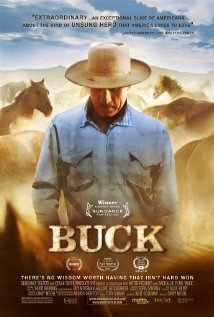
    But Batty and Roberts aren’t the only ones practicing this. These methods have been around some time. One of the most famous practitioners and teachers is Buck Brannaman, who found his years of being severely physically abused by his father actually provided some insight into training horses.

    Says Brannaman: “I’ve started horses since I was twelve years old and have been bit, kicked, bucked off and run over. I’ve tried every physical means to contain my horse in an effort to keep from getting myself killed. I started to realize that things would come much easier for me once I learned why a horse does what he does. This method works well for me because of the kinship that develops between horse and rider.”

    Recently, a film was produced that looks at Brannaman’s life and methods. It’s called Buck and is worth every minute. If you love horses, you’ll love this movie. If you have a horse and think you might want to learn these methods, or just want to watch and listen, you might want to check out Brannaman’s teaching schedule at his site brannaman.com. He travels all over the country and is likely to hold a class within driving distance.

    America The Vulnerable

    A few years ago I received an email from my bank. At least, it looked legit to me. I opened it. It said it needed me to update some parts of my account and provided a link to the bank’s website. I clicked on the link, which took me to my bank’s website. At least, it looked exactly like my bank’s website. I entered my account number, login, and password. I made the requested changes and logged out.

    Two days later, somebody in Spain cleared every penny out of my account—thousands of dollars stolen.

    That email was a phishing (fishing) scam. The website had been a fake. I had willingly handed over my account number, login, and password to thieves.

    Luckily, the bank insures such thefts. But the problem of information security remains. Thieves living in Spain, or Russia, or LA, or China, can rob me blind from their bedrooms in their pajamas. They can do this because our information processing nowadays is increasingly tied to the internet.

    And they don’t just rob dopes like me, because it’s not just individual criminals who are in the business. Corporations and governments are in this business as well.

    They steal billions of dollars of trade secrets, engineering designs, and other intellectual property from American companies through computer hacking. They steal military secrets. For example, the US Navy spent years and about $5 billion dollars to develop a quiet electric motor for submarines that would make them incredibly hard to find and track. Chinese spies stole that technology. The Navy then spent billions more to develop a new radar for their top-of-the-line Aegis Cruiser. Chinese spies stole that, too.

    And they not only steal. Terrorists, crime organizations, and foreign governments can now insert malicious software into the computers that control, among other things, our electrical grid. They can use this in an attack, not just to shut the grid down for a while, but to destroy power generators. They can insert such software into our air traffic control system. Our train transportation systems. Our banks. They have already done this. They have already breached some of our most secure government systems.

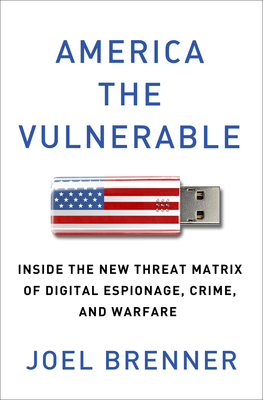
    It sounds too far-fetched to be true, but it’s reality. Joel Brenner, who has served as the former senior counsel at the National Security Agency (NSA), the national counterintelligence executive in the office of the director of National Intelligence, and as the NSA’s inspector general writes about what he’s seen in America The Vulnerable: Inside the New Threat Matrix of Digial Espionage, Crime, and Warfare. In the book, he explains the cyber threats to individuals, corporations, and the country and what we can do about it. If you want a fascinating look into the next phase of crime, espionage, and warfare, and an introduction to some of the things you need to do to protect yourself and your company, and what we need to do as a nation, you’ll want to read this book.

  • Conservative Republican Amnesia

    If you ask the “conservative” talking heads–Limbaugh, Beck, Hannity, etc.–who THE best conservative president of the last 100 years was, they will say Ronald Reagan. If you ask their dogs, they will bark “Ronald Reagan.” Their gerbils will say other things, but everyone knows you can’t trust rodents. Ask the regular conservative Wanda and Mack (Jane and Joe is so cliche), and they’ll give you the same response as the dogs and people. Ronald Reagan is the guy we conservatives and Republicans have been taught to worship.

    Except, when presented with a candidate as conservative as Reagan, no, probably more conservative (I’m talking Mitt Romney), many of these “conservatives” get out their inquisitional torches. Which is a big reason why the GOP primaries are as fluid as they are at this point.

    As a side note, have you noticed that these talking heads and the mainstream media either have a hobby horse they ride above all else (Rush Limbaugh and his anti global warming crusade) or they seem to promote some flavor-of-the-day litmus test for each election. In one election, they’re going on and on about homosexual marriage. The next election, it’s a talking head approved stance on Taliban bombing. The next, it’s the fact that budgets must be balanced. They line the candidates up and then start whacking them based on these flavor-of-the-day tests. It’s like going to buy a car and focusing all your attention on the steering wheel.

    Anyway, I think many of us have forgotten what THE so-called best conservative president of the last 100 years looked like. If Ronald Reagan were to run today as John Smith, the conservative talking heads would drop him like a hot potato.  You don’t believe me? Well, let’s see how he stacks up.

    1.      ILLEGAL IMMIGRATION

    1. Reagan signed in amnesty for 3 million illegal aliens. The south-west-east-north-of-the-border kind, not the ones with green antennas.
    2. Talking Head Response: After crapping a brick, they would proclaim that John Smith, aka Ronald Reagan, is a pro illegal immigration RINO and must be thrown out!

    2.      ENVIRONMENTAL REGULATION

    1. A few weeks ago Rush Limbaugh told a caller that Romney is not conservative because of his stance on man-made global warming (Romney says he doesn’t know, but there seems to be evidence men contribue; women, of course, never to contribute to such things–they’re too smart), which Limbaugh thinks will lead to big-government regulation of emissions etc.
    2. YET AS GOVERNOR, Reagan established the Air Resources Board to battle California’s worst-in-the-nation smog problem. In a 1984 radio address to the nation, Reagan took credit for the strong action he took in California to combat smog, saying: “I’m proud of having been one of the first to recognize that States and the Federal Government have a duty to protect our natural resources from the damaging effects of pollution that can accompany industrial development.”
    3. THEN AS PRESIDENT, he signed, with great pride, what many consider THE most successful environmental treaty of all time – the Montreal Protocol in 1987, which regulates emissions. Back in those days Ozone depletion was the Global Warming. Reagan believed it, despite folks questioning the science and was happy to regulate.
    4. In the 1987 State of the union he said: “We are also developing proposals that make use of market incentives to control air pollution caused by sulfur dioxide and nitrogen oxide emissions and the causes of acid rain.”
    5. What?! A cap and trade like program? Yes, putting Bush in charge. In 1990, the first Bush Administration successfully pushed through legislation establishing a cap-and-trade program to reduce acid rain—the program Reagan started!
    6. Talking Head Response: John Smith is a total pro-environmental regulation RINO, please queue Al Gore singing “Burning Ring of Fire”

    3.      ABORTION

    1. Reagan signed a permissive law that allowed abortions. Since that law went into effect more than 2,000,000 abortions have happened in the Golden State.
    2. Reagan says he failed to see how it would be abused. He blamed his own inexperience, stating that had he been in office longer he would have realized that the bill was wrong.  He blamed doctors for misinterpreting the bill. President Reagan stated his prolife position by saying: “Abortion on demand now takes the lives of up to one and a half million unborn children a year. Human life legislation ending this tragedy will someday pass the Congress, and you and I must never rest until it does.”  BUT he never introduced a bill to ban abortion or amend what he’d done. Not in California, nor as president.
    3. Furthermore, today’s conservative inquisitors would point to his Supreme Court appointments. He appointed the moderate Sandra Day O’Connor.  Anti-abortion groups were livid, fearing, rightfully as it turned out, that Mrs. O’Connor would not vote to overturn Roe v Wade.  He appointed Justice Anthony Kennedy who had a long history of supporting expanded rights of privacy, gay rights, and preserving a woman’s right to choose.
    4. Talking Head Response: actions speak louder than words–John Smith is a pro-choice RINO

    4.      UNIONS

    1. Reagan was a union president 8 times in a row.
    2. Reagan, aka John Smith, also had lots of troubling connections to the Teamsters, who endorsed him, and who suddenly saw less investigation of their leaders for corruption. This is during the Jimmy Hoffa organized crime years.
    3. Talking Head Response: choke, ack, sputter–Smith is a pro-union gangsta RINO!

    5.      GUN CONTROL

    1. It was Governor Ronald Reagan of California who signed the Mulford Act in 1967, “prohibiting the carrying of firearms on one’s person or in a vehicle, in any public place or on any public street.” Yeah, he aimed to stop the Black Panthers et al, but affected all gun owners.
    2. Twenty-four years later, Reagan was still pushing gun control. “I support the Brady Bill,” he said in a March 28, 1991 speech, “and I urge the Congress to enact it without further delay.” He was right with Clinton on that issue.
    3. The Brady Bill, for the first time ever, instituted federal background checks on firearm purchasers in the United States.
    4. NRA spent millions fighting it, when it pass they mounted cases in a number of states wanting to have it overturned as unconstitutional.
    5. Talking Head Response: anti-gun RINO!

    6.      FISCAL POLICY

    1. As Governor, Reagan signed into law the largest tax increase in the history of any state up till then. Meanwhile, state spending nearly doubled.
    2. As President he continued. While he did cut taxes his first year, he signed into law tax increases of some nature in every year from 1981 to 1987. Furthermore, the debt increased to nearly $3 trillion, roughly three times as much as the first 80 years of the century had done altogether.
    3. Talking Head Response: tax and spend RINO!

    7.      RELIGION

    1. Smith, aka Reagan, let Nancy’s astrologer affect his schedule
    2. Talking Head Response: troubling devilishness (scary for evangelicals everywhere!), even if he only did it to make Nancy feel peace

    Reagan the RINO? Are you kidding? And yet Reagan would be hounded out of the Republican party if he ran today. The talking heads would sound the warning long and loud, which is a shame.

    On the other hand, I’m not saying we need another Reagan. Clones never pan out–hasn’t anyone seen Multiplicty with Michael Keaton?! And despite the recent zombie craze, I don’t want one in the White House, even if the world would be a better place if said zombie should eat Vladimir Putin’s brains out. I tire very quickly of Reagan worship. Or any other politician worship. As good as Reagan was, I disagree with a number of things he did. What I am saying is that those who want to get another president “as good as Reagan” had better know what such a president looks like. And it ain’t the caricature that’s being held up today by many conservatives, especially the talking heads, who seem to gloss over the facts of history.