Author: John Brown

  • Generating Story 4: The Story Setup

    Okay, I lied. I was going to get into idea generation techniques, but decided to do one more short post on development objectives. Actually, I suppose this is a technique.

    In the last post, I said one of the main objectives of your initial story development is to have the story to come to life in your mind. I explained that the best method I’ve come across up to this point for making that happen was to focus on developing the 6 core parts. Then I explained in general what I’m shooting for when developing those parts at the outset of a new project.

    You can use a number of different types of documents to capture your thoughts on those 6 core parts. You might end up with a rough two-page sketch of the story. You might write brief character bios of some sort. You might bullet the general steps of the plot. Maybe you create a map. There are a lot of types of documents you can use to capture what you’ve developed. And often the creation of those documents not only captures what you’ve developed, but helps you develop the parts in the first place.

    I want to suggest a “document” that will help you capture and develop the essence of your story setup.

    This is ONE tool.  It is not THE tool. There are many ways to capture the essence of your story. There are many tools that can help you clarify your thinking. But I think this is a good one because it forces you to get right to the core of your story and clarify it in a compact manner.

    An idea that’s core and compact has great power because it focuses the mind.

    There are so many things to juggle when writing a story that it’s easy to get lost in the weeds.  I’ve found I become so much more productive when I know the core situation that’s driving the story.

    There are a lot of things that drive reader and author interest. There might be a thematic question, fascinating characters, genre stuff (chase scenes, romantic scenes, scare the soup out of you scenes), humor. One of the main things that rivet readers to the page are the hopes and fears they have for our characters.

    A reader’s hopes and fears are driven by presenting:

    • An event that causes
    • An interesting and likeable character to
    • Face a compelling and concrete problem—a threat/danger, lack/hardship, opportunity, or mystery.
    • The character decides he must try to solve the problem (which results in the character goal the story revolves around)
    • And struggles against significant opposition.

    That’s the core of the story setup. As David Howard puts it: “there is one basic dramatic circumstance: somebody wants something badly and is having difficulty getting it.”

    Of course, stories provide a lot of delights that require you to do more than define the person and the thing they want. But the setup is at the heart of a lot of what readers go to story for. Part of the initial development of a story should focus on helping you clarify this central dramatic situation.

    So here’s a tool to help you do that. I read about it years ago in Dwight Swain’s Techniques of the Selling Writer, which was written in 1965. Swain calls it the “Starting Line-up.” I read about another version of the same thing more recently in Dan Decker’s Anatomy of a Screenplay written in 1998. He calls it the “Story Line.” The hugely published romance writer Leigh Michaels calls it a “Framework” in her On Writing Romance: how to craft a novel that sells. The agent Donald Maass calls it the “premise of a novel” in an interview published in Agents, Editors, and You by Michelle Howry.  Jim Butcher calls it a “Story Skeleton.” Let’s look at each of these variations.

    Swain’s “Starting Line-up”

    Swain asks you to include five elements:

    1. Focal character
    2. Situation
    3. Objective
    4. Opponent
    5. Threatening Disaster

     These are to be cast into two sentences.

    • Sentence 1 is a statement that establishes character, situation, and objective.
    • Sentence 2 is a question that includes the opponent and disaster and can always be answered in a clear yes or no

     Here are his examples.

     John Storm

    Sentence One

    • When humans suddenly begin to grow to twelve-foot height [situation],
    • John Storm [character]
    • tries to find out why [objective].

    Sentence Two

    • But can he defeat the traitors in high places [opposition]
    • who want to kill him [threatening disaster] in order to make the change appear to be the result of an extraterrestrial plot?

     Irene Boone

    Sentence One

    • Lonely, frustrated, and tired of living in a home where she’s treated as an unpaid servant [situation],
    • widowed Irene Boone [character]
    • wants to marry widower Frank Dawes [objective].

    Sentence Two

    • Will she lose this chance for happiness [threatening disaster]
    • because her selfish sanctimonious daughter, Connie [opponent] accuses her of immorality?

    Dale Boulton

    Sentence One

    • Sick of the conformity and hypocrisy that go with his highpaid job, and with a modest life income assured [situation],
    • Dale Boulton [character]
    • decides to retire ten years early, to go live on a shanty-boat and poke through crumbling river ghost-towns, in fulfillment of a boyhood dream [objective]. 

    Sentence Two

    • Can he make the break successfully, when his hostile wife, Sandra [opponent],
    • fights him all the way and, finally, threatens to have him declared incompetent [threatening disaster]? 

    Decker’s “Story Line”

    Decker requires three components:

    1. The main character described by an adjective
    2. The inciting event or decision that propels the character into the story
    3. The main character’s objective, stated in concrete terms

    You can add other components—other characters described by an adjective or other important events or decisions. He prefers you start with a “when.”

    Here’s an example.

    When a booksmart savings and loan bailout accountant takes over the business he is assigned, he discovers it is a bordello and teams up with the Madame using his business skills to fend off a hostile take over and save the business.

     Another.

    When a blood thirsty killer and his gang are coming to kill him, a strong-willed, decent cop must fight them over the objections of his pacifist bride who will leave him if he does.

     Another.

    When he is given a factory full of doomed Jewish workers, a greedy, opportunistic Nazi deceives his taskmasters to save them.

     Another.

    After a tornado carries her off to a strange land, a spunky teenaged girl must face a series of challenges to get home.

     More.

    When his blundering uncle throws their building and loan company into insolvency, a despairing small town banker with low self-esteem has to find a way to save the bank.

    Leigh Michael’s “Framework”

    Michaels suggests four elements in her framework, although she doesn’t stipulate a specific form.

     This definition summarizes the four crucial basics that make up a romance novel:

    1. A hero and heroine to fall in love
    2. A problem that creates conflict and tension between them and threatens to keep them apart
    3. A developing love that is so special it comes about only once in a lifetime
    4. A resolution in which the problem is solved and the couple is united

     She then lists a number of questions to help an author think about those four elements. The document that could capture this is a summary of the answers to those questions.

    Donald Maass’ “Story Premise”

    Donald Maass was asked what he looks for in a query or pitch. Like Michaels, he doesn’t specify a form, but does include some basic elements.

     I’ll tell you exactly what I need, and I can get this information after just a few questions.

    First of all: What type of novel are we dealing with here? Mystery? Mainstream? Young adult?

    Second thing: Where and when is it set? Contemporary? Historical? Magical place? A real place?

    Third: Who is the main character?

    And lastly: What is the basic problem that the character faces?

    Those things wrapped up together are the premise of a novel, and I know right away if it’s the kind of work I handle, if the idea sounds original, if the main character is sympathetic, and whether I care about the problem. That’s all i need. If all those things are a go, then I want to read the work. It’s as simple as that.

    Most authors might perceive this as additional pressure. It’s exactly the opposite. What is means is that their job is much, much easier than they think.

     If you think about a query, this is something that should be contained in a few short paragraphs.

    Jim Butcher’s “Story Skeleton”

    A reader drew my attention to a short essay Jim Butcher wrote on this subject. I thought it was excellent. Here’s Butcher:

    The story skeleton is a description of the main plot of your book, broken down into its simplest elements. . . The story skeleton (also called a story question) consists of a simple format:

    *WHEN SOMETHING HAPPENS*, *YOUR PROTAGONIST* *PURSUES A GOAL*. But will he succeed when *ANTAGONIST PROVIDES OPPOSITION*?

    For instance, look at Storm Front. (Yes, I’ll use my own books as examples, because I’m just that way. 😉 Also, I’m more familiar with them than I am with almost any other writer.) Storm Front’s story question:

    ****************************
    When a series of grisly supernatural murders tears through Chicago, wizard Harry Dresden sets out to find the killer. But will he succeed when he finds himself pitted against a dark wizard, a Warden of the White Council, a vicious gang war, and the Chicago Police Department?
    ****************************

    See! It’s oh-so-simple! Almost to the point of looking ridiculous–and I have no doubt that some of the people reading this article will think that it *is* ridiculous. They’re wrong. 🙂 This is a fundamental description of the core conflict in your tale–and stories are all about conflict.

    Go read his whole essay.

    My Version: “The Story Setup”

    Did you notice any similarities in the examples above? Character, inciting event, problem, goal, opposition. Let’s go back to the core of story I listed.

    1. An event causes
    2. An interesting and likeable character to
    3. Face a compelling and concrete problem—a threat/danger, lack/hardship, opportunity, or mystery.
    4. The character decides he must solve the problem (which results in the character goal the story revolves around)
    5. And struggles against significant opposition.

     Written even more succinctly:

    1. Character
    2. Inciting event
    3. Problem
    4. Goal
    5. Opposition

    I like the idea from Swain and Butcher of projecting us forward using a question. I like the idea from Decker and Butcher to use “when” to state the inciting incident. I also like adding in the character adjectives. I like Michael’s and Maass’ focus on problem. But I also like flexibility. My version uses key elements of the others as guidelines, keeping it simple and core by limiting the statement to 90 words.

     Here’s one for The Incredibles.

    Bob is a frustrated retired superhero, living a boring life as an insurance claim processor. When he gets an offer to do illegal superhero work on the sly, he decides to take it and pursue a double life, even though he’s forced to lie to his wife about it. But his dream job employer is actually trying to settle and old score and kill him.  Will he lose his family when he’s drawn into a showdown with a super villain that has him outmatched?

    In many longer works there are often more than one story running. Sometimes the main character has an external conflict and an internal one. Or maybe a related subplot. Sometimes other characters have related B, C, D, and E story lines. In Curse of a Dark God, for example, I have at least eight story lines that I have to braid into each other. To keep them all straight, I found it very helpful to list out the five elements for each. The goal isn’t to make these into slick marketing tools: they’re to help me focus my efforts. However, I find that when they include all the elements, they have great power to pique my interest.

     Here’s one of the “inner” conflicts of Curse.

    Talen has escaped the clutches of the Mother, but something is growing inside of him. When he begins to hunger after the Fire and soul of those around him, he realizes he’s not all human. Will he be able to resist the growing and overpowering desires, or will he become the very thing he’s fighting against?

    Here’s one of the related “outer” conflicts.

    The Mother of Mokad wants Talen—to make him into a thrall or devour him. He escapes the first attempt to capture him, but will he be able to shake the Mother’s powerful hunter and his dreadmen now that he and his sister are on their own?

     Here’s a third story line in the book, the big external plot.

    Argoth is trying to build up an army of sleth that can free mankind. But the Mother of Mokad sends her Guardian to exterminate every last one of them. Will Argoth be able to defeat Mokad’s vastly superior army, especially when the Guardian has infiltrated his ranks?

     But Argoth has another plot line for the reader to worry about.

    Argoth damaged his son. Nettle’s condition is growing worse. A foreign Divine offers to heal Nettle in exchange for Argoth’s allegiance. Will Argoth betray those around him and save Nettle? Or will he let his son die and lose him to the perils in the world of the dead?

    Here’s one of Sugar’s.

    When Sugar sneaks behind enemy lines to retrieve some items her mother left for her, she’s given the opportunity to learn a powerful lore and use it to scout for Argoth’s army in the world of the dead. But each time she uses it, she comes closer and closer to death herself. Will she be able to survive as she’s asked to serve in more and more dangerous situations?

    Here’s her inner conflict. I wanted to develop a moment of dilemma for her just as I did Argoth.

    Sugar wants to keep her brother Legs safe. But as Mokad’s army arrives, it becomes apparent Argoth doesn’t have a chance. She and her brother might not survive. Sugar’s been learning the lore with a handsome and battle-hardy loremaster who saves lore users who have become true sleth. When he asks her to sail with him and his crew before it’s too late, Sugar has to decide if she will flee and abandon her friends or stay and fight and risk losing everything in this world and the next.

    Now you see why it’s virtually impossible to write such a book with so many story lines in the normal 100,000 words. And why I question my sanity in trying to write it.

    Anyway, there’s much more to writing a fascinating and compelling story than capturing a story setup, but I’ve found that working on stating the simple core of the story clarifies many things for me and makes me much more productive. I developed a short statement of all my story setups early on in the writing.

    There are a number of ways to capture the story setup. Let me suggest you give one a try. And if you aren’t to the point where you have enough material to capture a story setup yet, that’s fine. That’s what development is for.

    One last note. If you want to read an expanded description of how one writer develops story ideas, read Write Away by New York Times Bestselling author Elizabeth George. I loved the book.

    Bonus: Miss Snark Happy Hooker Examples

    Miss Snark was the pseudonym of an agent who I believe was Janet Reid of the JetReid Literary Agency.  When she was incognito, Snark had a blog. On her blog she’d often invite people to submit their story statements used in queries to hook editors and agents to ask for more.  These entries were called “Happy Hookers.”  Snark would rate them on her crap-o-meter, sometimes giving comments and suggestions.  Let me suggest you read 50 or 100 of those hooks.

    As you’re reading, look at Mrs. Snark’s comments. But more importantly, note the hooks that excite you and the ones that don’t. Because, frankly, Snark is just one person with one person’s tastes. In this exercise, you’re not trying to figure out what she likes. You’re trying to see what story elements work for you. So don’t be dissuaded by her tastes. Identify the hooks that interest you and the ones that don’t. Ask yourself where they were unclear, unbelievable, or boring. After you’ve done a few, you’ll start to see story patterns and ways to capture your own story setup that will be useful to you. 

    For more in this series, see How to Get and Develop Story Ideas
  • Halfway finished with 10% trim of CURSE

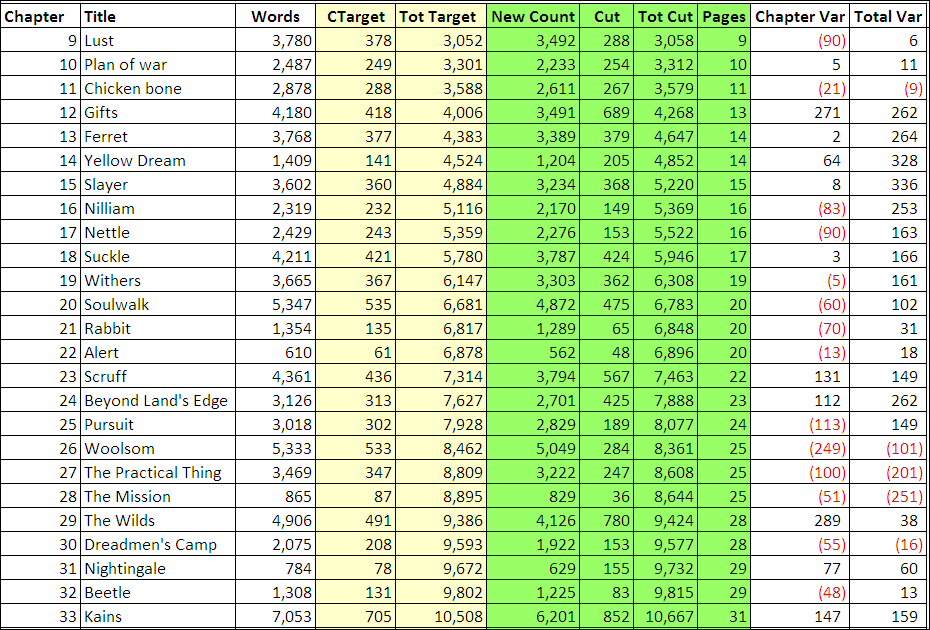
    I’m at the 51% mark with my trim and have cut 10,000 words. Right on target. And I haven’t cut any story, just flab in the writing. Usually when I revise, I add words. I thought I wrote lean, but that’s clearly not the case.  Strangely enough, I have to say that I’ve enjoyed every hour of this. I’m loving this edit,  improving the flow and immediacy, cutting out redundancies and superflous lines. Who would have thunk?

    For those of you who are numbers geeks, here’s a peek at the spreadsheet I’m using to track my trim goals and actuals. “Var” means variance. “CTarget” is the target to cut from the chapter.  

  • Generating Story 3: Develop The 6 Core Parts, Start Anywhere

    If you’re going to build a house, you need to know what type of house you want and what you want it to do. A two-man tent is a house of sorts.  So are a suburban rambler, a New York high-rise, and a medieval fort.  Each is a bit different, even if they share elements.

    Building a story is like building a house. You need to know what you’re after. You need to know how stories work in general and how the type of story you want to write works in particular.

    For example, if you love suspense, and it’s going to factor heavily in your story, you’d better learn the principles of suspense. If you love intrigue and mystery, you’d better learn how to build that in a reader. If your current project is a crime story, you need to know how crimes work and how they’re solved. If it’s a love story, you need to know how falling in love works. All of those things you identified as your personal style—you want to know how they work.

    Except sometimes, when you’re starting from scratch, you might not know exactly what kind of story you’re going to build.

    So what do you do?

    You get a list of development objectives. And you begin to work on them. Your mind needs a direction to run.

    Despite the fact that stories are different, they share some common core things. These are the things you want to focus on developing. When I start a new project, I know my task is to develop six core story elements. This gives me a direction. All I have to do is start developing these six things, and sooner or later the story comes to life.

    So what are these core elements?

    • Genre
    • Character
    • Setting
    • Problem
    • Plot
    • Text

    You need to develop all six parts. That’s your job. There’s no particular order that you develop the elements in. You just start with what you have. As you develop all six parts, the story will come to life. Your characters will begin to breathe and speak. They’ll take on a voice and attitude. You’ll see the landscape. Scenes and plot turns will come to mind. If you’re more of an auditory thinker, you might not see anything, but will start hearing the rhythms of the prose. Visual or auditory, you’ll care about and believe in the tale. You’ll have something wonderful to write and share with readers.

    Let’s look at each element to see what you’re trying to develop.

    Genre

    The genre tells you the overall effect you’re going for. It describes the salient aspects of the tale. Those aspects often focus on the emotional mix you’re delivering to the reader (horror, humor, thriller), but can also describe the setting (western, Regency romance), as well as the type of problem your characters will be facing (love story, political thriller), and the audience your writing to (young adult, middle grade, women’s fiction).

    But why do you want to know your genre? Isn’t that just a marketing thing?

    No, it’s not just some marketing thing. If I’m telling a story about a kidnapping, knowing it’s a tale of tale of horror–instead of a romantic comedy, fantasy, western, science fiction, or political thriller—makes a huge difference.

    It gives me an objective. Parameters. Remember, creativity is problem solving. If there’s no objective, there’s no solution. The moment we have an objective, our mighty brains can kick into gear and start suggesting ideas. The more specific we make the objective, the easier it is to think up ideas.

    Now, you might not know the genre when you start. You might simply have a cool bit of dialogue, an image, or newspaper clipping. That’s okay. You don’t need to start with genre, although it often helps. But you eventually want to peg that genre, even if it’s some blend of your own making, so you know the general effect you’re going for.

    Character

    You want to develop a couple of characters, usually at least a protagnoist and antagonist. They need to be interesting to you. If you want your readers to root for someone, that person had better also be sympathetic and likeable.

    What makes a character interesting? What makes them sympathetic and likeable? You might want people to dislike your antagonist. You’ll at least want them to fear him or her. What produces that? Read what I wrote about character here: http://www.sfwa.org/2010/12/key-conditions-for-suspense/. Then start noticing what makes people and characters interesting, sympathetic, and likeable to you, as well as what makes you fear and dislike others.

    There will be other characters you’ll need to develop—a mentor, lover, friend, henchmen, etc. Maybe you start with one of them. That’s fine. Just know you need to be on the lookout for your protagonist and antagonist. Almost every story has both. For the hero, you’ll usually want to develop someone that’s interesting and likeable. For the antagonist, you’ll want to develop someone who is interesting and powerful enough to make us fear for the hero.

    Setting

    Setting may play a huge role in your story as it does in epic fantasies, Westerns, historical pieces. Furthermore, a setting doesn’t have to be faraway place to play a big role. Your story may be set in a prison, rural town, or manufacturing plant, which may factor heavily into the story. Then again, setting may play less of a role. It all depends on what interests you and the type of story you’re writing.

    They key, I’ve found, is to develop the setting with the goal of having it come alive in my mind by identifying things in the setting that are interesting or will affect the hero and plot. I need to transport the reader to a place. I can’t do it, if I myself don’t know what that place is like. And it’s nice for them to find it interesting when they get there.

    Setting is also a great source of ideas for the other elements. When you develop setting, you’ll find characters, problems, and plot ideas galore.

    Problem and Plot

    I wrote a detailed explanation of problem and plot, which you can read here:  http://www.sfwa.org/2010/12/key-conditions-for-suspense/. Read it. I’m not going to rehash it now. But I will say that problem is the engine to your story. Your story is not going to go anywhere without it.

    You want to identify the main problem your character is facing. One that is going to generate enough scenes for the size of story you’re going to write. Read what I wrote about conflicts, obstacles, etc. Ultimately, you’re aiming to develop a problem that you find compelling.

    You might not develop the key aspects of the plot in the beginning. In fact, you’ll probably discover many of them only as you write. However, at this stage it does help to start looking at plot patterns for the type of problem you’re writing about because it helps generate ideas for scenes. For example, a romance about a gal who is a Minuteman or border agent and guy who is a coyote (smuggling folks across the border) will take a different course than one about a farmer trying to find his kidnapped wife.  

    In the first story, we might start by introducing the characters: the border agent interdicting a group suspected of being drug mules; the coyote is leading that group. In the next scene they might meet, and not know what the other is. They’re attracted. They meet again, maybe have dinner or dance or go hunting. The romance deepens. Then one finds out about the other.  If she finds out, does she turn him in? Maybe he inadvertantly leads the drug cartel to her and puts her in jeopardy.

    In the second story, we might start with the husband and wife in some funny situation. He leaves. Comes back. Finds her gone. Finds evidence of her kidnapping. Gets a call or a note. Is told they want him to pay them a ransom. Or maybe turn over title to something. Or maybe he works at a weapon manufacturer, and they want some piece of tech. Or maybe it’s something else.

    The point is that they develop differently. The plot patterns of love stories are different from the patterns of heists, kidnappings, shipwrecks, bullies, etc.  because they’re all different problems and require the hero to take different types of steps to solve them. When first developing a story, I’ve found it’s helpful to think about patterns for presenting, complicating, and resolving those types of problems. I’ve found it helpful to ask, what would I do in this situation?

    For more on plot patterns, see the link above. In addition to patterns, specific plot turns that really spark your interest will present themselves to you. Maybe I don’t have a pattern yet, but as I’m developing the character or setting a cool scene comes to mind. Or maybe it’s a cool plot turn–the border agent is captured by a drug cartel and the coyote goes in to save her. You want to be on the lookout for these.

    So in the beginning, you want to focus on developing a compelling problem, a general plot pattern, and be on the lookout for some cool or fun scenes or turns.

    Text

    Text is the prose on the page. It’s how you translate the story in your head to something the reader can consume. It’s the specific scenes, the dialogue, and narration, which means you don’t stop developing the text until you write “the end.”  Sometimes, the story can come alive without drafting. Sometimes, especially with those writers who are more auditory, you need a rhythm, a voice for the narrator and character before the story clicks. Often it just takes some freewrites or a drew chapters to discover this.  What I’m after is a point of view voice.

    Sum It Up

    Take some time and think about the key elements, how they work, and the core of what you need for each. Make yourself a simple checklist. Here’s one such checklist.

    • A protagonist who is interesting, fascinating maybe, someone you yourself can get behind and want to follow. 
    • An interesting antagonist who raises your anxiety for the protagonist.
    • Asetting that’s alive in your mind as well, including parts of the setting that are interesting—the things and people that are scary, cool, lovely, dangerous, funny, etc.
    • A problem that’s compelling to you. One that’s big enough for the size of story you’re writing. One that suggests a juicy plot.
    • A plot pattern or two. Maybe some scenes or plot turns that really spark your interest.
    • A voice for the main character / narrator. 

    Here’s another I recently shared with some younger writers:  

    It doesn’t matter where you start when you invent a story, but you  need to end up with a character you think is fun, cool, or  interesting, who has a problem other people will find funny or  compelling–that’s the core of your story. The problem can be a mystery the character needs to solve (there are strange green lights in the sewer), a danger or threat to some aspect of the character’s happiness or someone they care about (holy smokes, that big alien that looks like a bug wants to eat my head), or an opportunity for something that will make them happy (I live in a cupboard and get to go to magic school!) You start there. The rest of the story is about how that character goes about trying to solve the problem, the characters who help them, and those who work against them (including tiny evil mice villains). You know you’re done when the mystery is solved, the threat removed, or the opportunity is won or lost.

    Here’s another from Lou Anders that he offered on a Writing Excuses podcast that presents another way to sum up what you’re looking for with character and problem (BTW, I find no evidence that all satisfying stories need what he calls a relationship character; however I do think it’s a fantastic technique for stating theme and clarifying the internal problem in stories that revolve around a character making a change):

    [Lou] The protagonist is usually the most obvious one. He or she is the star of the film. The protagonist is someone who wants something. It has to be something concrete [emphasis added]. It can’t be “I want to be happy” or “I want to be pretty” or “I want to be rich.” It has to be a definite, achievable goal associated with that. So I want him to fall in love with me so that I will be happy. I want to win the game show that I’m going to be on so that I will be rich. I want to rob a casino of the guy who’s dating my ex-girlfriend, that will make us happy.

    [Dan] So I can be happy and rich.

    [Lou] Yes. Exactly. So it has to be a concrete, achievable goal.

    [Lou] The antagonist is the person who places obstacles to that goal in the path of the protagonist. This does not mean the bad guy. Now, we can talk about some very interesting examples. The antagonist is the one whose goals are diametrically opposed to the protagonist, and they’re the one who is blocking the protagonist’s journey.

    These aren’t twenty page design documents. They’re simple checklists. There’s power in keeping your objectives simple. Too many details and you lose your focus.

    I suggest you take some time to write a succient sumary of what you want to develop, one that gives you clear direction. It doesn’t need to be perfect. Just cobble something together. And keep it SHORT! Remember the 80/20 rule.

    Let me suggest you not get bogged down by rules: Rules vs. Objectives. And that you include at least four of the six parts: The 4 Parts. The key is have a list of core things you know you need to develop for the current project. Knowing what you need to develop gives your mind a direction to work in so you’re not just flailing about.

    You can’t know it all up front

    It’s important to know that even though you have a development checklist, you will NOT develop the whole story up front before you begin to draft. You can’t. It’s impossible. It’s a mistake to think you must.

    Even the folks who write detailed seventy-page outlines cannot imagine the exact words and turns of every scene before they actually write them. Furthermore, they are often surprised by ideas that come as they draft and find themselves adjusting their outlines.

    Your goal is NOT to develop a super detailed set of writing instructions that a monkey could follow. Your goal is to get enough ideas in the six parts for the beginnings of the story to come alive in your mind. When the story is alive in your mind, writing is almost like transcribing.

    You might develop your ideas by creating various types of sketches for the plot, problem, character, and setting before you begin to draft. This includes things like summaries, outlines, drawings, maps, character biographies, etc. On the other hand, it may take some drafting before those things begin to breathe.

    Also, it’s rarely the case that you develop the parts sequentially. What usually happens is that you develop a little bits about each part in random order. Maybe you start with the bare bones of a problem, then develop a bit about a character, then setting, which leads you to more about the character, then you see something on TV that sparks your ideas about the problem, then you write a draft of something and get some more details, then your brother says something that sparks an idea that fits. Or maybe you start with a snippet about a character and move to the setting and back to character then to problem. Or maybe you begin with setting and discover a bit about a character.

    It doesn’t matter where you start. The parts build by accretion, like a snowball—here a little, there a little. 

    Selective Attention

    Once you know what you’re trying to develop, ideas will literally jump out at you. It’s all part of the biology of selective attention (http://en.wikipedia.org/wiki/Attention).

    For example, if I tell you to develop a sexy female antagonist, I’m betting some ideas or images immediately leap to mind. If I tell you to present me with three different choices for this antagonist next week, someone who will fit into my kidnapping story, someone who’s a little surprising, and every day you think about this objective, you’ll encounter all sorts of ideas over the next seven days that you might use.

    Why? Because you’re primed to see them. You’re looking for solutions to a specific problem. You’re harnessesing your focus and working memory limitations. That’s selective attention.

    The more specific I get in my objectives, up to a point, the easier it becomes. If I tell you the kidnapping is a comedy set in rural Utah with Mormons and Peruvian sheep herders who work for 9 months and then return to Peru, that will lead you down one path. If I tell you it’s a thriller set in the deep south with Mexican drug gangs and a local police force, that starts you thinking in another.

    An Example

    Let me give you an example of all this. A few years ago, I was on a business trip, and just before checking out of my hotel, I read an interview with Deborah Vetter who used to be the editor for Cicada. She said they loved traditional fantasy stories and that many of those she liked took a common theme and gave it an unexpected twist. Cicada was open to fantasy at the time, and so I asked myself: what’s a twist on a common fantasy element?

    Boom, objective–my mind had a direction to run in.

    I got my luggage together, checked out of the hotel, and drove over to a Lowe’s around the corner to pick up something for the house. All this time I’m running various fantasy elements through my mind—witches, ghosts, dragons, etc.—asking how I might twist them. Trolls? No, boring. Witches? Meh. Vampires? Ugh. I went through a whole bunch of ideas. I got out of the car, entered the store, continued. When I was walking down the trim isle, I finally got to golems.

    Hum, that was interesting to me.

    All the golem stories I had read were about the rabbi creating the golem and what happens. Kind of like Frankenstein’s monster. So I asked: what if it wasn’t about the guy who creates the golem? What’s a twist? What if it’s about someone who finds a golem?

    I immediately saw the bank of a river, the Evanston, Wyoming river my girls and I had been playing on a few weeks earlier. I imagined the river in autumn, yellow leaves on the ground. I imagined a bald man of red clay, half exposed in the freshly shorn bank, the rune of power on his forehead and neck. The river was low, the mint growing on the exposed sand and gravel bars, the smell of leaf mold hanging low over the water.

    My cool meters went wild. Some ideas carry such a delicious energy.

    Did I have a story?

    Of course, not. I only had the first whispers of a character (the golem), setting (a river somewhere), and genre (some kind of fantasy). Maybe a bit of a problem. This was one cool idea, not anything close to a story. I knew I needed to develop character, setting, and problem. That’s what forms the premise of the story. So I got to work on those elements.

    I captured the image on a scrap of paper, and began asking questions. Who finds it? A woman, I thought. Where? I listed some options and liked the woods of North Carolina. And it was some Native American creature. What’s the problem? What’s at issue? Either the red golem has his own agenda, I thought, or it’s others forcing it on him, or he’s trapped. A trapped soul…and the woman and the golem love each other…

    Did I have a story yet?

    No. Not even close. I still didn’t have a clear problem. Or very much about the characters. No plot.

    So what could the problem be? What was the situation?

    I walked around Lowe’s, drove home, thought about it on the way, generating options. I took a few days and generated ideas about American Indians, pickups and rednecks. I researched golems. I asked myself–what would that girl do, if she found this thing?  What if she dug it out and took it home? So I had a girl who digs the golem out and transports it home in her pickup, modern day South Carolina. She takes it home, cleans it, becomes obsessed with it. Takes it into her room. One night she’s lying in the dark, the house is quiet.  And suddenly it takes in a breath. It’s trapped soul–they love one another, she has to say good-bye in the end, a bitter sweet ending.

    Whoa. Cool! Now this thing is alive. But then the more I thought about it, the more I realized I didn’t want to write a story about a woman obsessed with a golem. Golem love? So I tossed it and went back to developing more ideas.

    Here are some of my development notes so you can get a feel.

    <quote>The deep-trench men were admirable monsters. They knew the clay, the feel and pattern of it, for it had long been heavy in their minds and muscles. They were big in three dimensions and their eyes were black and barbarous…</quote>[just a scrap I ran across and put into the folder]

    Okay, this is going to be a hot writing, just letting the ideas flow to see where they take me and trying to simply let the ideas come.

    Zing: what if he leaves, she finds him, does something, and then one day she goes back and he’s gone. And what’s she going to do? He could be hiding there and malevolent. Or he could be following her.

    I like the idea of her falling in love with him.

    The red man in the bank of the river. And I’m pulled to the historical setting, a historical fantasy. Not a contemporary, but one that’s serious about the guy. One that has villagers etc.

    So she’s out there, collecting late berries (currants) or maybe mint, she’s out there and it’s a fine fall day and the water is tumbling, rushing by. And she’s in a dark blue skirt and a white blouse, and she’s got dirt on the skirt, carrying the mint, and she comes around one thicket of willow and there he is.

    He’s not all visible, but she sees the skull and the shoulder and thinks skeleton, perhaps a burial ground, some ancient thing.

    Goes to investigate. It’s not the bones of the dead. A statue? What is it? She digs a bit, dirt in its ear, digs and uncovers more of it. Sees the rune of power on his head. Steps back. He looks like someone struggling to get out of the rock, birthed from the rock. And now its very obvious to anyone coming by and she hides it. Struggling like a man from the womb.

    And so what’s the danger from here?

    She loses the cool thing.

      • He gets out and leaves–gone
      • The villagers or one guy, one big man, goes down to destroy it
        • Her fiancé
        • Her husband, she’s young, very young and he’s her husband?
      • Or she’s alone, very alone.
        • She takes the thing home, gives it a place, talks to it (like Wilson in Outcast)
        • And then one day it’s gone, he’s gone, this thing that’s taken her life, it’s gone and she realizes that it’s alive, the last image, last piece of information shows dirt, red clay dirt in the bottom of a bowl, the spoon laid to the side. Something that would signal that the thing was alive.
        • THIS IS A COOL STORY. Not a long one either. A cool one.
        • So she’s caring for it all the time. Cleaning, scrubbing
        • Does she at one time hear a gasp? Thinks, he’s coming alive. Has a place set for him, a plate etc. But that goes away, it goes long away, too long and she realizes she’s mad.
    • She digs it out? Digs it all out. Heavy as stone.

    It’s all freewheeling sketching.

    Now, I could have stuck with North Carolina and tried something else. But as you read, my interests were pulling me to a different setting. Where else might it be set?

    I listed some locations, and Croatia drew me. I’d just read and seen some cool stuff about Croatia. But I didn’t know much. Was it going to be modern or historical? I began to read about Croatia. And the 1100’s fascinated me. There was all sorts of stuff going on. I decided to set it there.

    Did I have a story?

    No. I still didn’t know what the problem was. So I outlined some options, did some character sketches. Did more research. Looked up old Croatian names and magic. I got out a map. I was wanting it to come to life in my mind. But it wasn’t there yet.

    I went searching for a problem. I didn’t really want that golem love story. I made the following entry in my pre-draft document. 

    What’s at stake? The woman finds this thing, so what? She’s obsessed. But what’s the big issue here?

    • Danger, if she wakens maybe it will kill
    • Maybe if people find out they will want to use
    • Maybe she will be declared a witch
    • Maybe it will eat her out of home
    • Eat her children
    • Maybe it will force her to feed it, force her to bring people to him so he can kill them
    • Is it a thing of danger?
    • Maybe it will force love upon her? Breed with her and create a race of goblins or trolls.
    • It is a great thief–bringing her presents, presents for the master. And one day it brings a child.
    • A goblin with long hair and not dumb, not brutish, by hungry, a predator, one who will eat you, who loves hunt and chase, but can dress and act civilized.
    • Maybe that’s the thing–it draws you, draws your dreams or your mind, feeds on these things until it has strength to go on and takes a part of you with it, you’re longing, longing, longing for it to return.

    I tried a few drafts, still focusing on it being a thing she wakens, but they all eventually lost energy. So I tried something new. Here’s what I wrote:

    What if it IS about him stealing things? “The golem was a thief, and this made her believe it might not have been such a holy thing after all.”

    Or

    She’s looking. Can’t destroy it because of its holiness. But didn’t the wizards of the devil turn rods into snakes in the Pharaoh’s court? And didn’t men always take God’s gifts, like Adam, and throw them away?

    This was a question.

    That last line brought in a voice. I’d recently watched Fiddler on the Roof; I loved the characters and voices in that movie, and it was that yiddish voice. I decided to try that voice on for size and freewrite again. Here’s what I wrote.

    The golem was a thief.

    [That felt exactly right; I love it and continued]

    Nothing in the village, nothing in the whole vale for that matter, was safe. The golem was forever stealing and bringing its thefts to Braslava’s door, laying them on her step like a cat lays down dead birds and mice.

    One day it’s the Butcher’s blue and white Turkish stockings, the next it’s cranky Petar’s new pitchfork.

    And then it would stand there, looking at her, and all she could say was, “You think you’re doing me favors? Take your inscrutable face and go sit.”

    I went maybe two pages before I ran out of steam. At the end of the freewrite, the story was alive and bucking in my hands. I was full of excitement. At this stage in the game, I had three characters I’d sketched, a problem (the thief golem), a setting, a bit of plot. I had a maybe two scenes I knew I wanted to write. I had a narrative voice for the piece. I knew, because I’d been researching the political situation, that a Hungarian lord was going to get wind of what was happening in the little village of Plavca and want to use the golem for war. I didn’t know everything, but I knew enough to start.

    You can read the story for free on my fiction page. It’s called “From The Clay of His Heart” and was the cover story for Orson Scott Card’s Intergalactic Medicine Show, Vol. 8, 2008 and reprinted in Year’s Best Fantasy #9, Ed. David G. Hartwell & Kathryn Cramer. Here’s a thumbnail of the illustration. Nice, eh?

    The key is that I knew the things I needed to develop and kept at it until everything reached a critical mass and the story came to life.  This is how you develop on purpose instead of on accident.

    Now What?

    Take some time to think about the six parts of your current project as well as some general principles about how those parts work. Write out a couple of things you want to develop in those parts. Over the next few days notice how much more productive you become.

    Of course, it helps to know how to go about developing the ideas. It helps to know some specific techniques. Because we can’t just wait for ideas to come along. Again, we want to create on purpose, not by chance.

    And that will be the topic of the next few posts.

    For more in this series, see How to Get and Develop Story Ideas

  • Will Kindle save Asimov’s, F&SF, and Analog?

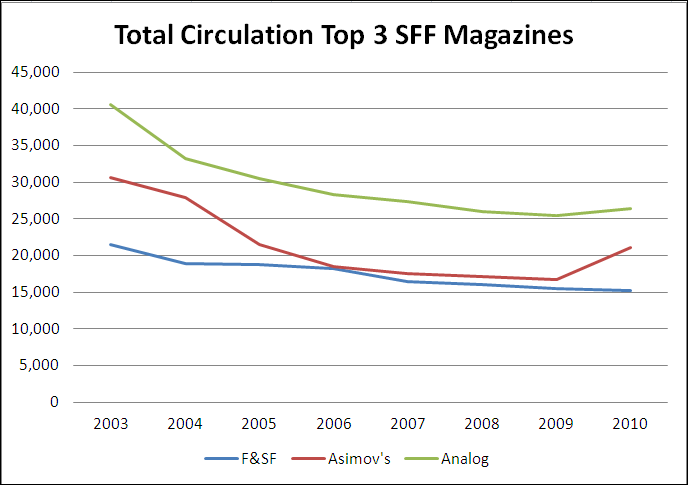
    It’s widely known that total circulation (sales) numbers for the main science fiction and fantasy magazines have been dropping for years. For example, in 1983 Analog’s circulation was around 115,000. Asimov’s and Magazine of Fantasy and Science Fiction, while not that high, were in the same general ball park. A lot has changed since then. Sales took a huge hit in the early 1990’s and continued to drop almost every year. However, last year something wonderful happened. Numbers went up.  


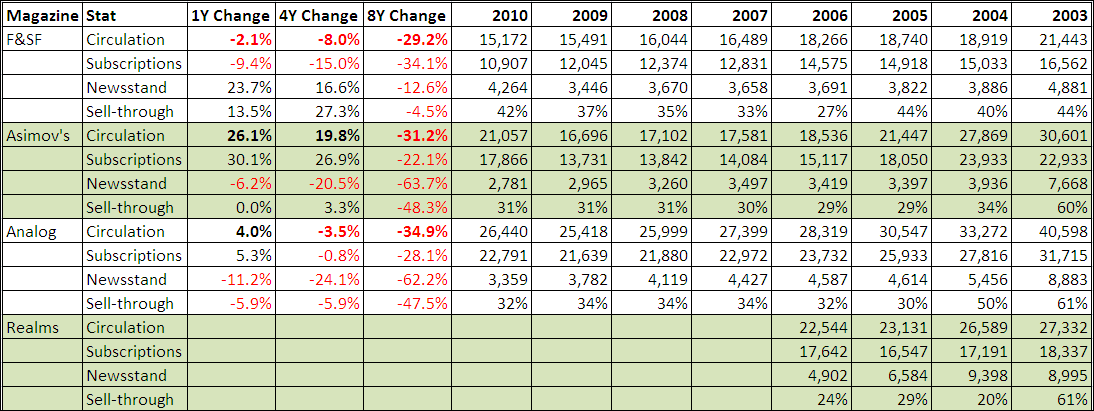
    Gardner Dozois, in his summation of the SFF industry for 2010, found in The Year’s Best Science Fiction Vol 28, from which 2010 and 2009 numbers were taken, mentions that the growth numbers for Asimov’s subscriptions were driven in large part by “digital copies sold for e-readers through devices such as the Kindle,” and that Analog’s increase in subscriptions was “also largely because of digital sales.”

    We all know that ebook took off last year. It will be very interesting to see the increase in total circulation continues for these magazines in 2011. Here is the supporting data that was collected from the reports in The Year’s Best Science Fiction volumes 20 – 28. Total circulation is made up of subscriptions and newsstand sales. Sell-through is a measurement of the % of the copies displayed in newsstands (at Barnes & Noble etc.) which sold. I added the Realms of Fantasy figures just so we could see, with the magazine recently dying its third death, just how big it once was.


    Of course, a fascinating question is: what are the chief factors that led to such a drastic decline in the first place? But I don’t know anyone who has been able to provide data to suggest what the chief cause(s) are. If anyone knows of one, please post in the comments.

    Wikipedia: Analog Science Fiction and Fact,

  • Author Interview: David Farland

    David Farland has been a big influence on me. It was his workshop back in the 90’s that actually made me think I could write professionally and led directly to my first publication as a Writers of the Future winner. Later Dave gave me comments on my first novel which helped me write a second, much better one that attracted Tor Books. And it was Dave who showed me the ropes on my first ever author tour.

    But long before all that, Dave was a writer whose work I loved. I read ON MY WAY TO PARADISE when it first came out and enjoyed the heck out of it. SERPENT CATCH and PATH OF THE HERO were next. I gobbeled them up too. Then came the THE GOLDEN QUEEN. By the way, SERPENT CATCH and THE GOLDEN QUEEN are two of my favorite novels. Now, all of those were written under Dave’s given name–Dave Wolverton. When he switched over to fantasy he used the Farland pseudonym.  His first Farland book was RUNELORDS. Folks, RUNELORDS is, in my opinion, one of the top 10 epic fantasies ever written. Ever.

    Of course, Dave has written many other novels and was involved with some Hollywood producers. Now he’s doing something new. He’s started his own publishing company–East India Press–and is releasing the first of his enhanced books through it.  Enhanced meaning far more than a book in print or electronic form–there’s also a soundtrack and art. NIGHTINGALE is that book. I asked him to share with my readers a bit more about it. Here’s his reply.

    *

    JOHN:  Tell us about how you came up with the idea for Nightingale?

    DAVE: Years ago, in the late 1980s or early 1990s, I read a book by a doctor who had worked for the CIA, experimenting with drugs that would erase both long- and short-term memories.  It was fascinating work, and he eventually won the Nobel Prize for it.  So I became interested in memory transfer.

    Later on, one Christmas, I got to thinking about the three “Wise Men” from the bible.  Normally, a “wise man” is called a wizard.  A “maji” is called a magician.  Why was it that the writers of the bible were using double-speak when discussing these guys?  Weren’t they astrologers?  Doesn’t the Old Testament condemn these folks to death?

    So I went back to the Hebrew and found out that indeed these three gentlemen were in the same class of magicians that the Old Testament condemned to death, the m’khashepah—which originally referred to a class of magicians that hung around royal courts.  Of them the bible says, “Thou shalt not suffer a m’khashepah to live.”

    So the thought occurred to me, “What if they weren’t just coming to give Jesus gifts?  What if they really had come to be . . . advisors.  What if they wanted to give him wisdom?”

    That started a whole train of thought dealing with memory transfer—transfer of memories, the possibility of training reflexes, transfer of memories on a cellular level, and so on—which led to the creation of my magic system. 

    The questions arose, what would people do with such power? 

    And of course from that a novel was born.

    Nightingale tells the story of a young man named Bron Jones, who is abandoned at birth.  Raised in foster care, he’s shuffled from home to home.  At age 16, he’s kind of the ultimate loner, until he’s sent to a new foster home and meets Olivia, a marvelous teacher, who recognizes that Bron is something special, something that her people call a “Nightingale,” a creature that is not quite human. 

    Suddenly epic forces combine to claim Bron, and he must fight to keep from getting ripped away from the only home, family, and girlfriend that he has ever known.  He must risk his life to learn the answers to the mysteries of his birth: “What am I?  Where did I come from?  Who am I?”

    This is a big project, an enhanced novel with illustrations and animations from half a dozen talented illustrators.  It has a sound track by the head of the National Composer’s Guild, James Guymon, with a dozen professional musicians and vocalists.  We’re releasing the novel in several formats, as an enhanced novel, a normal e-book, an audiobook, and as a hardcover.

    But we did one last cool thing.  The enhanced book was designed for the iPad, though you will also be able to read it on just about any other pad or smartphone.  But we had our programmers create a web app so that you can enjoy the book on your computer—read a few chapters, take it for a test drive, or simply buy it for reading online.  You’re free to go check out the results at www.nightingalenovel.com.  If you like it, remember to “Like” us on Facebook.  Better yet, re-post our site info and tell your friends on Facebook.

    Oh, and while you’re there, check out our short-story contest, where you can win $1000.

    *

    John sez: I’m very excited to see where this goes. I’ve loved Dave’s stories for a long time. And the premise of this book sounds great. Samples are available at: www.nightingalenovel.com