LDStorymakers Presentation

I’m at LDStorymakers this weekend. Had a wonderful time yesterday facilitating idea generation for the magic systems of eight writers who all had some really cool stuff.  Today I will be giving my presentation on banishing writer’s doubt, fear, and block using cognitive therapy.

For those who want the slides, here they are.

Banish writers fear doubt and block with cognitive therapy (PDF)

Enjoy!

Share

Similar Posts

  • |

    The average American reads 17 books per year

    Americans and Reading

    The Pew Research Center has just published their findings on reading in America. It’s called “The Rise of E-reading“. There’s a LOT of fascinating information in the report. Here’s a taste:

    1. Americans 18 and older read on average 17 books each year. 19% say they don’t read any books at all. Only 5% say they read more than 50.
    2. Fewer Americans are reading books now than in 1978.
    3. 64% of respondents said they find the books they read from recommendations from family members, friends, or co-workers.
    4. The average reader of e-books read 24 books (the mean number) in the past 12 months; the average non-e-book consumer read an average of 15.

    Building an Audience

    I also want to recommend this week’s post by Kris Rusch on Audience. She has a number of interesting things to say about the dream of being a best seller and building an audience. The money quote comes as she refers to a post by Tracy Hickman:

    “The point here is that you do not have to feel as though you are in competition with the entire world. You don’t NEED the entire world to be a successful writer. What you need is an audience—just enough of an audience, mind you—who reads your words, is changed by them and wants to come back for more.”

    An audience. More importantly, an audience that reads and “is changed by” your words. Not an audience who loves them, not even an audience who likes them. An audience who is changed by them, and because of that experience, “wants to come back for more.”

    Simple. Important. Usually forgotten.

    She talks about lots more. Read the whole thing.

    My thoughts?

    First, there’s no need for authors or readers to worry about wading through “crap.”

    According to Pew, readers only read 15 or 24 books a year on average.  That’s not a lot of books.

    More importantly, it takes about 3 seconds to get a lead for a good book.  You hear something from a friend or family member, you look at the USA Today best sellers list, you browse a few books at a store or online, you read a blog and suddenly you’ve found a book. 

    Readers fill up their book reading slots much more quickly than they can ever empty them.  That’s why we all have years of reading in our queues.

    It doesn’t matter that there are millions of other books out there, a good majority of which might have been written by monkeys. There’s no need for authors to worry that readers will have to wade through a mountain of crap to find a good book. They don’t need to because they have leads for good books coming out their ears.

    Second, people purchase books that friends, family, and co-workers love.

    Which means that when you deliver a great experience to one person, it’s going to ripple out. It’s probably not going to be linear. It’s probably going to ripple out like viruses do into different population pockets. Or seeds do into different environments. It will run through one pocket, make a jump to one or more others, or it may not jump at all. Some pockets are big, some are small.

    The way to keep a virus going is to release it in a lot of places where it’s likely to thrive or in places that a lot of people travel through. And as Kris points out, writing is all about repeat business–making sure you have a stream of good product (something I hope to rectify with my own writing this year).

    Bottom line: the best way to build your writing business is to simply write the best book you can, and keep them coming.

    Third, the market is BIG. 

    If you read Rusch’s and Hickman’s articles, you’ll see that even the mega sellers only reach a fraction of those who read. This is reinforced by the statement made by Thomas McCormack, former CEO of St. Martin’s that you can read here. So just because 100,000 people read one book doesn’t mean 100,000 others won’t read mine.  

    Moreover, e-books and online shopping are broadening distribution. Brick and mortar stores only have so many slots for books. Every 8-12 weeks they rotate the old books out (like 12 weeks is old) and replace them with the new ones, unless, of course, your book is selling very well and gets “modeled” at the store.  The point is: when you only display a few books at a time, those books will get bigger sales numbers. This happens because there isn’t anything else to purchase.

    But you don’t have that limitation with e-books and online shopping. Nothing rotates out of the store. Sure, things rotate on and off the best seller lists. But the books are always there. With an ever growing selection, there won’t be as many mega sellers.  Publishers Weekly discusses this trend in their 2011 Facts & Figures articles, which list best-seller numbers (make sure you click through to the Trade Paperback article as well). The same thing has happened with TV station viewership with the explosion of channels, DVDs, and online streaming. Same thing happened with music.

    What this means is each author has a better chance of getting his or her books to those who will love them. We’ll still have best-sellers. But we’ll also have a lot more medium sellers as well. And that’s great for authors everywhere.

    Share
  • Edward Bear Shares More Proofreading Secrets

    Mr. Edward Bear (pseudonym) shared an awesome secret for sussing out quote issues in a previous post. He’s back with a nifty way to help spot spelling issues.  It helped me spot a number of inconsistencies in Bad Penny, which I recently fixed. Take it away, Mr. Bear.

    * * * *

    Augmented Proofreading 2

    Last time, I mentioned checking spelling and spelling consistency, and this note is to fulfill my promise.

    To begin with, I’ll admit freely I do not recommend just running a spieling chucker over the text. And yes, I’m using the phrase deliberately. The spelling checker in the program I’m using to write this just waltzed right past it, despite the fact that neither word makes sense in this context. I got started trying to get some mileage out of spelling checkers a while back, when I realized that OCR scanners will work like hell trying to find a word and probably will come up with a word, but it will be the wrong word. Over at Project Gutenberg, they use the term “scanos” as an analogue of “typos.”

    The other adversary is consistency of spelling and usage. Examples might include “canceled” and “cancelled” or variant possessives, such as “Jones’” and “Jones’s” in the same text, or simply variant spellings of the same character’s name, such as “Erik” and “Eric.”

    So what do I do for these sorts of problems?

    What you need is a list of all the unique words in the story, and it’s easy with a dollop of regex. (See the first post on this topic. The one I’ve taken to using is the following:

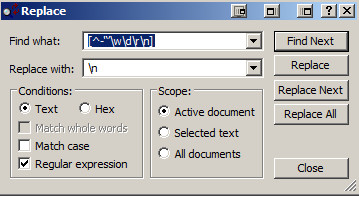
    [^-‘‘’\w\d\r\n]

    This one I can explain, since I wrote it. 🙂

    What it says is to look for any individual characters within the brackets([]). The leading caret (^) says “Nope, they should not be in this list.” Following that are the hyphen(-), the straight  quote(‘), and the opening and closing curly single quotes(‘’). After that, it’s any character that would normally be in a word (\w), any digit (\d), any carriage return(\r) or any new line aka paragraph terminator (\n).

    And what you do with the above is to set Textpad (see previous post again) to replace all of them with a newline (\n) character.

    Here’s what the search and replace box in Textpad looks like for this:

    Augmented Proofreading image001


    Notice that the “Regular expression” box is checked. And then you choose “Replace All”.

    The result is to turn this:

    Once upon a night we’ll wake to the carnival of life
    The beauty of this ride ahead such an incredible high
    It’s hard to light a candle, easy to curse the dark instead
    This moment the dawn of humanity
    The last ride of the day

    into this:

    Once
    upon
    a
    night
    we’ll
    wake
    to
    the
    carnival
    of
    life
    The
    beauty
    of
    this
    ride
    ahead
    such
    an
    incredible
    high
    It’s
    hard
    to
    light
    a
    candle

    easy
    to
    curse
    the
    dark
    instead
    This
    moment
    the
    dawn
    of
    humanity
    The
    last
    ride
    of
    the
    day


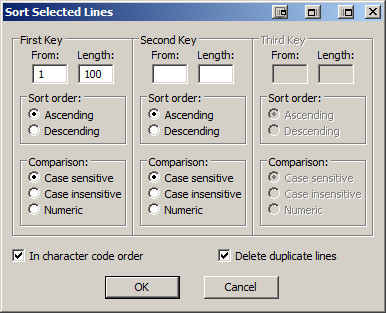
    For a book, this means what you have as a multi-thousand line long document and LOTS of repeated words. The next step is to lose the repetitions by sorting the list. For TextPad,  you’ll find Tools->Sort on the menu bar, and I generally set the sort up as the following:

    Augmented Proofreading image002

    This is a case-sensitive sort and “Delete duplicate lines”, of course, gets rid of all the duplications of words like “a”, “an”, and “the”.

    For the above text, you get:

    It’s
    Once
    The
    This
    a
    ahead
    an
    beauty
    candle
    carnival
    curse
    dark
    dawn
    day
    easy
    hard
    high
    humanity
    incredible
    instead
    last
    life
    light
    moment
    night
    of
    ride
    such
    the
    this
    to
    upon
    wake
    we’ll

    34 unique words.

    And here’s the payoff for all this funky text munging: Run a spelling checker over this, and it will find typos, of course, but it will also generally complain about most names, which aren’t generally kept in spelling checker dictionaries, and it will also show you words and their variants, nestled fairly closely together. Here’s an example from one of my projects:

    Swiss-born
    Take
    Talking
    Tallmadge
    Tallmadge’s
    Tarelton
    Tarleton
    Tarleton’s
    Tavern
    Tecumseh
    Tell
    Ten
    Thames

    The spelling checker landed on Tallmadge and its possessive form, but do you notice the “Tarelton” on the list? That’s the time for the Aha!, and you can fix the “Tarelton” form. The same thing applies to possessive variants and any other variant form you find.

    As with the last post, I’ll be peeking in on the comments and answering any questions that come up.

    Share
  • |

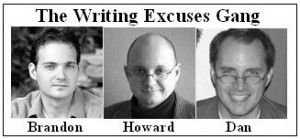
    Your local zombie author appears on Writing Excuses, Plus the Writing Debrief explained

    After a cancerous death, I appeared on Writing Excuses this week to groan and hold forth with the guys on writing second novels and second books in a series.

    During the podcast I talked about my practice of debriefing after every writing project. A reader just asked what that was, and so I thought I’d explain it here.

    The debrief is a simple thing. I learned it back when I worked as a business consultant. It always provides great insights. Sometimes  it provides massive insights. The principle is to pull back and look at the big picture every once in a while. So here’s what I do. When I finish a project, I sit down and simply list out what I struggled with, what went well, and anything I learned. I list out things I’d do again that worked particularly well and things I’d do differently. This might be about craft or process. Sometimes I might take some time to reflect on the nature of story and read a favorite book about the craft or perform a story analysis on another movie or book. Then I write up my insights in a form that I can read later and know what the heck I’m talking about. This can take a few hours or a few days. This last debrief after draft 3 of CURSE coincided with my preparation for a day-long workshop I had agreed to give on story, and so the insights came thick and fast. I recommend the practice highly.

    Share
  • |

    LTUE schedule posted

    ltuelogoLTUE has posted its schedule for the upcoming conference Thursday – Saturady, Feb 12-14. I’m, of course, stoked to present and participate on the panels. But I’m also looking forward to attending some of the sessions.

    Look at this one: How a Military Unit Works in Real Life: Zachary Hill, Brook West, Robert J Defendi, C. R. Asay, Mike Kupari (m)

    Or this one: All about armor: Zachary Hill, J. D. Raisor, Kay Mildenhall, Charles B. Stanford (m)

    Or what about this one: Law Enforcement: James Ganiere, Zach Hill, Robin Ambrose (m), which conflicts with one of mine, dang it!

    Or this: Making Creatures Realistic to their Environment: Keliana Tayler, Brian Hailes, Jessica Douglas, Bryan Beus (m)

    This: Applied Biotechnology: Derrick William Dalton, Mikki Kells, Charlie Pulsipher, Chersti Nieveen, Ali Cross (m)

    This: How to Create a Language: Maxwell Alexander Drake, Dirk Elzinga, Valerie Mechling, Samuel Stubbs, Bryce Moore (m)

    And tons of others.

    Oh, and what about the keynote address on Saturday by Toni Weisskopf?

    It’s going to be a great conference. I’ll be giving these presentations.

    • How to Build an Action Plot. In this one, Larry Correia and I team up to share a model of plotting that should make developing your action story much easier. Attendees will be able to use the methods on a novel idea Larry, Joe (Larry’s son), and I came up with called Mech Runners. Basically, Larry turned to Joe and said, “What’s awesome?” Joe said, “Giant robots, bandits, and murderers.” We took it from there.
    • How to Build a Romance Subplot. In this one, I team up with romance author LL Muir to share a model of plotting that should make developing your romance plot or subplot much easier. Attendees will be able to use the methods on a story idea Lesli and I came up based on The Hobbit. It’s called My Precious.
    • Tapping into the Power of the Story Setup. The story setup is a fabulous tool that’s not only helped me drastically cut down the time it takes me to develop my ideas, but it has also helped me develop better ideas. In this presentation, I will explain what the story setup is and how you can use it to help you nail your novel.

    I’ll also be moderating or participating on these panels:

    • The Hero’s Journey & the Virgin’s Promise: Patterns and Archetypes for Better Characters:Michaelbrent Collings, Tracy Hickman, Blake Cassleman, Renee Collins, John D. Brown (m). Did I tell you I think the hero’s journey is stupid? This ought to be a fun one.
    • Action Sequences: John D. Brown, D. J. Butler, Peter Orullian, Adrienne Monson, M. Todd Gallowglas (m)
    • Self-Publishing Pros And Cons: Jared Abram Barneck, John D. Brown, Mikki Kells, Joe Vasicek (m)

    Hope to see you there!

    Share
  • Some Key Concepts for Love Stories

    My first four professionally published short stories were all love stories of one kind or another. I love good love stories. And so when the Writing Excuses team podcasted about this topic with Dave Wolverton, I was excited to hear what they had to say. Of course, they didn’t dissappoint. However, I would like to add a few things here.

    1. A love story or romance is a happiness story. The problem is one of danger to, lack of, or opportunity for the happiness that comes with having a close bond with someone else. To be loved and included, to be valued by someone.

    2. Love stories don’t have to be between two characters who are romantically interested in each other. They can be between two people who become friends or a person who is on the outs with a particular group as with RAINMAN, or between a father (or father figure) and son as in TREASURE PLANET, or a mother and daughter.

    3. It seems to me that these social story problems can be broken down into four elements.

    1. Raising the idea
    2. Making the characters attractive
    3. Raising obstacles and conflict
    4. Showing signs of progression

    RAISING THE IDEA

    Just as with any story problem, we have to know there’s an issue. The idea of possibility or lack has to be presented to us. And the specific person who we hope the character bonds with has to be identified. How is this done?

    Lots of ways. But I can see two big ones right off the bat. The first has to do with what a character notices about the other person. In a romantic love story, it might be some thoughts about another’s attractiveness, either looks or character. This could happen when the character sees the other person, touches them, hears them speak. And it doesn’t have to be a stranger. Perhaps they had a crush on that person when they were younger. There are all sorts of cues we use to signal romantic potential. All we have to do is raise a few of those for the reader and the idea is planted.

    The second way the idea is raised is by having some other character raise it. Someone else notices the person and thinks them attractive. Or they make a suggestion that our character getting together with them is a possibility.

    So when Jack sees Mary he can think about when the blankety blank she’s going to get off the commando team because all she does is distract the men. Not him, of course. Or Bill can tell Jack that Mary has been watching him. And Jack can say, she can look all she wants because she’s never going to get a piece of this.

    MAKING THE CHARACTERS ATTRACTIVE

    The second thing I see that’s necessary is that the other person is attractive to the reader. Or, at least, the reader could see how the character could be attracted to this person. This doesn’t always have to be physical beauty. Nor does it have to be sexual attraction. A buddy story would be about something else–about someone who we think is admirable in some way. But it has to happen for the reader to believe the story.

    Of course, our hero may be duped. Jack might be falling for Cindy when she’s really just after his money. The readers know both sides and can see how Jack’s choices make sense, even while we feel great anxiety of the trouble coming down the line. 

    RAISING OBSTACLES AND CONFLICT

    These are key, of course. No obstacles or conflicts and there is no story. Jack sees Jill. Says I love you. They marry. The end. So we have to have obstacles. They can start immediately with the character recognizing a possiblity. For example, Jack is simply oblivious to Jill’s interest in him. And when he decides to trust his friend’s advice to pursue her, he sees her with another man. She’s not an option for him afterall.

    If we think about yes-buts and no-furthermores and that usually the hero has to fail at the end of act 2 for us to feel triumph at the end of act 3, we’ll see that obstacles and conflicts progress just as they do in any other story.

    There are many obstacles or points of conflict. Distance (CASTAWAY), social status, fears of rejection, a stuttering problem, another person who Jack is interested in or who Jill is interested in, something Jill does that Jack doesn’t agree with, jobs that are demanding and keep them apart or make them keep secrets (TRUE LIES). Are too closely related. It’s against your vows or values (you’re a nun or he’s a client) Etc.  Many are internal and have to do with trust, fear, competing desires, and commitment.

    The key to the obstacles, I’ve found, is in making it hard to choose or fulfill commitment. It isn’t about sex or kissing. Because you can have a story where two people have sex and it doesn’t resolve any tension in the love story (what if the guy is seen that night with another woman?). It’s about two people being able to say I love or value you and meaning it.

    And so anything that would keep them from commiting works. And after they’ve committed, anything that would make one recant. Or be unable to enjoy that love going forward.

    SHOWING SIGNS OF PROGRESSION

    The last thing is that the audience needs to know that things are moving forward. In plotting, we need a few yesses along the way or the story’s over. How do we do this? What are the signs? I can think of a few.

    1. The character’s thoughts are more and more about the other person, noticing all sorts of things, dealing more and more with inner dilemmas.
    2. The character’s actions become more and more open. The lingering looks, or glances she tries to  hide, the touching. The character’s words become more and more direct. Usually oblique at first and then more clear later.
    3. There is more validation from other characters.

    Why do so many stories have the characters in a romance dance? Not because dancing is some mystical thing. No, it’s a romantic cue. We associate romance with dancing. And being in such close proximity raises the pulse. But you can put people in close proximity in many other ways–in a crate as they’re being smuggled into the country, standing smashed together in a subway, retracting a bullet from the leg, cutting and washing hair (John Travolta in PHENOMENON), etc.  The reason why we do this; however, is so that we can get a yes, a sign of progression. Of course, we could also use it to raise a devestating conflict as when Maria dances with Captain Von Trapp in THE SOUND OF MUSIC. But that’s only devestating because during the dance they had declared in subtle ways that they were interested in one another.

    So we raise obstacles and show signs of progression, back and forth, the obstacles pointing more and more toward disaster until at the end of act 2 Jack loses…and we get the no-but plot turn. No, he’s failed completely. But then a desperate glimmer of hope…

    In the end we need final confirmation. One thing that says, yes, they’re committed. Often in romantic love stories writers use sex as a blunt confirmation. I think it’s often the lazy way out. Here, show Jack and Jill having sex. Okay, next plot point. It’s lost most of its power for me. And such a thing should be anything but cliche. My advice is to think of many other ways that show commitment and value. A few examples off the top of my head are what Dean Koontz in his ODD THOMAS series did this for Odd and Stormy, FAR AND AWAY with Joseph and Shannon, WHAT ABOUT BOB, and SABRINA. In fact, having sex was turned on its head in this one. Lovely.

    At least think about other options because romantic love stories are not about sex. Sexual tension stories are. But that’s a different problem. A different type of story. And it seems writers sometimes confuse these two. Romantic love stories are about two people finally saying, yes, I love you, I value you, and I mean it, and always will. And as an audience, we believe.

    And if that doesn’t move you, then remember that one of the things we go to stories for is surprise. Something new. How wonderful would it be if something as simple and Jackbiking into Jill’s work place with a parrot on his shoulder is the ultimate moment of the story, and says everything that needs to be said? And when Jill looks up at the commotion, her heart to this point hardened or desolate, and sees the bird, the audience weeps or cheers…

    Share
  • Advice from one of the biggest writers of our time

    How would you like to sit down and get writing tips from someone who created or co-created nearly 40 television series? Someone who wrote more than 450 episodes for those and other series and then went on to produce around 1,500 more.  Oh, yeah, and then after his thirty or so years in television, he published 18 novels. Whoa–eighteen. Like I’m shaking, right?

    It’s not like the guy knows much about telling stories. I mean, millions of viewers entertained–big deal. Still, do you think you might be interested in seeing if he hasn’t maybe one piece of advice that’s useful?

    If so, the guy’s name is Stephen J. Cannell.  He wrote about 9,000 words on developing stories and called it his Writing Seminar. I thought it was pretty good. Well, for a piker.

    Share

2 Comments

  1. This is good stuff. Though I’ve only read the PDF and didn’t attend the lecture, the message still comes through – very practical “IF you are experiencing X, THEN try doing Y” advice. And what writer doesn’t experience some (all) of the doubts and misgivings you list? Thanks, John – very cool!

Comments are closed.