Lesson 6 on writing done

Theory is important, but practice trumps theory. Every single day.

Lessons 1-5 have all been theory and helping you see how stories work and get sensitized to the effects they have on you. Now it’s time to get to work. In lesson 6, I guide you through a number of key techniques I’ve found helpful in getting me to the point where I’m ready to write the first draft. In this lesson, you’ll learn:

  • Productive creative Q&A questions for finding zing about setting, characters, and the main driver of your plot.
  • How to clarify your THOMR
  • A powerful technique to help you clarify the core of your story
  • How to figure out how many scenes you need
  • Techniques that help make potential events for your plot flood into your mind

Here it is: Lesson 6: Develop your idea

Enjoy!

Edit 1/24/15 at 10:45 a.m.: Lesson 6 revised

Share

Similar Posts

  • |

    Awful Intent Update: The power of having the electric ladies read to you

    Everyone says you cannot copyedit your own work.

    You’re an idiot if you try.

    Because you’re mind auto-corrects eorrs, and fills in missing punctuation or words like “of” “the” and “a”.  And often doesn’t care or know the house rules for capitalization. Etc.

    (Did you catch all the errors in that paragraph?)

    Except the brains of copy editors play this trick as well. That’s why some read the manuscript backward and others use arcane WordText code to suss out issues. And some change the font face. And some make multiple passes over a section, looking for dialogue issues the first time through, capitalization the next, and something else the third time. And despite all their work, you still find errors in the text.

    I’m not saying editors aren’t any good. I’m just saying that our brains, for the most part, don’t care about the details. They just care about the communication, and they’re very good at ignoring the rubbish. And when it’s just the brain and the eye working together, the brain makes sense of the text, even when something’s wrong or missing.

    So one trick to force the brain to see what’s actually on the page is to read your text out loud to yourself. It’s an excellent practice, except a human brain is still involved, and it sometimes still plays tricks. And sometimes we get lazy and start to read too quickly, and the next thing you know we’re subvocalizing and whipping along, missing all sorts of stuff.

    So what can you do?

    Well, a few book releases ago, I stumbled onto something. I invited an electric lady to help. And she was dynamite. (You can invite a man if you prefer the sound of those voices.)

    I’m talking about inviting your computer to read aloud every word of your manuscript to you. And highlight the words as it goes.

    I can tell you I’m never going back. These ladies have simply helped me see too many errors that were invisible to me and my beta readers who had editorial chops.

    I use WordTalk, a free plugin for Microsoft Word for this kind of reading. The University of Edinburgh created it to help kids learn how to read. It allows you to select from the text-to-speech voices you have on your computer, set the reading rate, and it highlights the word it’s reading so you immediately see where the error is.

    I set it at a slightly faster reading speed so my mind cannot wander during the reading and use the quick keys so I can start and stop and make my edits easily. And I always, always, always have my electric friend re-read any fixes I make because I can’t tell you how many times I’ve adjusted a sentence or paragraph and introduced more errors that I didn’t see, even though they were staring me in the face.

    I must admit that the electric ladies can’t do everything. Having them read to you cannot help you spot errors you don’t know are errors in the first place. If you don’t know, for example, the conventions for capitalization of personal titles or the conventions for numbers (is it a “.44mm” gun or “forty-four millimeter”?) If you don’t have your own house rules for the many areas where you have a choice like in an epic fantasy (do you use “Dreadman” or “dreadman”?) If you don’t know any of that, you’ll blithely skip over a host of errors and only see the issues you know like the misuses of “rise” and “raise” or “lie” and “lay.”

    So you have to learn the conventions or find someone who does (an editor). Or both.

    Also, doing this type of reading will not help you see if what you’ve written is actually translating the scene in your head clearly and vividly to the page for someone new to your story. Only a fresh set of eyes can tell you where your story isn’t clear, believable, or interesting (at least to that one reader).

    But for helping you spot the issues you do know, I haven’t found anything better. Give it a try.

    Oh, and the update on Awful Intent–Zira and I are almost finished with the copy edit! Which means the release is only days away.

    Share
  • |

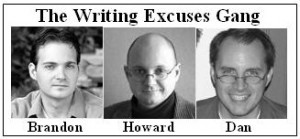
    John guests on Writing Excuses season 3 episode 19

    writing-excuses-the-guys2-300x139

    Here’s the third episode I recorded with the Writing Excuses guys.

    In the first podcast we talked about putting and not putting ourselves in our writing and making characters who don’t all sound like the author. In the second, we talked about how to not repeat yourself as an author. In this one, I shared some basics about generating emotion in readers and dealing with negative emotions writers face when they encounter rejection, compare their career with others, hit writer’s block, or hear someone didn’t like their story.

    As usual, the guys had some great insights. Check it out: Emotion in Fiction.

    Share
  • A Great Post on Writing by Mette Harrison

    Author Mette Harrison writes a column on writing for Orson Card’s Intergalactic Medicine Show. I think you can read them without a subscription. This month’s column had some great insights. Here’s one fab example.

    I also recommend that if you want to write a book that readers will not be able to put down, focus on one really good story (more on this next month). I am not saying that you can’t have sub plots or minor characters. You can. But I urge you to make sure that your page count does not obscure which characters are the main ones or what their main goal is. If you have lots of different characters who are in different parts of your world, that is fine. But make sure that they are all working at different ends of the same thread, that they all end up being part of the same story. If you cannot figure out which character is the one you want your readers to care the most about, to root for most desperately, you may have too many characters.

    Good advice. There’s more.

    Share
  • LTUE 2016 presentation materials

    I promised you I’d post my materials. Here they are.

    Succeeding as a Storyteller 2016-02-13 HANDOUT

    Vivid and Clear 2016-02-11

    What Comes Next 2016-02-12 PRINT

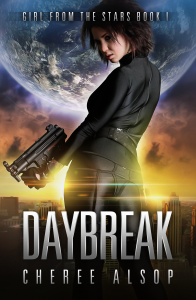
    Also, at the end of my and LL Muir’s presentation of Succeeding as a Writer, I offered some of my books, the ones I authored, for free in the back. I would like to ask whoever accidentally got caught up in the mad rush (it was like Black Friday) and took my copy of Cheree Alsop’s Daybreak: Girl from the Stars Book 1 to please mail it to me. It looks like this:

    Daybreak-Amazon-Kindle-196x300

    It is dedicated to “Mrs. Brown’s Class” and was a present for her. You may mail it to John D. Brown, PO Box 157, Laketown, UT 84038.

    Share
  • Zing Generators

    Where do you get your ideas? How do you turn them into story?

    Those are fabulous questions. The answer is a bit longer than I have time for today. But I have posted my list of idea generation methods, structured ways of performing creative Q&A.

    These have been collected over the years from a number of sources and are now passed on to you, faithful reader. Use them, cherish them, and, if you wish, start an order of crazed monks to preserve the fabulous secrets.

    John Browns’s Idea Generation Method List

    Enjoy!

    Share