Sure. An apptitutde for something always helps. But it appears it’s not enough. True expertise takes work. And those trying to help (i.e. parents, teachers, coaches) can hinder if they give the wrong kind of praise.
I wanted to share three articles reporting the results of a number of interesing studies on expertise which often appears as a skill level that seems unobtainable by normal, motivated individuals.
The Meadow Mount School of Music
This music school in the Adirondacks has “trained such luminaries as Pinchas Zukerman, Itzhak Perlman, Joshua Bell, Lynn Harrell, and Yo-Yo Ma.” A number of researchers wanted to see what the difference was between the students who seemed most skilled and those who weren’t. They divided students “into three skill levels, including one the faculty had identified as having the best chance of becoming world-class soloists.” Then they looked at the differences.
According to the report, “the results were clear-cut, with little room for any sort of inscrutable God-given talent. The elite musicians had simply practiced far more than the others…Psychologists found a second attribute in elite players that is less obvious than sheer hours of practice. While most of us think of practice as the repetition of tough spots (and this is how many young people do practice), elite musicians, they found, took a different approach.” Read full article.
The majority of childhood prodigies never fulfill their early promise
Why? According to these researchers it’s because so many early-bloomers get warped by their experience and fail to develop perseverance. More here.
Praise that Undermines Achievement
It appears that how we praise achievement affects performance. Sometimes in large and startling ways.
You may think that it’s good to praise your child for being “smart” or “good” in some subject. But there’s growing evidence that giving kids such labels doesn’t improve or motivate performance, but actually reduces it.
Psychologist Carol Dweck and her team have studied the effect of praise on students in a variety of settings. “Repeating her experiments, Dweck found this effect of praise on performance held true for students of every socioeconomic class. It hit both boys and girls—the very brightest girls especially (they collapsed the most following failure). Even preschoolers weren’t immune to the inverse power of praise.” So what type of praise actually works? Read here.
When does genius bloom?
We often think genius must be tied to being precocity. After all, Motzart was doing musical flips when he was still a kid. For writers, however, it appears this isn’t the case. More here.
A cracking good story idea requires five critical elements.
Until you have all five, you’ll struggle to plot. You’ll write a few scenes and run out of gas. You’ll feel like the story just isn’t going anywhere.
And that’s because it isn’t. It can’t. A story isn’t a story without all five elements.
However, once you develop these five things, your story will suddenly roar to life. There are a few other elements that are important as well, but these five things form the core of the story setup.
In this course you’re not going to merely learn about all of those story elements. You’re going to go deep and learn what can only be learned by actually doing the work and developing story idea after story idea with personal one-on-one feedback from someone who knows what they’re doing.
When you finish, you won’t just know story theory. You will be a story idea machine. And you will be that because you have put in the work. The right work.
Again, this is not a course full of lectures and videos. This is a course where you’re going to work. And develop the insights and skills that only come from doing the work.
You’re actually going to:
Come up with story setup after story setup after story setup
And improve them with one-on-one feedback.
It’s going to:
Eliminate years of you wandering about in the story wilderness trying to figure things out on your own.
Put you miles ahead of other writers who have no idea what’s really at the core of story.
You are going to learn how to develop killer story ideas on purpose instead of on accident. Which means you’ll be able to do again and again. Reliably. Like clockwork.
Course details
The focus of the class is not on learning about story, although you will do that. The majority of your time will be spent on developing stories.
You can’t become a carpenter by watching videos and reading books about it.
You have to get out on the work site, cut wood, and pound nails. You have to make the mistakes all beginning carpenters make, get feedback, and improve.
The same goes for writing.
And you’re going to work in this class. You develop 21 story setups. In fact, you develop more because the 21 are just the ones you turn into me. And with each one your skills, insights, and abilities grow.
In the beginning, your setups will be bare bones. By the end, they’ll be fully developed setups that beg to be written. Setups you can use to immediately write the first draft of your novel, whether that’s in outline or chapter form.
Here’s what you do each week.
Week 1.
Uncover the secrets of what’s really at the heart of story and how to generate ideas.
Define your genre requirements
Create story setups 1-3
Week 2.
Uncover the secrets to compelling characters
Create character sketches
Create story setups 4-7
Week 3.
Uncover the secrets to formidable obstacles
Create story setups 8-11
Week 4.
Uncover the secrets to interesting casts
Create story setups 12-15
Week 5.
Uncover the secrets to managing multiple storylines and series
Create story setups 16-19
Week 6.
Create story setups 20-21. These are your capstone projects where you apply everything you’ve learned and take it to the next level
In this class you develop story idea after story idea after story idea. You are going to be marinated in the work of developing characters, THOMs, goals, obstacles, settings, casts, and more. And because of that, each week will not only bring an explosion of insights, but new skills and abilities.
Every week you get two private, one-on-one, live sessions with me where you get encouragement and feedback on what you’ve developed. And you’ll have access to a private Facebook group where you can apply the principles to brainstorm even MORE ideas for each other’s stories.
At first you might feel a bit shy and worried about your ideas and abilities. But you’ll soon get over that. By the end of the course you’ll be one of those people that can generate terrific ideas easily. And you’ll be able to do that because you will have put in the work to become a different writer.
What’s the price?
Hours of one-on-one instruction from a professional editor or author costs thousands of dollars. An MFA program can cost $25,000 to $30,000 or more!
But this course won’t cost anywhere close to that.
Plus you’re going to learn things here you’ll never get in an MFA program (I know. I was accepted into a top-ranked program).
The cost of this course is $799. And I personally guarantee your results. You’ll be totally oh-my-gosh-I’m-so-happy-I-took-that-class satisfied, or I’ll give you your money back. No questions asked.
Now’s your chance to stop spinning your wheels. I can’t tell you how much I wish I’d had something like this when I’d started:
The secrets about the true core of story.
The secrets about how to come up with ideas.
Actual work with personal one-on-one feedback.
Laser focused on what actually matters, not a bunch of ridiculous writing rules.
When you finish, you will be a story idea machine.
You won’t know plotting. That’s a different course and set of skills. You won’t know how to write chapters. But you’ll know how to create the engine that powers all the rest of that. You’ll know how to create the core that makes awesome plots and chapters possible.
If you want to take this course, click the button below and contact me. I will tell you exactly how to apply.
I’m not going to be able to accept everyone who wants to take the class. I have a very strict limit on the number of students I can work with. So you need to get your application in before the deadline of midnight, December 11th.
I get a lot of emails from authors who are just starting out, or who are on the road but frustrated at the level of success they’ve seen thus far. I wish I had more time to correspond with everyone, but the truth is I’m usually slammed with writing/publishing related tasks, and don’t have a lot of opportunity to do more than offer a brief sentence or two.
But the last few missives I received got me thinking about what I wish someone had explained to me before I started self-publishing in June, 2011. So here’s my top 10 list, such as it is:
1) There are lots of talented writers out there. Lots. And it seems like everyone’s now got a book, or books, on Amazon. Being good isn’t enough to guarantee you anything but satisfaction for a job well done. It should, but it doesn’t. Don’t take it personally.
2) There are lots of crap writers out there. Lots. And while many sink to the bottom of the swamp with nary a whimper, some sell well, and some even become bestsellers. This is because the world’s unfair and, depending upon the genre, oftentimes readers don’t care much whether they suck or not, as long as the story entertains or reaffirms some conviction or bias the readers have. These authors succeed in spite of their abilities, rather than because of them. Don’t take it personally.
3) The internet is filled with gurus who know nothing. It’s hard to turn around without bumping into a writing or self-publishing expert. Most of them are completely full of shit, and don’t sell many books – but that doesn’t stop them from trying to get you to part with your money to hear them tell you what you need to do to sell well. Whenever you hear advice, consider the source. If it’s a million selling author, that means more than from someone whose work ranks slightly lower on Amazon than the collected love poems of Adolf Hitler in original German. Seems like everybody but me is selling seminars, courses, or how to books that promise much and deliver nothing. Must be a good business there, but I prefer labeling my fiction as such and putting in a car chase or gunfight rather than trying to trick the dim or desperate out of a few bucks.
4) You need to be able to put out books at a decent clip. Sure, you might hit huge off one, but probably not. You’ll be building your readership the hard way, which means one reader at a time, and the more quality books you have on your virtual bookshelf the more likely one will catch someone’s eye. This doesn’t appeal to a lot of authors’ wish that they could write a book every year or two and have a nice living. Sorry. I have yet to see that happen. But it’s a seductive siren song, so lots of newbies listen to it like it’s still a viable way to go. In self-publishing, not so much.
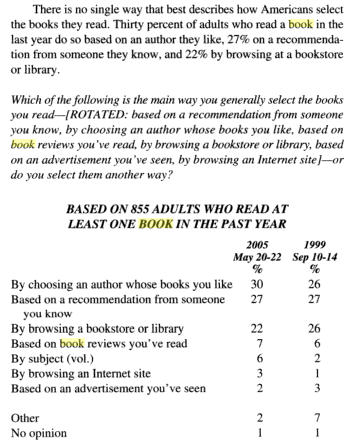
Gallup did a poll in 2005 asking readers how they selected the books they read. Here are the results.
What this says to me as an author is that the most important thing I can do to help my career is write the best dang story I can, seeing that almost 60% of what readers select is driven by the experience they or someone else had with the book.
The next most important factor has to do with helping my book stand out for browsers. This would include the cover, store placement, blurbs, flap text, and the opening pages. The only part of this an author can really focus on is the opening pages–again, writing the best dang story I can.
So it seems authors, especially debut authors, can’t do much to affect sales. But not being able to do much doesn’t mean they can’t do anything. Somewhere, somehow the first readers have to be enticed to give the book a go. Robert Sawyer talks about some of the methods to do that here.
EDIT: 4/8/2011
Kris Rusch adds more information that confirms the findings of the poll above in “The Business Rusch: Promotion”. READ HER WHOLE ARTICLE. Notice she does concede that publishers can get some notice for a book. So there ARE things that can be done to make the offer. But I agree with her advice that the best thing to do is get more product out the door. The studies she cites are:
2010 Survey of Book-buying Behavior by VERSO Advertising. The key conclusion on book-buying is that “Multiple factors impact consumer awareness of a particular title, but final purchase decision (online and offline) driven by author reputation, personal recommendations, and price.” If I were you, I’d read the whole presentation.
Here’s Joseph Finder, a NY Times best-selling author, talking about how he studied his craft, why he uses outlines, and what he decided about four-letter words and why.
I had the same reaction when my daughter came to me wanting to read my stuff. I’ve never heard of Joseph Finder–there are soooo many authors these days. But I can tell you I’m going to pick up one of his books to see what he’s all about.
Complaining is not a business strategy ~ Jeff Bezos
I love that quote.
That doesn’t mean folks should never express dismay, fear, or frustration. It can sometimes be very helpful to voice it.
Name it.
Pin it to the wall.
And then move forward.
So Amazon changed how they approach paying authors with Kindle Unlimited (KU). I think the move is fantastic. It rewards value provided to the reader. If you’re in the business of selling value to the reader, that’s a no-brainer.
I also think this whole KU 2.0 thing illustrates why Author Earnings is so important.
It reminds us that we are NOT Amazon.
It reminds us that we are NOT the publishers.
It reminds us that we are NOT the agents.
We are a totally different group.
Amazon is simply a partner. A great partner right now, but they are NOT us.
Which means we’re responsible to make our own way. How do you do that? The only way I can imagine is to own the idea that you’re a business. And then think like a business.
How?
I haven’t run any better way than the lean startup approach. I’ll be sharing some posts over the next few weeks that explains just what that means.
Happy 4th of July! May God bless America and the disruptive freedom-loving form of government she introduced.