Lessons on Story from the Hunger Games – Recording
Here you go. And here’s the presentation in PDF: Story lessons from The Hunger Games handout. Thanks again to Stephen Nelson for the recording!
Here you go. And here’s the presentation in PDF: Story lessons from The Hunger Games handout. Thanks again to Stephen Nelson for the recording!
“More than 50% of all traditionally-published book sales of any format in the US now happen on Amazon.com.”
That’s just amazing. But I found something even more amazing this week.
Author Earnings released a report this week of their analysis of a million titles on Amazon. Data Guy, the tech guy behind the software gathering the information and crunching it, posted this graph in the comments.
Do you see the amazing thing?
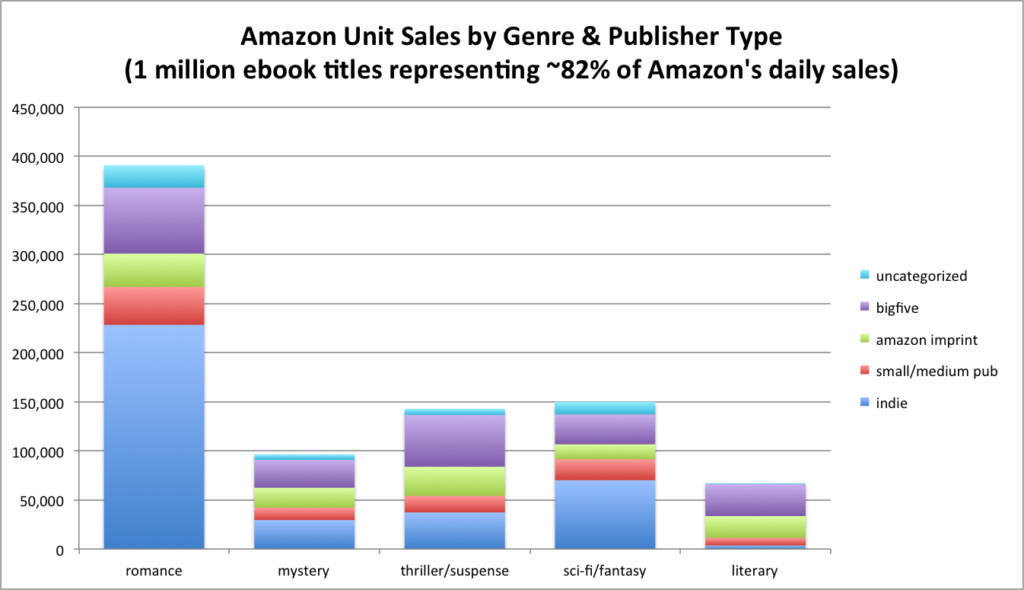
Well of course you do, I gave it away in the title of the blog. Science fiction and fantasy sell MORE units than thrillers.
More.
What?!
For, like, ever I thought SFF was a tiny portion of the market. Not so, my friends.
Some may say, well, but this only represents Amazon. What about the channels traditional publishers sell through? Author Earnings explains a way to account for that in their report. Basically just double the size of the purple and red bars. If you do that I think thrillers might just edge SFF out. But it doesn’t dwarf it by any means.
Furthermore, for an indie author, I don’t worry about those other channels because they’re not really a viable option for me. My world is selling online. And the online market for SFF is the SECOND BIGGEST MARKET after Queen Romance.
Oh, BTW, next book in the queue is volume 1 of Lord of Bones. It’s going to start with something like this.
The four men did not leave. Instead, they spread out just a bit in shallow semi-circle in front of Blaze.
Four of them. One of him. There was definitely going to be blood.
“You don’t want to do this,” Blaze said.
The big one drew his sword and swung it a bit to loosen his shoulders. “Oh, but we do. Because you’re not handing over the blackmeal. And we’re not leaving without it.”
No, he was not going to hand that over. Couldn’t. Not if he valued the lives of his wife and boy.
Two of the others drew their swords. The fourth brought his staff up and laid it on his shoulder in a two-handed grip.
The big one would be the obvious target to take first. But Blaze knew that would be a mistake. The big one was there just to focus his attention. To fix Blaze in place. And then the silent one would slice him up the side.
The man with the skinny face said, “Old man, the vultures will be picking your eyes out before lunch.”
Blaze said, “Well, if you’re so determined, let’s not keep them waiting.” And then he rocked forward.
I’ve not forgotten the Dark God series. I will finish it, but I need to get this smaller volume of Lord of Bones out.
Complaining is not a business strategy ~ Jeff Bezos
I love that quote.
That doesn’t mean folks should never express dismay, fear, or frustration. It can sometimes be very helpful to voice it.
Name it.
Pin it to the wall.
And then move forward.
So Amazon changed how they approach paying authors with Kindle Unlimited (KU). I think the move is fantastic. It rewards value provided to the reader. If you’re in the business of selling value to the reader, that’s a no-brainer.
I also think this whole KU 2.0 thing illustrates why Author Earnings is so important.
It reminds us that we are NOT Amazon.
It reminds us that we are NOT the publishers.
It reminds us that we are NOT the agents.
We are a totally different group.
Amazon is simply a partner. A great partner right now, but they are NOT us.
Which means we’re responsible to make our own way. How do you do that? The only way I can imagine is to own the idea that you’re a business. And then think like a business.
How?
I haven’t run any better way than the lean startup approach. I’ll be sharing some posts over the next few weeks that explains just what that means.
Happy 4th of July! May God bless America and the disruptive freedom-loving form of government she introduced.

You already know how I feel about writerly rules. So when I read James Maxey’s “The Only Law of Literature,” I had to share it.
I want to quote the whole thing here. But I’ll resist and quote only the conclusion.
[In response to critiquing stories that don’t work for you] All the literary analysis of writing techniques, of style, of world building, of creating characters–it all has it’s place, but it’s almost completely useless as a guide to writing a good book. You are never going to be able to think or study or analyze your way into writing a book that people love.
There is only one law of good literature: Write what you’d love to read.
Not what you have read and loved. What you love, but haven’t yet read.
To quote myself from the Impish Idea thread:
Every thing you write should be a love story. Not a romance. But a story written because you loved it.
Follow your passion. Don’t worry about pleasing everyone. Fill your book with the stuff that makes your heart race and leave out the stuff that bores you. If you don’t make it into print, at least you’ll have a book you can look at with pride as being truly your own.
Once you’ve learned this secret, everything else falls into place.
Go read the whole post.
It’s important to learn craft. You cannot get away from it. But craft is only useful as a tool to tell this cool, wonderful, poignant, amazing thing we’ve invented and discovered.
 I don’t know how it’s possible to aruge that media does not influence our decisions. The evidience is simply overwhelming. Here’s another report of a study linking media sexuality to teenage decisions about sexuality.
“CHICAGO — Groundbreaking research suggests that pregnancy rates are much higher among teens who watch a lot of TV with sexual dialogue and behavior than among those who have tamer viewing tastes.” Full article here.
The study shows that while teenage pregnancies have dropped overall, those teens watching racey shows had, not just a small incremental risk, but TWICE the risk of getting pregnant.
Now, I know this article by the Guttmacher Institute focuses on the 1990’s, but it still is enlightening. It discusses the reasons for the dropping teenage pregnancy rates during those years. It’s conclusion is that both abstinence and usage of more effective contraception are the main factors for the drop in teenage pregnancies.
When I put the two articles together, it makes me wonder if the racey shows are encouraging more sex among the teens who watch them or the use of less-effective contraception or both. My guess is that the shows are influencing a decision for more sexuality.
Either way, what does this mean for a writer?
To me, it means that while I’m never responsible for someone’s actions nor in 100% control of what people take from my writing, I AM responsible for those things I know are highly likely to influence folks one way or another. I hope my works provide a wonderfully entertaining experience, but also avoid influencing people into decisions that will lead them down paths that will limit their happiness.
 We already know that many people break into the novel market WITHOUT writing short stories. So they’re not necessary for starting a writing career, although they might have helped some folks. See this page http://johndbrown.com/writers/writing-business-facts-figures/ for links that will show you how people break in. But some people just love short stories, so the question is can you make a living writing them?
The answer is yes, you CAN do it–you go into television and get hired to write scripts for TV series (grin).
But what about doing it in print? Well, let’s try some conservative math.
TARGET: a conservative $30,000 gross per year.
The median household income in the USA is $50,000. But you can find a place (rural Ohio or Indiana or North Dakota etc.) where housing is relatively cheap and live on $30k. I think this is a reasonable target. So let’s make some assumptions about the stories. We’ll assume each short averages around 4,000 words and that you get paid seven cents per word. To earn your target amount you’d have to sell:
At 10 cents a word:
No, this doesn’t count reprints, movie deals, gaming contracts, etc. But reprints usually don’t pay well and movie deals, while they pay well, can’t be counted on. Besides, we’re being conservative.
Again, a little math.
TARGET: 2 stories, 8,000 words average per week
If we assume you write five days per week for six hours per day at a rate of 500 words per hour, which may be very aggressive if you try to include thinking and revising time in that, then you’ll produce 15,000 words per week.
So, yes, this is a feasible, if aggressive, production rate–on paper. But I don’t know anyone finishing this many stories per week. Furthermore, it’s highly unlikely you will sell 100% of what you send out. So you need to actually produce MORE than two stories per week. You might have to end up writing three or four. Week after week after week. That’s one story every day or two.
Theoretically, yes, that rate of production still fits in the 15,000 word capacity. But I’m going to say it’s doubtful anyone can do this because I haven’t seen anyone do it. Have you?
But even if you were the Lizard King of writing and could pull this off every week of the year, the question is can you sell all those stories?
According to http://duotrope.com/index.aspx there are about 200 venues for short fiction paying pro rates, which for them is 5 cents or more. No, anthologies are not represented there. But I’m not sure it will change the equations that much. So you have to sell 107 stories to these 200 markets. I don’t know how many slots are open in these places. Some of these venues publish one story per year, some publish twelve, some more. Some are published semi-annually, quarterly, bi-monthly. Let’s say there are 2,000 slots. Of course, we might need to count total wordage up for hire at these venues instead, but we’re just doing this on the back of a napkin. So 107 stories out of 2,000 slots means you’d have to make up 5% of the market. You sell five of every 100 stories these folks buy.
FIVE PERCENT OF THE WHOLE MARKET!
Nobody makes up 5% of the whole short fiction market. NOBODY. Okay, let’s say there are 4,000 slots. Each venue averaging twenty stories per year. So you have to make up 2.5% of the market. Nobody does that either. What about 1%? Anyone? One out of every 100 stories? No.
Is this because writers are lazy? Could it be done? You might be the first?
That’s lotto thinking. What you want is demonstrated income, i.e. people have DEMONSTRATED it can be done. Nobody has demonstrated this can be done in the current market. So it’s not reasonable to expect you’ll do something nobody else is doing.
So the answer is that even if you produce three to four short stories per week, you’ll never be able to sell enough to make a living. Now, I know of a few authors who can make a few thousand dollars per year writing short stories. I’ve heard of one guy who made $10,000 a year for a few years. But can you live on that? Even if you move to a place where housing is very, very cheap? Besides, we’re trying to avoid lotto thinking here. We’re trying to be practical and conservative. This is one guy. Do you yourself know anyone who has done this? I wouldn’t want to base my future on what one guy did.
CONCLUSION: there’s no evidence that strongly suggests it’s feasible to sell at the necessary rate to make $10,000 per year let alone $30,000.
Go back up and look at the annual output of words. If you can write 300,000 to 450,000 words per year, you could write four to six young adult novels (averaging 70,000 words per book) or two to three adult novels (averaging 120,000 words per) in that same time.
Why not build a career in novels?
Yes, you may start at $5,000 – $6,000 advance per book. But if you sell well, that goes up. Plus, if it does sell well, you get royalties. Plus you can sell foreign novel rights. Plus you get an advance to help with some expenses. More importantly, we have thousands and thousands of folks DEMONSTRATING they can make a living writing at that pace.
So write short stories if you love them, but don’t expect to make a living at it.
Could you make a living selling your shorts out there?
Only if your shorts were once worn by Brittany Spears.
For more on e-book sales, let me recommend you read a few posts by J. A. Konrath. I’ll let you decide. But please note that he’s selling NOVELS. And as always, you want to be realistic about this and make sure you see many people DEMONSTRATING it can be done. Do you think Konrath presents such evidence? You tell me.
Read these two posts by Dean Wesley Smith where he busts some big myths about not being able to make a living writing:
Killing the Sacred Cows of Publishing: Only 300 Writers Make a Living
Killing the Sacred Cows of Publishing: Can’t Make Money in Fiction
I am developing an online novel writing course and am looking for folks to pilot it with me and give me feedback. I’m thinking I want to limit it to 10-12 folks.
It’s free and will probably take two or three months to complete. If you join, your job will be to do the work. And there will be work. I’m thinking 10-15 hours of work per week. Please don’t ask to join if you don’t want to make this commitment. I only want folks who are serious and ready to give this a shot. In addition to the work, you’ll need to report your experience with the course as we go, sharing with me where you get stuck, what’s confusing, what’s helpful, what does and doesn’t advance your skill. In fact, if at some point the course just isn’t providing you any value, you are welcome to drop. That’s good feedback too.
It’s going to be a blended format that includes self-paced work and some type of weekly online meeting. I will be guiding the class. At the very least, we’ll meet and chat at my site. I don’t know if we’ll do a live meeting or not. Still working that out.
I struggled for many years, trying to figure this stuff out, then had a number of epiphanies during Orson Card’s boot camp and continued from there. Of course I still have lots to learn. But I want to share what I have.
I love teaching and have been teaching in one form or another for the last 20 years. I’m currently an education program manager at a large software firm. What this is all means is that I’m trying to build a course that guides folks through a process that will help them learn to WRITE novels. Not just talk about them.
So this is not a series of lectures with quizzes that test your ability to recall, although I will quiz you.
It’s not a course with an end goal of teaching you what I’ve learned about the concepts and principles of plot, character, and setting, although you will need to learn that.
This is about increasing your ability to get ideas, develop them, and then write.
It’s about doing the work. It’s about production. It’s about finishing product. And having a good time doing it.
If you already feel comfortable with your ability to finish novels, this is NOT the course for you.
You can learn more about the course here by clicking The Path in the On Writing menu.
Probably the only other thing you need to know is that the class is a PG-13’ish class. While the stories can deal with intense and adult themes, as the teacher, I’m not interested in working with stories with explicit or detailed sex or lots of language of the sort that would earn a movie rating more restrictive than PG-13.
Remember, this is a pilot. Even though I’ve taught about writing for a number of years to various audiences, there might be some rough spots. We might find we need to change the work requirements or activities or any number of things.
If you’re interested, click on the Contact link on the menu of my site, and shoot me an email.
Edit 1/30/15: I’m getting a number of excellent questions about the time commitment and schedule. Let me answer them here.
The gap I’m trying to fill
First, you have to understand that I am not interested in talking about novels and writing novels. I’m interested in helping folks finish novels. That’s a big gap I see in most writing instruction. It’s the gap I had. There was nobody to help me move from the theory to the writing, and writing all the way to the end. So this isn’t a class about novels. It’s a class where I hope to help you learn a number of techniques for developing and finishing one. And to learn those techniques, you have to actually use them. Which means you have to develop and finish a novel 🙂
So why 10 hours as a minimum?
If you’re a slower writer, it’s going to take you around 50 hours to develop and write a novel of 25,000 words. That’s the size of one of Louis L’Amour’s smaller novels (which we call sometimes call “novellas” today). It’s the size of some smaller romances. A lot of indies are writing serials around this size. If you want to write a 50k book, it’s probably 100 hours, maybe more. A 75k novel? 150-200 hours. The development and first draft of a 100k novel? 200-300 hours.
These are not exact times. Some writers are faster. But you get the picture. Writing a novel is a big project. And I’ve found that it’s just too hard to get any traction on less than 10 hours per week. When you spend much less time than that, you spend most of your time just trying to remember what the story is about. I’ve found it’s best to keep your writing engine hot, or at least warm.
So will these 10 hours be in meetings?
No. I don’t want to have a lot of meetings. That’s the beauty of online. We will have deadlines. But you should be able to complete you work during the times that suit you best.
What’s the course schedule?
I can’t give you an exact schedule. I haven’t timed everything. Figuring that out is part of what we’re doing in this course. But I do know what I want you to learn and how I hope to help you learn it. We’ll just have to see how far we get with each weekly 10-hour chunk.
Comments are closed.

So glad to see this finally up. I thought this was excellent, and It was truly said that more people didn’t stay late enough to see this. It changed my opinion on a lot of things, and gave me some much-needed encouragement to keep on writing. Thanks, John!
Sometimes staying late pays off. Sometimes it just makes you tired.
Looking forward to this. Thank you.