Indie Thoughts: Tend Your Garden

From Joe Konrath.

Your ebooks function much like a garden.

One rare occassions, a plant will thrive with little help from you.

Others may whither and die no matter how much help you give them.

But the majority need to be constantly tended. Planted, watered, fertilized, weeded, pruned, mulched, replanted, harvested. In other words, lots of work.

Ebooks aren’t a Mr. Popeill invention where you can set it and forget it. Quite the opposite. You need to pay attention, and keep active, or your garden won’t thrive.

Everyone experiences slow downs in sales. It’s inevitable, and it seems to be cyclical, but not in any sort of way I’ve been able to prodect. Sales seem to rise and fall for reasons unknown.

But if you’re doing what you can to make your books discoverable, you have a better shot at sales than those authors who self-publish then self-ignore.

Here are some tricks to tend to your garden.

1. Change prices. As an indie, this is one of the biggest advantages you have over the legacy industry. You decide what the customer pays, and this is powerful. Don’t be afraid to weild that power by experimenting with prices, both lower and higher.

2. Newsletter. There is no excuse why you don’t have a newsletter. People who sign up are actively looking for your titles. Make them aware a new title exists.

3. Sales. Unlike a change in price, a sale only lasts for a short time. KDP Countdown is what I’m currently using, because it offers 70% royalties when I drop the price. I’ve been pleased with my results.

4. Advertising. Bookbub and Booksends are the ones I use regularly. If you’ve had success with another company, list it in the comments.

He names eleven tips. Link to the rest at JA Konrath’s blog.

This goes back to something Blake Russell said in the myth posts I pointed to a few posts ago. There are some folks who suggest that you can either write the next book or you can promote the current one.

Folks who suggest it’s either/or leave me scratching my head. Why not do both?

Applying to BargainBooksy or BookSends takes less than 30 minutes. Sending a review copy out to a decent review site takes about the same amount of time. If I spend just one hour a week on promotion, I can do all three of those things each month plus something else.

Some folks suggest that promotion doesn’t work when you only have a few books out. And forget about it if you only have one. Promo can’t do anything for you if you only have one book out. At least, not as much as completing the next book can.

Let me ask a question.

If I open a McDonalds down some back road where nobody sees it and nobody travels, do we think that releasing a second McDonalds down some other back road where nobody travels is going to increase sales?

Nobody is going to go down those roads except by accident.

Is that how McDonalds or Walmart or whatever company you want to name built their vast empire? They did it by accident? How about the diner everyone loves in your town? They hid it at the end of a dirt road, told nobody about it, definitely did not put up a sign (good grief, not a sign), and, shazam!–the customers started rolling in?

Mcdonalds11

Some folks say, no, you’re missing the point. The purpose of a promotion is to get people to buy other books in your list at higher prices, so if you don’t have a lot of other books, your promotion can’t do anything for you.

Using loss-leader or sampling strategies with one book to sell others is certainly a smart thing to do. Because it works. With cheeses at Sam’s Club, with books, with a lot of things. But is that really the only thing you’re trying to do?

How about building a base of readers who have some degree of loyalty to your brand? You don’t need ten books to start to do that. You don’t need two books. You can start with one.

I started two series last December—a thriller and an epic fantasy–and (writing gods willing) will be releasing book 2 in the fantasy series this month. Since December I’ve sold close to a thousand in each series. It was easy to see that at least half of my sales, maybe more, came because of some type of promo. I know this because I watched the numbers.

This means I now have hundreds more folks waiting for book two than I did for book one in both series. I’m going to be releasing book two in both series with a bigger customer base than I would have had without promo. Why would I not want to start at a higher level for each successive book?

More readers means more word of mouth. Why wouldn’t I want more word of mouth about my books?

More word of mouth means higher odds that an influencer will hear about, try, like, and then promote my books. In fact, I’m looking at at least double the odds. Somebody remind me: why wouldn’t I want those better odds?

One of the main keys to this business is to get a big enough customer base so that the word of mouth takes on a life of its own. I am building that base more quickly with promo than without. Why would I want to build that base more slowly?

Finally, I have twice the money I would have had otherwise to invest in promo and covers and editing etc. Or just go spend on my wonderful wife and girls. Why wouldn’t I want this revenue?

Traditional publishers have built reader bases for an author one book at a time, often spaced a year apart, for decades. They put money into the promo that works in in-store venues: covers, pre-release reviews and the necessary ARCs, catalogs, a sales team, and co-op visibility in the stores. And while that promo didn’t guarantee anything, it made the odds more likely the book would get readers to sample and build that reader base.

Why shouldn’t we put money into the promo that increases the odds for online stores?

What business out there can’t benefit from good promo?

Of course, the next question is what methods of promo work? There are a many methods that are a waste of money. But not all of them are. I think it’s our job as entrepreneurs to test and find ways that are effective a la The Lean Startup by Eric Ries.

Anyway, Konrath’s advice to not self-ignore, and Blake’s “do both” approach make a lot of sense to me.

Share

Similar Posts

  • |

    John guests on Writing Excuses season 3 episode 16

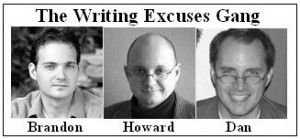
    writing-excuses-the-guys2-300x139A while ago the Writing Excuses team asked me to record with them, and last Friday I got to do it and had a blast.

    We recorded three episodes. In the first podcast we talk about putting and not putting ourselves in our writing and making characters who don’t all sound like the author. As usual, the guys had some great insights. Check it out: The Anti-Mary Sue Episode.

    Share
  • When the workshop works

    From a workshop participant at MountainCon:

    I’m going to give a shout out to all the goodness I experienced. So if you don’t really care what happened at the con, you can stop after this paragraph and take this message away with you: Brandon Sanderson (who does Writing Excuses, has published several novels, and is the chosen one to finish Jordan’s Wheel of Time series) and John Brown (with a must buy novel coming up next year) are incredible teachers. If you ever get a chance to attend a class or workshop by any of them, don’t let it pass.

    We loves to hear these things, Precious.

    But we loves it just as much when we can make the students shiver with excitement: more here: http://www.amichopine.com/blog/?p=318

    To those who missed this run of the 3 Things You Must Learn to Write Killer Stories Workshop, know I’ll be holding it again. Check back to see when.

    Share
  • |

    Is Product Popularity Random?

    In Why Publishing is Making You Crazy—and What You Can Do About It: The Tao of Publishing, Steven Axelrod and Julie Anne Long write an interesting post that takes some findings made by Duncan Watts and attempts to explain why writers should only focus on the quality of their work because they cannot reliably affect popularity in any other way.

    I agree with them that social-influence seems like a good explanation for the sometimes unexplicable successes we see in publishing and the difficulty publishers have in both predicting and producing a steady stream of hits. However, I do not find support for their main conclusion that writers can do nothing but write.  In fact, I suggest that Watts’ findings show quite the opposite.

    Axelrod and Long base much of their argument on an experiment conducted by Duncan Watts that tested the power of social-influence on music selection in some controlled music websites. Watts summarizes his findings in the excellent Is Justin Timberlake a Product of Cumulative Advantage?.

    In his part of the post, Axelrod points out that the Watts findings indicate “50% of the factors affecting your career could be totally outside of your control—totally random” and that “unless we can separate out those random factors which contributed to an author’s past success [and we can’t, Axelrod suggests], anything we can say or predict about why she succeeded will invariably be way off-the-mark.” And therefore “what’s interesting—and chilling, as well—is that there’s evidence that the harder a person works to make sense of a random event, the farther they’ll end up from the truth.”

    In other words, the only thing an author can reliably do to improve the popularity of his stories is focus on their instrinsic quality. And get more stories out so he has more shots in the fickle social-influence game.

    I agree that having more product in the market increases your odds. I also agree that focusing on the intrinsic quality of the writing can do the same. I even agree that this is where authors should spend most of their time. However, Watts’ studies do not indicate other efforts are wasted. In fact, they suggest the opposite.

    Watts does not controvert anything we now know about marketing. What he does is clarify the power of social-influence in our decision making and the dynamics of ONE type of endorsement system. What Watts shows is:

    1. A perceived non-bias endorsement of your product can have a huge effect in the product’s popularity.
    2. The intrinsic quality of the product has an effect on popularity, but social-influence plays as large or larger role.
    3. Popularity in the system set up in the test websites depended on the decisions of a few early-arriving potential endorsers, i.e. good early reviews (downloads in this case) are amplified and lead to an effect he calls “the richer getting richer.”
    4. In this one endorsement system, neither a future endorsement nor the identity of the early endorser can be predicted.

    These findings, however, need to be put in context. From cars, to camcorders, to recipes, the popularity of a product depends on three main factors. These aren’t new ideas and publishing is no different than any other industry. The factors come from long-standing marketing practice:

    1. Visibility (people know about it)
    2. Endorsement (recommendation from an attractive person, trusted authority or friend, or trusted system like the perceived unbiased reviews on Amazon or “most downloads” stats)
    3. Attractiveness (intrinsic to the product, the perceived value offered the target market, and the social effect as pointed out by Watts)

    Each of these three affects the other two. Visibility makes endorsements and initial attractiveness possible. Endorsements make a product more attractive and more likely to be visible. Attractiveness makes something more visible and more likely to be endorsed. And round and round we go.

    It’s true that Watts shows 50% of the effect is due to endorsement. But nowhere does Watts suggest an author cannot increase the probability of visibility and endorsement.

    In the study, the endorsement method used was a counter showing the number of times the song had been downloaded. It was random, anonymous, and perceived as unbiased. That was a controlled environment. However, what if a singer had been able to ask all those he knew who loved his song to download it from the site? Or what if someone organized such a campaign independent of the singer? Both actions would immediately affect the probability of the song increasing in visiblity and endorsement and, hence, popularity.

    It’s too bad Watts didn’t test this in one of his sites to see if he could make a winner. As it was, all Watts was doing was seeing if he could predict a success by quality alone. He was passively observing, not actively taking measures to increase visibility and endorsement.

    Furthermore, the counter is just one type of endorsement system. There are a number of others. We’ve all seen how an Oprah endorsement can move the market. The identity of that endorser is NOT random and has great predictive value. Her decision to endorse is still random. But what if you have a way to make your book visible to her? Would it be a waste of time to do so?

    Robert Sawyer loves to tell of one action he took with someone with much less endorsement power than Oprah and the effect it had on his sales. Was Sawyer guaranteed visibility and endorsement from that action? No. However, he DID increase the probability, and it resulted in sales. Here’s his account.

    Watts confirms that endorsements have a mighty effect on popularity. Even something as simple as a “most downloads” counter can easily overwhelm a listener’s own reactions. But the logical conclusion is not to do nothing. The logical conclusion is that if authors want to increase their popularity, they must not rely only on the intrinsic value of their product, but they must also search for ways to increase visibility and endorsement.

    Axelrod is correct that it’s sometimes difficult to see the effect of any given marketing campaign or tactic. This is because marketing efforts are probabilistic, not deterministic. However, probabilistic does not mean random. Furthermore, it does not indicate you cannot increase the probability of success. While publishers may not be able to produce best sellers every time, I’m confident if they decided to stop marketing altogether, sales would drop.

    Will all efforts succeed? No. Any marketing progam needs to consider the effect of diminishing returns. The effectiveness of some actions may be difficult to test. Furthermore, authors may not have the budget to run a campaign large enough to increase their probabilities, although there are strategies to become a big fish in a small pond (see Geoffery Moore’s Crossing the Chasm).

    Despite all these issues, we know, in general, getting endorsements helps. In general, the right placement in book stores increases visibility. Author visits to schools, if done right for middle age readers, can also increase visibility. Radio interviews, if done right, do the same. There are many things that DO improve an author’s odds. We can increase the probability of visibility and endorsement by taking intelligence, consistent action.

    And that’s good news. We might not be able to guarantee a hit, but one thing IS certain—we’ll have no direct influence on visibility and endorsement if we do nothing.

    (BTW, for those interested, here’s a great presentation on a related idea:Six Degrees: The Science of the Connected Age a presentation by Duncan J. Watts.)

    Share
  • What does an author earn per book?

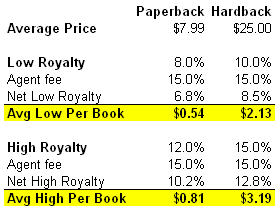
    People are always curious about this, so I thought I’d post it and refer to my previous post about what kind of sales numbers it takes to make a living as a fiction author in the US. Of course, the royalty rates depend on what’s in your contract. Many contracts have sales volume break points. For example, an 8% royalty on the first 50,000 paperbacks sold, 10% on anything above that. But this should give you a good feel.

    Earnings per book

    Share
  • My working process

    Because I get questions about how I work, whether I outline, etc., and to satisfy the curiosity of those waiting for Curse about what I’m doing right now, I’ve decided to share my working process.

    I use five types of documents in Word to write my books.

    1. Pre-draft documents
    2. Working outline
    3. Chapter development docs
    4. Manuscript drafts
    5. Book

    I then import the book into InDesign to create the ebook and POD versions.

    THE PROCESS

    1. PRE-DRAFT

    I start developing and collecting ideas for character, setting, problem, plot, and sometimes even text. This includes brainstorms, zings, setting sketches, character sketches, scene or dialog snippets, plot sketches, photos, maps, story setup statements or problem statements, etc.  I’ll often have separate pre-draft documents for character, setting, problem, and plot. Or it might be one big document. At some point all of that electricity has built to the point where the story starts to buck and kick in my hands. When I start to see scenes rolling out in front of me, I know it’s time to create the outline.

    2. WORKING OUTLINE

    Looking at my pre-draft material, I create a sequenced list of the events or scenes in the story. Sometimes I’ll describe an event with just one line, sometimes I’ll describe it with more. These events or scenes often match up to individual chapters, but they often change as I go because the outline changes as I work. This outline is usually 4-12 pages long.

    I usually have more detail about the first parts of the book when I start than I do the last parts. But even if some parts are sketchy, I usually have at least a line for each of the big events all the way to the end. When I start drafting (steps 3 and 4) and moving through the book, the details for those later parts begin to fill in. Again, it’s a “working” outline so things change.

    3. CHAPTER DEV DOCS

    When I finish the working outline to my satisfaction and start chomping at the bit to write, it’s time to start drafting. I open a new chapter development doc for the first event on the outline and copy/paste the event’s material from the outline into it.

    I do some sketching if necessary (see my posts on scene primers) in the new document. Then I begin to write with the outline material and scene sketch as a guide.

    If I run out of steam, or the take of the scene doesn’t work, I do another take. I just stop, create a new heading titled “Take 2” or 3 or 4 (whatever the take is), and start again. I may brainstorm as well in this document and do other pre-draft work that has finally presented itself to me to be done. There have been a couple of times that I’ve had to do 20+ takes to get a take that works. Most of the time I need 1-3 takes. Using Word navigation view I can see in the sidebar all the takes etc.

    The nice thing about these chapter development documents is that they’re working documents. I can be messy.

    4. MANUSCRIPT

    When I’ve gotten a good take of the scene, I paste that take into my manuscript document which contains all the final takes from the chapter development documents. This is “draft 1” of the manuscript. Usually each scene/event becomes a chapter, although I might split it if it goes long, or combine it with others if it’s short.

    5. REPEAT UNTIL DONE

    I repeat steps 3 and 4 until I’m done with the book. Using Word navigation I can see all the chapters in the sidebar.

    6. CHAPTER REVIEW

    Before I print the manuscript for the cold read, I will review the chapter breaks one more time based on what I feel is right for the length, the right effect, especially at the ending and beginning of the chapter, and what I think goes together.

    7. DRAFT VERSIONS

    After cold reading and marking up the printed form of draft 1, I copy the manuscript file and replace the suffix “draft 1” with “draft 2”, then make the edits for the cold read in draft 2.

    Then I send draft 2 out to my beta readers. When the manuscripts and comments come back, I copy draft 2 and change the suffix to “draft 3” and make the beta reader edits in draft 3.

    I do this for as many drafts as I go through, including those for the copy edits.

    8. BOOK

    When I’m done with drafting, I copy the final draft and replace the draft suffix with “book”. Then I add front matter and back matter (title page, copyright page, teaser, map, author’s note, table of contents, etc.) in preparation for importing into InDesign to create the ebook and POD (print-on-demand) versions.

    9. POD

    I create an InDesign document, import the Word book, then save it with the suffix “POD”. Next I finalize the interior formatting for printing. There’s quite a bit that goes into this with chapter breaks, widows, and orphans, breaks, etc. When that’s done, I upload it to CreateSpace and then print off the proof they provide.  By now the cover is finished as well.

    10. PROOF READ

    I read the POD proof to catch any last errors and make the appropriate updates to both the Word book and the InDesign POD document.

    11. EBOOK

    I copy the POD InDesign document and replace “POD” with “EBOOK”. I then add the appropriate changes (links etc.) to the front and back matter for the ebook. Next I export the InDesign document as an EPUB. I have to use Calibre Book Editor to edit a number of things in the EPUB. When that’s done I open the EPUB with the Kindle Previewer to create the MOBI version (Kindle file).

    12. PUBLISH

    The next step is the easiest–click a few buttons to upload the final version of the POD and ebooks to the various online retail venues. I go direct with Amazon, CreateSpace, NookPress, and Kobo. I use Draft2Digital for iTunes and Smashwords for all the rest. 

    Share
  • | |

    Teachers (and writers)! Free Class Next Monday on How to Teach Narrative for the Common Core

    If you feel a bit lost or anxious about how to teach narrative for the new core, especially stories, I think I can help.

    I’m an educator in the private sector and an award-winning novelist and short story writer. I’ve been teaching authors in various venues how to write for the last five years. I’ve been on writing podcasts with thousands of listeners, taught at a number of writers conventions, and had a series of articles published by the national Science Fiction and Fantasy Writers of America organization, an organization for professional authors. I’ve also been helping Nellie, my wonderful wife, teach her 7th and 8th grade language arts students the unit on short stories during that same period. We’ve taught it to twenty different classes and picked up a number of important insights along the way.

    This last year I couldn’t help but examine all the materials Nellie brought home during the district’s writing program adoption investigations. Some programs looked very promising; others not so much. Some got some things about writing flat out wrong. Most of the programs had gaps.

    Furthermore, because I work with so many people wanting to write, I know that it’s difficult to teach if you really don’t understand what stories really are and how they work. For lots of people, the subject matter can seem impenetrable. And yet writing stories is such a wonderful way to teach writing, especially because so many kids love it. You won’t find a kid who will spend extra hours writing a business letter or poem analysis, but you will find quite a few who will go crazy writing stories. And the whole time they’re practicing their writing skills.

    The question is how DO you write a story?

    What is a story?

    How can you tell if it’s good?

    How do you come up with ideas?

    Where do you start?

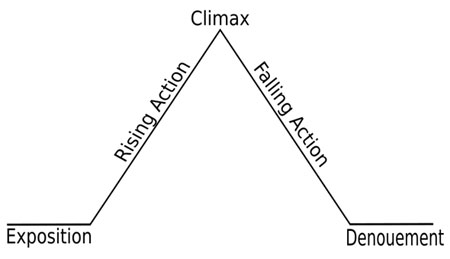
    And what the heck is this chart? Do writers really use this? (Not many that I know.)

    Story Diagram plot-mountain-pic

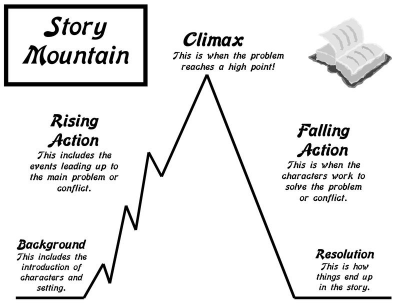
    And does anyone think changing the diagram to look like Aspen, Colorado actually helps?

    Story Diagram Aspen 

    Hey, students—please make your story look like Aspen, Colorado!  (Yeah, that’s going to be effective.)

    And yet it’s not as difficult as it appears. Nellie and I have seen a lot of kids really get into writing stories. We’ve seen kids WILLINGLY going way beyond the assignment to write stories that are eight, twelve, twenty-five plus pages. And as they’re writing, they’re practicing grammar, spelling, structure, vocabulary, etc. without knowing it and having a great time. I know that if you enable your students, many of them will write, write, write. Especially in grade school. But also in the higher grades.

    Stories can be a blast. The assignments can connect to many students. And the results can be wonderful. I’ve laughed out loud at some of the stories coming out of Nellie’s class. Others have been enjoyable on other levels.

    But for this to work in your class, you need to know some key things. You need to understand the core of story and the story development process. You need a lesson plan that details everything step-by-step so your students don’t flounder. And you need to know some fundamental tips (secrets?) about teaching this content.

    So I’m going to hold this day-long class for you. A full eight hours. And share everything Nellie and I have learned. This class will be for teachers at ALL levels (I’ll show you some ways to scale the complexity of what you’re doing). There will be NO cost. The only thing you have to bring is a pencil, paper, whatever program materials you have, and a willingness to have a good time.

    When we finish, you will know how to write a simple story like the ones your students will write because, ta-dum, you will write one! AND you’ll have a step-by-step lesson plan that builds on whatever materials you have—an official program or one of your own. AND you’ll understand story better than 99% of the population. AND you’ll have a bundle of techniques to help your students. AND you’ll solve both world peace and maybe the lost sock conundrum.

    Truly, I think that instead of feeling stress, you’ll actually be looking forward to teaching and writing stories with your students. If not, you may bring tomatoes and huck them at me, but please be aware that I will not stand still; to find satisfaction, you will have to be able to hit a moving target.

    If you’re interested, just click the Contact John link under my photo in the left sidebar and send me an email letting me know.

    Hope to see you in class!

    GET READY FOR A FUN DAY OF LEARNING!

    Topic: Teaching writing (narrative & the common core)

    Who: Teachers (and writers at least 18 years old), seats are limited

    When: Monday, July 29th, 8:15 AM – 5:00 PM

    Where: Rich Middle School, 54 E 100 S  Laketown, UT 84038

    Materials you need to bring:

    • Pencil
    • Paper
    • The writing program you’ll be using this year
    • Kooky socks, for those who cannot resist the urge
    • A lunch or a way to get one

    AGENDA

    8:15 AM Arrive

    8:30 AM – 9:20 AM

    • Can you create a redneck crapper?
    • The 1st secret to teaching writing: Attributes & techniques
    • The 5 parts of story
    • Thieves prosper – using existing patterns
    • A car, a beggar, and an idiot — basic pattern 1

    9:30 AM – 10:20 AM

    • The 2nd secret to teaching writing: Do it with them
    • Technique: Sketch then draft
    • Workshop 1: Zombies and kisses
    • Technique: Zing hunting
    • Workshop 2: Hunt zing

    10:30 – 11:20

    • What makes a story big or small
    • Workshop 3: Select a right-sized THOM and character
    • Workshop 4: Select a Goal
    • Workshop 5: Make character sympathetic
    • Workshop 6: 3 tries
    • Workshop 7: Resolution

    LUNCH

    12:00 – 12:50

    • The 3rd secret to teaching writing: Cognitive modeling and the 6-step process
    • The 4th secret to teaching writing: Our tiny brains
    • Writing is telling: Narrative & description
    • Technique: Yes, SiR
    • Technique: Broad-brush + 1
    • Technique: The Pause

    1:00 – 1:50

    • The 5th secret to teaching writing: Have fun
    • Workshop 8: Write your story

    2:00  – 2:50

    • How the pros revise—concept, line, & copy
    • Workshop 9: Content edit
    • The 6th secret to teaching writing: Our brains are still tiny
    • Workshop 10: Line edit

    3:00 – 3:50

    • The 7th secret to teaching writing: The 3 grunts (responding to a story and grading)
    • Share stories
    • What the heck did we just do?

    4:00 – 4:50

    • How to adjust for grade level
    • Common core
    • Your program and lesson plan
    • Identify black holes
    • Wrap up & next steps
    Share