Good Stuff! Unbroken by Laura Hillenbrand

hillenbrand-unbroken-4

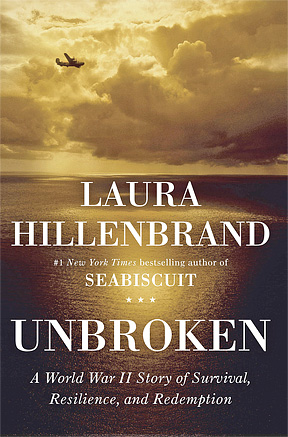
Unbroken by Laura Hillenbrand is the finest book I’ve read in some time.

It’s tells an engrossing and true World War 2 story about Louis Zamperini, who started out in life as a steal-and-run trouble-maker. He was a kid who’d try the patience of Job. His mother tried to reform him to no avail. His father administered spankings, but physical punishment seemed to have no effect. Louis was constantly in trouble with neighbors, school mates, cops, teachers, store owners.

Louis’s older brother thought Louis would succeed if he were to just receive some positive attention. He thought track, a very popular sport at the time, was just the ticket. Louis loved his brother. In 9th grade he tried running, but the workouts chafed, and then one day he had an altercation with his parents. Louis figured the train would take him away from all his problems. So he ran away, hopped a boxcar, and very quickly learned the freedom of the rails wasn’t freedom at all. It sucked.

When he returned home, defeated, he decided to submit to his brother’s plan. This time it was just what the doctor ordered. Louis ran like mad. He broke records. He got a scholarship to USC and broke more. Louis ran in the 1936 Olympic Games. He didn’t win, but he would the next time they came around. However, the world was in turmoil back then, and Germany and Japan had their own plans which changed Louis’s life forever. He became a bombardier in the Pacific theater.

And that’s where I’m going to stop. The story that awaits you is truly amazing. And Hillenbrand brings it to life with surprising and powerful details. From start to last, I was enthralled. And towards the end, just when I thought the story was over, it took a turn that lifted it from being just another WW2 story with plenty of action to a tale that goes right to the heart of what it means to live. I wept, not for Louis’s pain, as awful as that was, but for something far more vital.

When I first saw the book, its sepia-washed cover turned me away from the tale. But with so many folks talking about it, I thought I’d give the first pages a go. I was delighted, but didn’t make it a priority. Not long after that, my 10th grade nephew told me how much he enjoyed it, and that prompted me to go back (and I’m so glad I did). It’s not that this is a kid’s book or that my nephew has the maturity of an older man. He’s definitely got some reading chops, but it’s not about an advanced writing style either. What is enthralling old and young alike is Zamperini’s story and Hillebrand’s skills in telling it.

How much do I like this book? I’m reading it again, slowly this time, so I can savor every word. Let me recommend you do yourself a favor. If you read one book this year, make it Unbroken.

Share

Similar Posts

  • You thought Bad Penny was fiction?

    How about former CIA operatives and Navy Seals forming a private group to rescue child slaves?

    Last January, Ballard made a bold move and left his job to form his own team of former CIA operatives and Navy Seals who operate undercover to bust child slavery rings

    . . . . .

    Ballard’s organization is called Operation Underground Railroad, and members call themselves abolitionists. The references to 19th-century slave liberation are deliberate.

    There are currently 25 million people living in slavery, according to the 2014 Global Slavery Index research released by anti-trafficking organization Walk Free Foundation. The U.S. State Department puts the figure closer to 21 million, and about two million of those slaves are children.

    Ballard’s line of work has opened his eyes to a problem most people are blind to — the fact that there are more people living in slavery now than at the height of the trans-Atlantic slave trade.

    . . . . .

    Ballard knows better than anyone just how easy it is to buy a child. In an operation in Haiti earlier this year, he posed as a trafficker and visited an orphanage where two children — a brother and sister ages 2 and 3 — were sold to him for $15,000 apiece.

    That’s the going rate for a child, says Ballard, and over time, the owner can make millions of dollars by selling the child for sex or forced labor.

    Read the rest at Heroes of 2014. Become an abolitionist here.

    Then go on to read about another hero–the Iron Angel–who is helping folks out of another kind of slavery.

    Then a third called the Vicar of Bagdad, who has had over 1,000 of his flock killed for their beliefs.

    Here’s the full list of the six featured heroes.

    Share
  • If you want to work with publishers, you need this. Right now.

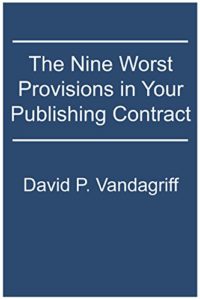
    thenineworstprovisionsinyourpublishingcontract-by-vandagriffWriters who want to deal with publishers need this book: The Nine Worse Provisions in Your Publishing Contract by David P. Vandagriff. And it’s currently free!

    Vandagriff is a lawyer whose business involves high-stakes intellectual property litigation. He has negotiated major contracts with a wide range of opposing parties, some of which include Apple, Hewlett-Packard, Microsoft, Intel, Morgan Stanley, Merrill Lynch, Fidelity Investments, AOL, Disney, Hallmark, plus other large publishers, agents and etailers.

    He’s also publishes The Passive Voice, a news blog on the publishing business that includes many posts from his lawyer perspective.

    Don’t fall for contract terms that turn you into a slave.

    Share
  • The Rocket Science of Overspending

    In July, I blogged some spending 101 for Congress and the President, including contigency planning for alien invasions.  I thought I made some good points.  However, through the whole spending debate that occured this last spring nobody in the media or elsewhere was able to make clear what is going on with the US government. Nobody except Dave Ramsey. He explained it on Fox and then on his website. If you take the big federal numbers and translate them to a size we can understand, here’s the situation:

    – Joe and Susie (the Federal government) make $55,000 a year
    – They spend $96,000 a year
    – At the same time, they have $366,000 in credit card debt

    Look at those numbers again. Every year those clowns in Washington are adding $41,000 a year to that massive debt total. Soon enough, our overspending will kill our ability to do anything else except pay the interest on that debt.  150 years after America abolishes slavery, we decide that debt slavery really is a good idea. Yea! Give us shackles! Give us shackles!

    No wonder our credit score as a nation (our bond rating) was reduced.

    So what did the government do this last Spring? They agreed to find some way to cut spending from $96,000 to $78,000. Meaning they’re still adding $28,000 dollars a year to the government’s massive credit card debt total. Which we have to pay!

    If the US Government was a family, they would be making $55,000 a year, they spend $96,500 a year, & are $366,000 in credit card debt. What’s the first step to get out of debt? Stop overspending! But that means a family that is used to spending $96,500 a year has to learn how to live on $55,000. That’s a tough pill to swallow. It works the same way for the government. You can’t borrow your way out of debt, whether you’re a typical American family or the entire U.S. government. At some point, you’ve got to say, “Enough is enough!” and make the hard cuts necessary to win over the long haul. – Dave Ramsey

    The answer is NOT to print more money.

    If you do that, you reduce the value of each dollar. It’s called inflation. As Ron Paul rightly points out, it acts effectively as a tax. Or as I like to put it–a PAY CUT. How many of you would like to get a nice fat 10% or 20% pay cut this year? Furthermore, instead of fixing the problem, the overspending continues, which means more pay cuts in the future. More fun!

    No, the thing we have to do is STOP SPENDING MORE THAN WE MAKE.  Here’s what has to happen.

    1. We must write into law that Congress balance its budget every year–they must not be able to spend more than they take in except in rare emergencies. This means they might need to build up a rainy-day fund.
    2. We must cut our spending. Now. I linked to an idea Ron Paul has for this in my 101 post where we just go back to 2007 levels of spending.
    3. We must work to increase our revenues. Not through hiking taxes to monstrous levels, but by providing optiomal regulatory conditions for economic growth. See my 101 post. 
    4. We need to make sure the taxes are visible, so the American people can easily see what’s going on. Congress has mandated that lenders provide clients an APR so they can clearly see the rate they will pay on a mortgage. Why shouldn’t we mandate that the IRS send out an ATR–annual tax rate (or maybe Annual Grab Rate or Annual Tax Burden or you come up with the name)–which includes all Federal taxes translated into one total rate?  
    5. We need to give everyone the opportunity to pay for the soldiers that defend them and the roads they drive on, even if it’s just $50-100 a year for the very poor.
    6. We must send people to the White House and Congress who are willing to do what it takes RIGHT NOW.

    I mentioned Ron Paul a number of times above. He’s not my choice for president. But he has added a number of good things to this discussion. Here are the Ramsey links:

    EDIT: Mark Holt makes an excellent point in the comments. Inflation isn’t just a pay cut. It’s a savings cut, a retirement cut, a 401k cut, a house value cut, an everything cut. Using that backdoor method, the DC Connivers institute a tax of everything, something they’d never be able to pass out in the open.


    Share
  • YA Books Ratings and Publisher Arrogance (shh, it’s about the $$)

    I’m a bit irked.

    I wish I could talk to a publisher about this. I should talk to a Barnes & Noble corporate book buyer. But since I don’t have one handy, I’ll discuss it with you folks. Maybe I’m up in the night? You tell me.

    Here’s the deal. My wife is 7th and 8th grade language arts teacher. My wife is also a mom who loves books and wants her girls to read until their eyes bong out of their heads.

    So we go to find books for her students and for our girls and, jeez, wouldn’t you know it, but this YA book features masturbation and that one features lots of fine words like F*** and S*** and this one is about giving the guys a blow job (tee, hee, hee).

    Yeah, I know about YA saves. This isn’t about banning this or that content.

    It’s about the fact that I’m a parent. And, geez, I have a certain way I want to raise my kids. My wife is a teacher who needs to provide books to her students that aren’t going to piss some parent off. Why? Because she’s providing a service to that parent. Because she wants to keep her job. And because it’s her job to help parents improve their kid’s reading ability not tell them how to raise a family.

    So why in the Sam Hill can’t publishers rate their books?

    There are millions of their customers who would find this useful.

    Well, here’s one answer I was given by a writer friend I respect.

    Everyone in the industry is really pushing back against the idea of a rating system. Let me see if I can explain why.

    A friend of mine, ZZ [name removed], is the nicest person in the world. Volunteered for years at a prison to help people learn to express themselves by writing. Her older brother was a closeted homosexual for years, contracted AIDS, died too young. She wrote a book recently called [title removed], about a family in the restaurant business (as hers was) who have a “late” baby and the problems it causes for the older teens, one of whom is coming out as gay. It’s a soft, quite, sad, moving book. And it would be part of the “rating” system and banned from a bunch of schools. ZZ also wrote a book a few years ago about teenage pregnancy. Also beautifully written, kind, compassionate. But it would get tagged by schools as “inappropriate.” ZZ feels strongly that there are kids out there who need books, kids in your wife’s school system who need to be told they are not alone.

    I don’t see any way to have a system that distinguishes between books that I see as anchors to kids who need help and those books which I see as genuinely offensive and encouraging bad teen behavior by glorifying it. The only system I know is me recommending the best books I see. And I’d much rather see librarians and school teachers go through books on a case by case basis, deciding whether they personally think it fits the values in their community than to have someone else not attached to the community do the same thing.

    Uh huh.

    If this is accurate, it shows the industry’s stunning lack of creativity AND arrogance. Because if publishers really were listening to parents, they could come up with a solution.

    No, really. They could.

    Why, there’s already one out there. They don’t even have to expend even one creative molecule to find it.  

    Look at the Kids-in-Mind rating system: http://www.kidsinmind.com/. It rates movies 1-10 on sex, violence, and profanity (SVP).

    There’s no age stipulation in their ratings.

    Unlike other rating systems, there’s no “children under 13 not admitted.” No “appropriate for teens.” No recommended range for this or that group or this book is good and that one’s bad.

    It just rates the content and gives it a number. You, as the user, determine what level you’re comfortable with and then find the movies that fit.

    I’m a 4-10-4 on sex, violence, and profanity. You might be a 5-2-9. That’s not good or bad. It’s just what it is. More importantly, the rating allows me as a consumer to EASILY FIND AND PURCHASE THE PRODUCT I WANT.

    I know some folks have never heard of it, but consumer choice is a really cool thing.

    And if I hear about a movie that’s amazingly good, but I see it doesn’t match my normal levels, then I can make an informed choice to watch or not watch. The King’s Speech, for example, is a bit above my normal profanity setting. But this didn’t prevent me from watching the film (it was a fabulous movie, btw). SVP just gave me a couple of pieces of simple data I find useful as I make my choices. Data I’m already looking for.

    If publishers were to use a similar rating system, every librarian could peg the levels they wanted in their school and be done with it. As well as consider special cases. Teachers could peg the level for their classroom. Parents could search and find and buy. And they could guide their kids in their purchases as well.  

    Make it easy for them to go case-by-case. And don’t imagine librarians and teachers and parents are going to read every YA book published to find those that fit with their values. They don’t, can’t, do that now. They won’t in some utopian future. If you give them SVP ratings, it will help them spend their time, case-by-case, on books that they’re likely to buy. Which probably means they’ll buy more.

    Write about homosexuality, rape, whatever. But make it easy on the consumer to see if it’s the kind of product they want to buy.

    Some might say, but themes of homosexuality and rape and child abuse etc. etc. are important and would be automatically excluded!

    No, they won’t.

    You can write a story about those themes that scores low on SVP. You can write about those themes and score high. Themes are outside the SVP scale.

    Some parents, librarians, and teachers may want to avoid some themes. Others would seek them out.

    So, good golly, here’s an idea only a rocket scientist could come up with. OR someone who took the issue a tiny bit seriously and wanted to serve their customer. How about a little box under the SVP rating that contained “sensitive” themes.

    They don’t have to do what Scholastic does with its school catalogs and label them “mature” themes, which might suggest “mature audiences only.” They’re not “mature” themes. They’re not “bad” themes. They’re not “good” themes. They’re just sensitive themes.

    SVP and Sensitive Themes: four little pieces of data consumers would find oh so incredibly helpful.

    But no. The industry can’t be bothered with that. And, consequently, reveals its arrogance and total lack of respect for a HUGE portion of their customers.

    I guess they think librarians are mindless idiots. Never in a million years, if a librarian is tuned into the needs of her community and thinks a book on homosexuality would be important, would she search on that sensitive theme and her SVP ratings. And parents would never do that for sure (do you know how many gun-clinging troglodyte parents there are out there!?)

    I guess the industry thinks because it sits in an office in NY City that it knows everything about raising kids. It knows so much it must dictate to parents how to do it right.

    Yeah.

    Or maybe what this really shows is that the publishers have got a book they want to sell. They want to make a buck. And, dang it, this might hurt sales. Because then people wouldn’t buy things they didn’t want.

    They really don’t seem to care about what many of their customers want. Because if they did, and they realio trulio cared about these sensitive topics and saving the world, then they’d publish books high on the SVP because they’re just sooooo goooood, but they’d also publish books on those topics that are equally as goooood with SVP ratings that the majority of parents and school districts would be comfortable with.

    And they’d let the customer choose what they wanted to purchase.

    Customer choice. Customer service.

    Wow, what revolutionary concepts.

    They even might find that if you delight the customer, they’ll come back for more.

    I know, I know. I’m living in fantasy land; delighted customers coming back for more . . . as if.

    Question is: will the publishers listen?

    We’ll see. I truly hope I’m wrong about their arrogance and disregard towards huge swaths of their customer base. In the meantime, you might want to think about talking to the manager of your favorite book store about this. Strangely enough, books stores have a lot of pull with publishers.

    You also might want to look at Kids-in-Mind. It seems to make a lot in advertising. Looks like there’s money to be made in a review site like that for YA books. I know a lot of people who have said they wished they could just read books for a living. Anyone feeling entrepreneurial? Anyone?

    EDIT

    Two more points.

    First, what’s sensitive for one person may not be for another. But that’s the beauty of this. This only identifies subjects that would be sensitive for reasonable sections of the market. For someone with your reading tastes, you’d say, eh, homosexuality, big deal. That’s not a sensitive subject. For others, they’d say, hum, have to think about it.

    It’s just giving data. A respect and recognition of different tastes. Not a prescription of what someone’s taste should be. Or what people should or shouldn’t feel is sensitive subject matter.

    For this reason, I don’t think publishers would want to use the word “controversial” because that implies controversy. Just sensitive (or some other similar label). Or even “Potentially Sensitive Themes.” This is just giving data about content areas SOME parents might want to know about.

    Second, the SVP is not going to be 100% perfect. But something is much better than nothing. And having some clear standard for rating, whatever it is, pegs things so you can figure out where you are. As long as the raters are fairly consistent, then you can tell if something is close to the type of product you’re interested in. There will be goofs. No doubt about it. Huge goofs would be probably very infrequent because a ten-point scale allows you to make gradual distinctions. But I’ll take some goofs now and again over nothing at all.

    Furthermore, because it’s NOT age-based like the MPAA and prescriptive in the target audience, it’s not telling parents what to do. There is no “good for your kids” and “bad for your kids” rating. Just the level you’re comfortable with.

    Finally, some people object to ratings because “how can you boil a book down to a few numbers?” I don’t think this boils a book down. It’s only a couple of pieces of data about a book. Data parents are already looking for. The cover, recommendations, word-of-mouth, flap, description, buzz–these are all pieces of data as well.

    In fact, you and I exclude many books based on genre labels alone. And yet we don’t worry about a genre labels much. They’re useful pieces of information. Are they always perfect? No. But they’re by-and-large very useful. I don’t see that this is much different. Just another piece of data to help consumers find what they want.
    Share
  • Temple Grandin, Butternut Soup, & Five Guys

    Must-See Movie

    Time magazine has named her one of the 100 most influential people in the world. This summer, the National Cattlemen’s Beef Association’s honored her with the Lifetime Achievement Award. She serves as an animal-welfare consultant for international companies like McDonalds, Wendy’s International, and Burger King. Her work has transformed the design of cattle handling facilities worldwide. In fact, fifty percent of the cattle in the U.S. and Canada are handled in equipment she has designed for meat plants.

    She is one of the most fascinating people I have read or listened to. Her name is Temple Grandin. And she’s autistic. When she was four years old she couldn’t speak a word. The doctors, at the time, wanted her mother to commit her to an institution. But her mother wouldn’t accept that. Temple learned to read. She was tormented in junior high and high school. But she persevered, got into college, was almost expelled, and ultimately earned a PhD in animal science.

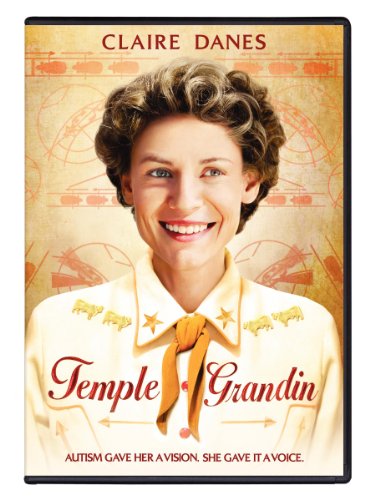
    Recently, HBO produced a film about her called Temple Grandin. It is one of the best films I have seen in the last five years. It’s full of drama, heartache, triumph, and good humor. When you’re done, Temple Grandin will likely become one of your heroes.

    Claire Danes does a fabulous job playing Temple. The movie also features Julie Ormond as Temple’s mother, Catherine O’Hara as her aunt, and David Strathairn as Dr. Carlock. Earlier this year, the film won seven Emmy Awards. But I didn’t need that to know how good it was. All I had to do was look at my wife and girls who sat rapt as the story unfolded. Get it on DVD. And if you want to know more about Grandin’s ideas, go to www.grandin.com.

    Squash Devils

    My wife was recently possessed by an evil squash spirit.

    How do I know this?

    Simple. Have any of you out there ever been sitting around and suddenly got a mighty hankering for pureed squash? Even when you were in the Gerber bottle stage?

    No, didn’t think so.

    So what else would explain her sudden need for a bowl of butternut bisque?

    Alas, I did recall once having a tasty pumpkin soup in a fancy restaurant in California, and so I didn’t immediately call the Brethren in for an exorcism. Instead I went to allrecipes.com and looked up a recipe for her.

    I found “Butternut Squash Soup II” by someone named Maplebird, which inspired tons of confidence since all the great chefs are named after tree-animal mixes.

    Then Nellie made the soup. I partook. And the evil spirit must have jumped into me because I’m telling you right now that I could not get enough of it. The mouth feel, the taste—the TASTE. There wasn’t a thing squashy about it.

    Folks, this is the real deal. And at least 494 other people out on allrecipes agree with me and have rated it an average of 4.5 starts out of 5.

    Ingredients

    • 2 tablespoons butter
    • 1 small onion, chopped
    • 1 stalk celery, chopped
    • 1 medium carrot, chopped
    • 2 medium potatoes, cubed
    • 1 medium butternut squash – peeled, seeded, and cubed
    • 1 (32 fluid ounce) container chicken stock
    • Salt and freshly ground black pepper to taste

    Directions

    Melt the butter in a large pot, and cook the onion, celery, carrot, potatoes, and squash 5 minutes, or until lightly browned. Pour in enough of the chicken stock to cover vegetables. Bring to a boil. Reduce heat to low, cover pot, and simmer 40 minutes, or until all vegetables are tender.

    Transfer the soup to a blender, and blend until smooth. Return to pot, and mix in any remaining stock to attain desired consistency. Season with salt and pepper. Say a prayer and call for a priest or someone with the Melchizedek priesthood to be on hand just in case.

    Burger Salvation

    Okay, I know some of you are rolling your eyes. Squash? Have you got to be kidding?

    If that’s you, then let me recommend Five Guys burgers and fries. Burgers started to bore me years ago. But a buddy recently recommended Five Guys, and I’m so glad I went. They’re a national chain. In Utah, we have eight of their joints from Layton to Orem.

    They don’t offer salads or wraps or yogurt. They make four kinds of burgers, three kinds of dogs, and two kinds of fries. That’s it. You order the toppings you want–the regular things like grilled onion, cheese, and pickle, but you can also get grilled mushrooms, bacon, jalapenos, and BBQ sauce. More importantly, your burger is cooked fresh, right before your eyes. No microwaved unmeat retrieved from a mystery bin. It comes to you hot and juicy. The fries, cooked in 100% peanut oil, are served up sizzling. And there are a lot of them. I ate mine with a Cherry Coke.

    If you’re ever in the mood for burgers and fries, you’ve got to try Five Guys.

    Share
  • |

    This American Life: Superpowers

    What superpower would you rather have–flight or invisibility? What do others choose? Why? What does it say about you?

    Want to hear about a gal named Zora who, as a teen, made a list of everything that a superhero would have to know how to do, things like flying helicopters and diffusing bombs, and then set out to do it. Zora finished her list, btw. She’s a bounty hunter now.

    You can hear this right now on  This American Life episode 178: Superpowers .

    It’s a fabulous hour-long program.

    Share