Good Stuff: Poldark, Monk, and the cure for dragon feet

For all of you longing for just one more season of Downton Abbey, I’ve found a new series from the BBC I think you’ll enjoy (thank you Duane Robinson for the recommendation).

It’s called Poldark and is set in the late 1700s in Cornwall, that little southwestern leg of England that juts out into the Atlantic. The dark-haired and handsome Ross Poldark returns to England after having fought in the American War of Independence and finds that his father has died, and he’s inherited the estate. Except the estate is in ruins.

The house, which is a long way from being anything grand, is a mess and being inhabited by the deceased father’s last two servants. A man and a wife who are equal parts louts and lushes. The land isn’t producing. The mine is closed. And Poldark has very little money.

By the way, when we think of British aristocracy, we most often think of dances and fine clothing and large tracts of lands. We seldom think of mines. But Cornwall has been mining tin for a very long time, and so were its lords. In fact, Cornwall was known outside of the Isles anciently, and some historians suggest that Cornwall was probably selling tin to the seafaring Greeks and Phoenicians many hundreds of years B.C.

So our young and handsome lord has come home to a mess and very little money. But he immediately sets about trying to repair things. And what unfolds is a wonderful story with love, action, humor, injustice, and villains plotting Poldark’s downfall.

We loved Downton in part for the refinement and high society (and Lady Grantham’s hilarious one-liners). However, Poldark isn’t about the top of the aristocracy. It’s about a man almost at the bottom. And many of those of the lower class who are his friends. There’s a refreshing earthiness about it even while you still have scenes of the high society and all that goes with it.

We just finished the first season and are hooked. In fact, I stood up and cheered at the end of the last episode we watched. So if you love English historicals, you’re going to enjoy Polkdark.

*

The humorous detective series Monk debuted in 2002 and ran for eight seasons. It was a huge hit. But because I’m a cave dweller I didn’t get to it until now. But, boy, I’m happy I did.
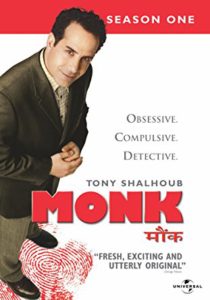
If you haven’t seen it yet, you’re in for a treat. Monk is one of those brilliant detectives like Patrick Jane in The Mentalist or Sherlock Holmes who sees all sorts of details that so many others miss. But unlike those guys, Monk has obsessive-compulsive disorder plus a number of phobias.

And so he can’t just walk in and stun everyone with his brilliance because at any moment he might get sidetracked straightening pictures or moving lamps or trying to avoid germs. In one funny scene he’s being chased on foot by someone intent on killing him, and he can’t help but touch the poles as he runs by. However, he’s not all helpless because he’s hired a female nurse, Sharona Fleming, to help him. And the interaction between the two of them adds another enjoyable dimension.

And so you get to experience all the awe of watching someone like Sherlock solve crimes plus laugh along the way. I couldn’t help but laugh out loud during a number of episodes.

If you like The Mentalist, Elementary, or Psych, I think you’ll really enjoy Monk.

*

This last review is for all of you who have dragon feet.

That’s what I had until two months ago. Dry dragon feet. So dry and with such sharp and jagged calluses that I regularly wore the area on my sheets around my feet to shreds. Nellie’s side of the sheets were nice and smooth. My side, after a year or two, looked like the dog had attacked it.

The calluses were so bad I periodically sanded them off with 400 grit sandpaper.

I also got stress cracks in the winter, which I tried to heal with band-aides and Neosporin. And that worked a decade ago. But the stress cracks were just getting more frequent and longer-lasting. This last winter I had three that stayed for weeks and weeks.

And so when I went into my dermatologist for my annual skin cancer check, I asked him if there was anything to be done. He said, “Get CeraVe cream with SA, salicylic acid. It has to have SA.”
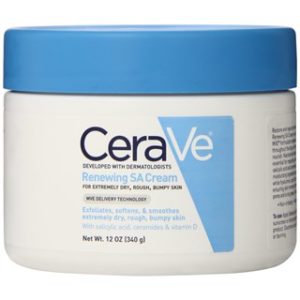

After the appointment, I promptly drove to Walmart and walked down to the cosmetic aisle and purchased a little tub of CeraVe Renewing SA Cream. And I began to use it that night, putting socks on after I applied it. I applied it every morning and night.

And, miracle of miracles, a few weeks later my feet were normal human feet again. The calluses were gone. The stress cracks gone. The pain gone. My sheets love me. My wife loves me. I’m saving money on sand paper.

Folks, if you have dragon feet and want to be human again, let me suggest CeraVe with SA.

Share

Similar Posts

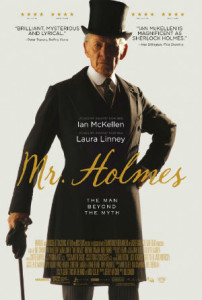
  • Good Stuff! Mr. Holmes and 13 Hours, the book

    Earlier this month I watched Mr. Holmes.

    Mr._Holmes_poster

    It left me with this fine peace. With this feeling of goodness and light, in spite of, or probably because of, a number of poignant moments. It also surprised me.

    To write a story like this, to give people this kind of gift…

    What a wonderful, powerful thing.

    Now, it was not a thriller. It’s not an episode of Sherlock or Elementary. It’s not a murder mystery. It reminds me of Saving Mr. Banks most, but also of Miss Potter, maybe even The King’s English. It has that kind of tempo.

    Basically, Sherlock Holmes is a much older man. He’s retired. And there’s a case he’s trying to solve. But, again, this isn’t a murder mystery. This story is about Sherlock himself and wisdom and the beauty of change whenever it occurs.

    The story lingered with me, and I avoided reading or watching anything else for a few days to savor it. Give yourselves a treat. Watch this wonderful story.

    *

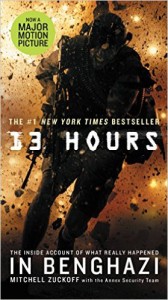
    The book 13 Hours: The Inside Account of What Really Happened in Benghazi was the answer to so many questions.

    13_Hours_ZuckhoffWant really happened in Benghazi?

    What we’re we doing there?

    Who are the brave men who tried to save the ambassador?

    It was also a thrilling read in the tradition of Marcus Luttrell’s Lone Survivor. As such, it purposely avoids the political aspect of the incident. It’s not about what the officials of the United States government did, said, or knew, or the political firestorm that ensued.

    It’s not a hit piece on Clinton and Obama, nor is it any kind of defense. Instead it simply documents the events on the ground in those last 13 hours, relying most heavily on what the five American security contractors who rushed to give aid said happened. Those men–two former Marines, two former SEALs, and a former Army Ranger—teamed up with Mitchell Zuckoff, the writer, to simply set the record straight.

    I couldn’t put the book down. Not only because the book’s well-written and the characters and situation are compelling, but also because of the insight it shared into some key dynamics within Libya itself. For example, it helps you understand why the revolt against Muammar Gaddafi centered in Benghazi, not Tripoli. It also touches on some of the currents inside these Muslim-majority countries close to the epicenter of Sunni extremism—Egypt and Saudi Arabia–so volatile. And it shares details, large and small, as only those who experience such things first hand can.

    If you want a fascinating account of really happened on the ground in Benghazi, get this book.


    Share
  • Good Stuff! Mitty, Non-Stop, and The Winter Soldier

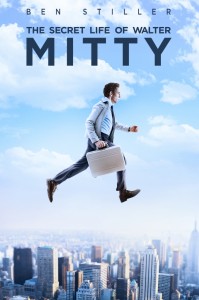
    the-secret-life-of-walter-mitty-poster-bigThe previews for The Secret Life of Walter Mitty didn’t look interesting at all. Furthermore, I’m not the biggest Ben Stiller fan. He’s a fine actor; I just haven’t been in the audience for a lot of his movies. Then someone I know recommended the film, and I decided to give it a go with Nellie.

    We didn’t have high hopes. I mean, look at the movie poster. Does that get you excited? She thought it was going to be dumb. I thought it was going to be dumb. But after five minutes, we found ourselves enjoying the characters and story. We finished it, both of us absolutely delighted. I liked it so much I corralled my two daughters into watching it with me. Then I watched it again. I think I watched it four times total. And I enjoyed it as much, maybe more, each time.

    Walter is a great guy who has had to play it safe and practical his whole life. When his and his co-worker’s jobs are threatened, he takes action and finds himself on a journey that starts in, ta-dum, Greenland. The movie’s got adventure, a slow-burn romance, and a cast of funny and quirky characters. But it isn’t mad-cap humor. It’s not a gushing love story. It’s something else. Something that left me feeling like my life had been leavened with a fine light joy. Give it a shot; I think you’ll be glad you did.

    * * *

    non-stop-movie-posterThe previews for Non-Stop with Liam Neeson and Julianne Moore looked great. I’m happy to report that it was every bit as good as the previews promised.

    Neeson plays a federal air marshal. While on a flight from New York to London, he gets a text telling him that unless 150 million dollars is transferred to an offshore account, someone will die every 20 minutes. But it’s not so easy finding the killer. The deaths are almost inexplicable. And things soon start to spin out of control.

    This movie is filled with surprises and suspense. And it moves. Thrillers normally move quickly, but this one was on turbo. But that doesn’t mean the story was a bunch of light and noise. Quite the contrary. The writers skillfully balance the mystery, action, suspense, and even the character backstories. A lot of folks liked Taken. I liked this better than that film. In fact, it’s one of the better thrillers I’ve seen these last few years.

    * * *

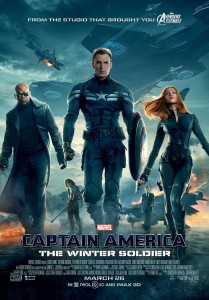
    winter-soldier-poster-no-maskI’m a superhero lover, have been since I was a kid watching the Superfriends cartoon every Saturday morning. But I never know if I’m going to enjoy a superhero movie. I love the genre, but for some reason so many of the films go for effect over story. It drives me nuts. The movie ends, the lights turn on, and I sit in my seat and go “huh.” So I’m happy to report that Captain America: The Winter Soldier actually delivers.

    I cannot say the same for Captain America: The First Avenger, the first in this series. That movie fell apart halfway through the film. The beginning was this wonderful story about a runt trying to do his duty and volunteer. The second half lost all its heart and turned into one big yawn. So for those of you who didn’t like that first film, know that this is a case of the sequel being far better than the original.

    In this one, SHIELD, the organization that directs the Avengers, comes under attack from within. Captain America and Black Widow have to uncover who is behind it and stop them before it’s too late. There are a lot of cool visuals and awesome action scenes. For example, I loved how Captain America “parachutes” into the opening mission. I enjoyed watching him and Black Widow fight in their distinctive ways. But the film didn’t focus on the tech or the super powers. It focused on the characters and the story. The plot includes a number of delicious surprises and reveals. There are funny moments and some poignant ones. And not only did this movie, unlike the first one, develop a single story all the way through, but it also echoes with our current search for national security.

    If you liked Iron Man and Iron Man 3, I think you’ll enjoy Captain America: The Winter Soldier.

    Share
  • |

    American Idol Story Elements

    I don’t have time to watch, but I found myself getting sucked in this week. And here’s something I realized as I watched Simon, Paula, Randy, Ryan, & the contenstants–the show is using story principles.

    Idol

    Duh, I know: of course, it is. But it does it so well. It reminds me of a research article I read about sportscasters and audience enjoyment of sports competitions. They found that if they could inject story elements–suspense, rivalry, etc.–people enjoyed the games more. Next time you watch a college football game, notice what the color commentators say to make it a contest. It’s not just about reporting what #45 did out in the flat.

    Anyway, back to Idol. Look at these elements.

    What draws us to characters?

    Beauty, threats, quirkiness, larger-than-life situation or skills, source of viewer wish-fulfillment.

    Humm, let’s look at the cast of performers. Don’t we see all of that? How many of us wouldn’t love to be able to sing like they do? Have a shot at becoming a recording artist? Or just goggle at someone getting this chance?

    What factors generate suspense?

    Threats to characters we like or marvelous opportunities for them, turns in the situation, a prolonged resolution.

    Humm. Our sympathy is engaged because these folks are normal folks, many of them underdogs. Many viewers identify strongly with one or two because of the contestant’s various social groups and because, heck, the auditions are for people like you and me. It could be us up there in front of the world! You’ve got the threat of peformance fright, but also the overriding opportunity to make a dream real. You’ve got a wonderful career, if not millions of dollars, on the line. You’ve got Simon who is honest, but also plays his part. Isn’t that the moment of most suspense with each performance? You’ve even got a little subplot going on between Simon and Seacrest. There’s no villain here. But there are plenty of obstacles. Weekly threats.

    What does Idol give us that Survivor never could?

    It’s all REAL, even if the producers let their selection of performers be influenced by things other than vocal talent. And because it’s real, we believe it. Which means we can more easily feel sympathy and root for the various performers.

    It’s a simple but brilliant concept. And I just wasted 4 hours watching it. And I’m likely to do it again.

    Zing, Baby. Zing!

    Share
  • Good Stuff! 3 Books to Introduce You to the Middle East

    ISIS, the Taliban, Al Qaeda, the Muslim Brotherhood, Iran.

    What drives these groups?

    What are they really about?

    Why is there so much religious strife in the Middle East?

    For that matter, what is Islam actually about? Is the religion really defined by these violent actors, or are they just the most visible because they’re what’s reported on in the media?

    I set out to find the answers to these questions, and what I have found so far surprised me. If you are interested in understanding what’s going on in the Middle East today, you have to understand Islam. And it’s a fascinating story. There are a lot of books on the subject, but you don’t have to sift through all those I did. I want to share with you three slim books that I found to be the most clear and engaging introductions I’ve come across.

    The first is Understanding Islam: An Introduction to the Muslim World by Thomas W. Lippman, an award-winning author and journalist who specializes in the Middle East and spent years living in Egypt, covering the events, and traveling from Tunisia to Pakistan. Again, this is a slim, easy-to-read volume, but it is packed with information. If you want to know the basic beliefs of Islam, who Muhammad was, what all this business about Sharia is, and who the major Islamic groups of the Middle East are today, this is the book to start with. One note, you want to make sure you get the third edition of this book.

    Understanding Islam by Thomas Lippman

    The next book is by Bernard Lewis, a man internationally recognized as one of our century’s greatest historians of the Middle East. The book is called The Crisis of Islam: Holy War and Unholy Terror. Again, another slim, engaging, but information-packed volume. In it, Lewis explains what it is in Islam that is breeding these extremist groups. And what is leading them to target America, which is especially interesting because for most of the 1900s the United States was seen as the good guy by the Islamic world. What changed? Read this book to find out.

    The Crisis of Islam by Bernard Lewis

    The last book, a lively, engaging read, is called After the Prophet: The Epic Story of the Sunni-Shia Split by Lesley Hazleton, another veteran Middle East journalist. When you finish this book, you will understand why Saudi Arabia supported ISIS before they so recently turned against it. You’ll understand why they recently joined Israel, of all nations, in condemning Iran’s nuclear program. You will also understand one main reason why the Iraqis can’t seem to get along. In this book, Hazelton goes back to the beginning of the religion and tells the story of the splitting of Islam–the split between the Shias and Sunnis. It’s as significant a split as that of the Protestants from the Catholics in the time of Luther. But unlike that split, which has lost almost all of its heat, the antagonism between Sunni and Shia still leads to war. You cannot understand the Middle East today without understanding this.

    After the Prophet by Lesley Hazleton

    So there you have it. If you’ve been wanting to learn more about Islam and the Middle East, you’ll find these the perfect introduction. And if you’re religious at all, you’ll find much to ponder. There isn’t one god-fearing Christian, Jew, Hindu, or what have you who doesn’t think that submitting our will to God’s won’t help us build a better families, communities, nations–a better world. Would it surprise to you to know that Muslims believe the same thing? That Islam means “to submit” to God?

    There are of course many differences between Islam and my own Christian beliefs, but there are also many striking similarities. And the experience I kept having reading these books was seeing over and over again echoes of my own faith and the history of Christianity. There are cautions, to be sure, but also things worthy of emulation. If nothing else, it felt like it did when I learned Dutch. Yes, it was all foreign, but I saw the ties and the differences and, surprisingly, understood my language better than I ever had before.

    Now there are three other equally fascinating books I want recommend that focus on Al Qaeda, fighting terrorism, and Saudi Arabia, but I’ll save those for another time. Go treat yourself and read these fine introductions.


    Share
  • The Husband by Dean Koontz

    TheHusband_DeanKoontzYou’re name is Mitch Rafferty. You’re a gardener. You have no past as a cop, spy, or Navy SEAL–you’re just a plain old petunias and begonias guy. You’re working in someone’s yard when you get a call on your cell phone. You answer. And the guy on the other end has your wife.

    He tells you that you will get him two million dollars or you’ll never see her again.

    You’re lost. This has to be a sick prank. You’re just a gardener. You know peat moss and mulch. You don’t have two million. Heck, you have, at the most, $11,000 in the bank. You tell him this. He tells you he knows.

    Then your wife screams over the phone. The wife who you love, who makes  you whole. They let her talk. It’s not just one man. And then, just to show you that they’re serious, they kill a complete stranger who is walking a dog across the road. They shoot him in the head. You know they’re watching you. You look around and can’t see where the sniper is hiding.

    You’re a gardener. They have your wife. If you go to the cops, they kill her. If you don’t deliver, they kill her. What do you do?

    That’s the premise of Dean Koontz’s The Husband. I listened to this on audio book, read by Holter Graham, and, folks, I don’t think a book has gripped me like this in a very long time. And that despite some quirks in the reader’s presentation. I’m coming to respect Koontz as a writer more and more. I can’t recommend this book highly enough. Go get it. Read it. Do it before they make the movie.

    Share
  • Good Stuff! Mike Loades on Swords and Bows

    Mike Loades is an expert on medieval fighting. He brings energy and, not just bookish learning, but insights from hands-on use. I loved the five-part Weapons That Made Britain television series for which he was the host and chief consultant. And so I looked to see if there was anything else he’d done. I found he’d written two books, which I am so happy to have read.

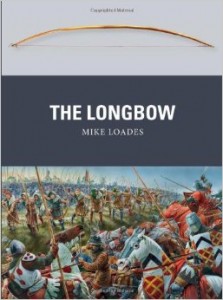
    The Longbow is not just a book about the longbow. It’s about its construction and how it impacted the development of armor, and types of armor, and the wood used for the bow, and how to make arrows, and what the various points were for, and how people trained, and then cared for the bows, and how it was used in war. And, again, the insights are not just bookish ones. He’s walked the battlefields. He’s used bows for years. He’s performed tests with them. It is a 80-page book that carries a monstrous bang for the buck and one of the best purchases I’ve made for my library. I loved it.

    MikeLoades_TheLongBow

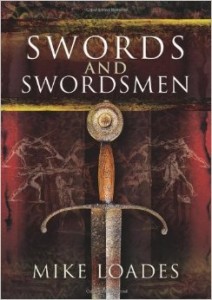
    Of course, after that experience, I had to get his Swords & Swordsmen. This book is almost 500 pages long, and I was rapt reading each page of it. Instead of focusing on one version of this weapon, Loades discusses exemplars of various types of swords through time, starting with the sword of Tutankhamun in Egypt all the way through the swords of J.E.B. Stuart and G.A. Custer in the American Civil War. There are 15 chapters all discussing different eras and swords that provide a mountain of insight. The love Loades has for and the practical experience he has with the topic shines through on every page. Just as with The Longbow, you’ll learn about use, construction, the interplay with armor, and much more. Heck, I got the ideas for at least three novels reading this book. I loved it as much as I loved the first.

    MikeLoades_SwordsAndSwordsmen

    If you enjoy military history and arms and armor, you will love these books. Guaranteed.

    While you’re waiting for them to arrive in the mail, treat yourself to five hours of fascinating video below.

    Weapons That Made Britain E01 – The Sword

    Weapons That Made Britain E02 – The Longbow

    Weapons That Made Britain E03 – The Lance

    Weapons That Made Britain E04 – The Shield

    Weapons That Made Britain E05 – Armour

    Share

4 Comments

  1. You sucked me right in with your teaser, but I’m so glad I found out about the creme!

  2. Love it when you find cool stuff and share, John -It is how i found you in the first place ( your ‘Simply Three’ review).

    Will definitely check out Poldark.

    As for Monk: A family fav of ours years ago. Watched it real time when it was on. Then introduced daughter to it as she grew up -we binge-watched it to its conclusion [2x for me]. Hope you and yours enjoy it as much as we did.

    Lastly, good review of what sounds like a good product. I never had those specific problems -but i know folks that do; i’ll pass along the suggestion.

    Always a joy to see an update, John -keep’em coming.

    Best of success on your current initiatives,
    Regards,
    Steve

Comments are closed.