Two Jillian Workouts & Gottman’s Seven Marriage Principles

Jillian Michaels is, in the words of my brother-in-law, “the woman who chases the fat people around.” And indeed, as one of the main trainers on the TV series Biggest Loser, she gets those folks moving. But I didn’t know anything about her or the show earlier this year when a friend recommended her 30-Day Shred DVD workout (thank you, Mr. Dayton).

I’m a cave dweller. I sit in my little basement office and do my thing. And I have to make sure I get some type of exercise lest I turn into a great jelly. So I’m always on the lookout for a good workout. But it’s got to meet certain standards. I don’t want anything that’s Mickey Mouse. And I don’t want any froo-froo.

So I asked this friend if these workouts featured a bunch of women dancing around in fruity outfits, because I can tell you right now, as open to new experiences as I am, I wasn’t going to buy a leotard and tip toe through the tulips with them. My friend assured me it was froo-froo free. And boy was he right.

Jillian shows up with two other gals, gives you a two-minute warm up, and then proceeds to bust your hiney with three circuits of strength, aerobic calisthenics, and ab exercises. The strength exercises include things like push-ups and squats with dumbbell military presses or curls. The aerobic segments have you doing jumping jacks and jump rope. The ab portions run you through all manner of crunches and lower ab exercises. The three circuits take twenty minutes to complete. And there are three different levels of workouts on the DVD.

I walk or hike three miles a day four days a week, and so I thought I was in reasonably okay condition. Jillian disabused me of that silly notion. I couldn’t keep up. Heck, the first dozen times through the workout I think I spent half the time either catching my breath or trying not to faint.

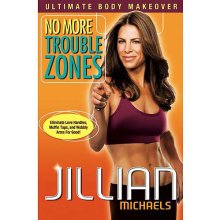
But I kept with it and got stronger. And then I found Jillian’s No More Trouble Zones. This is a forty-minute workout. And I defy any of you he-men out there to try it and tell me you can keep up with this broad in this DVD. I still pant like a dog and have to take breaks when I do the workout. My only consolation is that Jillian and her two smiling evil pals work out with three-pound dumbbells while I work out with seven, fifteen, and twenty-five pounders.

Like the shred workout, this forty-minute workout is comprised of circuits. But in the trouble zones workout there is no jumping about. It all double-whammy exercises that have you working both your upper and lower body at the same time or doing some killer ab maneuver. You’ll do pushups, squats, curls, a vicious plank circuit, and a dozen other exercises. You’ll work your triceps, biceps, shoulders, back, abs, and legs multiple times. This workout is no joke. 

If you’re looking for an intense workout that doesn’t waste your time, I think you’ll enjoy either of these Jillian DVDs. All you need are a few dumbbells, a mat if you’re working on a hard surface, and prayer beads for those moments when you suspect you’re about to give up the ghost in a muscle-burning cardiac arrest.

*

Back in April of this year, Dr. Liz Hale, a licensed clinical psychologist, started her remarks to a local audience of more than 100 mental health professionals by saying, “Dear fellow colleagues, you are in danger of having an affair.”

Her point was that every marriage, even those of the marriage gurus, is vulnerable to infidelity–be it sexual or emotional. Individuals have to actively curb all the subtle and often innocent beginnings that lead to unfaithfulness.

“We make the mistake of thinking (marital) vows will keep us safe; and they don’t,” she said. She went on to say that couples cannot depend on love or similarities to keep their marriage intact. It’s not enough.

Emotional or sexual infidelity isn’t as rare as we might think. But even if we don’t stray into some type of unfaithfulness, that doesn’t mean a marriage will stay together. Like anything worth having, a good relationship takes work.

But what kind of work? What are the key principles for making a marriage last?

For many years the prescriptions of marriage gurus were based on anecdotal evidence and rules of thumb—on opinion. Because the opinions weren’t tested, they led to all sorts of errors. For example, many yet believe that the road to marital bliss is through communication, specifically through successful conflict resolution. According to this idea, happy couples are those that have learned to resolve all their conflicts in a nice manner. The problem is that when conflict resolution was put to the test, the studies showed it didn’t work. Marriage therapies based on conflict resolution share a very low success rate—over the long haul they only work about 20% of the time.

So what does work?

John Gottman is a marriage counselor who took a different approach and started to collect rigorous scientific evidence on over 650 couples, tracking the fate of their marriages for up to fourteen years. The results of his work are startling.

He uncovered a number of relationship myths, including the one about communication. He found that happy marriages were never perfect unions. These satisfied couples often had differences in temperament, interests, and family values. They argued over money, kids, and housekeeping, just like unhappy couples did. They had problems and faced issues. However, all these satisfied couples also practiced seven principles, even if they didn’t know it, which helped them navigate their way through all the difficulties and keep their marriages happy and stable.

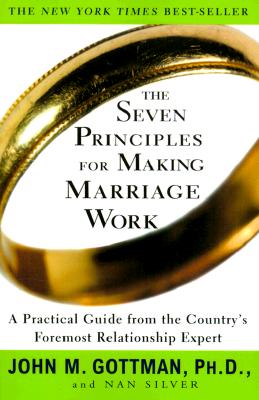
And it’s not just opinion. The success rate for the type of marital therapy based on his research is 80%. He knows what makes marriages work and has written it up in a fabulous book called The Seven Principles For Making A Marriage Work.

Every marriage is vulnerable to failure. It takes work to enjoy a satisfying relationship with a spouse. But it’s so much easier to improve and maintain a relationship when you’re working on the things that actually make a difference. If you want to improve your marriage, give Gottman’s book a read.

Share

Similar Posts

  • Good Stuff! Saving Mr. Banks, Elementary, Captain Phillips, & Lone Survivor

    Saving Mr BanksOver the last two months I’ve been able to squeeze in a couple of hours to watch a few shows and some episodes of a TV series. I was plesantly surprised to have actually had a wonderfully good run. If you haven’t watched any of these, you’re in for some awesome entertainment.


    Saving Mr. Banks

    I didn’t think I’d like this movie. I enjoyed Mary Poppins as a child and enjoyed it again with my kids. But a movie on Disney getting the rights to make a movie? Boring. Except I was completely wrong. This is not a story about some woman selling the rights to her story. It’s about why she never wanted to sell the rights to Disney in the first place. It’s about her childhood and the real source of Mary Poppins. And to pull that off Saving Mr. Banks has to tell two stories: an often funny one about P.L. Travers who does not want to license her story and Disney’s final attempt to win her over, and a poignant one that reveals why Travers was so resistant. And it leaves the last twist, one that expands the meaning of the title in the viewer’s heart, to the very end. I loved this movie. I loved Hanks as the affable Disney and Thompson as the irascible Ms. Travers. Loved all of the other characters. If you enjoyed dramas like Miss Potter or The Blind Side, you’ll love this too.


    ElementaryElementary

    I thought: another Sherlock Holmes series? Puh-lease. Yes, the two films featuring Robert Downing Jr. and Jude Law and the BBC series with Benedict Cumberbatch and Martin Freeman were superb. I loved both. But another Sherlock? Surely this is going to be some cheap attempt to capitalize on the success of the other two, something that is direct-to-DVD quality. Who is going to do it as well as Downing and Cumberbatch?

    Boy, was I wrong (yet again!)

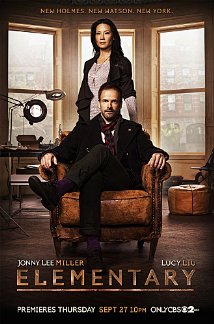
    Elementary is delightful. Sherlock, played by the talented Johnny Lee Miller who made Eli Stone such a joy, is a modern day Brit living in New York. He’s in the final stages of drug rehab, living with a “sober companion.” The companion is Joan Watson, played by Lucy Lui. The Captain of the NYPD is one of Sherlock’s old friends an appeciates his skills and so brings him in as a consultant on various cases.

    So how could they do anything different? Yes, you have the quick powers of observation and intellectual acrobatics the other Sherlocks have. But the female Watson and the whole recovering addict angle takes the stories in a new direction. This Sherlock has a past that haunts him. And this Watson is maybe a bit quicker than the other two, as wonderful as they are.

    I wouldn’t have believed it if I hadn’t seen it, but there is room for three Sherlocks and Watsons. I can’t tell you which of the three pairs I enjoy more.

    Captain_Phillips_PosterCaptain Phillips

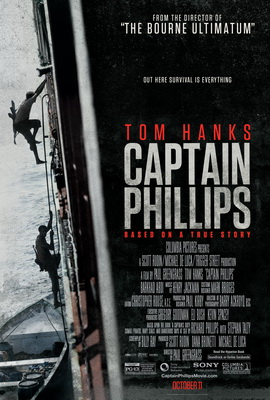
    As soon as the news stories about Somali pirates started breaking back in 2008 I knew it would lead to some thrillers. Heck, Abdul Hassan, “The One Who Never Sleeps” was one of the first zings I posted on this site. What I didn’t know was that the big thriller would be based on an actual story: the 2009 hijacking of the US-flagged MV Maersk Alabama, the first American cargo ship to be hijacked in two hundred years. Phillips is played by Tom Hanks, who always gives a great performance. But I also found the portrayal of the pirates interesting as well. As I did the many unexpected details of how these pirates operate and how the incident was brought to a close. If you like realistic thrillers, you’ll enjoy Captain Phillips.

    Lone Survivor

    I reviewed the book Lone Survior back in 2011. You can read my full report there, but the bottom line is that it was an awesome read. However, as with all awesome reads, you become a bit wary of the films based on those books. I’m happy to say the filmmakers did a great job on this one. They paid huge attention to detail because they wanted to honor the fallen soldiers by getting it right.

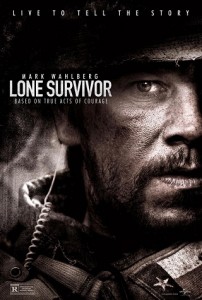
    Lone_Survivor_posterIn order to get it right, they brought Marcus Luttrel, the author, and a number of other SEALs onto the project as consultants. The SEALs put the actors through some basic training before they even began shooting. This was to not only help the actors get to the point where they handle their weapons and gear as someone seasoned might, but also so they could feel what is was to work as a team, an important part of being a SEAL. The SEALs stayed on to provide input as well during the shooting.

    But the details went beyond that. I have never seen a military film that felt as real to me, especially when it came to the characters. SEALs are warriors. But that doesn’t capture the variety they come in. And in the opening 25% of the movie we see sides to these men that many movies do not portray. It was so refreshing! In fact, without the groundwork laid in the beginning, this film wouldn’t have had near the impact it did. Yeah, the action is ACTION! It’s thrilling. You have never seen some of the shots the film portrays. But the action means nothing without the men.

    And this story is about the men.

    It’s about what it means to be one of those guys and gals who put their lives on the line for the rest of us. And if you want a special treat, when the film is over, you’ll watch all the extras.

    The f-word is used about five million times in this movie. I usually don’t like a lot of vulgarity in my entertainment. But I cut the folks some slack in this case because I felt the story was worth it. Besides, I didn’t consider it entertainment anyway, more documentary.

    If you are interested in what it’s like for Special Operations forces, if you want a story to help you see what so many are doing for the rest of us, I don’t know that it gets any better than this.

    Share
  • Interview with Author Judson Roberts

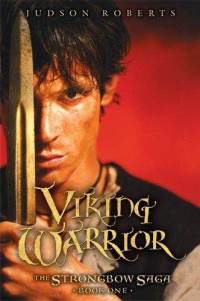
    I’m very excited to present an interview I did with Judson Roberts, author of the Strongbow Saga.

    Over his long and varied career, Judson Roberts has been a police officer, federal agent, organized crime prosecutor, and private investigator. He is also reputedly a distant descendant of Rollo, also known as Rolf or Hrolf, the Viking leader who in 911 AD entered into a treaty with the King of the Western Franks and was granted the lands located around the mouth of the Seine River which eventually became known as Normandy, after the Northmen who settled there. He currently lives in Houston, Texas, but is looking forward to moving. (I’d think–what’s a Viking gonna do in landlocked Houston except go crazy?)

    Here’s what the scion of Rollo had to say. BTW, you’re going to see how ebooks have changed things so much for authors.

    *

    JB: Judson, you’ve had quite a rollercoaster ride with publishing these last few years. You were picked up by HarperTeen for a trilogy. Orson Scott Card reviewed the first novel and called it “A well-written, well-researched, exciting, moving historical novel.” But some things didn’t go as planned. Give us the story.

    JR: That’s a good way of putting it: some things didn’t go as planned. The whole experience has been a valuable lesson for me, in part about what realistically to expect when dealing with a big publisher, but even more so, that often in life, things that seem like disasters at the time can, in the long run, prove to be opportunities we never could have found otherwise.

    My experience with HarperCollins was not a happy one. But before I get into that, I should give a bit of background information. The books that HarperCollins published are the first three volumes of a historical fiction series, set in the world of the Vikings during the 9th century, which I plan to eventually be five books long. I always envisioned the series as adult fiction, and wrote each book as such.

    I initially had a very hard time finding an agent. After a year or so of trying, I saw an advertisement about the Maui Writers Conference in Hawaii that said that authors could submit a “resume” consisting of a brief excerpt and a pitch for their current work to the conference-for a fee, of course-and the resume would be circulated to all agents and publishers attending the conference. I gave it a shot, and ended up being contacted by three agents as a result. One was especially eager—she asked me to give her an exclusive look at the full manuscript, but promised to give me her decision within two weeks. In fact, she asked to represent me within a week. Her agency primarily handles children’s and young adult books, but she assured me she also handled some adult fiction and wanted to handle more, so that, and her enthusiasm, won me over.

    She ended up being unable to interest any adult fiction editors in the book—at that time, I’d only actually written what is now book 1 of the series, Viking Warrior, although the way that book ends there’s obviously more of the story to come. So she asked if she could try to sell it as YA fiction, I agreed, and not too long after that, she secured a three book contract for the Strongbow Saga with HarperTeen, part of the children’s books division of HarperCollins.

    My editor at HarperCollins was very good-whatever I may feel about other divisions of that publisher, I’ve had nothing but good experience with editorial staff there-and was very enthusiastic about the series. She never made me tone the books down in any way—as intended adult fiction, and historically accurate to the period, there are some scenes that are quite violent. She even went so far as to say that she could see the series developing the kind of enthusiasm across different age groups-becoming a cross-over book for teens and adults-whose popularity might last for many years, similar to The Lord of the Rings, and she. That was a bigger vision than I had for the books, but it was certainly an exciting comparison to hear-The Lord of the Rings has been my favorite book since I first read it decades ago in high school. Unfortunately, the marketing side of HarperCollins apparently did not share her vision.

    Trouble in paradise initially began with the cover design. Someone in marketing decided that the group of targeted readers (and as it turned out, the marketing side never had any idea of trying to reach adult readers—they worked for the children’s division, after all) least likely to be attracted to a book about the Vikings was teenage girls, so they developed a series of covers, using different samples and focus groups, specifically designed to attract them. The results look a lot like covers for romance novels, though at least without the bare chests.

    In the months leading up to the release of book 1, I asked the marketing department what plans they had to get the word out about the new series, and what I could do to help. They responded that their primary focus was going to be libraries, that they’d be pushing the books hard to librarians, using them as a gateway to get the books in front of young readers. They’d also be sending out the typical round of advance review copies prior to release.

    The reality was far different. Had it been a test of stealth technology, Viking Warrior’s release would have been a great success, but book releases are not supposed to totally invisible. It was not reviewed in a single major review venue—my agent said she had never, in her entire career, seen a new series being launched in hardback by a major publisher get no reviews at all. I’d suggested a number of specialized venues to send review copies to also—publications specifically targeted at fans of history and historical fiction, reenactors, and the like, and none of them put out reviews, either. Eventually I started contacting a number of these smaller venues, and learned than none had received review copies of my book. It looked like someone on the marketing side made a huge mistake and somehow failed to send out review copies, although HarperCollins has repeatedly refused to admit that had happened.

    Eventually a few scattered reviews were received months after Viking Warrior had been released, but by then the damage had been done. I learned a new term: “sell through.” In publishing, that term refers to how many of the copies of a book that are shipped out to distributors and booksellers are actually sold, instead of being returned. The first months after a book’s release are the most carefully scrutinized—publishers want a new book to hit the ground running and sell lots of copies quickly. Needless to say, if no one has ever heard of a book, and its only sales occur when someone just happens to discover it on a bookstore’s shelves (and on the shelves of the children’s books section, in the case of my books) that kind of early momentum does not happen.

    The promised campaign to reach out to librarians never happened, either. About two or so or so years after the series first came out, I began periodically receiving emails from school librarians who had belatedly discovered the books, fallen in love with them themselves, and had become eager advocates for the series to their students. Over and over, I’ve heard from these librarians, “Why have I never heard of these books before?” One even confronted a HarperTeen representative at a big library conference, asking why they didn’t publicize the series more, and the rep didn’t even know what books she was talking about. And always, they asked when the next book in the series would be coming out.

    That was a painful question. Because the sell through numbers were so low for book 1, each of the next two books had successively smaller printings, and again received little or no support from the publisher. By the time the third book came out, the series was unofficially dead. My editor said that, based on the numbers, there was no way she could persuade HarperCollins to buy the other two books in the series. However, the publisher had the right to buy them locked up with an option clause in the contract, so I was unable to publish them any other way, either. It was not until 2010—after my original editor had moved from HarperCollins to another of the big publishers, and after the decision had been made to start taking the series out of print-that the option clause was released, and I had the unrestricted right to finish my own series.

    JB: Oh. My. Heck. Wow, talk about a sucker punch. Body blow, body blow! I knew some of the details from Card’s review, but this just fills me with dismay. How could that happen? I don’t know. Mistakes are made, but geez. I’m sure those must have been a rough couple of years as a writer. Of course, you knew you had a good book. So what happened next?

    JR: There were certainly a couple of grim years in there. I couldn’t write the next book in the series because HarperCollins was keeping it locked up with the option clause of the contract, my sales—and royalty income—were dropping to minimal levels, and my agent—now my former agent—basically said it was all a tough break, and I should just give up on the series and move on to something else. Given that I’d spent years of research developing my base of knowledge and expertise about the Vikings and their time period, that suggestion didn’t sit very well.

    What really sustained me as a writer during this period were the emails I received from readers. Understand that when I starting writing this series, my goal was to try to write a story that  would have the following attributes, of the novels I’ve read over my lifetime that I’m most enjoyed and that have stuck with me as lasting favorites: I wanted the world the story takes place in to be exotic and different from our own, but so vivid that the reader is swept into it (and since the series is historical fiction, I also wanted it to be as rigorously accurate as possible), and I wanted the characters to become real for the reader, so that readers would become emotionally involved with them. But I truly never anticipated the kind of responses the story seems to be evoking in some people. For example, I had several emails from a major in the Australian Army, stationed in Afghanistan, who said the books are part of his permanent inspirational collection, and that he and his young son both love them. A young man told me the books had helped him during a difficult period when he was going through drug rehabilitation, and recently a young woman wrote to tell me that her cousin, who’d recently returned from a tour in Afghanistan and was deeply disturbed by his experiences there, had enjoyed the books and they’d given him comfort. I’ve been tremendously moved, but also more than a little amazed, at how deeply some readers are connecting Halfdan, the protagonist of the series, and I am resolved to finish the story for them.

    I eventually decided to sidestep the option clause by writing a stand-alone historical thriller, which involves some of the characters from the series but not the protagonist, which will in some ways also be a prequel to the series, in that I’m using it to introduce a new character who will play a major role in the final novel of the Strongbow Saga when it’s written. The new novel—its title is The Beast of Dublin—is set in Ireland about five years before the series begins, and part of its plot involves a twist on the Beowulf story. I’m still in the midst of writing that novel—Ireland in the mid-ninth century proved to have horribly difficult history and culture to research and understand, so I’m far behind my planned schedule.

    Meanwhile, during 2010 things started to happen. Around the middle of the year I begin hearing about an author named J.A. Konrath and his experiences self-publishing through Amazon’s Kindle e-book store. He had a number of books that had previously been traditionally published but had gone out of print, so he made them available again as e-books, and also self-published some books he’d written that had never sold. He has experimented a lot with pricing, cover designs, etc. and has published his results on a blog he writes, to spread the word about how Amazon has changed the game for authors, giving them a way to make a living through their writing free of the problems inherent in the traditional publishing system. As an experiment and to learn how to create an ebook, I published a roughly 30,000 “first look” preview of The Beast of Dublin for any Strongbow Saga fans who wanted to get a glimpse of what I’m currently writing—almost every email I receive from readers asks when my next book is coming out.

    Also around the middle of 2010, I noticed that Amazon had started listing book 2 of my series, Dragons from the Sea, as unavailable. It took months to get HarperCollins to even admit they’d taken that book out of print, and then to respond to a request I sent them that rights to the book be reverted to me, but finally, in October, I owned that book again. While I was waiting for the reversion to come through, I worked with a tremendously talented computer and graphics designer named Luc Reid to create a new cover which does justice to the book, and after the time consuming process of re-editing the book (is any author ever satisfied enough with a finished book to forego a chance to tweak it one more time?) and the excruciatingly slow process of converting it into Kindle format—I do NOT have any skills at computer language or programming—I managed to get the book live in the Kindle store by late October.

    In the meantime, HarperCollins took book 1 of the series out of print, so the whole process—request reversion of rights, design new cover, re-edit, and convert to Kindle format, began again. Book 1 of the series, Viking Warrior, did not go live in Amazon’s Kindle store until December 24th. Christmas had been my target date, because Amazon has surprised every analyst and expectation by selling somewhere between seven and eight million Kindles during 2010, many during the months leading up to Christmas, so even the traditional publishers have been expecting to see a huge surge in e-book sales beginning in early 2011.

    It’s still early days yet, but so far I’m tremendously encouraged by how my books are moving on Amazon. The total numbers still probably would not impress a big traditional publisher looking for the quick sell-through blitz, but thanks to Amazon’s generous royalty program, I’m starting to see my series produce some meaningful income. In October, when book 2 first went live for part of the month but book 1 was unavailable, I earned barely over $100. During November, despite the fact that book 1 was still unavailable, sales earnings climbed to about $470. In December they jumped to over $800, and if the rate of sales for January keeps up for the entire month like the first two weeks have gone, they’ll easily pass $2,000.

    And the earnings alone aren’t the whole story. Amazon’s sales reports reflect that a significant portion of these sales are taking place outside of the U.S., and I’ve begun having contacts from new readers in the U.K., Scandinavia, and even Spain. HarperCollins had insisted on acquiring foreign rights with their contract, but then essentially did nothing with them. Now I have a chance to get the story into overseas markets.

    I’m not yet ready to say I’ll never try the traditional publishing route again—I’ll probably at least test those waters with The Beast of Dublin once it’s finished. But I will, without question, self-publish book 4 of the series through Amazon once it is written. There are just so many advantages, not the least of which is that I can get the book to readers within a month or two after I’ve finished writing it, compared to a year or longer via the traditional publishing route. The world we as writers are working in is changing dramatically.  I don’t think anyone really knows what it’s going to look like ten years from now, but so far, it’s looking like the changes could be very good for writers.

    JB: Hey, I’ll take an extra $1-2k any month (grin). I’m so excited to see this series find its audience. What particularly impresses me is the resonance the books have had with some of your readers. You know, there’s art that entertains, art that gets in your face on purpose, art that enlightens, art that gives solace—I’m sure there are dozens of other things that art does. You mentioned your goals with the book in your response. But do you have another ultimate goal? Or maybe I should say, what’s your view of yourself as an author? What is it you see yourself providing the reader?

    JR: I view myself as a storyteller. My goal is to provide readers with entertainment, escape, to touch them emotionally, and maybe occasionally subtly provide a bit of inspiration.

    JB: I love it. It’s clear you’re succeeding. I think I have two more questions for you. First, I’d like you to tell my readers about Viking Warrior, the first book in the Strongbow Saga, itself. It should be clear now that it’s a historical, but what’s it about?

    JR: The story is set during the mid-ninth century. When it begins in Viking Warrior, Halfdan, the protagonist, is a fifteen year old slave living on the estate of a Danish chieftain. His mother, also a slave, is an Irish noblewoman stolen years ago in a raid, and his father the chieftain whose estate they live on and belong to.

     The chieftain is mortally wounded in a raid on England, and is brought home by his son, Harald, to die. The chieftain wants Halfdan’s mother to accompany him on his death voyage to the next world (an actual custom sometimes practiced in Viking society). She cuts a bargain that will cost her her life–if he tries to force her, she will call upon the god of the Christians to curse him and derail his death voyage, but if he agrees to free Halfdan and acknowledge him as his son, she will go willingly.

     After the funeral, Harald, now the head of the family, undertakes to train Halfdan in the skills he will need as a free man and a warrior. But Halfdan’s new life is soon shattered by a terrible act of treachery that leaves Harald and most of his followers dead, and Halfdan on the run with the warriors of an enemy chieftain hunting him.

    JB: (Folks, if Card’s review and that description doesn’t induce you to read this excellent book, I don’t know what will.) Dude, talk about a setup. I think anyone who is a Bernard Cornwell fan should enjoy this. You’ve mentioned a bit about what books you’re working on, but give us the details about what’s coming next and what’s available right now.
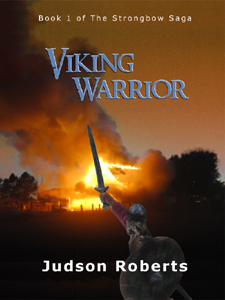
    JR: Currently the first three books of the Strongbow Saga series are available, although paper editions of book 1, Viking Warrior, and book 2, Dragons from the Sea, are temporarily out of print. I hope to get a new print edition of Dragons  back out within a week or so.  It will take a bit longer to get the new print version of Viking Warrior  into circulation, because I have to hire someone to set up the print format, and I’m at the mercy of their time constraints. However, for now new and used copies of both are still available–often quite cheaply–on Amazon through affiliated booksellers, and they’re also available as e-books through Amazon’s Kindle store.

     I’m currently in the middle of writing the novel I mentioned earlier, The Beast of Dublin, which is set in same the world as the series and includes a number of characters from it, but takes place in Ireland about five years before the series begins and will be a stand-alone historical thriller. As soon as I finish it, I’ll begin writing the fourth book of the Saga–I’ve already got the plot roughly outlined. Over the five books of the series, readers will journey with Halfdan over much of the Viking world. Books 2 and 3 are set mostly in western Frankia–the kingdom that became modern France–and in book 4, Halfdan’s pursuit of his sworn enemy will carry him from Denmark to Sweden and down into Russia.

    JB: It looks like you’re going to be keeping busy. Judson, this has been great. I really enjoyed the interview. Thanks so much for taking time out to share your experience with us.

    JR: Thank you, John. It was my pleasure. You’re a thorough interviewer.

    *

    John sez . . . first of all, wow. Talk about a fighter. Bam, bam, bam and the series is on the floor, bleeding and written off as dead. A lot of authors might have given up at that moment and gone onto pole dancing or avocado picking. Not Roberts. He gets back up and finds new distribution and continues to write (this time a cool Beowulf thriller). And, lo, his books are finding their audience–all over the world! Second, I think five years ago Roberts could have only come back under a different name. But now, heck, he’s selling on Amazon. And not just floating around with a book sale every month. He’s in the 2000’s out of hundreds of thousands of books. Holy schnitzel. Look at this ranking as of 1/24/11 5:11 PM my time (the most important time).

    Amazon Bestsellers Rank: #2,349 Paid in Kindle Store (See Top 100 Paid in Kindle Store)

    A book and series considered dead is selling as well as or better than thousands of other “live” books. Long live the zombies. Ebooks have changed everything. Everything. So much power is shifting to the creators. It’s totally exciting to me.

    LINKS

    Judson Robert’s website

    Reviews & Praise

    Viking Warrior on Amazon

    2011 Codex Blog Tour
    Share
  • Best Buy, Samsung, and Sony

    I am not an early adopter. I do not rush out to buy the latest and greatest of anything. If I have something that works, then I keep using it until it absolutely won’t work anymore.

    For example, Nellie and I bought a Honda Accord when we were first married. Fourteen years later, we had put almost 300,000 miles on that car and would have tried to put on another 300,000. Unfortunately, it met an early demise when it encountered a herd of black Angus cattle on a very dark country road at one a.m. in the morning. So long, brave companion.

    We have a computer we purchased thirteen years ago which is still running Windows 98. Computers evolve about as quickly as fruit flies, which means that in human years our computer is like 450 years old. This is like going to war with first-generation muskets while everyone else is using Predator drones. And we’re okay with that, even though it appears we’re going to have to retire the old fellow this year.  Alas.

    I have these fine olive green dress pants that are fifteen years old. When the rise finally wore out, I had Nellie fix it.  She put in a bright Kermit-The-Frog green patch, which draws a lot of attention to an area that’s been down-played ever since the codpiece went out of fashion in the late 1500’s. Was this sweet revenge for eating her stash of chocolate? Or a cleverly planned source of constant enjoyment? I do not know. But as a result, I do not wear these pants to church and important business meetings. I wear them hiking. They protect me from bushes and mosquitoes, yet breathe with perfection. Why would I ever get rid of them?

    As you can see, I’m not a buy buy buy guy. Which means that when I get something it better darn well be a fine product because I know I’m likely to be using it for a very long time. And this brings me to our recent television and blu-ray player purchase. Two years ago some friends who had just purchased a big flat screen TV saw that we were still using our twenty-three year old 15″ RCA, took pity on us and gave us the 21″ TV they were replacing. It is one of those big suckers that weighs 475 pounds, but still a fine TV, and we watched it with joy.

    However, a few weeks ago our antenna converter box broke. Our church’s semi-annual worldwide conference was coming up, which is a feast we love to watch, and so we were faced with choice: buy another converter box or pay a few more dollars and move into the twenty-first century with a flat screen. Now, while it’s true I’m not a buy buy buy guy, it is also true that I have been longing for a manly TV lo these many years. This was my chance. When Nellie agreed we should look for a new TV, I went into immediate action.

    We started our search at Best Buy. The sales guys there were incredibly helpful. But we wanted to shop a bit more. So we went to a discount club, and thinking we’d save thirty bucks, purchased our TV there. We took it home, and I did not like it. I looked up the reviews on Consumer Reports and liked it even less. So I took it back. Sam’s has a great return policy, and gave us a full refund. Good bye, piece of crap.

    I went to Best Buy again. After talking with the floor guy there for some time, I purchased a 32″ Samsung LN32D Series 4. No, it’s not 60 inches of gorilla manliness, but a 32″ TV does have a bit of hair on its chest. And it was bigger than what we’d been using. And it was only a few hundred bucks. I found this TV’s picture much better. Excellent, in fact, with the TV stations. However, my DVDs didn’t play so well on it.

    I took it back to Best Buy. The folks there spent an hour testing other TVs and demonstrating that the issue was not the TV but my old Sony DVD player which could only use RCA cables. I needed a new player with the new HDMI cable, which is able to deliver much better quality. So I purchased one, a blu-ray player, brought it home, and found that the picture was indeed much better, but I hated the player’s remote controls. For example, I want to push one button to bring up the disc menu. I do not want to click options, over, down, down, down to do this each time.

    I took it back. The folks at Best Buy were as friendly and helpful as ever. There was no hassle returning it. We spent another thirty minutes test driving different players and their remotes. I finally settled on a Sony BDP-5390 which is fabulous, not only because the remote and on-screen controls were helpful and it remembers where I was with movies I don’t finish, but also because it has a number of apps that allow me to connect to my wi-fi and watch things like YouTube, listen to internet radio, and pipe music all through my house.  There are so many cool features that I’m going to be enjoying discovering them all for a number of weeks. In all of this, the folks at Best Buy were cheerful, helpful, knowledgeable, and willing to work with someone who was very particular in what he wanted. I am now a Best Buy believer. If you want excellent customer service and good prices, go to Best Buy. I’ll be going back there for my next TV . . . when this one has racked up two gajillion viewing hours and at last gives up the ghost.

    Share
  • |

    Writing Update: Curse, trebuchets, CONduit, book industry, & Robinson Wells

    As of 5 PM this last Saturday I have finished 15,000 words of the climax of Curse of a Dark God. I think I have another 10,000 to go and the book will be done. I’m so close to the end of this draft! So don’t let the progress bars fool you. The ending is coming together fabulously–lots of spectacle, big reveals, and major heroics. At least, I think so.

    While working on this, I had to spend a number of hours finding out how strong a wind must be to pick up humans and stones. I also needed to know the destructive forces of various classes of tornados and hurricanes. Why would I need to know such things? I write fantasy, for Leroy’s sake!

    (Yes, that’s good English; I’m a writer, and one of my prerogatives is to make up silly versions of common expletives using the names of friends and enemies.)

    Here’s why: I just can’t write if I don’t believe in what I’m writing. And when I’ve got monsters (skir) that can generate winds that will be used in a siege, well, I had to know the terminal velocities of what these creatures could throw, and what that might mean for fortress defense. I had to know the limitations and ramifications.

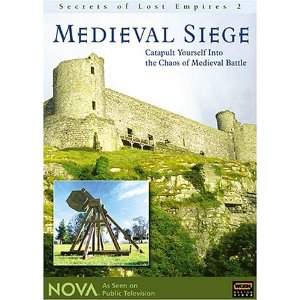
    I won’t rehearse all the fascinating details (and it WAS fascinating), but all that research did lead me to a wonderful documentary. It’s called Secrets of Lost Empires 2: Medieval Siege and was produced by Nova in 2000. You can get it on Netflix or Amazon.  In the film, fifty carpenters worked day and night to create and test what they dubbed “the fourteenth century version of the atom bomb”–the trebuchet (tre-byou-SHAY). The trebuchet as the most popular throwing machine in Europe during the middle ages. If you love the history of medieval war, you’ll love this film. You might want to add to it a reading of the excellent Ancient and Medieval Siege Weapons by Konstantin Nossov, which you can get via the inter-library loan program.

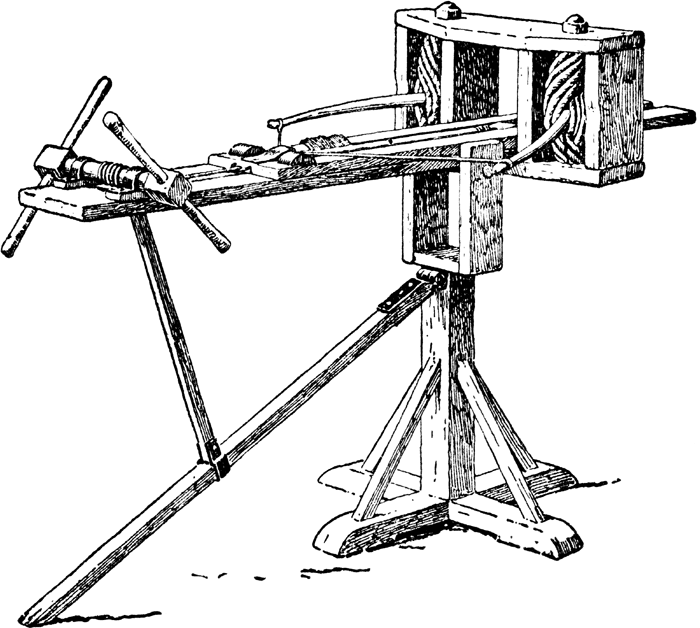
    I’ll share two cool factoids for you history fans. “Catapult” means “shield-breaker,” “cata” meaning break or penetrate and “pelta” being the name of the shield used by the Greek light infantry. The original catapults were NOT big spoons–they sped arrows and balls along a track like a crossbow. However, instead of using the spring force of a bow, they used torsion-springs, which is what you get when you twist fibers that want to be straight. In the case of catapults the fibers were ropes made out of animal sinews or hair (horse or human, a woman’s hair being considered the best) and soaked in oil. Click on the image to see a larger picture. 

    A modern example of a torsion-spring are those balsa wood airplanes with propellers attached to a rubber band that’s hooked to the belly of the plane. To fly them, you rotate the propeller round and round, twisting the rubber band. Then you let the propeller go. Because the rubber wants to be straight, it reverses the twist, spinning the propeller the opposite way you twisted it. 

    You might think these torsion-spring engines were weak. But one catapult was reported as being powerful enough that an arrow shot from it broke through a shield, and the armored warrior standing behind it, at a distance of 400 yards! Hence, the name.

    The other factoid is that “trebuchet” comes from the French term meaning to overthrow. If you saw Return of the King, you’ll recognize them as the engines used on the towers of Minas Tirith. Trebuchets are simply an evolution of the staff sling. When it came to breaking castle walls, there was nothing more effective until the cannon appeared. Of course, in my book I use them a bit differently. You’ll see.

    One funny thing. I watched the movie with my oldest who was just as fascinated with the engines as I was. When she was telling my wife about the film, she kept referring to trech-uh-butts. Which, I guess, is as fair an attempt at “trebuchet” as any. However, my wife kept picturing buttocks and couldn’t figure out what the heck my daughter was talking about–“You were watching what with your father?!”

    The French make things so hard . . .

    ***

    The Monday after CONduit I left for work in Mexico and then Vegas. I didn’t get back until this week. So I just wanted to say I had a great time at the con. Loved chatting with all the folks there.

    It was great to see the Larry Correia, Paul Genesse, Jessica Day George, Isaac Stewart (and his brother Dan), Mette Harrison, Eric James Stone, Darren Egget, Julie Frost, Sandra Tayler, LE Modesitt, Josh Perkey, Nicole (whose husband is an Orem cop and I lost his number), Daniel Who-I-Sacrificed-to-My-Editor, and the Dungeon Crawlers Radio guys.

    It was also nice to speak with Julie Wright who was one of the initial judges for the Whitney Awards. She’s always nice to chat with, but this time it was especially nice since she said reading Servant of a Dark God was like eating chocolate. I’ll take chocolate praise any day.

    I also met new author Janci Patterson who just sold a YA with a great premise. It’s called SKIP and is about a young girl whose parents are divorced. The girl has to go stay with her dad who lives in a trailer and is a bounty hunter. I’m a sucker for bounty hunter stories. Especially this one, because she goes out with him and falls in love with one of the guys her dad has to haul in. I’ve slaughtered the pitch, but I got that good old writer’s envy when she told me about it. Can’t wait to read it.

    I also got to see Barbara Hambly. I was at LTUE when she was there like 20 years ago. We loved her stuff. She suddenly dropped out of the writing scene in the early 90’s and now I know why–it appears Del Rey dropped all their midlist authors except for Anne McCaffery and someone else. Hambly was one of the causalities.

    ***

    After Hambly’s main address, I sat with a few authors and had a brief discussion about the book industry where it was suggested the industry was shrinking–fewer readers, fewer sales, doom, doom, doom. But that is exactly opposite all the data I’ve seen.

    1. Book sales have an annual average growth over the last seven years of 1.1%, adult paperbacks are growing 2.9% http://www.publishers.org/main/IndustryStats/indStats_02.htm or http://www.publishers.org/main/IndustryStats/documents/S12009Final.pdf . Now, this doesn’t show units sold. So it could be that they sold fewer units for more money per unit. Still, it shows at the very least that $$$ aren’t shrinking.
    2. The New Book Titles report here shows an increase in the number of titles: http://www.bowker.com/index.php/book-industry-statistics — 80% increase from 2002 to 2009.
    3. Reading rates are actually on the rise: http://johndbrown.com/2009/03/literary-reading-rates-on-the-rise/
    4. Finally, I contacted Bookscan for their numbers for an ALA conference I did last summer. This is just juvenile fiction, but the numbers are in units. Now, I don’t know if they added more sources to their database and so that caused a rise, but I explained to them what I was trying to do—see trends over time—and this is the data they provided. According to their numbers, more juvenile books are being sold now than in 2004. Click on the graphic below. This means we have more and more readers rising up through the ranks! One author asked how much of that was Rowling and Meyer. During that period books by those authors accounted for an average of 7-10% of all juvenile fiction. Bookscan categorizes “juvenile” as everything for kids. That means from Go, Dog Go up through what we consider Young Adult. R&M accounted for an average of 33-36% of what Bookscan categorizes as science fiction, fantasy, or magic within the juvenile mega-category. What all that means is the growth is across the whole category, not just with their books.

    So I’m very sanguine about the book industry’s prospects. Today’s youth seem to be able to play computer games AND read in great quantities.

    ***

    Finally, one last bit of news. Robinson Wells was the one of the main ones to start the Whitney Academy and the Whitney Awards. Well, he just got some fabulous news. Here’s the announcement from Publishers Marketplace: “Robison Wells’ YA debut dystopian thriller VARIANT, a modern-day LORD OF THE FLIES, set at a boarding school where not everything is as it seems and every day is a fight for survival, in a significant deal, in a three-book deal, to Erica Sussman at Harper Children’s.”

    For those of you who don’t know, here are the PM deal categories.

    • “nice deal” $1 – $49,000
    • “very nice deal” $50,000 – $99,000
    • “good deal” $100,000 – $250,000
    • “significant deal” $251,000 – $499,000
    • “major deal” $500,000 and up

    Oh, baby. Someday. Someday. Of course, I’m nothing but happy for Mr. Wells!

    Links

    Share
  • The 2009 BBC version of Austen’s Emma

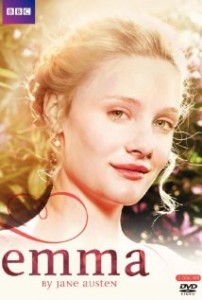
    Emma BBC Romola GaraiYou read some reviewers because they regularly set you back in your chair with keen insight. You read others because their phrasing and voice are so delightful that you find yourself unable not to read, even when they venture forth into exciting areas like soup cans and lug nuts. I, alas, fear I cannot occupy either role when I tell you about the BBC’s 2009 mini-series production of Jane Austen’s Emma.

    I cannot because have no keen insight into acting or film-making or film adaptations. I am not an expert on the late 18th and early 19th century England.  I am not an Austen junkie (although you can be sure I intend to become one shortly).

    Surely, as a writer, I could come up with some kind of amazing assessment. But I cannot because I am speechless. I am filled with a fine joy. I have spent nearly four hours with my wife and two of my lovely daughters watching a delightful tale unfold about the fates of a number of characters–some foolish, some arrogant, some quirky, but most of them splendidly human and noble.

    This. THIS is what I go to story for. To be transported. To laugh. To cry. To hope and fear and feel suspense for another.  To spend time with wonderful characters.  To have lived just a little more while under the story’s sway.

    Gush, gush, gush.

    Such an unmanly thing to do. But to hell with that. I am a man who loves Jane Austen and shoot ’em up thrillers both.

    And if you enjoy Cranford or Pride & Prejudice or Downton Abbey, then you will love this production of Emma too. You will want to own it.

    Romola Garai plays the star role of Emma. I enjoyed every minute she was on the screen. I didn’t know who she was, but it appears she was in the 2006 Amazing Grace with Ioan Gruffudd. I might have to watch that one again just to see more of her work. Mr. Knightly, Emma’s lifelong friend, is played by Jonny Lee Miller who starred in Eli Stone, one of my favorite TV series. I loved watching every minute with him equally as well. There were some other familiar British actors; and more I hadn’t seen before. I thought they all did an excellent job.

    As for the story, it’s about Emma, who believes she has an amazing ability at match making and prognosticating and very soon runs into to trouble because of it. It’s also about kindness, and generosity, and, most of all, love. Of so many varieties.

    If you’re wondering what to watch this next week, order this one now.

    Share
  • |

    Black Chokecherry Syrup

    When you live where we do, you cannot hope to landscape likes folks in a warm suburb. First of all, at 6,000 feet with a min temp of -30 Fahrenheit you can’t grow a lot of warmer climate plants. Second, the deer seem to eat everything else you do grow. So we’ve been looking and I think I’ve found a tree to add.

    I actually found it earlier when I was biking around the beautiful Round Valley and had to stop and go back to revel in the delicious fragrance. But I didn’t know what it was at the time. I do now. 

    It’s the black chokecherry.

    It grows naturally up here. Has beautiful fragrant blossoms in the spring. And it produces fruit that can be made into a delicious syrup. Oh, the raccoons like it as well.

    Now when you eat the raw berry, unless you eat it late in the fall, you’re in for an astringent, alum after-punch. But we picked the berries up a canyon behind our town after the first frosts. In fact, many of our berries were wrinkled. They just fine raw. Even Lilia, my pickiest eater, enjoyed them.

    We picked about 1.25 gallon ice cream buckets of the stuff. Then we followed this recepie and made about 4 quarts of syrup.

    • 3 cups chokecherry juice (see first step)
    • 3 cups apple juice (not from a store, but cooked from apples)
    • 6 1/2 cups sugar
    • (I’ve heard some folks add 1/4 teaspoon almond extract for a stronger cherry taste)
    1. Wash chokecherries, place in a large kettle, barely cover with water and cook, covered, for about 30 minutes till the cherries are soft. Mash gently and strain the chokecherry juice through a sieve or cheesecloth.
    2. Do the same with the apples.
    3. Pour the juice into a large kettle; stir in the sugar.
    4. Cook on high, stirring constantly.
    5. Boil hard for 1 minute.
    6. Remove from heat and skim foam.
    7. To can: Pour hot syrup into sterilized hot jars to within 1/8th inch from top.

    It’s absolutely delicious on pancakes. 


    Share

2 Comments

  1. I really need to get back on the Jillian exercises again. My wife and I, after talking with my doctor and getting a very very enthusiastic approval, have actually gone vegan. That’s right, no animal products. I thought it would be terrible, but after a couple of months the only things I really still crave are cheese and the occasional donut. Don’t get me wrong, it’s not because I love fluffy bunnies and can’t stand to see a delicious steak or two. No, it’s because I’ve lost and kept off something like 25 lbs for a few months now, and my blood pressure is normal and my blood sugar looks pretty darned good, too. Now I’ve just got to get back into my exercise routine….and now I want a donut. Stupid comments!

Comments are closed.