Plot Basics

In the comments to this week’s writing excuses on the 3 act structure, a writer asked if the try/fail cycle would really work with her chase story because her folks do not “fail to solve the problem” every time so much as “escape by the skin of their teeth”.

I thought this was a great question because we ARE often led to believe that the characters need to fail in each attempt. But if we look at a number of stories we’ll see that this isn’t the case. The hero is NOT always failing in his scene or sequence goal. In fact, much of the time he succeeds. So how does plot really work? Here’s my post.

[edited for clarity]

Jen, fwiw:

A few things finally opened up acts and plot to me. Maybe they’ll be helpful to you. I say this because a chase would work the same as anything else. I’ll just start at the beginning, although I’m sure you know a lot of this.

1) Story is about someone solving a problem. The problem is one of happiness (danger or lack on some level–physical, social, freedom, etc.) or mystery.

2) The reason why we tell stories about problems is because the solving of problems, if done a certain way, evokes suspense, surprise, and curiosity in the reader, and then a release of emotional tension. Why we humans like that ride, I don’t know. But we must keep this in mind when dealing with #1 because these effects are the main effects the bulk of people go to story for.

3) Plot is simply the actions the characters take, the results of their action, and what they decide to do next. Except this can’t be any old action and result. It has to be action and result that builds the anxiety of suspense, surprise, and the mystery or puzzle.

4) There are four possible answers to the question of “did the hero’s action solve the problem?”: yes, no, yes but, no furthermore.

For example. Yes, you killed the monster. No, you didn’t. Yes, you killed the monster, but it bit you and now you have the virus that’s going to turn YOU into a monster. No, you didn’t kill the monster furthermore you woke up its mumma.

Of those four possiblities, only the last two build suspense and curiosity. The first removes it totally. So it’s out. And a no answer leaves suspense unchanged. All you’re doing is delaying things with that. What you want to do is ratchet it up.

So if you want to build suspense then when a character takes an action, that action has to make things worse. They may escape by the skin of their teeth, but now the federal police know where they are (yes-but). Or not only did they not escape the police, but now the mafia, the real bad guys, know where they are (no-furthermore). These escalations and complications to the plot/problem continue until the hero’s plan is in total shambles and it appears he really is done for. That’s when they get one last shot at it.

If someone is trying to escape you don’t need a different plot structure. Their actions simply need to make it harder and harder and harder. Their plan needs to start to come apart. Things go wrong. Things they didn’t plan for make it worse. Someone double-crosses them or goes AWOL. We need to see them walking into dangers they didn’t plan for. If you go back and look at Prison Break season 1, you’ll see this all over the place in the last two episodes.

5) Acts are just a nifty way of breaking up the problem solving process into parts. In act 1 (the beginning), as stated, you introduce the problem and show that the character won’t or can’t walk away. Often a big reversal or reveal (a big yes-but or no-furthermore) marks the end of that act. But the key thing is that the hero MUST act. The stakes or too high or they simply can’t get away.

Now in act 2 (the middle) the hero says, aha, this is the real problem. Let’s try to solve it. Act 2 is a breeze to write IF you think about escalations and complications and nasty surprises–yes-buts and no-furthermores. He takes an intelligent action. BAM. It gets worse. And as these complications pile up we see that the hero comes to a point where his plans are in a shambles and the problem looks almost certain to squash him for good. In Star Wars, sure they saved the princess, but they led the empire to the secret base and the death star is going to blow them away (a grand yes-but).

In the last act, the hero straps on his guns and trys one more thing. Sometimes it helps to think of acts 1 and 2 as the hero reacting and act 3 as the hero finally getting the inititative, although it appears to be almost too late, and strapping on his guns. In Star Wars they do this. They’re running, running, running, and then they attack the death star. But the odds are slim. And they only have one little chance.

Remember: the odds are slim at this point and things get worse not because this is how problems are solved. Many get solved on the first try in real life. But because solving a problem in this way produces maximum suspense, surprise, and curiosity–the chief effects readers go to stories for. Any time you see a new plot structure or theory, you need to ask yourself what effect it has on the reader. If you can’t see any, junk it.

So you might have three acts, four, five, seven (all variations I’ve seen). It doesn’t matter. An act usually ends with a huge change in the nature of the problem. See Robert McKee’s STORY. But the number of acts isn’t the issue. It’s the effect on the reader. The acts are just means to an end. If we don’t keep the end in mind we’re likely to misuse the techniques. 

6) The key for moving through the acts is to ask myself about actions, obstacles, and results. Here are some questions I’ve found productive.

Action. What are some intelligent actions the hero might take in this situation? What would I do? What are some logical steps that the reader might not think of?

Obstacles. What happens? What are some compelling obstacles the hero will face in this attempt? Are there points of conflict with himself, someone else on his side, the antagonist or his henchmen, someone in the background, with the setting? What does the antagonist do to foil the hero? What is a logical but maybe an unexpected and surprising obstacle to both the reader and hero? How does the hero’s plan begin to come apart?

Results. What happens? What are some possible results that pose a yes-but or no-furthermore? What would be unexpected, surprising to both the hero and the reader? How does the character’s action make it worse? How does the result reveal the problem is much worse than the hero and reader first thought?  I’m thinking of complications and escalations–things that make the problem harder to solve or more important because more’s at stake.

In all of these, I choose the options that gives me the most zing and run with them. If they peter out, I try another (take 2, take 3, take 4), until I have one that works. Then I repeat it all over again and again until the hero is looking the gun in the face.

7) The “hero’s journey” is nothing more than a bunch of mystical names for common elements in this specific type of problem solving structure. Why does the hero have to leave home? Not because of some mystical archetype mumbo jumbo. No, because this forces them out into unfamiliar territory–adventure, risk. Things go wrong. The hero has to face the problem.

Why does the hero go to “the cave”? Again, not because of some mystical archetype mumbo jumbo. No, because turning and facing the monster, going onto ITS turf, poses the MOST RISK and hence most danger and hence most suspense for the reader.

Always keep the purpose of the story in mind. Suspense and curiosity DRIVE the structure of most stories. Yes, there are other effects we go to story for. But the reason stories are structured the way they are is because of those two reader effects. And all the rest of those Joseph Campbell terms are useless to writers unless they make the connection and see how they play into suspense and curiosity.

And even then I’ve found it’s wrong-headed to bind yourself to to a form just because. Or to think you need to slavishly follow it. The decision has to feel right for the story. It has to build anxiety and curiosity. And whatever does that well is right, regardless of whether it follows some formula. Although, I will say that certain story structures are used again and again because they deliver the goods to the reader better than other structures. Like biological evolution, they survive because of natural selection by readers.

So that ended up longer than I intended. Hopefully the ideas were as helpful to you as they were to me.

This writer’s question arises because of the common way of explaining the try/fail cycle sets us up to think there is only a no or no-furthermore option to each attempt by the hero. However, if we just look at a handful of stories, we’ll see the yes-but option is used all the time. What we want to avoid is the yes option, because that just stops the story. It stops the story because story is about solving a problem. And once the problem is solved, the story is over.  

Other writers talk of formulas, however “pattern” has always been a more helpful way of looking at it than “formula.” I know, that’s semantic quibbling. But “formula” suggests to me THE way while “pattern” suggests to me something not so strict, something with some give to it and perhaps a great number of variations. Either way, pattern or formula, I found that unless I can understand the why of a part of the pattern, the effect it has on the reader’s experience, it’s not much use to me. It all comes down to plunging our hero into trouble or mystery, and then making the trouble or mystery worse SO THAT the reader feels increasing anxiety, curiosity, and surprise.

BTW, here’s a good explanation of the 3 act structure with some tips from Stephen J. Cannell, an old pro. I really like his tips on act 2 issues and complications. Because if we make the antagonist an active force, he or she will provide many wonderful yes-but and no-furthermore options.

You’ll find other excellent explanations of plot in TECHNIQUES OF THE SELLING WRITER by Dwight V. Swain, HOW TO WRITE BEST SELLING FICTION by Dean Koontz, and THE SECRETS OF ACTION SCREENWRITING by William C. Martell.

Share

Similar Posts

  • Some lessons from Tom Clancy’s first novel

    tom-clancy-the-hunt-for-red-octoberTom Clancy is one of the biggest authors of our time. How did he break in? It’s an interesting story that Deborah Grosvenor, the editor who acquired The Hunt for Red October (Clancy’s first book), tells here.

    And this early interview provides more insights.

    So what conclusions can you draw from this? Here’s what I picked up.

    1. Writing a good book is one thing. That book finding success is quite another.

    2. Endorsements from the right people make a huge difference. More here in my blog Is Product Popularity Random?

    3. Know what you write. And if you don’t know it, do the research. And then invent what you have to.

    4. It’s not always a bad thing to start with a small press, especially if they’re going to put as much $$ into marketing and PR as this one did.

    5. To finish your novel, you’re going to have to set aside time and get it done.

    6. Finally, follow the zing. Clancy loved this stuff. Notice how his book was fed by the stories he heard and read.

    Share
  • |

    The book trade is a . . . trade

    James Dawson, YA author, feels it’s somehow wrong to hold back on cussing in his fiction. He wrote an article about this in the UK Guardian called “Why Teens in Books Can’t Swear.” He thinks it’s unrealistic. He thinks it’s about gate-keeper censorship. You know, parents wanting to steer their children towards certain experiences and away from others.  

    People.

    Dawson’s approach to the whole problem is wrong-headed. This isn’t about the virtues and vices of fiction. Or about gatekeepers, especially in today’s ebook world.  Or what experiences parents want to provide their children. And it’s not about art reflecting reality. Reality includes trips to the toilet, and yet we somehow fail to include realistic bum wiping in so many of our tales. Good heavens, have we betrayed our artistic integrity? No. We’ve just naturally chosen to include things that appeal to us and leave out others that don’t. Every book is an exercise in hundreds of such choices.

    The fact is that Dawson’s forgetting that a fundamental aspect of the book trade is the trade.  The buyer trades his or her money for a product (the book) that provides a service (the entertainment, thrills, chills, etc. of the reading experience) he or she values.  A customer preferring one kind of experience over another isn’t censorship (the horror, the horror).  It’s choice.  

    As an author, you make your offer. If folks like it, they buy it. If not, they don’t. Nobody owes you a purchase.

    This means that in any business, and selling fiction is a business, the most sensible way forward is to offer your intended buyers something they are likely to value.  Something they’re going to like.  Something they want.  If your buyer is thirsty and wants water, offer him a cold glass of water, not a waffle iron.  And if you can’t bear to develop anything but waffle irons, then, by all means, develop waffle irons.  Just make sure you offer them to the folks looking for . . . waffle irons. 

    This business of making offers also means that we package our products and services so that customers can easily tell what’s in the box. You don’t want someone to purchase your box thinking it contains breakfast cereal when in reality it’s a bunch of bolts.

    Yeah, writing is an art. But offering it in trade to others is also a basic economic act.

    Share
  • |

    Writing Update: 6/13/11 – reviewing the beginning

    I’ve finished chapter 17 of CURSE. I’m up to 50,000 words and have moved from the presentation phase into the struggle. And I’m stopping at this point to review the what I’ve got. I’ve learned that if the foundations of the story–the presentation phase–has fundamental flaws in it, you’re only going to create a HUGE rewrite mess if you push on.

    I know this from experience. When writing the first draft of CURSE back in 2009 (oh my heck, it feels like forever ago), I ignored my Spideysenses and told myself I could fix anything that was wrong in post production.  And it IS possible to fix many things afterwards–you can change scenes, improve clarity and transport, remove continuity errors, layer in character tags and things like that.

    And it IS true that sometimes you do just have to write to the end to figure out the story.  Sometimes you have to just write to the end, and do it in a substandard way, because if you don’t you’ll never finish anything. Sort of like sketching first and then painting. But if there’s something wrong with the basic premise of a story line, and you keep writing, then that story line affects everything it touches. The fractures ripple out all the way to the end of the book. And you might end up, like I did, having to toss a huge amount of what you’d written.

    Which is not all bad. I learned a lot and invented a lot of cool stuff while writing that. But when you’re on a deadline, it can be a killer.  And I’m not doing that this time. I worked out the big issues in my chapter outline.

    So I’m pulling back and reviewing. I’m delighted with everything but the villain. He’s still not right. I love his chapters, the scenes. I love the name I’ve given him–Endless. But the structure isn’t right. I’ve inadvertantly created two main villains. And that’s not useful. Having two “main” villains doesn’t double the power of the opposition. It splits it. The villain/henchman model works well. But I don’t have that either. Over the next few days I’ll be rectifying the setup. Then moving forward.

    For those of you who are writers, I thought you’d be interested to know that there were a few times these last two weeks when I dreaded the writing. I had a large problem before me or had to invent a new chapter (as opposed to using something from the previous draft), and a dread filled me. But I sketch/drafted my way to the end, and soon found the writing a joy again. 

    I can’t say enough about the sketch/draft method. I’ve found it works in creative activities OUTSIDE writing as well. When working up a lesson plan for my day job, designing landscaping for our house, developing a talking script for a sales call, writing a technical manual, or a hundred other things I’ve had to do–it’s always easier to work from something than create everything all from scratch.

    Sketching allows me to create that first draft. And it allows me to do this without having to worry about quality. Sketches can be silly. Weird. Full of crap. They can be all this because I can throw them away. They’re not meant to be permanent. And so there’s no pressure to perform. There’s no staring at a blank screen or page. Sketching is a free-wheeling joy. It fills me up with ideas. And then, when I’ve got the general idea of what I want to do, I can start in on the “real” draft knowing WHAT I want to accomplish which leaves me free to think about the HOW. And if I run into problems and realize the draft isn’t going to work, or I run into something better, I just call the current draft a sketch (or “take” as used in the movie business) and move on to the real one.

    Sometimes a chapter or section requires 1 sketch or take, sometimes I’ve run up into the 20’s. Sometimes I haven’t needed any at all. It’s not the number that’s important, it’s the process that has really freed me.

    Share
  • Edward Bear Shares His Proofreading Secrets

    One of the things I enjoy about being an author are the emails I receive from readers. A few months ago I received one from Mr. Edward Bear. He’d purchased Servant and, as he was reading, found an unclosed dialogue quote.

    Mr. Bear could have simply noted it and read on. But he did not. Mr. Bear is a proofreader. And so he practiced a bit of wizardry, found that I had a handful of quote goofs, and emailed them to me.

    Many of them ended up being weird smart quote issues Word introduced into the text when I broke a line of dialogue with an action like this: “You will not”–he scratched his nose angrily–“share another pair of my panty hose with that woman!”

    You’d think that would be enough for a doughty reader. But Mr. Bear didn’t just notify me of the errors. Oh, no. He also included the page from his proofreader’s grimoire that allowed him to find those quote issues in a matter of minutes in the first place.

    As soon as I had the time, I tested the spell on Bad Penny, and, voila, in a matter of a few minutes found a couple of issues in that text. I was delighted.

    But Mr. Bear wasn’t satisfied with mere delight. He then sent me another page from that grimoire to help with spelling. We luvs wizardly readers, Precious.

    Copy editing and proofreading require patience, painstaking reading, and a knowledge of what to look for. You have to know not only the mechanics of the written word (capitalization, spelling grammar, syntax, punctuation, abbreviations, usage, etc.) but also, if you’re reading for a printed edition, interior formatting (widows, orphans, word or hyphen stacks, headers, and so forth). There’s a lot to it. And anything that speeds up the process and minimizes errors is welcome.

    If you’re contracting your proofreading out, a cleaner copy can also translate into lower rates. Knowing that many of you who visit this website are writers, and because your host’s generosity knows no bounds, I asked Mr. Bear if he might be willing to share his wizardry with you. The wizard responded with a yes.

    Augmented Proofreading 1

    By Edward Bear I’m Ed Bear. I work, both professionally and otherwise, as a proofreader. I’ve gone over books for my publisher and I’ve done scan/OCR/check against paper books for republication, both electronic and back-to-treeware. When I mentioned some of the “ancillary tools” I have for aiding the work, John offered me this guest post slot in his blog. Feel free to pass this stuff around. I’ve found these techniques invaluable in getting the job done faster, and with better quality.

    First, though, I need to tell you about the tools themselves. The biggest component is the software for electronic text editing. However, I’m NOT talking Word or anything like that. I’m talking about an editing program which can a: work with plain text and b: handle Regular Expressions. (What are those, some of you ask? I’ll get to that.)

    Since I’m a windows user, I have two such programs available. My favorite is a program called TextPad (www.textpad.com).  I’ve used it for years and it’s become invaluable to my work. They currently charge $28 for a single user license, but IMO, the program’s so useful that, even though upgrades are free, I buy another license every time they bring out a new major release. The other program is free. It’s called NotePad++ (http://notepad-plus-plus.org/) I’ve tested it and it can handle the methods I use, but I haven’t used it much, since TextPad and I are long-time buddies. If anybody out there knows a program for the Macintosh which will do these jobs, please mention it in the comments.

    Regular Expressions

    You don’t have to be a wizard to use them. The tutorial over at http://www.regular-expressions.info/tutorial.html describes them elegantly:  “Basically, a regular expression is a pattern describing a certain amount of text.”  They are also called a regexp or regex, and I’ll be including the regexes I use in this post.

    I have a small library of regexes, and two of them are critical to aiding the proofreading process. One of them allows checking dialogue quotemarks, to insure that speech is properly closed off, and the other makes it possible to generate a word list of each unique word in the  book. I’ll be walking through the usage, including screenshots.

    Quote Checking

    One of the challenges of checking dialogue passages is that, with one exception, every opening quote (“) needs to have its matching closing quote (”). The exception, of course, is when the same character is speaking in the next paragraph. This can lead to a heavy false positive load if the characters are loquacious.

    The first time I tried this stunt, I found  73 paragraphs with unbalanced quotes. Only 6 of them were errors. But being able to find them quickly so they could be fixed in minutes instead of hours? That paid for the effort.

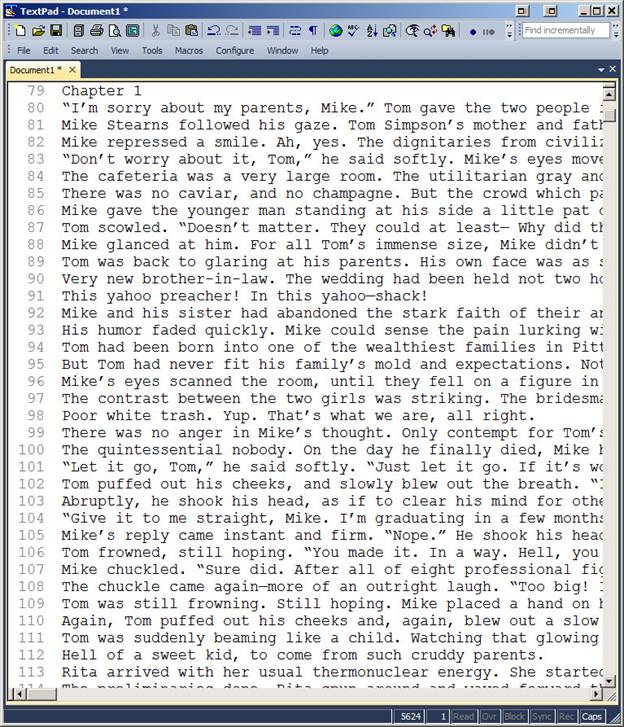
    The process itself is simple: You take the document and convert it to plain text. If it’s an RTF or Word document, you simply select ALL, hit copy, and paste it into Textpad.  The result will look something like this:

    image001

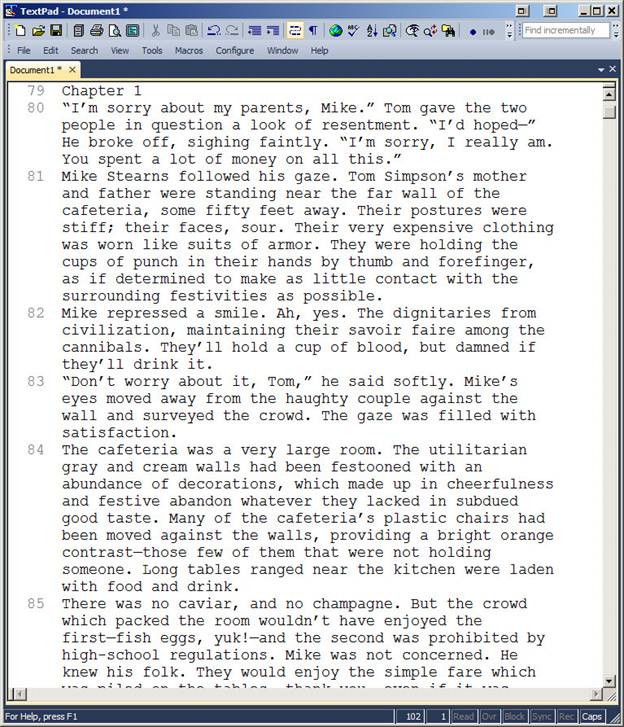
    What I normally do is turn on word wrap, so I can see the whole paragraphs as I go. So it looks like this:

    image002

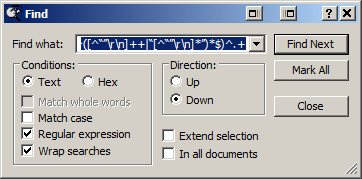
    Now, we go hunting. The next step is to set up the search pattern using a regex. The one I use for this is the following: (?!^([^“”\r\n]++|“[^“”\r\n]*”)*$)^.+ Complicated little brute, isn’t it. I didn’t write it, but I knew who to ask if he could write one, and the above is the result. FYI, there’s also one for straight quotes: (?!^([^”\r\n]++|”[^”\r\n]*”)*$)^.+ You use it the same way. So go into find, and put the regex into the “Find what:” box:

    image003

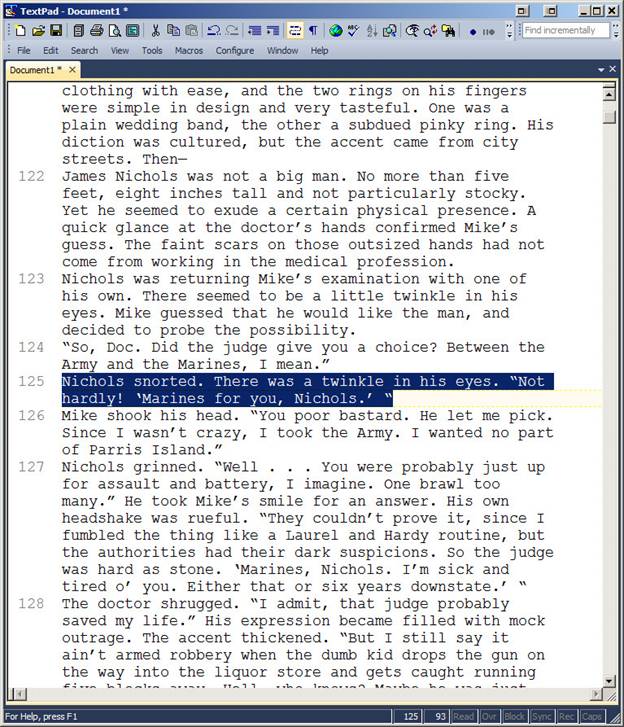
    Notice that the “Regular expression” box is checked. I also “Wrap searches” just in case I miss something and want to loop around. Click “Find Next” and:

    image004

    The paragraph highlighted has two opening quotes, one at the beginning and one at the end. Word assumes that a quote preceded by a space is an opening quote, so you need to correct it in your RTF/DOC. Wash, rinse, repeat. You keep doing “find next” all the way through, checking for situations like the following:

    image005

    As I said, same speaker, next paragraph, so this one is good. This post is getting a little long for a blog entry, what with illustrations, so I’ll break off here. Stay tuned for part two: checking spelling and spelling consistency. In the meantime, here are the RegEx tool commands plus a few bonus goodies: RegExToolCommands.

    Share
  • New creatures & mystery in wonder fiction

    I love listening to writing excuses because I get to hear three smart and funny authors discuss interesting topics that get me thinking. This week’s writing excuse was on building non-humans in SF&F.

    Here’s my take.

    An alien race, if done right, can be a huge draw to a story. For example, Brandon Sanderson’s Kandra point of view in HERO OF AGES is one of the most enjoyable parts of that book.

    However, I want to suggest that aliens (in fantasy or sf) create that draw only IF they’re kept sufficiently strange or mysterious. The minute they become common or too human, they lose their power to enchant.

    That’s one thing I like about how Tolkien did the elves and orcs–we never got the National Geographic on them. They never became common. And so I always wanted to know more. Easterlings, ents, balrogs, the orders of wizards, dragons, etc. were the same. There were tons of tales Tolkien hinted at, curioisties raised, but those desires were never sated. This is part of what drove me to other fantasy books.

    It’s the same thing that made me love mammoths and dinosaurs, bats and giant squid, and far-off places. However, once these things became common and explained, their magic departed. The curiosity generated by the wonder of things new is one of the key things science fiction and fantasy offer its readers. But I think authors can only keep it alive if they approach it in the same way a fan dancer approaches her work.

    This leads me to another point. It’s true that focusing our world building on the conflicts and story touch points can keep us on track. And we do need to produce. However, I think if we strictly limit our alien development to the central story conflicts, we might miss many opportunities for that wonder. Some of what we develop might end up complicating the plot while other parts might only enrich the experience. And I don’t think that’s bad.

    For example, one of the most poignant parts of the LOTR, of which there were many, was the tale of the ents and the entwives and Treebeard’s poem. Tolkien could have eliminated that and the story never would have been affected. But, O, how much richer the story was for that little side trail that still beckons. Or you might think of the ring Bilbo found. When Tolkien first wrote THE HOBBIT, it wasn’t THE ring of power. It was merely a ring that Gollum used. Only later, when he began to work on LOTR and was trying to figure out the main problem of the story did he work that detail into it becoming THE ring of power.

    Share