Sticky Ideas, Cook’s Country Magazine

They stole his kidney . . .
A friend of a friend of mine is a frequent business traveler.  To keep his identity safe, I’ll call him Bill.  Bill was recently in Atlantic City for an important meeting with some new clients.  Afterward, he went to a local bar to kill some time before his flight and took a seat at a table. 

He’d just finished one drink when an attractive woman approached and asked if she could buy him another.  He was surprised, but flattered (Bill isn’t exactly a Brad Pitt).  He accepted the drink.  The woman walked to the bar and brought back two more drinks—one for her and one for him.  He thanked her and took a sip. And that was the last thing he remembered . . . before he woke up, disoriented, lying in a hotel bathtub, his body submerged in ice.

He looked around frantically, trying to figure out where he was and how he got there.  Then he spotted the note:

DON’T MOVE. CALL 911.

A cell phone rested on a small table beside the bathtub. He picked it up and called 911, his fingers numb and clumsy from the ice. The operator seemed oddly familiar with his situation. She said, “Sir, I want you to reach behind you, slowly and carefully. Is there a tube protruding from your lower back?”

Anxious, he felt around behind him. Sure enough, there was a tube.

The operator said, “Sir, don’t panic, but one of your kidneys has been harvested. There’s a ring of organ thieves operating in this city, and they got to you. Paramedics are on their way. Don’t move until they arrive.”

Incredible, isn’t it?

More importantly, do you think you could remember enough of that, without review, to tell it to someone tomorrow?

My guess is that you could. And if you did, you’d be spreading one of the most successful urban legends of the past fifteen years.  

But I didn’t tell you the story to focus on urban legends. There are a lot of stories people tell one another that don’t go viral.  What makes this one different?  In fact, what makes any idea stick effortlessly, like this one does, in someone’s brain?

Are you a teacher? In school, at home, or at your business? Do you give presentations?  Do you ever need to advertise something—a product, service, or yourself? If so then you’ve had this question.

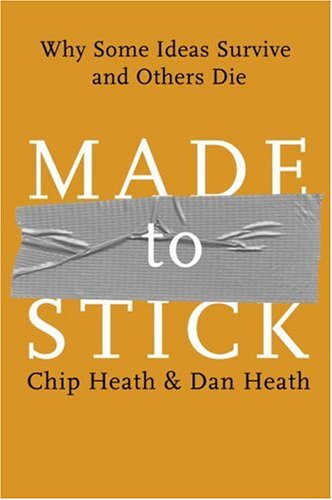
Maybe you’ve uncovered some of the secrets. Maybe you haven’t.  But there’s no reason to despair: Chip and Dan Heath have written the book on it. It’s called Made to Stick: Why Some Ideas Survive and Others Die and is one of the most fascinating and practical reads I’ve come across in the last few years.

The brothers Heath spent hundreds of hours researching sticky ideas: urban legends, advertising campaigns, wartime rumors, proverbs, conspiracy theories, jokes, some of the nation’s best teachers—you name it; if it was sticky, they looked at it. They asked questions like what makes some urban legends so compelling? Why do some chemistry lessons work better than others? Why do some political ideas circulate widely and others fall short? What they found was that sticky ideas exhibit six traits. And it was relatively easy for someone, once they understood those traits, to make almost any idea stickier.

I can see the traits in some of the things that I’ve done that have been sticky. I can see other ways to improve. The cool thing is that I’m not going to be guessing as much. If you need to make your ideas stick, let me recommend you get this book.  If you want a preview, go to madetostick.com.

Recipes that actually work?

I was once induced, through insidious mind control, to purchase a cookbook that included all sorts of tempting dishes. I prepared a number of the recipes, and every one of them was a bust, especially the cinnamon flank steak with eggplant, which I think Nellie and I chewed for about six hours until our jaws dropped off.

Not satisfied to learn my lesson once, I soon purchased another book on making bread the Old World way. Despite our best efforts and many valiant attempts, all we could produce were loaves that were so bitter and sour they could have been used at Guantanamo Bay to threaten captured Talibanists to talk.

Let’s just say that after a few more of these, I finally beat back the mind control. I’ve been gun-shy of cookbooks ever since. We’ve been very selective over the years, and this has saved me some money. Unfortunately, I think all of those lessons learned are going to go out the window.

I was recently watching the Create channel and saw an episode of Cook’s Country where they showed how to make coleslaw that wouldn’t get all watery and a grilled chicken with traditional Southern white BBQ sauce that had me slavering in my seat. During the show they talked about testing these recipes and their failures.

I learned that the folks there had just finished an eleven-season series called America’s Test Kitchen (where was I all that time?). In the series, they tested hundreds of recipes five ways to Sunday to come up with ones that really worked.

When the episode of Cook’s Country finished, the old cookbook mind control had risen to full force. This time, though, I was able to exercise some restraint. Instead of buying fifty cookbooks, I started a 14-day trial to Cook’s Country magazine, a thirty-four page, oversized, bi-monthly that’s full of recipes that have been tested. 

One of the neat features is that they don’t simply present the recipes, they also include the stories behind the testing so a reader can learn from their failures and successes right along with them. In fact, the stories of the tests were so interesting I made Nellie sit down while I read them to her. The magazine also includes cooking tips and product ratings. In the issue I received, I learned, for example, which egg wash proved, through testing, the most successful on pies and which graham cracker tasted best in recipes. One of the best things about the magazine is that, unlike many magazines that have three sentences of content and forty pages of advertisements, Cook’s Country has zero advertisements. Zero! It’s nothing but cooking.

We’ve tried five recipes so far. Three of them have been clear winners for all the tasters in this family. There other two were good, but not spectacularly so. Still, there weren’t any cinnamon flank steaks! 

In the next set of reviews, I’ll share their potato salad recipe that had us all oohing and aahing. And maybe the chocolate éclair cake we adjusted to perfection. I’m going to continue the subscription and give their family cookbook a try.  I’ll report my results. In the meantime, I suggest you look at Cook’s Country magazine online at cookscountry.com or watch the show on Create.

Share

Similar Posts

  • The Rocket Science of Overspending

    In July, I blogged some spending 101 for Congress and the President, including contigency planning for alien invasions.  I thought I made some good points.  However, through the whole spending debate that occured this last spring nobody in the media or elsewhere was able to make clear what is going on with the US government. Nobody except Dave Ramsey. He explained it on Fox and then on his website. If you take the big federal numbers and translate them to a size we can understand, here’s the situation:

    – Joe and Susie (the Federal government) make $55,000 a year
    – They spend $96,000 a year
    – At the same time, they have $366,000 in credit card debt

    Look at those numbers again. Every year those clowns in Washington are adding $41,000 a year to that massive debt total. Soon enough, our overspending will kill our ability to do anything else except pay the interest on that debt.  150 years after America abolishes slavery, we decide that debt slavery really is a good idea. Yea! Give us shackles! Give us shackles!

    No wonder our credit score as a nation (our bond rating) was reduced.

    So what did the government do this last Spring? They agreed to find some way to cut spending from $96,000 to $78,000. Meaning they’re still adding $28,000 dollars a year to the government’s massive credit card debt total. Which we have to pay!

    If the US Government was a family, they would be making $55,000 a year, they spend $96,500 a year, & are $366,000 in credit card debt. What’s the first step to get out of debt? Stop overspending! But that means a family that is used to spending $96,500 a year has to learn how to live on $55,000. That’s a tough pill to swallow. It works the same way for the government. You can’t borrow your way out of debt, whether you’re a typical American family or the entire U.S. government. At some point, you’ve got to say, “Enough is enough!” and make the hard cuts necessary to win over the long haul. – Dave Ramsey

    The answer is NOT to print more money.

    If you do that, you reduce the value of each dollar. It’s called inflation. As Ron Paul rightly points out, it acts effectively as a tax. Or as I like to put it–a PAY CUT. How many of you would like to get a nice fat 10% or 20% pay cut this year? Furthermore, instead of fixing the problem, the overspending continues, which means more pay cuts in the future. More fun!

    No, the thing we have to do is STOP SPENDING MORE THAN WE MAKE.  Here’s what has to happen.

    1. We must write into law that Congress balance its budget every year–they must not be able to spend more than they take in except in rare emergencies. This means they might need to build up a rainy-day fund.
    2. We must cut our spending. Now. I linked to an idea Ron Paul has for this in my 101 post where we just go back to 2007 levels of spending.
    3. We must work to increase our revenues. Not through hiking taxes to monstrous levels, but by providing optiomal regulatory conditions for economic growth. See my 101 post. 
    4. We need to make sure the taxes are visible, so the American people can easily see what’s going on. Congress has mandated that lenders provide clients an APR so they can clearly see the rate they will pay on a mortgage. Why shouldn’t we mandate that the IRS send out an ATR–annual tax rate (or maybe Annual Grab Rate or Annual Tax Burden or you come up with the name)–which includes all Federal taxes translated into one total rate?  
    5. We need to give everyone the opportunity to pay for the soldiers that defend them and the roads they drive on, even if it’s just $50-100 a year for the very poor.
    6. We must send people to the White House and Congress who are willing to do what it takes RIGHT NOW.

    I mentioned Ron Paul a number of times above. He’s not my choice for president. But he has added a number of good things to this discussion. Here are the Ramsey links:

    EDIT: Mark Holt makes an excellent point in the comments. Inflation isn’t just a pay cut. It’s a savings cut, a retirement cut, a 401k cut, a house value cut, an everything cut. Using that backdoor method, the DC Connivers institute a tax of everything, something they’d never be able to pass out in the open.


    Share
  • |

    Diagnosing Quantum of Solace

    ***SPOILERS***

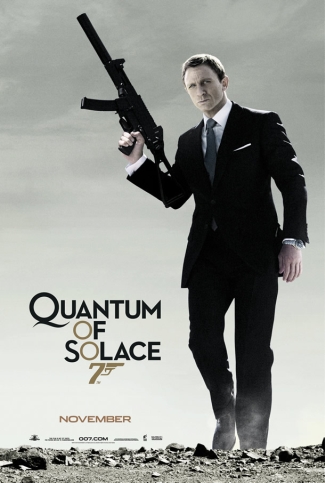
    Last night I went out with my wife and some friends to watch QUANTUM OF SOLACE. I was so excited. But when the movie ended, I was totally unsatisfied. There was no release. Nothing. It just ended.

    There was lots of great stuff in it. Love the character and style of this new bond. Loved CASINO ROYALE, but this just didn’t work for me. My diagnosis has two parts.

    MINOR ISSUE: clarity in story. The chase scenes were so choppy I couldn’t get a feel for what was going on so I could worry for Bond. All I did was get sick to my stomach. Part of the way through I told my wife I was going to write death threats to the freaking director. Who in the world thought that was a good idea? It doesn’t mimic battle etc. In battle you are HYPER alert and focused. Your world doesn’t turn into chaos.

    But it was more than the chase scenes. There were times when I did not know what was going on. Why was Bond going to his friend from movie 1, why was he watching that guy pick up a bag at the play, why was he going to the party, etc.?

    If he’d shared any of his plans, I could have gotten worried when antagonistic forces thwarted him. As it was, I was just watching him do stuff and only realizing at the end what the goal was.

    The basic principle of suspense is to let me know what they need to do and why they need to do it, then let me worry as I see the operation fall apart. Or let me know the danger and see them walking into it. But time and again they didn’t provider the viewer with the necessary information in this movie. 

    MAJOR ISSUE: ineffective story structure. I think for a film to build to a huge climax and release, the hero has to find himself in more and more desperate circumstances. His situation has to become darker and darker until we see no way out for him. By the end of act 2 his plans etc. should all be in shambles. He’s out of options.

    In this Bond I rarely felt he was in danger. Yes, there were some fight sequences which were tense, but he never ended up in worse shape afterwards. We got messages that he was being framed for murders, but I never really felt the screws tightening on him. So it never got darker and darker for him.

    His plans seemed to only be delayed, not destroyed. In Casino Royale, his car is wrecked and he’s taken captive and is going to die. He loses. In this one, nothing. Even when his plane is shot down going out to the desert, it’s just a delay. They walk to the bustop and are soon back on track.

    There might be another point about something being at stake. The water grab is a great idea, but we’re talking a 50 year plot. It’s not THAT urgent.

    A FIX?

    I think they could have done more by playing up the revenge/mystery of the last one. Yes, have the water grab, but make this personal to him. He’s searching for the answers to who was behind his lover’s death. Why not?

    Then get the villain, the US CIA, and the British hunting him down with real resources. He evaded everyone fairly easily in this one. He’s running FROM all these forces, barely one step ahead, until he gets caught by them. And it’s one of Green’s guys in the CIA or something like that who captures him. So he’s totally screwed. Then have the Black CIA officer do something to spring him. He’d probably have to die for it.

    I’m sure there are more and better options. But do something so that Bond is running for his life, FAILS, then pulls it out. Not chasing down the bad guys one by one with relative ease.

    Just one option. Thoughts?

    Share
  • Good Stuff: Poldark, Monk, and the cure for dragon feet

    For all of you longing for just one more season of Downton Abbey, I’ve found a new series from the BBC I think you’ll enjoy (thank you Duane Robinson for the recommendation).

    It’s called Poldark and is set in the late 1700s in Cornwall, that little southwestern leg of England that juts out into the Atlantic. The dark-haired and handsome Ross Poldark returns to England after having fought in the American War of Independence and finds that his father has died, and he’s inherited the estate. Except the estate is in ruins.

    The house, which is a long way from being anything grand, is a mess and being inhabited by the deceased father’s last two servants. A man and a wife who are equal parts louts and lushes. The land isn’t producing. The mine is closed. And Poldark has very little money.

    By the way, when we think of British aristocracy, we most often think of dances and fine clothing and large tracts of lands. We seldom think of mines. But Cornwall has been mining tin for a very long time, and so were its lords. In fact, Cornwall was known outside of the Isles anciently, and some historians suggest that Cornwall was probably selling tin to the seafaring Greeks and Phoenicians many hundreds of years B.C.

    So our young and handsome lord has come home to a mess and very little money. But he immediately sets about trying to repair things. And what unfolds is a wonderful story with love, action, humor, injustice, and villains plotting Poldark’s downfall.

    We loved Downton in part for the refinement and high society (and Lady Grantham’s hilarious one-liners). However, Poldark isn’t about the top of the aristocracy. It’s about a man almost at the bottom. And many of those of the lower class who are his friends. There’s a refreshing earthiness about it even while you still have scenes of the high society and all that goes with it.

    We just finished the first season and are hooked. In fact, I stood up and cheered at the end of the last episode we watched. So if you love English historicals, you’re going to enjoy Polkdark.

    *

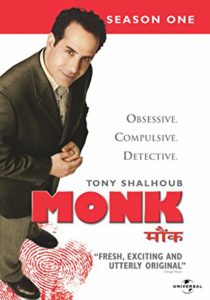
    The humorous detective series Monk debuted in 2002 and ran for eight seasons. It was a huge hit. But because I’m a cave dweller I didn’t get to it until now. But, boy, I’m happy I did.

    If you haven’t seen it yet, you’re in for a treat. Monk is one of those brilliant detectives like Patrick Jane in The Mentalist or Sherlock Holmes who sees all sorts of details that so many others miss. But unlike those guys, Monk has obsessive-compulsive disorder plus a number of phobias.

    And so he can’t just walk in and stun everyone with his brilliance because at any moment he might get sidetracked straightening pictures or moving lamps or trying to avoid germs. In one funny scene he’s being chased on foot by someone intent on killing him, and he can’t help but touch the poles as he runs by. However, he’s not all helpless because he’s hired a female nurse, Sharona Fleming, to help him. And the interaction between the two of them adds another enjoyable dimension.

    And so you get to experience all the awe of watching someone like Sherlock solve crimes plus laugh along the way. I couldn’t help but laugh out loud during a number of episodes.

    If you like The Mentalist, Elementary, or Psych, I think you’ll really enjoy Monk.

    *

    This last review is for all of you who have dragon feet.

    That’s what I had until two months ago. Dry dragon feet. So dry and with such sharp and jagged calluses that I regularly wore the area on my sheets around my feet to shreds. Nellie’s side of the sheets were nice and smooth. My side, after a year or two, looked like the dog had attacked it.

    The calluses were so bad I periodically sanded them off with 400 grit sandpaper.

    I also got stress cracks in the winter, which I tried to heal with band-aides and Neosporin. And that worked a decade ago. But the stress cracks were just getting more frequent and longer-lasting. This last winter I had three that stayed for weeks and weeks.

    And so when I went into my dermatologist for my annual skin cancer check, I asked him if there was anything to be done. He said, “Get CeraVe cream with SA, salicylic acid. It has to have SA.”


    After the appointment, I promptly drove to Walmart and walked down to the cosmetic aisle and purchased a little tub of CeraVe Renewing SA Cream. And I began to use it that night, putting socks on after I applied it. I applied it every morning and night.

    And, miracle of miracles, a few weeks later my feet were normal human feet again. The calluses were gone. The stress cracks gone. The pain gone. My sheets love me. My wife loves me. I’m saving money on sand paper.

    Folks, if you have dragon feet and want to be human again, let me suggest CeraVe with SA.

    Share
  • You thought Bad Penny was fiction?

    How about former CIA operatives and Navy Seals forming a private group to rescue child slaves?

    Last January, Ballard made a bold move and left his job to form his own team of former CIA operatives and Navy Seals who operate undercover to bust child slavery rings

    . . . . .

    Ballard’s organization is called Operation Underground Railroad, and members call themselves abolitionists. The references to 19th-century slave liberation are deliberate.

    There are currently 25 million people living in slavery, according to the 2014 Global Slavery Index research released by anti-trafficking organization Walk Free Foundation. The U.S. State Department puts the figure closer to 21 million, and about two million of those slaves are children.

    Ballard’s line of work has opened his eyes to a problem most people are blind to — the fact that there are more people living in slavery now than at the height of the trans-Atlantic slave trade.

    . . . . .

    Ballard knows better than anyone just how easy it is to buy a child. In an operation in Haiti earlier this year, he posed as a trafficker and visited an orphanage where two children — a brother and sister ages 2 and 3 — were sold to him for $15,000 apiece.

    That’s the going rate for a child, says Ballard, and over time, the owner can make millions of dollars by selling the child for sex or forced labor.

    Read the rest at Heroes of 2014. Become an abolitionist here.

    Then go on to read about another hero–the Iron Angel–who is helping folks out of another kind of slavery.

    Then a third called the Vicar of Bagdad, who has had over 1,000 of his flock killed for their beliefs.

    Here’s the full list of the six featured heroes.

    Share
  • What you need as a storyteller

    Brand-StorytellerOne of the most important things I ever learned about telling stories was in Orson Card’s weeklong boot camp where we “workshopped” stories by doing zero workshopping. Zero critiques. In fact, critiques were verboten.

    Instead, Card asked us to simply provide a report of what he called the three grunts a reader makes when things aren’t working–where it was boring, unclear, or didn’t ring true.

    We were to provide a report of our reader reaction, including parts that really entertained or interested us. NOTHING more.

    He compared it to going to the doctor. We were to report our “symptoms.” The writer’s job was to diagnose if it was an issue and prescribe a remedy, if any.

    Doing that with 19 stories over three days was amazing. It totally opened up what story was about. And taught me what beta reading was all about. One of the most insightful writing experiences I’ve ever had.

    Nowadays when I read, I try my best to simply report. And that’s it. If, afterwards, the writer wants to brainstorm ideas together, that’s fine. But I don’t ever want to diagnose and prescribe because there have been too many books that didn’t work for me that delighted tons of readers. My critique or advice would have been exactly the wrong thing.

    All I can do is report my reaction. And then think about what would have fixed it for me.

    Kristine Rusch recently wrote a great article about this and other things called “Writing by Committee” in which she suggests a list of things authors need to be successful. Give it a read. I think she makes a lot of good points.

    And a few I disagree with. She is quite forceful about writers not acting as first readers. I think that’s bunk. And she says as much in the comments. If a writer can give a reader response instead of a critique, that’s as helpful as a non-writer giving a reader response. I also disagree that you have to toss something and start over if it doesn’t work. If it’s fundamentally broken, sure. But many times a small adjustment gets you back on track.  Finally, yes, a story has to be surprising. At the same time, you had better deliver the type of experience you promise your reader. And that’s all defined by genre. You can’t promise your readers a thriller and deliver a romance. That only leads to irritated readers. I believe you have to consider your audience. But these are all quibbles. The article is great.

    BTW, please note I used “storyteller” in the title. I did that on purpose. More and more, I find I’m not interested in writing. “Writing” doesn’t seem to convey what I’m after. However, I am interested in telling cracking stories.

    Share
  • Lone Survivor by Marcus Luttrell

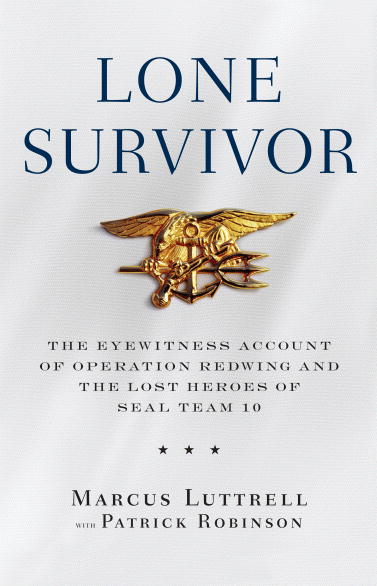
    I’m a sucker for military stories. I wanted to be an ARMY Ranger was I was in my teens. Wanted to go commando. Still regret it to this day that I didn’t. And so when a friend told me about Lone Survivor by Marcus Luttrell with Patrick Robinson, I had to read it.

    In June of 2005 four U.S. Navy SEALs took up a position on a godforsaken mountain in Afghanistan close to the Pakistan border. Their goal was to capture or kill a notorious Taliban/al Qaeda  leader whose small army had been ambushing and killing Marines. The problem was: three goat herders stumbled upon the SEALs not very long after they got into position.

    If the SEALs don’t kill the goat herders, they will almost assuredly alert the Taliban force. SEALs are the best. But four against two hundred doesn’t compute. If they do kill the goat herders, then they’re sure someone will find the bodies. The Taliban will claim US soldiers are killing innocent civilians.  And the US media will pick it up. The SEALs were sure they will end up being tried for murder. It wouldn’t be the first time.

    The SEALs let the goat herders go. Within hours the Taliban show up. Four SEALs. Two hundred plus Taliban armed with rifles and grenade launchers who have the high position on a mountain with plummeting slopes and very little cover.

    Lone Survivor tells the story of Marcus Luttrell, the leader of that SEAL team, his training as a SEAL and then that desperate fight in the mountains. He and the other three SEALs fought ferociously. He was the only one to survive.

    I had to force myself not to read this book in one sitting. Not only do you get a great story, but you also get insights into what makes a SEAL and their system of values. You’ll get to know a man who makes you want to stand up for God and country. And you’ll marvel at the courage of those who fight in our armed services.

    I loved this book. May God bless the men and women who risk life and limb for all the rest of us. For the rest of us, we can see what they face in this excellent first-hand account.

    Share

2 Comments

  1. The Barefoot Contessa cookbooks are good for their precise directions and yummy results. “Barefoot Contessa: At Home” and “Barefoot Contessa: Family Style” are two of her best. Try checking them out of the library if you’re gun-shy about dropping twenty to thirty bucks.

Comments are closed.