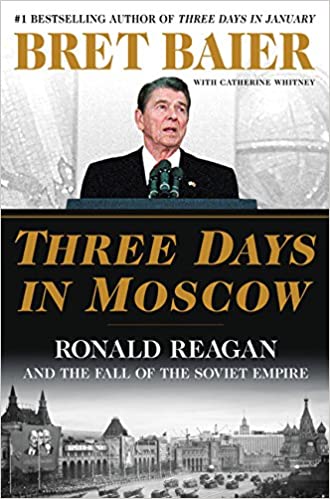
I just finished Three Days in Moscow: Ronald Reagan and the Fall of the Soviet Empire by Bret Baier. It’s a New York Times bestseller that takes you into the world of Ronald Reagan, his rise to power in politics, and his role in ending the Cold War. And it does in a personable way with gentle humor throughout.
I enjoyed the fascinating behind-the-scene insights about the personalities involved and the clarity about what really happened. And how the book brings Reagan to life, as if he’s almost there. Along the way you’ll also get insight into Mikhail Gorbachev, the assassination attempt on Reagan, and more.
Baier is the chief political anchor for Fox News. In 2001, he became the station’s chief Pentagon correspondent and ended up traveling to Afghanistan 11 times and Iraq 13 times. In 2007, he became the station’s chief correspondent to the White House. More importantly, Baier seems to be one of the few journalists these days who is simply trying to get and report facts instead of spin. And that’s exactly what he’s done here.
If you like biographies or history, if you want to know how the U.S.A. and the U.S.S.R. stepped back from decades of mutually assured destruction, if you want to get a view into how diplomacy is done, then I think you’ll love this book. And you’ll probably love it even more if you can listen to the audio book version, read by Baier himself, which also includes a recording of Reagan’s speech to the students at Moscow State University. I listened to it via the Overdrive account my public library provides. Baier’s reading was terrific.
If you want to understand the secret to Mormonism, something 99.9% of the world does not know, even though many think they do, read on.
This last Tuesday I was at dinner with a number of wonderful coworkers. We were talking about religion and listening to the guy who helps set up our training environments talk about the interesting hunting ministry he’s involved with (it’s very cool—12,000 acres of woodland in Alabama all dedicated to hunting, outdoor survival, and God).
At one point in the conversation, a delightful fellow trainer, who shared with us the night before the definition of diplomacy as being able to tell someone to go to hell and have them look forward to the trip, asked me, “Does your church believe in Christ. Or, no, is it some other fellow?”
It’s a great question, and I realized that many people are confused. And so I wanted to take time to clear it up.
So what the heck is a Mormon?
It’s not what you think.
And for those of you who think you know, nope, it’s not about that book.
Let me explain. You’ll come away knowing more about us than anyone in any of your circles, and you can lord your superior knowledge over them at dinner parties, when playing games that require vast stores of smarts, or at random moments, just because you can.
Here’s the deal. The first part of the name of the church is “The Church of Jesus Christ.” So, yes, we believe in Christ, that he died for us, was resurrected, is our Lord and god, etc.
The last part of the name is “of latter-day saints.” We don’t use “saint” to mean super-holy people like the Catholic church does, but more as followers or disciples. So you could translate the last part of the name of our church as “of latter-day followers.”
So the whole name would be The Church of Jesus Christ of Latter-day People who Follow Him.
Okay, then what’s the deal with the name “Mormon”?
Well, here’s where we get to the nub of it and the thing that 99.9% of the world doesn’t know. The key difference between the Mormon church and other Christian churches is that we believe that Jesus has called apostles again in our day, just like he did back in the good old days. And when I say apostles, I mean guys like Peter, James, John, Paul, etc.
You might be wondering what an apostle is. What made those guys special?
It wasn’t that they had great faith in Jesus. Lots of people had great faith. It was that they were called to bear special witness of him. And that special witness was not merely that they believed, but that they knew Jesus was the Messiah because they had seen and heard him after his resurrection.
Peter himself said it best when he wrote in his letter, “For we have not followed cunningly devised fables, when we made known unto you the power and coming of our Lord Jesus Christ, but were eyewitnesses of his majesty.”
When the apostles had to choose someone to replace Judas, Peter said, “Wherefore of these men which have accompanied us all the time that the Lord Jesus went in and out among us, beginning from the baptism of John unto that same day that he was taken up from us, one must be ordained to be a witness with us of his resurrection.”
These guys didn’t simply believe. They knew. They were eyewitnesses to the fact that Jesus wasn’t just some preacher—he was the son of God and was resurrected.
So Mormons believe that Jesus has called apostles again today who bear witness of an absolute certain knowledge of the reality of Jesus the Christ. We believe their purpose is also to be the Lord’s spokesmen when He wants to make general announcements or give general instructions. Finally, we also believe they’ve received the authority to offer the covenants the Lord wants to make with all of us.
We believe the first apostle called in these latter days was a fellow by the name of Joseph Smith. We don’t worship Smith. He was just an apostle. Just like Matthew or John of old were. But we do believe the Lord called him to be an apostle and restore some truths that had gotten lost or confused over the years.
We also believe the Lord asked him to bring forth other scriptures in addition to those in the Bible. One of these new scriptures was a translation of an ancient record called The Book of Mormon. It’s called that because Mormon is the name of the guy who wrote it. And Mormon was another apostle—one called by Jesus in ancient America.
And guess what the purpose of The Book of Mormon is? It’s to testify of Jesus Christ and explain his gospel.
So the name of the Mormon church is really The Church of Jesus Christ of Latter-day Saints. Mormons believe that Jesus has called and commissioned apostles in our times, right up to today, to bear special witness of him. And in addition to that, those apostles have brought forth additional scriptures that witness of the divinity and mission of Jesus Christ.
For Mormons, it’s all about Jesus Christ.
So when someone asks, what’s a Mormon? You can say, let me tell you the real answer. It’s not about an additional book of scripture. Yes, folks gave them the nickname of Mormons because of that book, but the key difference is that Mormons believe that Jesus has called apostles like Peter and Paul again in our day to be his spokesmen, and bear a certain witness of him and his good news, and help folks receive all the blessings the Lord wants to pour out on them.
And, O, what a wonderful message we Mormons believe that is.
It’s March. Spring is here in most places. And this is when the house hunting season starts to get rolling. I used to moonlight as a realtor. I started from nothing, ran my own little gig, and did very well. Then I got a book contract, and there was no way I could do three jobs. But I learned a lot.
One of the things I learned is that home buyers very frequently have a very hard time staying within their budget.
They set a number, start looking in their price range, then peek at the homes in a higher price range, and of course those homes look better. Why wouldn’t they? They’re more expensive! And, geez, they have such nice faucets and cool counters and a shower with five heads so you can wash your body from every imaginable angle, and suddenly many of my buyers would refuse to see cheaper homes. Because they just had to have the ultrawash shower.
Or a dent in a wall that’s officially called an alcove.
Or a super deluxe gas heater fireplace that runs on banana peelings and saves gerbils.
Or whatever.
It’s called house craze. It’s a temporary thing. It passes as soon as you get in the house and start making the payments.
And then you wake up and realize you have a hot tub and you hate hot tubs! What in the world were you thinking?!
Well, you had house craze.
The unfortunate side effect of buying too much house is that the mortgage eats up so much of the take-home pay that it makes everything else exceedingly tight. Or impossible.
You don’t have room to pay off debts. Don’t have room to invest much, or at all. Don’t have room to have fun vacations. Don’t have room for anything except the fricken-ricken, blankity-blank, #$%!* house!
This condition is called being house poor.
So house craze leads to being house poor.
Which leads to second jobs and stress and often more debt. You may also end up in a roadside ditch. The situation below occurs with more than just with cable companies.
The lender will tell you that you can lend up to 36% of your take-home pay!
Your eyes go wide, and you being to think that maybe you can afford two ultrawash showers. But just slow down and think for a second–the lender is the one SELLING you the loan.
Right…
Don’t listen to the lenders.
Listen to common sense.
My advice is the same as Dave Ramsey’s:
Don’t buy a house until you’re out of debt and have saved enough to pay 10% of the purchase price of the house.
When you’re at that point, get a 15-year, fixed-rate mortgage with a monthly payment that’s no more than 25% of your take-home pay.
So that’s my advice. You’re free to do with it what you wish. Just know that being house poor sucks.
And all that to introduce the calculator which will tell you exactly how much home you can afford. It takes 10 seconds to fill in.
During LTUE this year I sat down with John Goodwin, who manages the Writers and Illustrators of the Future contest, to chat about the contest, my win, and other writerly topics. I had a great time with John.
If you’re a new writer or illustrator working in the science fiction or fantasy genres, I strongly recommend you submit each quarter. There is no fee and the prize is generous. Best of all, it comes with a week long workshop with pros.
James Dawson, YA author, feels it’s somehow wrong to hold back on cussing in his fiction. He wrote an article about this in the UK Guardian called “Why Teens in Books Can’t Swear.” He thinks it’s unrealistic. He thinks it’s about gate-keeper censorship. You know, parents wanting to steer their children towards certain experiences and away from others.
People.
Dawson’s approach to the whole problem is wrong-headed. This isn’t about the virtues and vices of fiction. Or about gatekeepers, especially in today’s ebook world. Or what experiences parents want to provide their children. And it’s not about art reflecting reality. Reality includes trips to the toilet, and yet we somehow fail to include realistic bum wiping in so many of our tales. Good heavens, have we betrayed our artistic integrity? No. We’ve just naturally chosen to include things that appeal to us and leave out others that don’t. Every book is an exercise in hundreds of such choices.
The fact is that Dawson’s forgetting that a fundamental aspect of the book trade is the trade. The buyer trades his or her money for a product (the book) that provides a service (the entertainment, thrills, chills, etc. of the reading experience) he or she values. A customer preferring one kind of experience over another isn’t censorship (the horror, the horror). It’s choice.
As an author, you make your offer. If folks like it, they buy it. If not, they don’t. Nobody owes you a purchase.
This means that in any business, and selling fiction is a business, the most sensible way forward is to offer your intended buyers something they are likely to value. Something they’re going to like. Something they want. If your buyer is thirsty and wants water, offer him a cold glass of water, not a waffle iron. And if you can’t bear to develop anything but waffle irons, then, by all means, develop waffle irons. Just make sure you offer them to the folks looking for . . . waffle irons.
This business of making offers also means that we package our products and services so that customers can easily tell what’s in the box. You don’t want someone to purchase your box thinking it contains breakfast cereal when in reality it’s a bunch of bolts.
Yeah, writing is an art. But offering it in trade to others is also a basic economic act.