For those whole love ENDER’S GAME

Enders World Essays SmartPopThere’s a special joy in sharing a wonderful experience with someone else. There’s a delight in reliving the experience afterwards, in recalling key moments and quoting funny or cool lines. This is especially true of books. One of my favorite book experiences is Ender’s Game. Which is why I’m so happy to announce that Smart Pop is about to release a collection of articles written by folks sharing their experience with that book.

You get to hear from Eric James Stone about how the book should have ended. You get to hear from Matt Nix (creator and producer of Burn Notice) how the book was a guide to his life. You get to hear from Colonel Tom Ruby why he made the book mandatory reading for the Air Force’s Air Command and Staff College.

There are 11 other articles from Neal Shusterman, Captain John F. Schmitt U.S.M.C., Mary Robinette Kowal, Hilari Bell, Ken Scholes, Mette Ivie Harrison, and many others. There are Q&A sections. And there is Card’s own introduction in which he explains what Ender’s Game is really about for him. All of these articles are wonderful reads.

If you loved Ender’s Game like I did, you’re going to enjoy this book. You can get a free PDF excerpt from the book that includes a few of the Q&As from Card along with the full version of my essay “The Monster’s Heart.” To download the PDF, just scroll down to where it says “Sign Up for Free Chapters & Book Updates”: http://www.smartpopbooks.com/book/enders-world.


Share

Similar Posts

  • The Meth Epidemic, The Marines

    The Meth Epidemic

    Mamphetamine is the most addictive illegal drug in America. Unlike marijuana, cocaine, or heroin, all of which are synthesized from easy-to-obtain plant material (cannabis, cocoa leaf, opium poppy), meth requires ephedrine or pseudoephedrine, which are very complex to make and require a lot of know-how and high-tech processing. The only folks who have that ability are legitimate chemical factories. In fact, there are less than a dozen such factories around the world that produce these chemicals. Which means it should be easy to stop illegal use at the source.

    “Should” is the key word there.

    When you’re trying to halt drug trafficking, you can work two sides. There’s the demand side and the supply side.

    When you work on the demand side, you try to affect people’s desire and use.  For example, in the 1960’s the Federal Trade Commission, along with other government agencies and private groups, began a campaign against tobacco. Using government policy, public awareness, and education over the last forty years, these groups have significantly altered demand for tobacco in the United States. In 1963 more than half the nation smoked. 4,345 cigarettes were consumed per capita. But as these groups worked to affect demand, those numbers dropped steadily until by 2006 only 1,619 cigarettes were consumed per capita.

    That’s astounding, folks. A whole culture was changed.

    When you work on the supply side, you try to reduce the production and distribution of drugs. This can sometimes be almost impossible to do. For example, almost anyone can grow marijuana. And it takes very little knowledge to harvest and package the parts that are used.  Same with alcohol–home brewing has been practiced for ages. In both examples, the ingredients are easy to obtain and the processing is relatively simple and easy to hide.

    But there are some drugs that are very difficult to produce. The key ingredient for barbiturates is one. In the 1950’s and 1960’s barbiturate abuse was increasing. But the government instituted some regulations on the legitimate businesses that produced these ingredients, and it reduced the amount available on the streets until we very seldom hear of barbiturates being used these days.

    So where does meth fit in? Well, as I stated above, there are less than a dozen factories that create the key ingredients. Meth is a perfect candidate for supply side intervention. Unfortunately, regulation isn’t as easy as it may seem.

    PBS’s Frontline recently aired “The Meth Epidemic” which explains the history of meth in the United States and the battle raging over its cure. If you’ve ever wondered about what meth is and how it affects our nation, you’ll want to watch this. I think you’ll find it eye-opening and well worth your time. Watch it for free here: http://video.pbs.org/video/1933783731.  

    The Marines

    The US Marine Corps is a fascinating organization with special capabilities. With the exception of the Coast Guard, they are the smallest of the United States’ armed forces, although they’re still bigger than the entire British army. Part of what makes the Marines unique is that they have the ability to rapidly deploy an independent task force (infantry, air support, ships) to almost anywhere in the world within days. Because of this, they are usually the first boots on the ground in any engagement. They pave the way and the Army and other branches follow to provide overwhelming and continuous force.

    But the differences include more than their mission. The Marine Corps emphasizes authority and responsibility downward to a greater degree than the other military services. It members are, on average, younger. And its creed “Every Marine’s a Rifleman” has special implications for its commanders and troops.

    In order to do some research for a novel I’m writing, I’ve been watching a lot of documentaries about special operations forces and the Marines. One of the best introductions to the Marines I’ve come across is the 2007 PBS documentary called The Marines. It examines what it takes to become a Marine and what it truly means to be one, outlining the rigorous training process that each recruit must endure to become a commissioned officer. I found it fascinating.

    If you have ever been curious what makes the Marines different from the other branches of the military and what it takes to become one, you’ll want to watch this film. I couldn’t find it on the PBS site, but you can find it split into 10 parts at YouTube.com. Just go to site and search for “pbs the marines”.

    Share
  • Good Stuff: For All Eternity

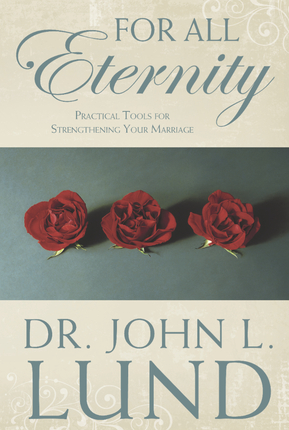
    This year I was introduced to a little gem of a book that has had a significant and pleasant impact on Nellie’s and my marriage.

    We heard about it from my newlywed daughter and her husband. Now you’d think that two people who, in just a few months, will have been married for twenty-nine years would know all the ropes of this marriage thing. You’d think they wouldn’t come across any real new ideas. But this little book proved that idea wrong.

    This book is For All Eternity by Dr. John L. Lund. At the time of its writing Lund had over forty years of experience as a counselor, college professor, and marriage educator. His focus is in interpersonal communication, and part of his background was working with John Gottman, one of the best marriage researchers of the last few decades.

    In this book, Lund shares what he’s learned with lots of humor and stories. Some of it will be familiar to you, but some of it will be refreshing and new. For example, one belief we frequently cherish is the idea that if someone really loves us, they will know our wants and needs. Their love will somehow endow them with superpowers so that we will never have to communicate our wants. Our loving spouses, if they have any love in them, will be able to discern our wants from the most subtle signs. A nod, a sigh, the wiggle of a nose. And if that doesn’t do it, then surely we will never need to drop more than the merest hint.

    Yeah, wrong.

    Lund explains why the whole notion of “If you have to ask, it doesn’t count” is not only unrealistic, it’s damaging. And that’s just one insight. There are many more. I will let you discover them. But I can tell you that I have found this book so useful and delightful that it will now be one of the two standard books I buy and give as gifts to those who are newly married. I wish I’d had these insights right from the beginning, but better late than never. I’m so happy to have them now.

    A little note. For those who are not members of the Mormon church, Lund is directing his teaching at that crowd. So you will find a sprinkling of quotes in here from church leaders that support what he’s learned in his practice and research. Don’t let that stop you. Mormon or non-Mormon, if you want to improve your marriage, you don’t want to miss this book.

    Share
  • Good Stuff: Books Worth Multiple Readings Part 2

    What’s your typical response when someone shares a frustration, problem, or issue with you? Or when they state an opinion or desire you disagree with?

    Sometimes we get impatient, exasperated, or annoyed with them and simply don’t want to hear it.

    Sometimes we get mad. Or defensive. And want to line them out.

    Sometimes, however, we want to help.

    And wouldn’t you know it, but we sometimes cause as many problems with that last reaction as the first two.

    How can this be?

    Your teenage daughter comes home and expresses disappointment about something that happened at school, and you want to help. How in the world could that be wrong?

    Your spouse shares a frustration about something that happened with a friend, and you don’t want him or her to be sad. This is a bad thing?

    Your coworker expresses annoyance with a program management is trying to implement, and you know exactly what will fix the problem and want to share it. This is going to cause problems?

    In their fabulous book, I Don’t Have to Make Everything All Better: Six Practical Principles that Empower Others to Solve Their Own Problems While Enriching Your Relationships, Gary and Joy Lundberg show two different ways of acting on the desire to help others that have dramatically different results. If we try to help using the first method, we actually create more issues. We will make the person less willing to talk to us, introduce strain into the relationship, and create a lot of stress for ourselves. On the other hand, if we try to help using the second method, we’ll find the person more willing to talk. There will be more friendliness in the relationship. And our own stress will go way down. Furthermore, we’ll end up helping the person far more than we ever could with the first method.
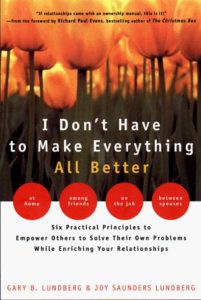
    Gary is a licensed marriage and family therapist. His wife Joy is a writer and lyricist, and they have held marriage retreats, firesides, and seminars throughout the country. And the six principles they share in the book for using the second method all revolve around accepting this one statement: “I do not have the power to make anything all better for anyone else. I can offer my help, but I cannot make it all better.”

    Accepting this view has a dramatic impact on how we approach helping others.

    So when the teenage daughter comes in and expresses disappointment, instead of trying get her to buck up or tell her she just needs to do xyz with her friends, or do 123 in sports practice, we listen, validate her emotions, leave the responsibility for the problem where it belongs—with her!—and then, when it’s all out, offer to help in a way that empowers her, not have us take over.

    When the spouse shares frustration, it’s the same. When the coworker expresses annoyance, the same. When someone comes in to complain to us, it’s the same.

    What the Lungbergs do in this book is show exactly what this looks like with tons and tons of examples. They even have a whole chapter (a short one) which gives a list of validating phrases and questions. The first six chapters of the book explain the principles. The last eight each apply them to a different group: young children, teenagers, adult children, spouses, parents and parents-in-law, friends, and coworkers.

    Folks, this book is a gem. It’s loaded with wisdom and insight. Every time I practice what’s in here, my interactions go better. This stuff produces immediate results. I just wished I’d studied and practiced it more. But it’s never too late. And that’s why I’m rereading it now.

    And why I wanted to share it here. If you want to improve your interactions with others and enrich your relationships, do yourself a favor and immediately go get this book.

    Share
  • “Wally” by Aslyn

    My daughter was playing this song on her internet list. The tune and singer’s voice grabbed me. I downloaded it based on that. Then I really listened.

    Oh, man.

    I cannot tell you how much I love this song. I love the melody and phrasing, Aslyn’s voice. I love the lyrics. I love the true story behind them. Gracious Lord, this is what it’s all about.

    This youtube is of a live performance. She gives a great into to the song. She tells how her grandfather Wally, who was in the Coast Guard when he young, met his wife Fae. They were married for 55 years. Then Aslyn tells how she found Wally, a few days after Grandma Fae died, sitting in his rocking chair holding a black and white picture of his wife, his eyes wet with tears. Fae had written on the picture: “to sweetest boy I’ve ever known.” You gotta listen to that intro. Then you have to get the Lemon Love album version of the song. It’s 99 cents on Amazon.

    Here are the lyrics. I’ve added the little spoken part you get on the Lemon Love version that’s not in the live performance.

    “Wally”

    [Aslyn’s grandfather]

    Hello, I’m Wally. I’m the man that had the good fortune of one day of finding a companion that would live with me for more than 55 years. No man could have ever asked for a better wife, or better friend, than the one I found across the dance floor at the USO.

    [Song begins]  

    Dear Wally, I’m writing this letter sincerely.
    To tell you you’re the “sweetest boy I’ve ever known.”
    Remember that USO when we met.
    You almost didnt go.
    Well, me and your two sons are very glad you did.
    Cause when your eyes found me I could hardly breathe.
    I wanted you.
    Glad you wanted me.

    I never stopped falling in love with you, Wally.
    From the first day I saw you
    I was sailor-bound, I just knew.
    You had me, I was yours.
    We danced out on the floor.
    And with each passing day.
    I only loved you more.

    That night was pure magic.
    Who would have imagined.
    It would become 55 loving wonderful years.
    Your job was not all easy.
    Those last years I could hardly speak.
    But when I looked at you I knew nothing had changed.
    And when I was leaving.
    I could feel you hurting.
    But then I saw those angels and I knew your love would want this for me.

    I never stopped falling in love with you, Wally.
    From the first day I saw you
    I was sailor-bound, I just knew.
    You had me, I was yours.
    We danced out on the floor.
    And with each passing day.
    I only loved you more…more… more…more… more

    So while you’re waiting
    Know that I’m saying I love you
    I love you………

    I never stopped falling in love with you, Wally.
    From the first day I saw you
    I was sailor-bound, I just knew.
    You had me, I was yours.
    We danced out on the floor.
    And with each passing day.
    I only loved you

    You had me, I was yours.
    We danced out on the floor.
    And with each passing day.
    I only loved you more..

    Dear Wally…

    Share
  • You thought Bad Penny was fiction?

    How about former CIA operatives and Navy Seals forming a private group to rescue child slaves?

    Last January, Ballard made a bold move and left his job to form his own team of former CIA operatives and Navy Seals who operate undercover to bust child slavery rings

    . . . . .

    Ballard’s organization is called Operation Underground Railroad, and members call themselves abolitionists. The references to 19th-century slave liberation are deliberate.

    There are currently 25 million people living in slavery, according to the 2014 Global Slavery Index research released by anti-trafficking organization Walk Free Foundation. The U.S. State Department puts the figure closer to 21 million, and about two million of those slaves are children.

    Ballard’s line of work has opened his eyes to a problem most people are blind to — the fact that there are more people living in slavery now than at the height of the trans-Atlantic slave trade.

    . . . . .

    Ballard knows better than anyone just how easy it is to buy a child. In an operation in Haiti earlier this year, he posed as a trafficker and visited an orphanage where two children — a brother and sister ages 2 and 3 — were sold to him for $15,000 apiece.

    That’s the going rate for a child, says Ballard, and over time, the owner can make millions of dollars by selling the child for sex or forced labor.

    Read the rest at Heroes of 2014. Become an abolitionist here.

    Then go on to read about another hero–the Iron Angel–who is helping folks out of another kind of slavery.

    Then a third called the Vicar of Bagdad, who has had over 1,000 of his flock killed for their beliefs.

    Here’s the full list of the six featured heroes.

    Share
  • Awakening by Christy Dorrity

    Art is a huge part of what draws me to science fiction and fantasy. I still have the Hildebrant LOTR calendars I got back in the early eighties.

    On the web you can browse awesome work on DeviantArt.com and CGHub.com. But something that’s been around for much longer is Spectrum: The Best in Contemporary Fantastic Art. It’s an art annual released each year that highlights the best art produced that year in Fantasy, Science Fiction, Horror, and the Surreal.

    This year will mark the 21st year of publication.  Spectrum has become the broadest distributed art annual in the world. Having art included in Spectrum is top honors for artists around the globe.

    So why am I telling you this?

    Well, Devon Dorrity, the guy who helped me pull together my covers,  not only had his sculpture “Queen of the Seas” included in a past annual, but he’s just won a spot in this year’s annual with the cover he created for his wife’s book, Awakening. It’s a big honor.

    Here’s the description of how he put it together.

    For the book cover for Awakening by Christy Dorrity, Devon Dorrity selected the cover model, Shelbilee Lee, from hundreds of local models.  Jason Morrison, a photographer friend, was hired to do the photoshoot.  Devon purchased the wig, fingernails, and props from Amazon. Then Dennis Dorrity, Devon’s brother, did an illustration of the photo selected from the photoshoot.  Devon then composited the illustration and the photo together blending the two to emphasize the best of both pieces.  After applying various effects and custom color, the piece was finished.

    After the book’s publication, Devon submitted the cover to Spectrum with Dennis Dorrity listed as the Artist.  Dennis did the illustration that plays such a heavy role in the finished piece.  Devon was listed as the Art Director/Designer.  Spectrum announced in the end of March that the Awakening book cover was selected for inclusion in The annual.  Spectrum 21 will be released in November 2014.

    Awakening: Book One of The Geis is itself a clean young adult fantasy filled with Celtic mythology, magic, romance, and mystery. And it’s been getting great reviews.

    “Dorrity invites her readers to a céilí that will quicken the pulse of anyone with Ireland in their blood! AWAKENING will draw you deep into the mysteries of the Celtic worldview—and leave you wanting more of McKayla and her fascinating Aunt Avril!”
    – KERSTEN HAMILTON, author of Tyger Tyger and the Goblin Wars books

    “I thoroughly enjoyed AWAKENING, a captivating and unique debut novel that creatively integrates Irish dance.”
    – CHRIS NAISH, Riverdance member and Creative Director of Fusion Fighters Irish dancers.

    5 Stars! “AWAKENING is an exciting mashup of fantasy, action-adventure, and mystery, with a touch of romance thrown in for good measure.”
    – KATE MCCURRY, top 100 Amazon reviewer

    How many authors do you know who have unlocked the achievement of having someone from Riverdance plug your book? Awakening right now is free. If you like YA fantasy with a bit of romance, this is the perfect time to give this new author a go.

    Share