Good Stuff: For All Eternity

This year I was introduced to a little gem of a book that has had a significant and pleasant impact on Nellie’s and my marriage.

We heard about it from my newlywed daughter and her husband. Now you’d think that two people who, in just a few months, will have been married for twenty-nine years would know all the ropes of this marriage thing. You’d think they wouldn’t come across any real new ideas. But this little book proved that idea wrong.

This book is For All Eternity by Dr. John L. Lund. At the time of its writing Lund had over forty years of experience as a counselor, college professor, and marriage educator. His focus is in interpersonal communication, and part of his background was working with John Gottman, one of the best marriage researchers of the last few decades.

In this book, Lund shares what he’s learned with lots of humor and stories. Some of it will be familiar to you, but some of it will be refreshing and new. For example, one belief we frequently cherish is the idea that if someone really loves us, they will know our wants and needs. Their love will somehow endow them with superpowers so that we will never have to communicate our wants. Our loving spouses, if they have any love in them, will be able to discern our wants from the most subtle signs. A nod, a sigh, the wiggle of a nose. And if that doesn’t do it, then surely we will never need to drop more than the merest hint.

Yeah, wrong.

Lund explains why the whole notion of “If you have to ask, it doesn’t count” is not only unrealistic, it’s damaging. And that’s just one insight. There are many more. I will let you discover them. But I can tell you that I have found this book so useful and delightful that it will now be one of the two standard books I buy and give as gifts to those who are newly married. I wish I’d had these insights right from the beginning, but better late than never. I’m so happy to have them now.

A little note. For those who are not members of the Mormon church, Lund is directing his teaching at that crowd. So you will find a sprinkling of quotes in here from church leaders that support what he’s learned in his practice and research. Don’t let that stop you. Mormon or non-Mormon, if you want to improve your marriage, you don’t want to miss this book.

Share

Similar Posts

  • For those whole love ENDER’S GAME

    Enders World Essays SmartPopThere’s a special joy in sharing a wonderful experience with someone else. There’s a delight in reliving the experience afterwards, in recalling key moments and quoting funny or cool lines. This is especially true of books. One of my favorite book experiences is Ender’s Game. Which is why I’m so happy to announce that Smart Pop is about to release a collection of articles written by folks sharing their experience with that book.

    You get to hear from Eric James Stone about how the book should have ended. You get to hear from Matt Nix (creator and producer of Burn Notice) how the book was a guide to his life. You get to hear from Colonel Tom Ruby why he made the book mandatory reading for the Air Force’s Air Command and Staff College.

    There are 11 other articles from Neal Shusterman, Captain John F. Schmitt U.S.M.C., Mary Robinette Kowal, Hilari Bell, Ken Scholes, Mette Ivie Harrison, and many others. There are Q&A sections. And there is Card’s own introduction in which he explains what Ender’s Game is really about for him. All of these articles are wonderful reads.

    If you loved Ender’s Game like I did, you’re going to enjoy this book. You can get a free PDF excerpt from the book that includes a few of the Q&As from Card along with the full version of my essay “The Monster’s Heart.” To download the PDF, just scroll down to where it says “Sign Up for Free Chapters & Book Updates”: http://www.smartpopbooks.com/book/enders-world.


    Share
  • Good Stuff! Mitty, Non-Stop, and The Winter Soldier

    the-secret-life-of-walter-mitty-poster-bigThe previews for The Secret Life of Walter Mitty didn’t look interesting at all. Furthermore, I’m not the biggest Ben Stiller fan. He’s a fine actor; I just haven’t been in the audience for a lot of his movies. Then someone I know recommended the film, and I decided to give it a go with Nellie.

    We didn’t have high hopes. I mean, look at the movie poster. Does that get you excited? She thought it was going to be dumb. I thought it was going to be dumb. But after five minutes, we found ourselves enjoying the characters and story. We finished it, both of us absolutely delighted. I liked it so much I corralled my two daughters into watching it with me. Then I watched it again. I think I watched it four times total. And I enjoyed it as much, maybe more, each time.

    Walter is a great guy who has had to play it safe and practical his whole life. When his and his co-worker’s jobs are threatened, he takes action and finds himself on a journey that starts in, ta-dum, Greenland. The movie’s got adventure, a slow-burn romance, and a cast of funny and quirky characters. But it isn’t mad-cap humor. It’s not a gushing love story. It’s something else. Something that left me feeling like my life had been leavened with a fine light joy. Give it a shot; I think you’ll be glad you did.

    * * *

    non-stop-movie-posterThe previews for Non-Stop with Liam Neeson and Julianne Moore looked great. I’m happy to report that it was every bit as good as the previews promised.

    Neeson plays a federal air marshal. While on a flight from New York to London, he gets a text telling him that unless 150 million dollars is transferred to an offshore account, someone will die every 20 minutes. But it’s not so easy finding the killer. The deaths are almost inexplicable. And things soon start to spin out of control.

    This movie is filled with surprises and suspense. And it moves. Thrillers normally move quickly, but this one was on turbo. But that doesn’t mean the story was a bunch of light and noise. Quite the contrary. The writers skillfully balance the mystery, action, suspense, and even the character backstories. A lot of folks liked Taken. I liked this better than that film. In fact, it’s one of the better thrillers I’ve seen these last few years.

    * * *

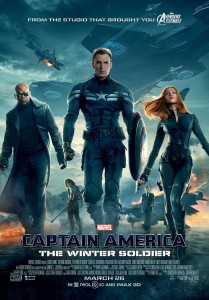
    winter-soldier-poster-no-maskI’m a superhero lover, have been since I was a kid watching the Superfriends cartoon every Saturday morning. But I never know if I’m going to enjoy a superhero movie. I love the genre, but for some reason so many of the films go for effect over story. It drives me nuts. The movie ends, the lights turn on, and I sit in my seat and go “huh.” So I’m happy to report that Captain America: The Winter Soldier actually delivers.

    I cannot say the same for Captain America: The First Avenger, the first in this series. That movie fell apart halfway through the film. The beginning was this wonderful story about a runt trying to do his duty and volunteer. The second half lost all its heart and turned into one big yawn. So for those of you who didn’t like that first film, know that this is a case of the sequel being far better than the original.

    In this one, SHIELD, the organization that directs the Avengers, comes under attack from within. Captain America and Black Widow have to uncover who is behind it and stop them before it’s too late. There are a lot of cool visuals and awesome action scenes. For example, I loved how Captain America “parachutes” into the opening mission. I enjoyed watching him and Black Widow fight in their distinctive ways. But the film didn’t focus on the tech or the super powers. It focused on the characters and the story. The plot includes a number of delicious surprises and reveals. There are funny moments and some poignant ones. And not only did this movie, unlike the first one, develop a single story all the way through, but it also echoes with our current search for national security.

    If you liked Iron Man and Iron Man 3, I think you’ll enjoy Captain America: The Winter Soldier.

    Share
  • Good Stuff! The Highwayman by Alfred Noyes

    Alfred Noyes (1880-1958) wrote poetry that thundered and sang. It’s the kind of stuff that begs to be read aloud. And I want to share with you one of my favorites–“The Highwayman.” I love it for the sound, the story, and the awesome images (note all the color).

    All you need to know is that back in the 1600s and 1700s, a highwayman was a robber, often on horseback, who held up travelers. And that when it mentions “priming,” it’s talking about the charge of powder used to ignite a musket.

    For maximum pleasure, let me suggest you start Loreena McKennitt’s killer ballad version I’ve embedded at the end, then scroll back up and read along as she sings.

    THE HIGHWAYMAN
    By Alfred Noyes

    The wind was a torrent of darkness among the gusty trees.
    The moon was a ghostly galleon tossed upon cloudy seas.
    The road was a ribbon of moonlight over the purple moor,
    And the highwayman came riding—
    Riding—riding—
    The highwayman came riding, up to the old inn-door.

    He’d a French cocked-hat on his forehead, a bunch of lace at his chin,
    A coat of the claret velvet, and breeches of brown doe-skin.
    They fitted with never a wrinkle. His boots were up to the thigh.
    And he rode with a jewelled twinkle,
    His pistol butts a-twinkle,
    His rapier hilt a-twinkle, under the jewelled sky.

    Over the cobbles he clattered and clashed in the dark inn-yard.
    He tapped with his whip on the shutters, but all was locked and barred.
    He whistled a tune to the window, and who should be waiting there
    But the landlord’s black-eyed daughter,
    Bess, the landlord’s daughter,
    Plaiting a dark red love-knot into her long black hair.
    And dark in the dark old inn-yard a stable-wicket creaked
    Where Tim the ostler listened. His face was white and peaked.
    His eyes were hollows of madness, his hair like mouldy hay,
    But he loved the landlord’s daughter,
    The landlord’s red-lipped daughter.
    Dumb as a dog he listened, and he heard the robber say—

    “One kiss, my bonny sweetheart, I’m after a prize to-night,
    But I shall be back with the yellow gold before the morning light;
    Yet, if they press me sharply, and harry me through the day,
    Then look for me by moonlight,
    Watch for me by moonlight,
    I’ll come to thee by moonlight, though hell should bar the way.”

    He rose upright in the stirrups. He scarce could reach her hand,
    But she loosened her hair in the casement. His face burnt like a brand
    As the black cascade of perfume came tumbling over his breast;
    And he kissed its waves in the moonlight,
    (O, sweet black waves in the moonlight!)
    Then he tugged at his rein in the moonlight, and galloped away to the west.

    He did not come in the dawning. He did not come at noon;
    And out of the tawny sunset, before the rise of the moon,
    When the road was a gypsy’s ribbon, looping the purple moor,
    A red-coat troop came marching—
    Marching—marching—
    King George’s men came marching, up to the old inn-door.

    They said no word to the landlord. They drank his ale instead.
    But they gagged his daughter, and bound her, to the foot of her narrow bed.
    Two of them knelt at her casement, with muskets at their side!
    There was death at every window;
    And hell at one dark window;
    For Bess could see, through her casement, the road that he would ride.

    They had tied her up to attention, with many a sniggering jest.
    They had bound a musket beside her, with the muzzle beneath her breast!
    “Now, keep good watch!” and they kissed her. She heard the doomed man say—
    Look for me by moonlight;
    Watch for me by moonlight;
    I’ll come to thee by moonlight, though hell should bar the way!

    She twisted her hands behind her; but all the knots held good!
    She writhed her hands till her fingers were wet with sweat or blood!
    They stretched and strained in the darkness, and the hours crawled by like years
    Till, now, on the stroke of midnight,
    Cold, on the stroke of midnight,
    The tip of one finger touched it! The trigger at least was hers!

    The tip of one finger touched it. She strove no more for the rest.
    Up, she stood up to attention, with the muzzle beneath her breast.
    She would not risk their hearing; she would not strive again;
    For the road lay bare in the moonlight;
    Blank and bare in the moonlight;
    And the blood of her veins, in the moonlight, throbbed to her love’s refrain.

    Tlot-tlot; tlot-tlot! Had they heard it? The horsehoofs ringing clear;
    Tlot-tlot; tlot-tlot, in the distance? Were they deaf that they did not hear?
    Down the ribbon of moonlight, over the brow of the hill,
    The highwayman came riding—
    Riding—riding—
    The red coats looked to their priming! She stood up, straight and still.

    Tlot-tlot, in the frosty silence! Tlot-tlot, in the echoing night!
    Nearer he came and nearer. Her face was like a light.
    Her eyes grew wide for a moment; she drew one last deep breath,
    Then her finger moved in the moonlight,
    Her musket shattered the moonlight,
    Shattered her breast in the moonlight and warned him—with her death.

    He turned. He spurred to the west; he did not know who stood
    Bowed, with her head o’er the musket, drenched with her own blood!
    Not till the dawn he heard it, and his face grew grey to hear
    How Bess, the landlord’s daughter,
    The landlord’s black-eyed daughter,
    Had watched for her love in the moonlight, and died in the darkness there.

    Back, he spurred like a madman, shouting a curse to the sky,
    With the white road smoking behind him and his rapier brandished high.
    Blood red were his spurs in the golden noon; wine-red was his velvet coat;
    When they shot him down on the highway,
    Down like a dog on the highway,
    And he lay in his blood on the highway, with a bunch of lace at his throat.

    . . .

    And still of a winter’s night, they say, when the wind is in the trees,
    When the moon is a ghostly galleon tossed upon cloudy seas,
    When the road is a ribbon of moonlight over the purple moor,
    A highwayman comes riding—
    Riding—riding—
    A highwayman comes riding, up to the old inn-door.

    Over the cobbles he clatters and clangs in the dark inn-yard.
    He taps with his whip on the shutters, but all is locked and barred.
    He whistles a tune to the window, and who should be waiting there
    But the landlord’s black-eyed daughter,
    Bess, the landlord’s daughter,
    Plaiting a dark red love-knot into her long black hair.
     

    Share
  • The Meth Epidemic, The Marines

    The Meth Epidemic

    Mamphetamine is the most addictive illegal drug in America. Unlike marijuana, cocaine, or heroin, all of which are synthesized from easy-to-obtain plant material (cannabis, cocoa leaf, opium poppy), meth requires ephedrine or pseudoephedrine, which are very complex to make and require a lot of know-how and high-tech processing. The only folks who have that ability are legitimate chemical factories. In fact, there are less than a dozen such factories around the world that produce these chemicals. Which means it should be easy to stop illegal use at the source.

    “Should” is the key word there.

    When you’re trying to halt drug trafficking, you can work two sides. There’s the demand side and the supply side.

    When you work on the demand side, you try to affect people’s desire and use.  For example, in the 1960’s the Federal Trade Commission, along with other government agencies and private groups, began a campaign against tobacco. Using government policy, public awareness, and education over the last forty years, these groups have significantly altered demand for tobacco in the United States. In 1963 more than half the nation smoked. 4,345 cigarettes were consumed per capita. But as these groups worked to affect demand, those numbers dropped steadily until by 2006 only 1,619 cigarettes were consumed per capita.

    That’s astounding, folks. A whole culture was changed.

    When you work on the supply side, you try to reduce the production and distribution of drugs. This can sometimes be almost impossible to do. For example, almost anyone can grow marijuana. And it takes very little knowledge to harvest and package the parts that are used.  Same with alcohol–home brewing has been practiced for ages. In both examples, the ingredients are easy to obtain and the processing is relatively simple and easy to hide.

    But there are some drugs that are very difficult to produce. The key ingredient for barbiturates is one. In the 1950’s and 1960’s barbiturate abuse was increasing. But the government instituted some regulations on the legitimate businesses that produced these ingredients, and it reduced the amount available on the streets until we very seldom hear of barbiturates being used these days.

    So where does meth fit in? Well, as I stated above, there are less than a dozen factories that create the key ingredients. Meth is a perfect candidate for supply side intervention. Unfortunately, regulation isn’t as easy as it may seem.

    PBS’s Frontline recently aired “The Meth Epidemic” which explains the history of meth in the United States and the battle raging over its cure. If you’ve ever wondered about what meth is and how it affects our nation, you’ll want to watch this. I think you’ll find it eye-opening and well worth your time. Watch it for free here: http://video.pbs.org/video/1933783731.  

    The Marines

    The US Marine Corps is a fascinating organization with special capabilities. With the exception of the Coast Guard, they are the smallest of the United States’ armed forces, although they’re still bigger than the entire British army. Part of what makes the Marines unique is that they have the ability to rapidly deploy an independent task force (infantry, air support, ships) to almost anywhere in the world within days. Because of this, they are usually the first boots on the ground in any engagement. They pave the way and the Army and other branches follow to provide overwhelming and continuous force.

    But the differences include more than their mission. The Marine Corps emphasizes authority and responsibility downward to a greater degree than the other military services. It members are, on average, younger. And its creed “Every Marine’s a Rifleman” has special implications for its commanders and troops.

    In order to do some research for a novel I’m writing, I’ve been watching a lot of documentaries about special operations forces and the Marines. One of the best introductions to the Marines I’ve come across is the 2007 PBS documentary called The Marines. It examines what it takes to become a Marine and what it truly means to be one, outlining the rigorous training process that each recruit must endure to become a commissioned officer. I found it fascinating.

    If you have ever been curious what makes the Marines different from the other branches of the military and what it takes to become one, you’ll want to watch this film. I couldn’t find it on the PBS site, but you can find it split into 10 parts at YouTube.com. Just go to site and search for “pbs the marines”.

    Share
  • Peak

    peakbyandersericssonHow many pushups can you do in a row?

    10, 20? Could you do 100?

    And you’d have to be a freak if you could do 500 in a row, right?

    Well, no.

    You’d just be human.

    In 1980 Minoru Yoshida of Japan did 10,057 pushups nonstop.

    In 1993 Charles Servizio of the good old USA did 46,001 pushups in 21 hours and 21 minutes.

    In 2016 David Escojido of the USA did 2,298 pushup in 1 hour.

    You might think that these folks must be oddities. They must be gifted. They must have some weird thing in their DNA allowing them to do these things.

    But you’d be wrong.

    None of these people were born that way. In fact, what researchers are finding is that most of the folks that we think are prodigies—folks like Mozart, Tiger Woods, chess masters who can play 20 games at once without even looking at a board—the biggest thing that separates them from the rest of us isn’t DNA.

    Anders Ericsson, a researcher at Florida State University, has spent the last 30 years studying what gives experts their edge. And he reveals in Peak: The New Science of Expertise that he and other researchers have found that while there are some physical traits like height and size that definitely make a difference in some physical activities (notice how all the top gymnasts are short), what really sets people apart is how much of a certain type of practice they’ve done.

    Not just practice, but a certain type of practice.

    Practicing “hard” doesn’t do much for you. Putting in a lot of hours doesn’t do much either. Instead, you need to practice in a way that has been shown to lead people to actually improve their performance. You still have to put in a lot of time practicing—there is no shortcut—but only the type of practice he explains in the book seems to lead to the increase of performance.

    Is he saying that anyone can do anything?

    No. When I first looked into his research, one of my big issues was that it seemed he was claiming anyone could do anything with 10,000 hours of practice.
    But he’s not saying that.

    Is he saying genetics has no influence?

    It can, but what he’s found is that it doesn’t have the role we normally think of when we think of top performance. And, most importantly, we place artificial limits on ourselves by thinking people are born to this or that activity.

    There is far too much to post here. What you need to know is that what he shares in this book is fascinating, compelling, and surprising. I’ve been training people for over thirty years. And I found myself enlightened. If you’re at all interested in education, or getting better at some activity (from parenting to golf), or helping your kids get better, you’ll want to read this book. Highly recommended.

    Share
  • Good Stuff! Extinct, RadioWest, and Ruca’s

    I’ve been looking forward to watching Extinct, a brand-new TV series. I watched the pilot with my wife and teenage daughter, and we enjoyed it. I watched the next episode, and then a few days later couldn’t help but binge-watch three more. And I’m happy to report it’s full of good stuff and interesting stories.

    First of all, it starts with a killer concept. Aliens invade earth and wipe us out, but that’s been done to death. This story doesn’t start there. This story is set four hundred years in the future after the extinction of the human race, when a small group of humans is revived by an alien civilization.

    But this isn’t Star Wars, Star Trek, Blade Runner, Battlestar Glactica or anything like that. It feels more like the TV series Lost or The Maze Runner. The heroes are three humans who have been brought back and are trying to figure out what’s happening and how to survive in a place that’s low tech and is the home to a dangerous band of other humans that were also brought back. They’re dangerous, by the way, because they have been taken over by spores that latch other their nervous system and use their bodies as a host.

    This series transports you to a world of cool tech and alien stuff like the sparks that regenerate the humans in pools of water, two interesting drones, and alien ruins and glyphs. But the best part about this isn’t the spectacle of the technology. It’s the stories. There’s suspense and action, but also mystery and a lot of stuff that’s human and warm and, surprisingly enough, thought-provoking.

    We try to hold a family night once a week to have fun together and discuss important topics. And I can see us easily watching one of these episodes and finding ourselves in a deep discussion about free will, or the creation, or whether Duncan, one of the skin riders, looks like someone right out of The Hobbit.

    I liked episodes one and two, but it was episode three that kicked it into high gear for me. If you liked Lost or The Maze Runner or the series Once Upon a Time, I think you’ll really enjoy this. Right now you can stream the first eight episodes for free from byutv.org/extinct or extinct.tv.

    EDIT: I just finished episode 8. I really like this series.

    #

    Do you like listening to interesting ideas? If so, you will love tuning into RadioWest. It’s a daily program from KUER in Salt Lake City that features hour-long interviews of folks who are experts on some of the most interesting things or have an interesting story to tell.

    Doug Fabrizio is the host and has to be the best interviewer on the planet. I love his voice, but it’s his skill in drawing out the fascinating meat of the topic from his guests is what sets him apart. And unlike some interviewers who don’t even read the books they’re talking about, you can see that Fabrizio has done his homework. He’s really thought about what they have to say.

    For example, just this last week, I got to listen to compelling interviews of (1) Tom Christofferson, the gay brother of Elder Todd Christofferson, a Mormon apostle, (2) Ben Shapiro, an orthodox Jew who is an up and coming voice on the Right and was recently protested at Berkeley and the University of Utah, and (3) science writer Ben Mezrich who has written a book about the scientists and researchers who are trying to bring back the wooly mammoth.

    Week after week, Fabrizio brings amazing people and ideas into my car and home. You can listen to his interviews every morning at 11 a.m. and 8 p.m. on the radio at FM 90.1 (Salt Lake Area), FM 90.5 (Logan and Bear Lake), and FM 88.3 (Randolph and Woodruff). Or you can listen live online at radiowest.kuer.org, which is also where they keep all the recordings so you can catch up on any you miss.

    #

    New restaurants come and go all the time in Garden City, Utah. Most of them don’t last more than a few seasons. Often this is because they charge lots of money for food that’s really not worth it. So it’s with great delight that I tell you about Ruca’s, a little spot on the block between the city park and Bear Lake Pizza on the main drag.

    Not only are the prices reasonable, but the food is delicious. They have sandwiches and other stuff, but we have gone back multiple times for their ebleskivers (AY-bill SKEE-vurs). These are Danish pancakes in the shape of a ball that can be filled with all sorts of stuff. My wife and daughter love the ones filled with peaches and the others filled with Nutella and strawberries. I like the savory ones filled with bacon and cheese with eggs on top.

    They’re going to be closing up for the winter, so if you want some great food for a great price, get over there now and enjoy a new delight.

    Share

2 Comments

  1. Thanks for the reveal re this book, John.

    I’ve been married 33 years -and can attest that there are no 100% useful superpowers. Its all about a willingness to continue to learn, to accept, and to admit ones own “gotchas”.

    So your brief review struck a chord -and stimulated my interest. I’ll check it out.

Comments are closed.