Folks. I have 2 mp3 files. One for Story Turns. One for Vivid & Clear. They are each about 48mb in size. But I don’t have the time to figure out how to make them available to you.
But I know someone out there does have the skillz to mash the slides with the audio in a short period of time and make it available. Maybe create something to upload to YouTube.
So if you have been waiting for this and would like to offer your services, I’d be happy to throw in a free copy of the ebook edition of Bad Penny and Servant for your efforts. It would in no way cover your time, but it’s better than a poke in the eye with a sharp stick. And the project will also give you all sorts of glowy goodness inside knowing that you’ve served a whole bunch of writers.
That’s my offer: glowy goodness and ebooks.
If you’re interested, click my picture in the left sidebar and and let me know 🙂
I just changed the cover of a book (Maid for Love, book 1 in my McCarthys of Gansett Island Series) that’s been on sale for three years and free for two as a loss leader for a series that has 11.5 books (as of today–release day for book 11). I changed the cover (of books 2 and 3 as well) just ahead of a BookBub ad for Maid for Love. This book has been on BookBub quite a few times since it’s been free and lately, I could expect about 25,000 or so downloads across the platforms after a BookBub ad. This time, the number was closer to 70,000 downloads with a huge conversion to books 2 and beyond. Another thing we did before the BookBub ad was drop the prices on books 2-3 from $4.99 to $2.99 and books 4-6 from $4.99 to $3.99, leaving the front list at $4.99. I realized with 11 books and a novella in the series, it would cost a new reader more than $50 to buy the full series, thus the price break on the earlier books. Both the new cover for Maid for Love and the new pricing for books 2-6 yielded very impressive results. The series has sold more than 1.3 million ebooks since it debuted in 2011 and the last three have been top 10 NYT bestsellers. I was hoping to gain many more new readers from these strategies, and so far, it seems to be working just as I’d hoped it would. I love being able to try these things as an indie author!
Another poster congratulated her and said he’d gone and purchased the book. It was free; why not give it a shot?
Thanks, Bill. Hope you enjoy Maid for Love, and thanks for the congrats. The 1.3 million sales is especially thrilling when you consider that Maid for Love was rejected all over the place. Except by the readers. 🙂
What’s Marie using? A series with a number of titles in it, competitive pricing, loss-leader sampling that sometimes includes a free book, and BookBub.
Will Present Keys to Successful Fiction at BYU Symposium
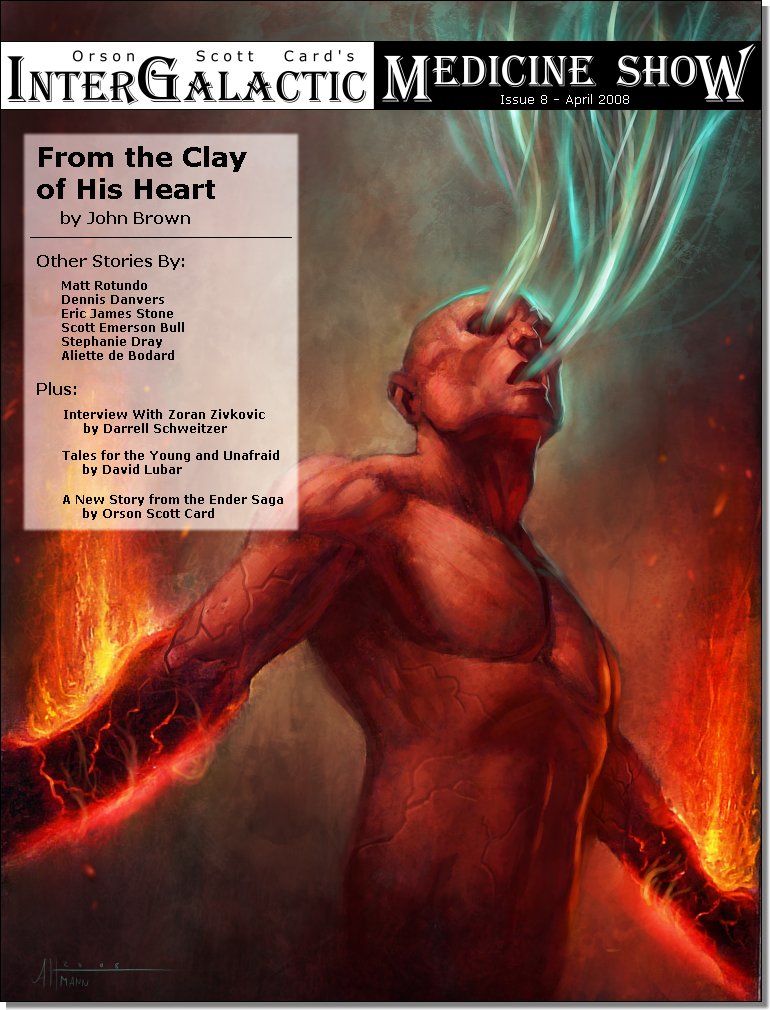
LAKETOWN, UTAH | February 9, 2009 | Utah author John Brown’s novelette, “From the Clay of His Heart,” has just been listed as one of the best stories of 2008 by Locus Magazine, the main trade publication for the field of science fiction and fantasy. Locus Magazine selected its list from the hundreds of stories published and reviewed in 2008. Brown’s novelette will also be included in the annual Year’s Best Fantasy anthology edited by Hugo award-winning editor David G. Hartwell.
“I’m thrilled with the recognition,” says Brown. “Still, I suppose you’d have to be a potato head not to squeeze some drama out of a story that’s a mix of religion, thieves, monsters, and love.”
Brown will present his views on the keys to successful fiction in a lecture and workshop titled “The 3 Things You Must Learn To Write Killer Stories” at BYU on Friday evening, February 20, 2009 as part of Life, The Universe, & Everything, a symposium on science fiction & fantasy. Admission is free and open to all.
John Brown is an award-winning Utah author. His epic fantasy, Servant of a Dark God, will be released in September 2009 by Tor, the largest publisher of science fiction and fantasy in the world. For more information on the author visit: http://JohnDBrown.com
Click on image. Artwork for “From the Clay of His Heart” which will appeared in Locus Magazine’s recommended reading for 2008 and will appear in the Year’s Best Fantasy #9 edited by David Hartwell.
Quesion: is it dangerous as a writer to try to improve your style?
A lot of respected authors say it’s foolishness to focus on style. Because story is what people want. Story is the thing. Put all the lipstick you want on a pig, it’s never going to be anything but a pig.
I agree with them. Why fiddle with the words when the content oinks? If you have to focus on something, focus on delivering killer stories.
However, story content is not everything. There is a feeling that comes with how the story is written. You can serve prime rib on fine china in a $100 / plate restaurant, or you can serve it in a cardboard box out on the back lawn by the shed. Same beef, but not quite the same experience.
Orson Card is one of those who cautions against thinking about trying to improve your style. I want you to read this.
Question 5:
I would like to use the discussion in Lesson One as a springboard to my own inquiry. I understand that obsessively analyzing the style in which one writes can lead to bigger problems. However, my problem is not with an overall stylistic deficiency, but a very specific one. Through dialogue, the voices of the characters speak with one another. Are there any techniques you can offer which make the process of composing dialogue any easier? (I don’t expect a wonder formula, just some methods which would help me organize my thoughts a little better.)
— Submitted by Jennifer Dittrich
OSC Replies:
Composing Dialogue
The secret is not to think about dialogue as a separate task. You aren’t writing dialogue, you’re writing an encounter between characters. Part of the encounter is what they say, but part of it is how they react to each other, what they want from each other, what has happened between them in the past, who else is watching and the impression they want to make, and so on. When the characters speak, therefore, they aren’t “speaking dialogue,” they’re using words to do something to the other person — sometimes to try to get the other person to understand some information, but more often to get the other person to do something or feel something or reveal something. That’s what you concentrate on, and then come up with words you might use to accomplish that character’s purpose. Sometimes you’ll try many different opening lines as a conversation begins, and see where they go; sometimes you’ll erase long passages because they don’t feel right to you. But the solution to dialogue problems is rarely to “write better dialogue.” It’s almost always to clarify or change what the character wants or feels or thinks.
Most often, bad dialogue is bad because it’s “clunky.” The usual cause is that you’re trying to “write well,” and your idea of writing well comes from the horrible essays you were forced to write in high school and college. Forget all that! But don’t forget it just when you’re writing dialogue — that’s bad writing even in the essays and papers produced by those very same teachers! Good writing sounds like a person talking. Your narrative sections should be written in fluid language that can easily be read aloud. In other words, your narrative should sound like dialogue spoken by a good storyteller!
So if you worry about your writing style, especially your dialogue writing, chances are that the problem you have is that you are worrying about your writing style instead of worrying about what happens and why in the story! Bad style is almost invariably the result of trying for “good style,” because “good style” is invariably defined by writing teachers and the students who believe them as “writing like someone else who writes better than you.” But you can’t write like them, because you’re not them and their voice isn’t your voice. You can only write well when you write the way you talk, only more clearly and precisely. If you are laboriously constructing your sentences, searching in the thesaurus for “just the right word,” you are almost certainly writing unreadably; and, while you might only notice it in your dialogue, chances are you are writing badly all the time.
How do you cure this destructive habit? Let me give you a parallel example. When I was a child, I had a lyric boy-soprano voice, complete with vibrato. I sang high and sweetly, and that ability to sing was an important part of who I was. But when my voice changed, the “high” was gone and so was the sweet. Grimly determined to get my voice back, I forced a vibrato using very bad technique — a strained, rapid diaphragmatic vibrato rather than one that arises from a relaxed throat. It made my voice sound eccentric and unpleasant — and the tightness that resulted severely limited my range. I went through my college career with that voice, even though I knew it didn’t sound all that good, because I didn’t know how to do it better.
Then I went to Brazil as a missionary. Nobody there knew me as a performer. No one cared how I sang. I stripped away the old pretense and sang “straight,” with clear tone, no vibrato at all. I learned to relax my throat. I sounded like nothing; and then, to my surprise, a genuine, relaxed vibrato began to enter my voice on sustained notes. And my singing range increased, both higher and lower. When I came home, my singing voice was a far more versatile and powerful instrument than it had ever been before. During my forced-vibrato years, I couldn’t “do voices” — I could only sing the one way. Now I could take my relaxed voice and shape it to sound like an old man singing, or a child, or an untrained singer, or an operatic buffoon. I could sing conversationally; I could sing formally. I had my voice at last.
But I had to stop trying to force my voice and just relax, concentrating on the song and not the singer. Before I could sing well, I had to stop trying to sing well and concentrate on singing clearly, singing to the audience.
And if you don’t understand how this applies to writing style, I’m not a good enough writer to explain it to you any better.
You can read it on his site here: http://www.hatrack.com/writingclass/lessons/1998-08-14-5.shtml
Lots of great insights there. How many ways can you say, “Please, focus on the content of the story!”
But did you notice this line: ” Your narrative sections should be written in fluid language that can easily be read aloud. In other words, your narrative should sound like dialogue spoken by a good storyteller! ”
And this one: “You can only write well when you write the way you talk, only more clearly and precisely.”
Card is talking about improving your style to make it more clear and fluid and authentic to you. Even while warning this questioner as strongly as possible to avoid trying to improve your style, Card prescribes improving your style.
So style matters, even to Card. It just doesn’t matter nearly as much, in most cases, as content does. And I agree with him on his priorities.
However, I still think Card is throwing the baby out with the bath water. Maybe because he’s seen too many wretched stories that had great style. Nevertheless, there IS a way that each of us talks. We talk that way out of habit, but also because we like some of those turns of phrases. Because certain sounds, words, and rhythms appeal to us at some level. Because they feel right.
So what if you’re reading TC Boyle and love the rhythm of his prose? What if you figure out some of what drives that rhythm? What if you begin to use it in your writing? Is that bad?
Or what if you notice how David Farland always puts movement into descriptive passages? Or that you use “really” and “very” really a lot in very many places? What if you like how Dean Koontz stops to paint his characters? His use of metaphor to evoke an image of a person? What if you notice how some of Card’s prose works poetically?
What if your editor notices something you do that jars him so much it sets his teeth to rattling, and when he points it out you agree?
What if you pick up new stylistic elements and options and try them? Are you then going to write excrement?
No. You’re not. Because it’s natural to pick up words, phrases, manners of speaking. It’s natural to try them on. In fact, trying to AVOID this is what’s unnatural.
I used to work with a guy named Rick Jendro. He looks like a young Sylvester Stallone. One thing I loved about him was that he is a wonderful water cooler story teller. Rick used his hands and voice and face when telling his water cooler stories. He wasn’t Acting with a capital A, but he was acting. He was evoking the story. He reminded me of another friend, Jeff Cuthbert, who did the same thing.
I loved listening to both of them. LOVED IT. Partly because of this acting they did.
So I noticed what Rick was doing and Jeff had been doing. The next time I told a story I let myself be a bit more free with my hand motions and actions. I didn’t study movements or anything like that. Didn’t rehearse. I found they just came when I reminded myself to let them come. I tell a better story today than I did before because of this.
Was I wrong to delight in what they did and try it? I don’t think so. There’s nothing wrong with imitation. Good gravy, that’s how we learned language in the first place.
My advice, lowly writer that I am, is to read and imitate. Notice things. Notice every thing that sings. Every thing that clunks. From character to plot to punctuation to paragraphing to dialogue to whatever. Then try things on. Try on structures and plot twists and dilemmas. Try on paragraphing and poetical devices like simile and metaphor. Try on everything that strikes your fancy. Get a whole closet of outfits that feel wonderful on your bones.
And when you write, just write. Don’t worry about the style because all these new outfits you’ve got: the ones that feel most natural for the task at hand will present themselves to you when the time is right. I promise.
As a thank you, those that answer the question will get a seat at a virtual, 1-hour training session I’m putting on where you discover 3 key principles of keeping your readers hooked.
I just turned in a 35 page chapter outline of Curse of a Dark God to my editor. This is the third iteration of the outline since December. Hopefully, at last, we have a story we can all agree on. Keep your fingers crossed.
Of course, since this back and forth has been a process of write like mad then wait a few weeks then write like mad and wait again, I’ve been working on another project during the waits. It’s a straight-up thriller.
Leon is ex-Special Forces (or an Army Ranger, but I’m leaning SF). He left the service when a colonel decided it was his job to make Leon’s life hell. He did security and a number of other things. Tried to be a plumber, but fell into bad company and then crime. And then was send to the big house and learned about a whole new theater of war. During his stay, he saw the light. Changed. He shaped up, and despite the swastika tatoos on his feet, flew straight when he got out. He had his odd jobs, but figured it was easiest to avoid all the questions and fuss that arise when you tell a prospective employer that you’re a felon. So he got himself a laundromat. Then another. Then he invested in a car wash. There’s good money in cleaning. And with the proceeds he bought himself a little ranch.
Leon’s a big man. Knows a lot about guns (although he can’t possess one), security, and crime. He lives in Rock Springs, Wyoming. On occassion, the sheriff is known to ask for his services. On more frequent occassions, the sheriff’s wife keeps trying to set him up with an unending line of women. But he doesn’t know if he’s ready for women. He doesn’t know if he’s ready for his nephew that his sister wants him to reform.
Then two old buddies from prison show up one night. They’ve got a girl with them. They need a place to stay. But it’s clear the girl isn’t there of her own accord. He figures they’re either holding her for ransom or blackmail. He’s not sure which. He knows these boys are connected to some bad men. Then his nephew breaks her free. The excons get in their car and chase after her. Leon gets in his car and chases after them. And soon he finds himself in the middle of something bigger than he could imagine.
Or something like that. I should have the chapter outline ready to go as soon as I finish Curse. I can’t wait to write it.
Just wanted to update anyone planning on attending my keynote at the Idaho Library Association conference in Soda Springs–I had the wrong location and time. The correct location and time are below. See you there.
Keynote Speech
Southeast & Eastern Idaho Library Association Conference
DATE AND TIME
Friday, April 30th, 10 AM
LOCATION Tigert Middle School
250 E 200 S
Soda Springs, ID 83276-1412
(208) 547-4922