My working process

Because I get questions about how I work, whether I outline, etc., and to satisfy the curiosity of those waiting for Curse about what I’m doing right now, I’ve decided to share my working process.

I use five types of documents in Word to write my books.

1. Pre-draft documents
2. Working outline
3. Chapter development docs
4. Manuscript drafts
5. Book

I then import the book into InDesign to create the ebook and POD versions.

THE PROCESS

1. PRE-DRAFT

I start developing and collecting ideas for character, setting, problem, plot, and sometimes even text. This includes brainstorms, zings, setting sketches, character sketches, scene or dialog snippets, plot sketches, photos, maps, story setup statements or problem statements, etc.  I’ll often have separate pre-draft documents for character, setting, problem, and plot. Or it might be one big document. At some point all of that electricity has built to the point where the story starts to buck and kick in my hands. When I start to see scenes rolling out in front of me, I know it’s time to create the outline.

2. WORKING OUTLINE

Looking at my pre-draft material, I create a sequenced list of the events or scenes in the story. Sometimes I’ll describe an event with just one line, sometimes I’ll describe it with more. These events or scenes often match up to individual chapters, but they often change as I go because the outline changes as I work. This outline is usually 4-12 pages long.

I usually have more detail about the first parts of the book when I start than I do the last parts. But even if some parts are sketchy, I usually have at least a line for each of the big events all the way to the end. When I start drafting (steps 3 and 4) and moving through the book, the details for those later parts begin to fill in. Again, it’s a “working” outline so things change.

3. CHAPTER DEV DOCS

When I finish the working outline to my satisfaction and start chomping at the bit to write, it’s time to start drafting. I open a new chapter development doc for the first event on the outline and copy/paste the event’s material from the outline into it.

I do some sketching if necessary (see my posts on scene primers) in the new document. Then I begin to write with the outline material and scene sketch as a guide.

If I run out of steam, or the take of the scene doesn’t work, I do another take. I just stop, create a new heading titled “Take 2” or 3 or 4 (whatever the take is), and start again. I may brainstorm as well in this document and do other pre-draft work that has finally presented itself to me to be done. There have been a couple of times that I’ve had to do 20+ takes to get a take that works. Most of the time I need 1-3 takes. Using Word navigation view I can see in the sidebar all the takes etc.

The nice thing about these chapter development documents is that they’re working documents. I can be messy.

4. MANUSCRIPT

When I’ve gotten a good take of the scene, I paste that take into my manuscript document which contains all the final takes from the chapter development documents. This is “draft 1” of the manuscript. Usually each scene/event becomes a chapter, although I might split it if it goes long, or combine it with others if it’s short.

5. REPEAT UNTIL DONE

I repeat steps 3 and 4 until I’m done with the book. Using Word navigation I can see all the chapters in the sidebar.

6. CHAPTER REVIEW

Before I print the manuscript for the cold read, I will review the chapter breaks one more time based on what I feel is right for the length, the right effect, especially at the ending and beginning of the chapter, and what I think goes together.

7. DRAFT VERSIONS

After cold reading and marking up the printed form of draft 1, I copy the manuscript file and replace the suffix “draft 1” with “draft 2”, then make the edits for the cold read in draft 2.

Then I send draft 2 out to my beta readers. When the manuscripts and comments come back, I copy draft 2 and change the suffix to “draft 3” and make the beta reader edits in draft 3.

I do this for as many drafts as I go through, including those for the copy edits.

8. BOOK

When I’m done with drafting, I copy the final draft and replace the draft suffix with “book”. Then I add front matter and back matter (title page, copyright page, teaser, map, author’s note, table of contents, etc.) in preparation for importing into InDesign to create the ebook and POD (print-on-demand) versions.

9. POD

I create an InDesign document, import the Word book, then save it with the suffix “POD”. Next I finalize the interior formatting for printing. There’s quite a bit that goes into this with chapter breaks, widows, and orphans, breaks, etc. When that’s done, I upload it to CreateSpace and then print off the proof they provide.  By now the cover is finished as well.

10. PROOF READ

I read the POD proof to catch any last errors and make the appropriate updates to both the Word book and the InDesign POD document.

11. EBOOK

I copy the POD InDesign document and replace “POD” with “EBOOK”. I then add the appropriate changes (links etc.) to the front and back matter for the ebook. Next I export the InDesign document as an EPUB. I have to use Calibre Book Editor to edit a number of things in the EPUB. When that’s done I open the EPUB with the Kindle Previewer to create the MOBI version (Kindle file).

12. PUBLISH

The next step is the easiest–click a few buttons to upload the final version of the POD and ebooks to the various online retail venues. I go direct with Amazon, CreateSpace, NookPress, and Kobo. I use Draft2Digital for iTunes and Smashwords for all the rest. 

Share

Similar Posts

  • |

    John guests on Writing Excuses season 3 episode 16

    writing-excuses-the-guys2-300x139A while ago the Writing Excuses team asked me to record with them, and last Friday I got to do it and had a blast.

    We recorded three episodes. In the first podcast we talk about putting and not putting ourselves in our writing and making characters who don’t all sound like the author. As usual, the guys had some great insights. Check it out: The Anti-Mary Sue Episode.

    Share
  • Advice from one of the biggest writers of our time

    How would you like to sit down and get writing tips from someone who created or co-created nearly 40 television series? Someone who wrote more than 450 episodes for those and other series and then went on to produce around 1,500 more.  Oh, yeah, and then after his thirty or so years in television, he published 18 novels. Whoa–eighteen. Like I’m shaking, right?

    It’s not like the guy knows much about telling stories. I mean, millions of viewers entertained–big deal. Still, do you think you might be interested in seeing if he hasn’t maybe one piece of advice that’s useful?

    If so, the guy’s name is Stephen J. Cannell.  He wrote about 9,000 words on developing stories and called it his Writing Seminar. I thought it was pretty good. Well, for a piker.

    Share
  • Edward Bear Shares His Proofreading Secrets

    One of the things I enjoy about being an author are the emails I receive from readers. A few months ago I received one from Mr. Edward Bear. He’d purchased Servant and, as he was reading, found an unclosed dialogue quote.

    Mr. Bear could have simply noted it and read on. But he did not. Mr. Bear is a proofreader. And so he practiced a bit of wizardry, found that I had a handful of quote goofs, and emailed them to me.

    Many of them ended up being weird smart quote issues Word introduced into the text when I broke a line of dialogue with an action like this: “You will not”–he scratched his nose angrily–“share another pair of my panty hose with that woman!”

    You’d think that would be enough for a doughty reader. But Mr. Bear didn’t just notify me of the errors. Oh, no. He also included the page from his proofreader’s grimoire that allowed him to find those quote issues in a matter of minutes in the first place.

    As soon as I had the time, I tested the spell on Bad Penny, and, voila, in a matter of a few minutes found a couple of issues in that text. I was delighted.

    But Mr. Bear wasn’t satisfied with mere delight. He then sent me another page from that grimoire to help with spelling. We luvs wizardly readers, Precious.

    Copy editing and proofreading require patience, painstaking reading, and a knowledge of what to look for. You have to know not only the mechanics of the written word (capitalization, spelling grammar, syntax, punctuation, abbreviations, usage, etc.) but also, if you’re reading for a printed edition, interior formatting (widows, orphans, word or hyphen stacks, headers, and so forth). There’s a lot to it. And anything that speeds up the process and minimizes errors is welcome.

    If you’re contracting your proofreading out, a cleaner copy can also translate into lower rates. Knowing that many of you who visit this website are writers, and because your host’s generosity knows no bounds, I asked Mr. Bear if he might be willing to share his wizardry with you. The wizard responded with a yes.

    Augmented Proofreading 1

    By Edward Bear I’m Ed Bear. I work, both professionally and otherwise, as a proofreader. I’ve gone over books for my publisher and I’ve done scan/OCR/check against paper books for republication, both electronic and back-to-treeware. When I mentioned some of the “ancillary tools” I have for aiding the work, John offered me this guest post slot in his blog. Feel free to pass this stuff around. I’ve found these techniques invaluable in getting the job done faster, and with better quality.

    First, though, I need to tell you about the tools themselves. The biggest component is the software for electronic text editing. However, I’m NOT talking Word or anything like that. I’m talking about an editing program which can a: work with plain text and b: handle Regular Expressions. (What are those, some of you ask? I’ll get to that.)

    Since I’m a windows user, I have two such programs available. My favorite is a program called TextPad (www.textpad.com).  I’ve used it for years and it’s become invaluable to my work. They currently charge $28 for a single user license, but IMO, the program’s so useful that, even though upgrades are free, I buy another license every time they bring out a new major release. The other program is free. It’s called NotePad++ (http://notepad-plus-plus.org/) I’ve tested it and it can handle the methods I use, but I haven’t used it much, since TextPad and I are long-time buddies. If anybody out there knows a program for the Macintosh which will do these jobs, please mention it in the comments.

    Regular Expressions

    You don’t have to be a wizard to use them. The tutorial over at http://www.regular-expressions.info/tutorial.html describes them elegantly:  “Basically, a regular expression is a pattern describing a certain amount of text.”  They are also called a regexp or regex, and I’ll be including the regexes I use in this post.

    I have a small library of regexes, and two of them are critical to aiding the proofreading process. One of them allows checking dialogue quotemarks, to insure that speech is properly closed off, and the other makes it possible to generate a word list of each unique word in the  book. I’ll be walking through the usage, including screenshots.

    Quote Checking

    One of the challenges of checking dialogue passages is that, with one exception, every opening quote (“) needs to have its matching closing quote (”). The exception, of course, is when the same character is speaking in the next paragraph. This can lead to a heavy false positive load if the characters are loquacious.

    The first time I tried this stunt, I found  73 paragraphs with unbalanced quotes. Only 6 of them were errors. But being able to find them quickly so they could be fixed in minutes instead of hours? That paid for the effort.

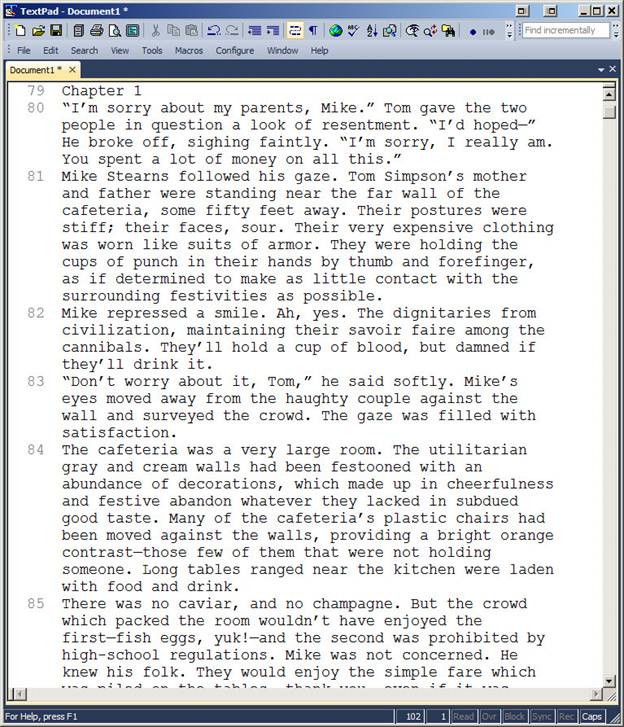
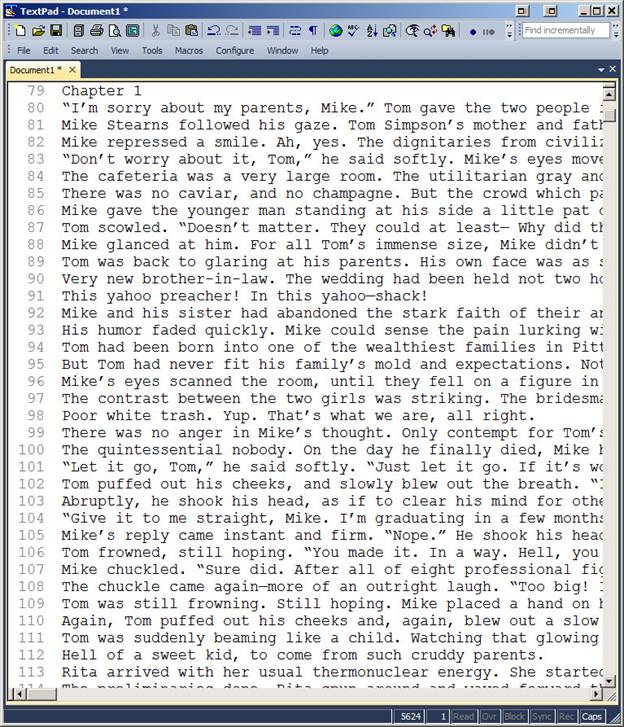
    The process itself is simple: You take the document and convert it to plain text. If it’s an RTF or Word document, you simply select ALL, hit copy, and paste it into Textpad.  The result will look something like this:

    image001

    What I normally do is turn on word wrap, so I can see the whole paragraphs as I go. So it looks like this:

    image002

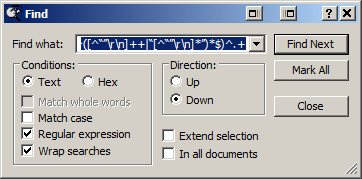
    Now, we go hunting. The next step is to set up the search pattern using a regex. The one I use for this is the following: (?!^([^“”\r\n]++|“[^“”\r\n]*”)*$)^.+ Complicated little brute, isn’t it. I didn’t write it, but I knew who to ask if he could write one, and the above is the result. FYI, there’s also one for straight quotes: (?!^([^”\r\n]++|”[^”\r\n]*”)*$)^.+ You use it the same way. So go into find, and put the regex into the “Find what:” box:

    image003

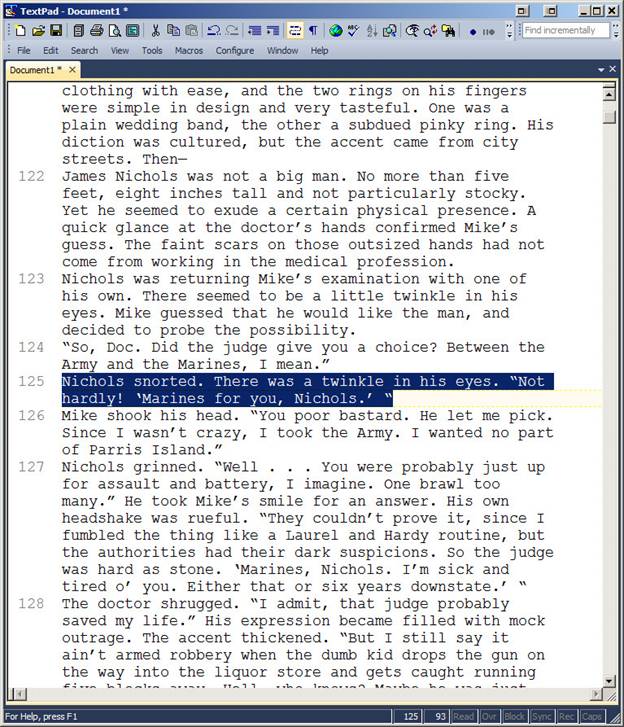
    Notice that the “Regular expression” box is checked. I also “Wrap searches” just in case I miss something and want to loop around. Click “Find Next” and:

    image004

    The paragraph highlighted has two opening quotes, one at the beginning and one at the end. Word assumes that a quote preceded by a space is an opening quote, so you need to correct it in your RTF/DOC. Wash, rinse, repeat. You keep doing “find next” all the way through, checking for situations like the following:

    image005

    As I said, same speaker, next paragraph, so this one is good. This post is getting a little long for a blog entry, what with illustrations, so I’ll break off here. Stay tuned for part two: checking spelling and spelling consistency. In the meantime, here are the RegEx tool commands plus a few bonus goodies: RegExToolCommands.

    Share
  • |

    Get great writing tips, for cheap!

    The annual Life, The Universe, and Everything writer’s conference is being held this year February 11-13. It’s chock full of panels and presentations from working authors. And this year you don’t have to live within driving distance of Provo, Utah to go because they’re doing it all online (thank you, Covid).

    I will be delivering two hour-long presentations. The first is about plot, where you learn the John Brown Story Framework that makes plotting so much easier. Heck, it makes story much easier. The second is for folks new to self-publishing and is called Indie Publishing 101.

    If you’re a new writer or looking to hone your craft, you will want to check it out.

    Share
  • |

    Writing Update: 5/28/11 – Freewrites, Storylines, Proportion

    I finished the next chapter of my outline, which turned into three chapters. Hurray for making progress. However, I’m going to need to make more time on a weekly basis if I’m going to meet my goal.

    I’ve kept stats over the last four novels. My average is 500 words per hour during the drafting stage. That includes revising and doing quick researches etc. So sometimes I will write a smoking (for me) 800 or 900 words per hour. Sometimes I won’t finish a thing. When I’m all done it averages out to 500 words. I’m going to see if I can’t get 20 hours this next week and finish 10,000 words. 

    Addition to last week’s post

     Do you remember last week’s post about the process of making it come alive in my mind first? Orson Card illustrates this as he describes how he prepared to write a story in his essay “How One Story Can Give Birth to Another“.

    Spideysense, farmer’s faith, and freewrites

    Last week when writing chapter 7, I finished, but felt something was off.  Years ago I would have freaked about writer’s block.  I would have told myself I sucked because the chapter was glucky. But not now.  It’s a gift.  So I stopped and talked to myself in a freewrite.  I had farmers faith that if I just kept working on it, something good would result. 

    Here’s what I wrote in that freewrite. It’s an awful read for you, but it shows you just how sloppy and cryptic and freewheeling my freewrites are.

    Okay, so I’ve written the stuff below and I could tweak it, I guess. But I keep having this nagging feeling that it’s not good. It’s not a compelling villain. I think he’s creepy and evil. And, truth be told, I don’t want to make him into something other than what he is—a total thrall to the Glory and the mother. So as the “pet” of the mother, what else could he be called? I don’t know.

    I shall call you endless because you will be spared, you shall continue, whereas the rest will not. Blessing. Blessed. Grateful. What would you call a thing that did you bidding reliably? But enthralled. I am part of you, you are part of me, and so you may take my name.

    He WOULD think—I am not like them. I am GRACED by the Mother’s touch. I have taken her into myself. Or she has graced me and so I have become more than I would be otherwise. I am obedient.

    What else do you call pets or tools. Maybe that’s what she calls him. My skir master. The skir lord. My trowel. Harvester.

    He’s over the harvest. Reaper. Or he’s the one that supplies food. Supplier. Gatherer. Cook. Chef. Hunter. Provider. Butcher. Slaughter.

    So I like Endless with the whole part of him being part of her. But he could use that—”you’re just like us” “no, we are part of the XXX (what was the name I had for them?) endless. You are meat”

    Devourers, Mothers, Sublimes

    Okay, so do I go with Endless or Harvest Hope. Endless it odd, neat. What could I add to Harvest to do the same. Harvest Lord, King, Overseer, Meatman, Food provider, Feeder, Harvester, Harvest, Rancher, Collector, The Harvester. Harvest.

    I think when you’re raised, you get a new name.

    Rebellion.

    Soul collector.

    The Shepherd.

    Harvest Prime

    Bald Head

    Laughter

    Everlast

    DIVINES

    ID HIM AS THE MAIN HARVESTER

    RIGHTEOUS ANGER

    The issue was that his motive wasn’t working.  I had a feel for what I wanted him to be, and my Spideysense was telling me it wasn’t working, wasn’t interesting.  Thomas McCormack in his book calls this feeling for what you want in your story a “prelibation”.  What an odd term.  But it’s real. 

    “Prelibation.  The desire for a certain effect on the reader.  It may or may not be followed instantly by an intuition of what item of narrative will cause that effect, and it’s important to see that intuition and the prelibation it is trying to serve are not the same thing. The intuiting of the narrative that will produce the effect-wanted is the work of the imagination” (p153 The Fiction Editor, The Novel, and the Novelist)

    There’s more in his book. I recommend it highly. So, after that freewrite, I didn’t have a solution, but I’d pinpointed the issue, the prelibation. I took a break with kids into the big city. Came back and had my solution for a narrative that would do the trick.  Luckily, it was something I’d cut out of the outline. Back it went with some significant tweaks and was better than before.

    Storylines & the Size of this Presentation Phase

    For those who have read my series on suspense, at this point, the presentation of the problem for the main story and many of my sub-stories is complete.  Depending on how you categorize them, I have nine to eleven story lines (which makes it impossible to write this book in 100k words).  There’s one main story line that touches everyone—the Mokaddian threat.  Then there are other questions and issues I raise that set the reader up with the expectation for a resolution.

    1. Talen
      1. Mokad/Nashrud (external threat)
      2. Lusts (internal threat, mystery)
      3. Sugar (relationship)
    2. Legs: Vulnerability
    3. Sugar
      1. Talen (relationship)
      2. Urban (relationship)
      3. Ancestors (relationship, mystery)
      4. Mokad (external threat)
    4. Argoth
      1. Mokad (external threat)
      2. Nettle (relationship)
      3. Bone Faces (external threat)
    5. Eresh
      1. Flax (conflict relationship)
      2. The Creek Widow (relationship)

    So most of these story lines have been presented, although not all. It took about 30,000 words to finish the presentation phase. I’m estimating 170,000 words, so that a presentation phase of roughly 18%.

    There are a lot of story lines and characters to juggle. Sometimes I kick myself for having so many. Of course, I love them, despite the challenge they present. Nevertheless, I AM looking forward to writing that thriller with a limited cast.

    Share
  • The Novel Writers Academy – Do you want it?

    Are you tired of being educated ABOUT writing?

    Do you just want someone who knows what they’re doing help you do it?  

    Specifically, do you want to develop a killer story idea, outline it, and write the first 3 chapters with the guidance of a pro?

    If so, then here’s your chance to vote to have me create a course that will do just that. 

    Read on for more information…

    Educating versus Training

    When you’re educated about something, you can talk about concepts and principles. You can recall facts. But most people I know don’t want to be educated about writing. They want more than another class, podcast, video, or book about the topic.

    They want to be trained.

    They want to develop a killer idea, sketch it out, and actually begin writing. Not just watch or read about it. But they want some help.

    I’ve been asked many times if I would teach an online class or workshop, but I’ve put it off for years because I know that I don’t want to offer just another set of videos about writing.

    Of course, I will offer just videos. That’s all some people want.

    But I know there are others out there who want to go beyond that. They want on-the-job training. They want to develop a fun story, but don’t know the process well enough, and want someone who knows it to guide them.

    They want training.

    But training takes time. More than the time it takes to create videos or posts.

    That’s what I do, by the way. When I’m not writing novels, I work in corporate America training people to actually do things. Over the last 20 years I’ve trained people to do everything from give compelling presentations and speak Dutch to plan and schedule manufacturing plants and close their accounting books at the end of a financial period.

    And so I know there’s a difference between being educated about something and being trained.

    Just think about it. Do you want a surgeon who has been educated about surgery or one that’s been trained to perform surgery at a mastery level? Do you want a plumber who has been educated about plumbing, or one that’s been trained to plumb? Do you want your airplane pilot to be educated about flying or trained to fly, in all sorts of weather?

    Going to school and being educated is cool, awesome, and necessary. But we all know we have to go beyond that. We need to be able to actually DO things. Training requires you know concepts and principles, but it also requires you take the next step and actually do something.

    Do You Want Training?

    I’m willing to provide this on-the-job training, but before I develop and conduct this course, I need to know enough people are interested in it for it to be worth my time (it would probably be more sensible for me to focus exclusively on getting the books I need to write out the door, but I love to teach too, and had to figure out a way to do it).

    So here’s the test. If you want to take the class described below, sign up to express your interest.

    This does not obligate you to anything. It simply says that you are almost 100% sure you want to take the class, barring earthquakes, plagues of demons, or crazy in-laws.

    When enough people signup, I know it will be worth my time, and the love of teaching part of me will be able to convince the sensible part of me to do it.

    And then I’ll do a Kickstarter to make it official. Or I may just develop and release. We shall see.

    So, here’s more on the course.

    Your Novel’s Core: Develop a Killer Idea, Outline it, and Write the First 3 Chapters

    The first order of business is to determine if this course is right for you.

    Do you want to write a novel, but feel like you have no idea what you’re doing?

    Do you often get ideas for a character or setting or snippets of scenes and dialogue, but find they just never go anywhere?

    Are you tired of learning about writing, and just want someone who knows what they’re doing help you to do it?

    If so, this class is for you.

    This is not a theory class. Oh, we’ll talk about theory. You’re going to learn a ton of theory. But this isn’t about theory because I don’t care about theory. And neither, I suspect, do you. I care about developing an awesome story experience and sharing it with readers who enjoy it as much as I do.

    So I’m not interested in talking about it. I’m interested in doing it. And having fun.

    Which means that in this course you’re going to:

    • Develop at least 10 story ideas that beg you to write them
    • Select one of those ideas and create an outline
    • Write the first three chapters of that novel

    In order to do that, you will need to learn the secrets to:

    • A story idea that works and how to come up with one
    • Interesting characters and how to develop one
    • Transporting your reader to the story so they feel like they are witnessing the whole thing
    • Keeping readers on the edge of their seats
    • What story and plot are really about
    • Writers block and why it’s a gift (no, really, it is)
    • Knowing what comes next
    • Getting feedback from beta readers that’s actually helpful (and if you don’t know this, much of what you’ll get will be worthless)

    These secrets and many more. But remember: this isn’t a course about secrets. It’s a course about you actually improving your ability to generate story ideas, develop them into ideas worthy of a novel, and then write them.

    This means you need to not only produce, but also have someone who has the ability look at your work and guide you along. It means getting feedback.

    So I will be there helping you every step of the way. And if you’re writing in a genre I don’t know as well, I will loop in working authors who are successful in that genre to add their two cents.

    Fumbling in the Dark

    I started my novel writing career when I received a three-book, $50,000 deal from a major publisher. I am now an indie author with books that sell thousands of copies each year to readers all over the world. I’ve had publishers purchase and produce my books in audio. I’ve sold story rights to foreign publishers. I love developing and telling stories. And I love teaching others how to do the same.

    But when I started, years before that novel contract, I had no idea what I was doing. I didn’t know where to start stories, how to develop them, or even where they were supposed to end. And I didn’t have anyone to really help me. In fact, I remember asking one of my creative writing professors after class how you knew where to end your story. He looked at me, shrugged, and said, “I don’t know. I just end them.”

    What the heck?

    It was all a vast mystery. I loved stories, but I was clueless about what they were, how they worked, and how someone went about developing and writing one. I had a lot of fun, enjoyed my writing teachers (they were all great people), but I was never able to write something that hung together and felt like something you’d see in a movie or read in a book.

    But that didn’t discourage me. I kept at it. And over the years, I made a number of breakthroughs.

    What I discovered was that there are three things you must learn to write killer stories. You must learn:

    • What stories do to the reader
    • How they do that
    • And effective techniques for both developing and telling the story

    In this class, you’re going to learn those three things and the key principles for each, saving yourself all the frustration and discouragement that comes from trying to discover these insights by stumbling around on your own in the dark. With this class, you can cut years off the time it takes to learn how to write.

    When you know these three things, you will be able to write stories on purpose, instead of by accident. You will have power over your craft.

    You will see that instead of trying to remember a list of hundreds of “writing rules” or use “writing formulas,” many of which are nonsense, you’ll write by focusing on the simple and fundamental heart of what storytelling is all about.

    Course Outline and Price

    Below is a more detailed view of the course. My lessons are called quests because I’m expecting you to actually do something, not just watch.

    Quest 1: Discover what stories do, then create your personal story profile

    • The three things you must learn to write killer stories
    • Your personal story type
    • The three main reader responses you must generate
    • The big secret: trigger and delay
    • Genre
    • Sensitizing yourself

    Quest 2: Discover what you need at the core of your story, then perform a craft analysis of 2 of your favorite novels and report your findings

    • The story engine (without this, your story goes nowhere)
    • What makes characters interesting
    • The vital THOMR
    • The desire to gain or retain something specific
    • Formidable obstacles
    • Uncertainty
    • Surprise
    • The same but different
    • The 3 grunts

    Quest 3: Discover the secret to developing ideas, then develop 10 fully-formed story ideas that beg to be written

    • The 4 main creative principles you must follow
    • 5 super productive techniques for generating ideas
    • Creating a schedule and goals
    • Using the story engine job aid
    • Using the setting job aid
    • Using the magic job aid
    • Using the world building job aid
    • Using the character job aid
    • Using the formidable obstacle job aid

    Quest 4: Discover how to figure out what comes next, then develop your story sketch (outline)

    • The number of scenes for your story
    • The story cycle
    • Story turns
    • Trigger and delay
    • Structure, and why structure models so often fail to help

    Quest 5: Discover how to transport your reader to the story, then write your first three chapters

    • Techniques for telling your story so it’s vivid and clear
    • Narrative summary versus narrative detail and when to use  each
    • Effective description
    • Writing point of view, hot and cold
    • Orienting the reader
    • Transitions

    Quest 6: Discover the three main effects you should read for, then deliver a reader report for the first chapters of seven different novels

    • The 3 grunts (the secret that allows you to learn from other novels)
    • Reader report rules
    • How to get feedback for the rest of your project

    Quest 7: Discover your next steps, then create a plan

    • Methods to write quickly
    • What you need to do to publish independently
    • What you need to do to publish with a traditional publisher

    As you can see, in this course you aren’t going to just hear someone go on about theory. You’re going to define your type of story, surprise yourself by developing at least 10 solid story ideas that beg to be written (by you). Then you’ll select one of those ideas, sketch an outline, and write the first three chapters, all under my guidance, using the same practical, simple methods I use.

    Most important of all, you’ll actually stop thinking about writing and be well on your way to finishing your novel with a clear path to the end.

    Instead of dreaming about someday, you’ll enjoy the excitement of writing a novel right now.

    The cost of the course depends on what you want:

    • Access to all of the videos: $199
    • Access to all of the videos and two rounds of coaching on your story idea, outline, and first three chapters $399

    Not for everyone

    Having said that, you need to know that this class is not for everyone. If you are not willing to actually make time to do the work I ask, you will find no benefit.

    How much time will you need to spend?

    With all of the videos, reading, and development you’ll do, you should expect to take 30-40 hours. You can move through it at your own pace, but I strongly suggest you spend at least five hours per week. Any less than that, and you’re going to find it very difficult to keep your creativity hot enough to make dinner.

    Also, if possible, I recommend you take the course with a friend. You will progress so much more quickly when you discuss the lessons and insights and bounce your ideas off of each other.

    If you want to just watch the videos, that’s perfectly fine. If you want to actually develop a story and learn on the job, then you have to make time to do this awesome thing, just as you would if you wanted to learn how to dance, quilt, race cars, rappel, or paraglide.

    So if you aren’t in a position to make the time, I understand. Please don’t sign up.

    But if you’re interested, then click below to raise your hand as someone who is definitely interested. Once I see there are enough people interested, you’ll get the class.

    Yes, I’m definitely interested!

    If you’re interested, let me know by filling out the form below.

    This does not obligate you to anything. It simply says that you are almost 100% sure you want to take the class, barring earthquakes, plagues of demons, or crazy in-laws.
    * indicates required


    Share