Indie Thoughts: Russell Blake’s Indie Author Myths

This is from Russell Blake, a pseudonym for Craig Osso, a 52-year-old retired home developer who has sold close to 450,000 copies of the 25 books he published in the last 30 months. The man has made over a million bucks at this.

1) Books Sell Themselves. No, sweetie, they don’t, at all, and never did. That’s why trad pubs spend massively on promotions. Because they know that visibility sells books, not invisible cosmic forces or author brilliance. It’s a highly competitive market with millions of choices, and it’s a retail market, and in retail, visibility is key. Which means constant promotion. Which most authors hate. But it’s reality, so get used to the idea. A companion to this aphorism is the next one…

2) Just write the next one. Sure, if you want to have two undiscovered gems instead of one. Look, writing the next one’s important, but not if it’s used to justify not promoting the last one, which is often the case. You have to both market the last one AND write the next one. Sorry. You do.

3) It’s all about luck. Well, perhaps some of it is. Maybe even much of it is. But so’s everything. You drive to the market, and 30 seconds after you pass the intersection some dumbass crashes into the car behind you. Luck. A hundred people start restaurants in town and two do well while the rest fail. Luck. A mugger attacks you after a movie. Luck. Sometimes good, sometimes bad. The book biz is no more or less random and chaotic than life, and yet some folks seem to consistently do better than others. I believe you need to work very hard, prepare, and be persistent, thereby creating some of your own luck. As an example, it’s possible you always wear your seat belt and the other driver didn’t today. In that case, bad luck becomes disastrous due to a simple lack of preparation. Or in the case of the restaurants, perhaps the ones that prospered had owners that worked 18 hour days and were talented chefs, and further, were savvy and inventive about getting people to try their cuisine. Preparation, persistence, hard work combine in that case to drag Lady Luck in their direction. With the mugger, maybe you have pepper spray or spent years on martial arts or have a concealed carry. Your preparation is the mugger’s bad luck.

Luck may be a factor, but in my experience it’s only one factor, and that perspective of it all being all about luck breeds apathy.

4) Do everything right and you’ll make it. Huh. If that were so, every book put out by big pubs would do well. The vast majority don’t. But that doesn’t mean you don’t have to do everything right, unless you want to worsen your already slim odds rather than improving them.

. . . .

10) Your muse cannot be forced to dance. Of course it can. If you were a writer on 24 or CSI or SNL you’d be expected to perform every week or you’d be out of a job. Most who work hard enough to get those gigs don’t want to lose ‘em, so they perform. Whether they feel like it or not. Whether they’re particularly inspired or not. The notion that you need to wait for your muse to decide to infuse you with story is fine if your books sell 10 million and you can afford to wait 4 or 5 years between each one. If that’s not you, you need to develop two things: a work ethic, and a system to inspire yourself.

One technique I use is to ask myself how I can make this book, or this chapter, the best I’ve ever written. You get completely different answers depending upon what questions you ask yourself. “How can I consistently write 5K a day and enjoy it?” will get you a different answer than “How am I ever going to do this?” If you’re stuck, ask better questions.

. . . .

12) I’m too busy to read. Who’s got the time? This one kills me. How in the hell do you expect to be a good writer if you don’t read a lot of good books? Intuition? Divine guidance? Magic?

. . . .

1[6]) Write a good book and you will make decent money. Or write a lot of good books and you will make decent money. Would that it were so. Reality is that the overwhelming majority of good books, which is to say competently written-and-edited tomes, fail to sell much.

. . . .

My message is simple: working very hard and very smart can improve your terrible odds, but that’s all it can do. It’s not a magic pill, nor a recipe for success.

. . . .

I can tell you how to operate your writing and publishing company intelligently, but you need to recognize that most well-run publishing companies fail. Just as most well-run any-kind-of-companies fail. Most start-ups don’t last. They go belly up. Even those with the smartest people and shiniest wow products. That’s just how it works. Don’t start a company if you’re uncomfortable with that idea.

. . . .

I’m a big proponent of choosing a genre that can support you, which means one that’s popular, and sticking to it (with the caveat that if it doesn’t meet your expectations after a massive, concentrated effort, pay attention to the result you’re getting, and switch to something with better odds). I’m also big on publishing regularly, meaning every three or four months (more often if possible) if you intend to make this your living. I’m huge on pro editing and covers and proofreading. I consider your cover and your blurb essential to success. But those are the basics. Important basics, but still, building blocks.

They will narrow your long odds because most authors simply don’t do what they should to make themselves successful. Understanding that is an advantage. It means you already know more than 90% of those who will publish on Amazon this year. If you do everything right, that will make you the 10% that has a chance.

But still, it’s not a lock. By any stretch of the imagination. Get clear on that. In all businesses, this included, you can do everything absolutely, spectacularly right, and go nowhere. Because God hates you. Or because the world’s unfair. Or because you’re not good enough. Or were born under a dark star. Or didn’t get breast fed enough as a child. Pick your reason. It doesn’t matter what it is, as long as you recognize that in ALL industries, most businesses do not succeed.

. . . .

I wish I could tell you how to avoid being that person. I wish there were a formula. What I’ve come up with I share openly: Pick a genre you love and that’s large enough to support you, stick to it, write a lot of seriously good books, focus on improving your grasp of craft each time you sit down to write, make each book your best ever (meaning respect your reader above all else), package and quality control your books like the pros do, market intelligently, and spend massive amounts of time and energy working smarter than everyone else. And above all, be extremely realistic about everything. Some might say, cynical. I’d say pragmatic.

. . . .

Can you do this part time and make it? Sure you can. So can someone who starts any business part time. Just recognize that your odds of making it are lower than if you did it full time. Duh. Put in 80 hours a week, you might get better results than 10. Big surprise. Can you put in 10 or 20 and still do well? Sure. Again, anything’s possible. But you have to be unable to grasp basic business concepts if you think your odds will be the same. If they were, nobody would put in the 80. They’d all put in the 10, because their odds are identical.

. . . .

What’s my point? That self-publishing is both exciting in its possibilities and daunting in its requirements. And that very few businesses succeed, whether it’s a new shoe shop, or a convenience store, or a restaurant, or a software start-up…or a publishing company. But it’s more possible now to succeed than at any point in the past. I’m living proof.


Link to the rest at Russell Blake’s Author Myths-1, Author Myths-2, and Author Myths -3.

Blake has some of the most sensible advice I’ve read. If you want more, search for him over on KindleBoards.

Share

Similar Posts

  • What I’m looking for from SFWA

    SFWA has asked M.C.A. Hogarth to head up the new self-publishing committee. Hogarth posted about this and asks:

    So here’s my question for those of you who self-publish, either entirely or as a hybrid author: what services would you look for in a professional organization? What would make you say, “Wow, that’s worth $90 a year, sign me up?”

    I applaud SFWA’s move. And the many good things SFWA has done in the past. However, as an indie and SFWA member, here’s what would interest me: Business.

    That’s with a big B.

    That means . . .

    Distribution into brick and mortar venues. So indie authors can get on the Ingram’s catalog. Big whoop. The retailer still has to order. If SFWA was able to facilitate the sales function in some way, that alone would be worth it.

    One idea is a SFWA catalog of vetted work. I don’t know how you’d vet. Maybe some certain sales and revenue level. And revenue would have to be part of it. Brick and Mortar isn’t going to be interested in stocking the person who “sold” 50,000 units but only made $300 because 99% of them were free downloads.

    You might also consider the back lists of authors with work that was once published that has been brought back indie style. So a catalog of that includes new stuff and a section for the back list. Quality and popular indie work.

    BTW, this catalog would ALSO go to libraries.

    Education in cover design AND art direction. Maybe adding this to an awards category chosen NOT by the general membership but art pros.

    The Nebulas recognize author’s who sell. But what about recognizing those who are author-publishers, what about recognizing and celebrating quality and achievement in the key elements of publishing?

    Education in Marketing that has actually been tested and shows positive ROI. Not a bunch of articles about bookmarks and conventions. Real ROI.

    Interior formatting. Principles. Awards.

    News. What’s new on the indie front. New markets etc.

    Selling foreign rights as an indie with and without an agent.

    What about an award like RWA’s Golden Heart, but for indie books? Or make indies more inclusive in the Nebulas.

    A vendor forum where folks who provide services to indie authors (editors, artists, etc) can be listed and rated, GoodReads style, but only by SFWA members.

    And two things I have submitted to SFWA before as a trad pub author.

    Education and discussion of contracts and contract terms. What’s current. What’s alarming. I get more off of Kris Rusch’s blog than the professional organization I belong to. I should be giving my $90 bucks to Kris. What the heck?

    Education and discussion of current contract rates. Same as above. For a professional organization to not have data on current rates for novels is a real head-scratcher.

    How is it that Tobias Buckell can run a survey, but it never occurs to SFWA to survey and publish annual numbers?

    How is it that Brenda Hiatt, the romance writer who does an annual “Show Me The Money” and “Indie Earnings” report, provides more info on Tor advances than SFWA? Romance writers are better organized than any writing group on the planet, but do they need to spank us in our own house?

    These last two are no-brainers.

    This is a trade organization. These types of things would be a HUGE help.

    Share
  • | |

    Teachers (and writers)! Free Class Next Monday on How to Teach Narrative for the Common Core

    If you feel a bit lost or anxious about how to teach narrative for the new core, especially stories, I think I can help.

    I’m an educator in the private sector and an award-winning novelist and short story writer. I’ve been teaching authors in various venues how to write for the last five years. I’ve been on writing podcasts with thousands of listeners, taught at a number of writers conventions, and had a series of articles published by the national Science Fiction and Fantasy Writers of America organization, an organization for professional authors. I’ve also been helping Nellie, my wonderful wife, teach her 7th and 8th grade language arts students the unit on short stories during that same period. We’ve taught it to twenty different classes and picked up a number of important insights along the way.

    This last year I couldn’t help but examine all the materials Nellie brought home during the district’s writing program adoption investigations. Some programs looked very promising; others not so much. Some got some things about writing flat out wrong. Most of the programs had gaps.

    Furthermore, because I work with so many people wanting to write, I know that it’s difficult to teach if you really don’t understand what stories really are and how they work. For lots of people, the subject matter can seem impenetrable. And yet writing stories is such a wonderful way to teach writing, especially because so many kids love it. You won’t find a kid who will spend extra hours writing a business letter or poem analysis, but you will find quite a few who will go crazy writing stories. And the whole time they’re practicing their writing skills.

    The question is how DO you write a story?

    What is a story?

    How can you tell if it’s good?

    How do you come up with ideas?

    Where do you start?

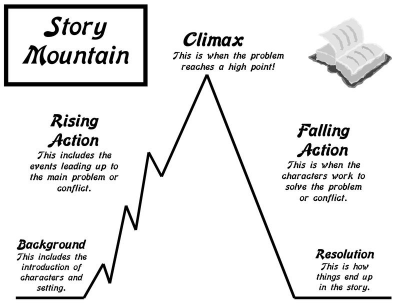
    And what the heck is this chart? Do writers really use this? (Not many that I know.)

    Story Diagram plot-mountain-pic

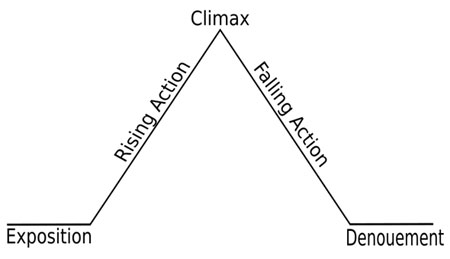
    And does anyone think changing the diagram to look like Aspen, Colorado actually helps?

    Story Diagram Aspen 

    Hey, students—please make your story look like Aspen, Colorado!  (Yeah, that’s going to be effective.)

    And yet it’s not as difficult as it appears. Nellie and I have seen a lot of kids really get into writing stories. We’ve seen kids WILLINGLY going way beyond the assignment to write stories that are eight, twelve, twenty-five plus pages. And as they’re writing, they’re practicing grammar, spelling, structure, vocabulary, etc. without knowing it and having a great time. I know that if you enable your students, many of them will write, write, write. Especially in grade school. But also in the higher grades.

    Stories can be a blast. The assignments can connect to many students. And the results can be wonderful. I’ve laughed out loud at some of the stories coming out of Nellie’s class. Others have been enjoyable on other levels.

    But for this to work in your class, you need to know some key things. You need to understand the core of story and the story development process. You need a lesson plan that details everything step-by-step so your students don’t flounder. And you need to know some fundamental tips (secrets?) about teaching this content.

    So I’m going to hold this day-long class for you. A full eight hours. And share everything Nellie and I have learned. This class will be for teachers at ALL levels (I’ll show you some ways to scale the complexity of what you’re doing). There will be NO cost. The only thing you have to bring is a pencil, paper, whatever program materials you have, and a willingness to have a good time.

    When we finish, you will know how to write a simple story like the ones your students will write because, ta-dum, you will write one! AND you’ll have a step-by-step lesson plan that builds on whatever materials you have—an official program or one of your own. AND you’ll understand story better than 99% of the population. AND you’ll have a bundle of techniques to help your students. AND you’ll solve both world peace and maybe the lost sock conundrum.

    Truly, I think that instead of feeling stress, you’ll actually be looking forward to teaching and writing stories with your students. If not, you may bring tomatoes and huck them at me, but please be aware that I will not stand still; to find satisfaction, you will have to be able to hit a moving target.

    If you’re interested, just click the Contact John link under my photo in the left sidebar and send me an email letting me know.

    Hope to see you in class!

    GET READY FOR A FUN DAY OF LEARNING!

    Topic: Teaching writing (narrative & the common core)

    Who: Teachers (and writers at least 18 years old), seats are limited

    When: Monday, July 29th, 8:15 AM – 5:00 PM

    Where: Rich Middle School, 54 E 100 S  Laketown, UT 84038

    Materials you need to bring:

    • Pencil
    • Paper
    • The writing program you’ll be using this year
    • Kooky socks, for those who cannot resist the urge
    • A lunch or a way to get one

    AGENDA

    8:15 AM Arrive

    8:30 AM – 9:20 AM

    • Can you create a redneck crapper?
    • The 1st secret to teaching writing: Attributes & techniques
    • The 5 parts of story
    • Thieves prosper – using existing patterns
    • A car, a beggar, and an idiot — basic pattern 1

    9:30 AM – 10:20 AM

    • The 2nd secret to teaching writing: Do it with them
    • Technique: Sketch then draft
    • Workshop 1: Zombies and kisses
    • Technique: Zing hunting
    • Workshop 2: Hunt zing

    10:30 – 11:20

    • What makes a story big or small
    • Workshop 3: Select a right-sized THOM and character
    • Workshop 4: Select a Goal
    • Workshop 5: Make character sympathetic
    • Workshop 6: 3 tries
    • Workshop 7: Resolution

    LUNCH

    12:00 – 12:50

    • The 3rd secret to teaching writing: Cognitive modeling and the 6-step process
    • The 4th secret to teaching writing: Our tiny brains
    • Writing is telling: Narrative & description
    • Technique: Yes, SiR
    • Technique: Broad-brush + 1
    • Technique: The Pause

    1:00 – 1:50

    • The 5th secret to teaching writing: Have fun
    • Workshop 8: Write your story

    2:00  – 2:50

    • How the pros revise—concept, line, & copy
    • Workshop 9: Content edit
    • The 6th secret to teaching writing: Our brains are still tiny
    • Workshop 10: Line edit

    3:00 – 3:50

    • The 7th secret to teaching writing: The 3 grunts (responding to a story and grading)
    • Share stories
    • What the heck did we just do?

    4:00 – 4:50

    • How to adjust for grade level
    • Common core
    • Your program and lesson plan
    • Identify black holes
    • Wrap up & next steps
    Share
  • The main thing about villains

    The main role of villains and antagonists in stories is to generate suspense, anxiety, and fear in the reader. They make it possible for us to worry that the hero will not be able to avoid a significant threat or remove a lack. There are other effects–mystery, poignancy (about the human situation like in Les Mis). But those are secondary.

    For the main things to happen the villain has to be a credible, significant, and immediate threat…all the way through the book until he or she is smushed or wins.

    If he’s not credible, the reader realizes there is no real threat. If the threat is not significant, who cares? If it’s not immediate, again, who cares?

    So how do we make a villain like that? We make him or her smart, powerful, a few steps ahead of the hero, and dedicated to doing something we root against (because it’s just plain wrong or because we love our hero and want the best for him and the villain is pitted against him). He has to be able to put the hero on his heels most of the way through the book, and our poor hero is scrambling to adjust.

    You can have all sorts of villains–liked by many or few, kooky or calculating, eccentric or plain, noble or sadistic–just as long as they remain significant, immediate, and credible threats. The minute they lose threat status, the game’s over because at that point fear, anxiety, and suspense in the reader vanish.

    Share
  • Slides for my LDStorymakers Presentations

    I loved attending the LDStorymakers conference this year. It was awesome, fun. I chatted with old friends and met new ones.  Got (stole) a great story idea from Donald Carey, the Conference King. Enjoyed Provo–love the weather down there this time of year! Attended some great presentations on writing. Gave some that seemed to help a number of folks. It’s a special delight to deliver a presentation that both entertains and helps. Furthermore, my family came down with me. So I got to hang out with them in the evenings. My daughters sneaked into the mass booksigning and got autographs from some of their favorite authors.  They were giddy with delight.

    It was bliss.

    I also worked with Isaac Stewart on a mock up of the new cover for SERVANT, and dude. DUDE.  If we can swing it, the covers for the Blacksword Books version are going to rock.

    Anyway, I promised many people I would post my presentation slides here. Here they are in PDF format:

    Vivid and Clear

    Story Turns

    And for those of you in the Story Turns class wanting that fine car chase clip, here it is!

    Share
  • |

    American Idol Story Elements

    I don’t have time to watch, but I found myself getting sucked in this week. And here’s something I realized as I watched Simon, Paula, Randy, Ryan, & the contenstants–the show is using story principles.

    Idol

    Duh, I know: of course, it is. But it does it so well. It reminds me of a research article I read about sportscasters and audience enjoyment of sports competitions. They found that if they could inject story elements–suspense, rivalry, etc.–people enjoyed the games more. Next time you watch a college football game, notice what the color commentators say to make it a contest. It’s not just about reporting what #45 did out in the flat.

    Anyway, back to Idol. Look at these elements.

    What draws us to characters?

    Beauty, threats, quirkiness, larger-than-life situation or skills, source of viewer wish-fulfillment.

    Humm, let’s look at the cast of performers. Don’t we see all of that? How many of us wouldn’t love to be able to sing like they do? Have a shot at becoming a recording artist? Or just goggle at someone getting this chance?

    What factors generate suspense?

    Threats to characters we like or marvelous opportunities for them, turns in the situation, a prolonged resolution.

    Humm. Our sympathy is engaged because these folks are normal folks, many of them underdogs. Many viewers identify strongly with one or two because of the contestant’s various social groups and because, heck, the auditions are for people like you and me. It could be us up there in front of the world! You’ve got the threat of peformance fright, but also the overriding opportunity to make a dream real. You’ve got a wonderful career, if not millions of dollars, on the line. You’ve got Simon who is honest, but also plays his part. Isn’t that the moment of most suspense with each performance? You’ve even got a little subplot going on between Simon and Seacrest. There’s no villain here. But there are plenty of obstacles. Weekly threats.

    What does Idol give us that Survivor never could?

    It’s all REAL, even if the producers let their selection of performers be influenced by things other than vocal talent. And because it’s real, we believe it. Which means we can more easily feel sympathy and root for the various performers.

    It’s a simple but brilliant concept. And I just wasted 4 hours watching it. And I’m likely to do it again.

    Zing, Baby. Zing!

    Share
  • |

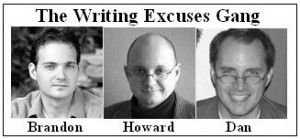
    John guests on Writing Excuses season 3 episode 19

    writing-excuses-the-guys2-300x139

    Here’s the third episode I recorded with the Writing Excuses guys.

    In the first podcast we talked about putting and not putting ourselves in our writing and making characters who don’t all sound like the author. In the second, we talked about how to not repeat yourself as an author. In this one, I shared some basics about generating emotion in readers and dealing with negative emotions writers face when they encounter rejection, compare their career with others, hit writer’s block, or hear someone didn’t like their story.

    As usual, the guys had some great insights. Check it out: Emotion in Fiction.

    Share

2 Comments

  1. With number (10) it sounds like he has Patrick Rothfuss or George R. R. Martin in mind. 🙂

    Of course, those two are a bit old-fashioned. They seem to work and procrastinate until they have huge, “perfect” books to release.

    With ebooks, I still think it makes the most sense to release early and often. Once the whole story has been serialized in ebook form (even if the individual pieces are rough), then you can always go back and collect it into larger books or ebooks, possibly with major modifications that you may have thought of while working on the pieces.

Comments are closed.