I spent 7 days in a car with Larry Correia, International Lord of Hate, and lived to tell about it

Larry-Correia
I think this was taken when someone stole  the ILOH’s Cheetoes

Seven days.

San Diego, Phoenix, and a wild trip through Wyoming, around Denver, and back to Utah.

Seven days.

Five nights.

In Arizona, I was told by a wild-eyed denizen of the Barnes & Noble we were signing at that my epic fantasy book was true–we are ruled by lizard people!

Imagine how shocking it was to learn that. I mean it doesn’t have anything to do with my book, but lizard people? A hollow earth? Is the CIA in on it? I don’t think I’ve recovered yet.

In San Diego, we rode around with Dave Farland in his old four-door sedan. A Lincoln? All I remember is that it was big and floated like a dream. After some narrow misses, Dave asked me to drive. Two big guys up front. One older, rough-looking guy being chauffeured in the back. At one point we walked to a restaurant during the day like some made man and his two goons. The restaurant was empty except for three rough characters sitting around a table on the far side. They looked at us, sized us up, then looked away. We sat at a table on our side.

In Wyoming we drove in high winds that sent streams of snow across the highway like multitudes of slithering snakes. At one point we passed one semi that was on fire, winds howling about. About an hour later, we passed a truck driver out in the median, thigh-deep in snow, a huge knife in his hand. He was trying to saw off the frozen antlers of an elk that had been hit. I looked up at his rig as we passed and did not see anyone behind the wheel. I swear the thing was rolling slowly down the highway, unmanned.

On the way back from Denver, we rode along a wintery, icy highway with trucks and cars littering the sides. Larry white-knuckled the steering wheel, but we made it. Two big guys, one 6’4″ the other 6’2″, in a tiny Ford Focus.

Did the very road fear the Lord of Hate? I cannot tell.

On this trip, Larry, that man of hate, brought a bag of Walmart beef jerky that smelled like, well, a particular kind of flatulence. What kind of person does that to beef? But we ate it. Because you do such things on epic journeys.

Now, here’s the thing. If you spend any amount of time with me, you will eventually tell me your life story.

You will.

Not because I’m a prier. But because I’m simply and sincerely interested. In people. If you work for the sanitation department, I’m going to want to know about garbage trucks. If you bowl, I’m going to want to know about bowling. If you’re some kind of wackadoo, I’m going to want to hear your wackadooness. Sooner or later, you’re going to talk. And, yes, there will be things along the way that I just might put in my zing file. That’s not why I’m talking to you. But sometimes the slices of life are too good not to capture.

So you put Larry Correia, International Lord of Hate, into a car with me, and he’s going to spill his guts.

Let me tell you what I found. Oh yeah, wait until you hear this.

Larry loves Bridget, his wife. No, do not turn away in horror. You must hear the rest of the tale.

He doesn’t like taxes, which is outrageous. Simply beyond the pale.

He’s a strong advocate of the right to bear arms. He figures people are safer with guns than without. And he was loaded. I remember getting to the hotel in Denver and seeing he draw his guns and put them on the table. A Kimber/Bul Poly .45 from his waist and a little Kahr MK9 on the ankle. Frightening. Of course, I never worried about going anywhere with him, but the guns had nothing to do with that.

He doesn’t like the idea of a small group of people in Washington telling folks what they need to do. He’s not anti-government. He just likes a minimal amount of government. This too is outrageous. Government is the source of all good in the world.

He doesn’t like a lot of what Franklin Delano Roosevelt did. One of those things he doesn’t like is the rounding up of Japanese Americans and putting them in war camps. Another was Roosevelt’s attempt to pack the Supreme Court with justices who would rule his way, essentially eliminating that branch’s check on the presidency. Nor does he like Roosevelt for being the first president to explicitly embrace deficit spending. The list with Roosevelt could go on. Of course, we all know that wise people everywhere thought Roosevelt made the right choice on these things.

Larry honors the folks who serve in our military and law enforcement. Big time. Guys and gals who put their lives on the line or support those who do. I roll my eyes.

Larry’s a big believer in pulling yourself up by your boot straps and getting to work. He worked on his father’s dairy farm milking cows early in life. Busted his chops in school. Busted his chops at work. Busted his chops writing novel after novel. And now he lives on Yard Moose Mountain. A supposed example of can-do economic mobility, which all smart people know is a farce.

I mean, work? Come on. Do you see how unreasonable the man is?

He’s an accountant and pretty good with numbers. Ergo he doesn’t like a lot of bureaucratic waste. It stinks to his accountant soul. And he saw a lot of that as a military contractor. I’m really for a lot of waste of taxpayer dollars, but I let him have his say.

Larry was once a bouncer.

He’s a big guy, but got his trash kicked in some early amateur MMA. But he still loved it.

LarryCorreiacismale
The International Lord of Hate in multiple colors

In a friendly wrestling match, he broke his roommate’s toe, and said roommate responded by breaking the International Lord of Hate’s nose. Yes, the nose, Ladies and Gentlemen.

Larry is funny.

Larry has a lot of friends because, shocker, he’s a friendly guy.

He’s also kind of a sheepdog.

Larry is a capitalist. And it appears he’s the dirty greedy kind who uses his capitalistic ties for helping folks down on their luck.

There’s more. But let me tell you what I never heard. I never heard him make a racist remark. Not even when he told me about growing up in California’s Central Valley, or when some idiot kids who had been tasked with beating someone up to to join a Hispanic gang targeted him. Never heard him make a misogynistic remark.

I did hear how he loved to argue with folks on the internets. And then saw that later when I started reading his blog. It’s clear Larry likes a good fight. He’s a barbarian with big boots. But, in truth, he’s a friendly barbarian.

That’s the expose. I know. Shocking, isn’t it.

Now he’s gone and done this Hugo thing and calls people names and uses four-letter words on his blog posts.

I’ve found that Larry in person is not quite the same as Larry online when you disagree with him. In person he’s usually very conversational when you disagree.

Some might say he needs to be more polite online. Use more class.

They might have a point. Sometimes I think he steps over the line. Then again, they might not. He does get people to listen. And some of the things he has to say are insightful and worthwhile. Others are just plain funny.

Whatever your opinion, all I know is that if you’re wanting Abraham Lincoln, you’re going to have to look elsewhere. If you come out swinging, he’s not going to regale you with Kumbaya.
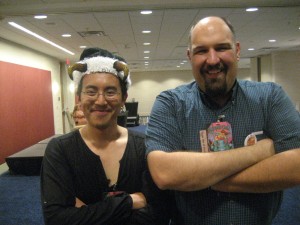
larrycorreia
The International Lord of Hate radiating fearsome hate

And because he fights the way he does as Internet Larry, his posts seem to push some folks buttons to the point that they actually miss his intent.

For example, when Larry responded to Alex MacFarlane’s call for “an end to the default of binary gender in science fiction stories,” he never once suggested that we should discriminate against the folks MacFarlane wants to read stories about. He never suggested there shouldn’t be any such stories. Nor did he ever suggest folks who are discriminated against never have a case. His point was that the best way to write an entertaining story was to put the entertainment first, not some political agenda. His point was also that he’s sick of folks trying to foist their interests on him and everyone else. If you want to write about certain types of characters, do it. But don’t tell everyone else they must.

That was lost on some people. All they saw was someone who disagreed “rudely,” and they saw red.  I’d be seeing red too if I felt ruded upon. At the same time, they still missed his point. A lot have missed his point about the Hugos as well.

But whatever happens with this latest kerfluffle, I had to tell my tale. Because I spent seven days with Larry Correia, International Lord of Hate. It was nip and tuck the whole time, but I survived his horrible onslaught. And then we enjoyed some ice creams and tropical trail mix, which I can happily report smelled a lot better than the beef jerky.

Share

Similar Posts

  • Another review and interview for Servant of a Dark God

    On Saturday, gun nut (and author of Monster Hunter International) Larry Correia had a group of his buddies show up to the signing. They explained the explosive target business to me. Larry read the book over the weekend and then held forth in this review.

    In this interview with Lon Prater I discuss the how much work it required for me to write this novel.

    Share
  • |

    Indie Thoughts: When an author should self-publish and how that might change

    From publishing consultant Mike Shatzkin:

    For a number of reasons, the belief here is that most of the time for most authors who can get a deal with an established and competent house, their best choice is to take it.

    Sounds reasonable, but then we get to the money quotes.

    The strength of the traditional publishers and the traditional deals is directly related to the amount of the market that is served by inventory in stores. When that proportion was “nearly all”, the power allocation was “nearly all” to the traditional publishers.

    ***

    Self-publishing and new-style digital-first publishing can grow more to the extent that the book-in-store share of the market shrinks more. But while that’s happening, the big publishers are also adding to their capabilities: building their databases and understanding of individual consumers (something that all the big houses are doing and which the upstarts seem not to believe is happening, or at least not happening effectively), distributing and marketing with increasing effectiveness in offshore markets, and controlling more and more of the global delivery in all languages of the books in which they invest.

    It will compound the pressure on the alternative players if Amazon continues to grow its global market share for ebooks. The bigger the percentage of the market that can be reached by self-publishers with one stop at Amazon, the less interest they’ll have in picking up smaller chunks of the market with additional deals and the more powerful will be any incentives Amazon cares to offer for making the title exclusive to them.

    Link to the rest at The Shatzkin Files, and thanks to Passive Guy for the original link.

    Shatzkin’s discussion of the amount of the market served by inventory in stores is right on. But his “best choice” conclusion doesn’t follow.

    Why?

    Because the question for each author has to be which stores will I be in, what kind of floor space will I have, and how long will I be there? And in many cases the answers to those questions do not compete well with indie options.

    For example, a lot of in-store sales come from the drug store, grocery store, airport, Walmart, Costco type venues. But it’s rare than an author getting an average deal will see the light of day in those places. Those are reserved for bigger sellers. And not very many of those. So unless you’re getting a big deal, you can’t count that floor space.

    Poof. Tens of thousands of venues are now no longer part of the equation.

    So you are now left with whatever number of stores the publisher can get you into at Barnes&Noble (a max of 675 stores), Books-a-Million (max of 200 stores), Hastings (max of 149 stores), non-chain stores,  etc. I think the total number of book stores in the USA is around 10,000 or so. But publishers won’t get you into all of them. Some don’t carry your type of book: they’re used books stores, or kids book stores, or Christian book stores. And even if it’s a store like Barnes&Noble, you probably won’t get into all their stores. So how many stores will you actually be in?

    Next, you have to wonder where you’ll appear in the stores you do get into. Will you be face-out somewhere prominent? Or will you have two copies spine-out in the back? If you’re spine-out, that’s just reduced the value of the floor space publishers offer you yet again.

    Finally, how long will you be there? If you sell your two copies in a store, are you done at that store? Will your books be there longer than 12 weeks? Will they be there even 8 weeks?

    James Patterson can sell millions of books because he has multiple copies in tens of thousands of stores with great display. And he’s usually there for more than just a handful of weeks. If you have two books spine-out in each of 500 stores for eight weeks, how well are you going to do?

    Here’s some math on author revenue and units sold. Is selling 1,000 books with the royalties and contract terms offered really worth it? What about 4,000 books? 7,000? Are you going to be in enough stores with a decent placement to get those numbers?

    If you’re going to be in thousands and thousands of stores with good placement, and the terms of the contract are reasonable, then, good golly, working with a publisher looks great. But if you’ve got a book that’s good enough to make an editor somewhere want to buy rights to it and the publisher is offering to put you spine-out in a little over a thousand stores with all sorts of contract crap, then Shatzkin’s “best choice” is really a poor one. In those situations my money is on going indie.

    EDIT: It seems there are about 12,700 book stores in the USA. But that includes big-box stores, which I think are the Walmarts and Costcos.

    Share
  • Good Stuff! The China Study

    T. Colin Campbell grew up on a dairy farm, loved milk, loved meat, and started his career as a nutrition scientist thinking the cornerstone of good nutrition was high-quality animal protein—meat, milk, and eggs.

    One of his first projects was for MIT, trying to help the chicken industry. Millions of chickens were dying each year from something toxic in their feed. What was the mystery killer? Campbell was responsible for isolating and determining the structure of the chemical. Through his work, he helped discover dioxin, one of the most toxic chemicals ever found.

    After helping with that, he began work helping malnourished children in the Philippines. He wanted to find ways to help them get more protein in their diets, because, again, protein was supposed to be the cornerstone of health. Part of the project was remedying an unusually high incidence of liver cancer in children, which is normally an adult disease. At the time, they thought a lack of protein was leaving the children vulnerable to aflatoxin in their diet.

    But as they began their scientific investigation, Campbell discovered the kids who ate the most protein had the highest rates of liver cancer.

    But that just couldn’t be right.

    And then he came across a study of rats and aflatoxin. The scientists in the study administered the cancer-causing aflatoxin to all of the animals. Half of the animals were then fed a diet with 5% protein. The other half were fed a diet with 20% protein. All of the animals fed a diet with 20% protein developed liver cancer. None of the animals fed a diet with 5% protein developed the cancer.

    Again, that couldn’t be right. Protein was good for you. A respected colleague suggested surely the researchers must have mislabeled the animal cages. Campbell decided to run his own studies and find out. Back at Cornell, he and his research assistants ran the experiment multiple times and in various ways. And all of the experiments confirmed that protein promoted cancer growth. In fact, they could turn cancer growth on and off by the amount of protein they fed the animals.

    But it wasn’t all protein. It was animal-based protein. The plant-based protein didn’t promote cancer growth.

    Campbell was astounded. The findings rocked his world, but he was determined to follow the facts wherever they led. This began decades of research into diet and nutrition. The culmination was what’s called The China Study. It is the most comprehensive study of nutrition ever conducted. And what all of his decades of research demonstrated was that “People who ate the most animal-based foods got the most chronic disease. Even relatively small intakes of animal-based food were associated with adverse effects. People who ate the most plant-based foods were the healthiest and tended to avoid chronic disease.”

    Campbell didn’t rest there. He sought out the findings of other researchers and clinicians. And what he found all demonstrates that “The same diet that is good for the prevention of cancer is also good for the prevention of heart disease, as well as obesity, diabetes, cataracts, macular degeneration, Alzheimer’s, cognitive dysfunction, multiple sclerosis, osteoporosis and other diseases.”

    What was the diet that showed such important results? A whole food plant-based diet. It’s a diet rich in legumes, whole grains, vegetables, and fruits with little or no meat, milk, and eggs.

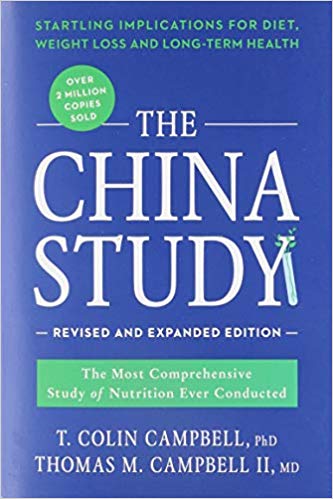
    Campbell has written a book for lay people like you and me that explains the science and findings called The China Study: Revised and Expanded Edition.

    The book is a fascinating masterwork of clarity. In it, he not only explains the research but also how and why various groups have tried to suppress and discredit the information.

    Campbell is not some crazy quack. He isn’t someone selling pills and supplement drinks on the internet. He has no financial interest in you believing him. He is one of the foremost researchers on nutrition, a renowned scientist at Cornell University, who has worked as a senior science adviser to the American Institute for Cancer Research, sat on government nutrition panels, and is on the advisory board of the Physicians Committee for Responsible Medicine.  

    If you or someone you love are worried about any of the following:

    • Heart disease
    • Cancer (breast, prostate, colon, liver, and others)
    • Type 1 Diabetes
    • Type 2 Diabetes
    • Erectile dysfunction
    • Multiple sclerosis
    • Cataracts
    • Macular degeneration
    • Osteoporosis
    • Alzheimer’s

    I think you will be interested in hearing what he has to report. Of course, you’ll have to make up your own mind about the evidence he provides. But I think you owe it to yourself to hear what he has to say.

    Share
  • YA Books Ratings and Publisher Arrogance (shh, it’s about the $$)

    I’m a bit irked.

    I wish I could talk to a publisher about this. I should talk to a Barnes & Noble corporate book buyer. But since I don’t have one handy, I’ll discuss it with you folks. Maybe I’m up in the night? You tell me.

    Here’s the deal. My wife is 7th and 8th grade language arts teacher. My wife is also a mom who loves books and wants her girls to read until their eyes bong out of their heads.

    So we go to find books for her students and for our girls and, jeez, wouldn’t you know it, but this YA book features masturbation and that one features lots of fine words like F*** and S*** and this one is about giving the guys a blow job (tee, hee, hee).

    Yeah, I know about YA saves. This isn’t about banning this or that content.

    It’s about the fact that I’m a parent. And, geez, I have a certain way I want to raise my kids. My wife is a teacher who needs to provide books to her students that aren’t going to piss some parent off. Why? Because she’s providing a service to that parent. Because she wants to keep her job. And because it’s her job to help parents improve their kid’s reading ability not tell them how to raise a family.

    So why in the Sam Hill can’t publishers rate their books?

    There are millions of their customers who would find this useful.

    Well, here’s one answer I was given by a writer friend I respect.

    Everyone in the industry is really pushing back against the idea of a rating system. Let me see if I can explain why.

    A friend of mine, ZZ [name removed], is the nicest person in the world. Volunteered for years at a prison to help people learn to express themselves by writing. Her older brother was a closeted homosexual for years, contracted AIDS, died too young. She wrote a book recently called [title removed], about a family in the restaurant business (as hers was) who have a “late” baby and the problems it causes for the older teens, one of whom is coming out as gay. It’s a soft, quite, sad, moving book. And it would be part of the “rating” system and banned from a bunch of schools. ZZ also wrote a book a few years ago about teenage pregnancy. Also beautifully written, kind, compassionate. But it would get tagged by schools as “inappropriate.” ZZ feels strongly that there are kids out there who need books, kids in your wife’s school system who need to be told they are not alone.

    I don’t see any way to have a system that distinguishes between books that I see as anchors to kids who need help and those books which I see as genuinely offensive and encouraging bad teen behavior by glorifying it. The only system I know is me recommending the best books I see. And I’d much rather see librarians and school teachers go through books on a case by case basis, deciding whether they personally think it fits the values in their community than to have someone else not attached to the community do the same thing.

    Uh huh.

    If this is accurate, it shows the industry’s stunning lack of creativity AND arrogance. Because if publishers really were listening to parents, they could come up with a solution.

    No, really. They could.

    Why, there’s already one out there. They don’t even have to expend even one creative molecule to find it.  

    Look at the Kids-in-Mind rating system: http://www.kidsinmind.com/. It rates movies 1-10 on sex, violence, and profanity (SVP).

    There’s no age stipulation in their ratings.

    Unlike other rating systems, there’s no “children under 13 not admitted.” No “appropriate for teens.” No recommended range for this or that group or this book is good and that one’s bad.

    It just rates the content and gives it a number. You, as the user, determine what level you’re comfortable with and then find the movies that fit.

    I’m a 4-10-4 on sex, violence, and profanity. You might be a 5-2-9. That’s not good or bad. It’s just what it is. More importantly, the rating allows me as a consumer to EASILY FIND AND PURCHASE THE PRODUCT I WANT.

    I know some folks have never heard of it, but consumer choice is a really cool thing.

    And if I hear about a movie that’s amazingly good, but I see it doesn’t match my normal levels, then I can make an informed choice to watch or not watch. The King’s Speech, for example, is a bit above my normal profanity setting. But this didn’t prevent me from watching the film (it was a fabulous movie, btw). SVP just gave me a couple of pieces of simple data I find useful as I make my choices. Data I’m already looking for.

    If publishers were to use a similar rating system, every librarian could peg the levels they wanted in their school and be done with it. As well as consider special cases. Teachers could peg the level for their classroom. Parents could search and find and buy. And they could guide their kids in their purchases as well.  

    Make it easy for them to go case-by-case. And don’t imagine librarians and teachers and parents are going to read every YA book published to find those that fit with their values. They don’t, can’t, do that now. They won’t in some utopian future. If you give them SVP ratings, it will help them spend their time, case-by-case, on books that they’re likely to buy. Which probably means they’ll buy more.

    Write about homosexuality, rape, whatever. But make it easy on the consumer to see if it’s the kind of product they want to buy.

    Some might say, but themes of homosexuality and rape and child abuse etc. etc. are important and would be automatically excluded!

    No, they won’t.

    You can write a story about those themes that scores low on SVP. You can write about those themes and score high. Themes are outside the SVP scale.

    Some parents, librarians, and teachers may want to avoid some themes. Others would seek them out.

    So, good golly, here’s an idea only a rocket scientist could come up with. OR someone who took the issue a tiny bit seriously and wanted to serve their customer. How about a little box under the SVP rating that contained “sensitive” themes.

    They don’t have to do what Scholastic does with its school catalogs and label them “mature” themes, which might suggest “mature audiences only.” They’re not “mature” themes. They’re not “bad” themes. They’re not “good” themes. They’re just sensitive themes.

    SVP and Sensitive Themes: four little pieces of data consumers would find oh so incredibly helpful.

    But no. The industry can’t be bothered with that. And, consequently, reveals its arrogance and total lack of respect for a HUGE portion of their customers.

    I guess they think librarians are mindless idiots. Never in a million years, if a librarian is tuned into the needs of her community and thinks a book on homosexuality would be important, would she search on that sensitive theme and her SVP ratings. And parents would never do that for sure (do you know how many gun-clinging troglodyte parents there are out there!?)

    I guess the industry thinks because it sits in an office in NY City that it knows everything about raising kids. It knows so much it must dictate to parents how to do it right.

    Yeah.

    Or maybe what this really shows is that the publishers have got a book they want to sell. They want to make a buck. And, dang it, this might hurt sales. Because then people wouldn’t buy things they didn’t want.

    They really don’t seem to care about what many of their customers want. Because if they did, and they realio trulio cared about these sensitive topics and saving the world, then they’d publish books high on the SVP because they’re just sooooo goooood, but they’d also publish books on those topics that are equally as goooood with SVP ratings that the majority of parents and school districts would be comfortable with.

    And they’d let the customer choose what they wanted to purchase.

    Customer choice. Customer service.

    Wow, what revolutionary concepts.

    They even might find that if you delight the customer, they’ll come back for more.

    I know, I know. I’m living in fantasy land; delighted customers coming back for more . . . as if.

    Question is: will the publishers listen?

    We’ll see. I truly hope I’m wrong about their arrogance and disregard towards huge swaths of their customer base. In the meantime, you might want to think about talking to the manager of your favorite book store about this. Strangely enough, books stores have a lot of pull with publishers.

    You also might want to look at Kids-in-Mind. It seems to make a lot in advertising. Looks like there’s money to be made in a review site like that for YA books. I know a lot of people who have said they wished they could just read books for a living. Anyone feeling entrepreneurial? Anyone?

    EDIT

    Two more points.

    First, what’s sensitive for one person may not be for another. But that’s the beauty of this. This only identifies subjects that would be sensitive for reasonable sections of the market. For someone with your reading tastes, you’d say, eh, homosexuality, big deal. That’s not a sensitive subject. For others, they’d say, hum, have to think about it.

    It’s just giving data. A respect and recognition of different tastes. Not a prescription of what someone’s taste should be. Or what people should or shouldn’t feel is sensitive subject matter.

    For this reason, I don’t think publishers would want to use the word “controversial” because that implies controversy. Just sensitive (or some other similar label). Or even “Potentially Sensitive Themes.” This is just giving data about content areas SOME parents might want to know about.

    Second, the SVP is not going to be 100% perfect. But something is much better than nothing. And having some clear standard for rating, whatever it is, pegs things so you can figure out where you are. As long as the raters are fairly consistent, then you can tell if something is close to the type of product you’re interested in. There will be goofs. No doubt about it. Huge goofs would be probably very infrequent because a ten-point scale allows you to make gradual distinctions. But I’ll take some goofs now and again over nothing at all.

    Furthermore, because it’s NOT age-based like the MPAA and prescriptive in the target audience, it’s not telling parents what to do. There is no “good for your kids” and “bad for your kids” rating. Just the level you’re comfortable with.

    Finally, some people object to ratings because “how can you boil a book down to a few numbers?” I don’t think this boils a book down. It’s only a couple of pieces of data about a book. Data parents are already looking for. The cover, recommendations, word-of-mouth, flap, description, buzz–these are all pieces of data as well.

    In fact, you and I exclude many books based on genre labels alone. And yet we don’t worry about a genre labels much. They’re useful pieces of information. Are they always perfect? No. But they’re by-and-large very useful. I don’t see that this is much different. Just another piece of data to help consumers find what they want.

    Share
  • Gun Runner wins Dragon Award

    I was very happy to receive news that GUN RUNNER, the novel Larry Correia and I wrote together, just won the 2021 Dragon Award for Best Military Science Fiction or Fantasy Novel.

    The Dragon Awards are a set of literary and media awards presented annually by Dragon Con in Atlanta, Georgia for excellence in various categories of science fiction, fantasy, and horror novels, movies, television, and games.

    And the cool thing is that these awards are voted on by fandom, meaning thousands and thousands of folks voted.

    Past winners have included authors such as Terry Pratchett, Brandon Sanderson, Rick Riordan, and Stephen King.

    As stated in earlier posts, the seed came from Larry’s eleven-year-old son, Joe.

    When Larry and I sat down to develop an idea for a workshop we were holding for Life, the Universe and Everything, a large annual writer’s conference in Provo, a number of years ago, Joe was listening in on the stairs.

    We settled on a genre, and then Correia asked, “Hey Joe, what’s cool?”

    Joe immediately popped up and said, “Giant robots, bandits, and murderers.”

    “We looked at each other and said, ‘Dang, that IS cool.’”

    Forty minutes later we had the key elements we needed for the story we’d use in the workshop. A number of years after that workshop, Baen Books wanted a collaboration from Larry, and that story was one of the first he thought of.

    Larry and I are both frequently asked to present at writers conferences. And one of the tips each of us shares to new authors is to loosen up and have fun. One of the keys to writing an entertaining story is to simply ask, “What’s cool?” And go from there.

    I’m thrilled and honored that those who voted selected Gun Runner for this award.

    Share

14 Comments

  1. I have not had the pleasure of spending time with Larry (or even meeting him, despite the fact that we live in the same city), but this is very much how I imagine it would be. Thanks for the confirmation.

  2. Wow. What a series of inconvenient truths for those who have suffered butthurt from Larry’s opinions.

  3. Nice picture of Larry on the top there. That’s probably the view a lot of short, wide, shrill little Social Justice Warriors get at conventions, I’d wager.

    I bet SJWs are more polite at conventions than on the Intertubez.

  4. Larry is a teddy bear unless riled… Then stand the F by… 🙂 And he IS also a supporter of the folks that helped him get where he is. As far as the HUGO BS… He did nothing different than the others, (well he proved he had more readers), but that’s an aside… 🙂

  5. You’ve sumed up Larry very well. I also count him as a good friend and he’s one of the nicest, kindest people I’ve ever met. Yes, he’s big, loud and opinionated, but he always does it with a smile that’s very disarming.

  6. As someone who knows Larry, I appreciate your well-reasoned post. Lest anyone doubt that you (for some arcane reason) are making up this event, let me verify that Larry is just how you described him.
    As Sqt said above, this is one of, if not THE, best responses to the Hugo Event.

    Thanks, good sir.

  7. Well Said John.
    Larry, is a kind giving, fun guy to be around. Had dinner with him after a book signing and loved the stories, and fun that were enjoyed by all.
    The stories I loved the most was how he came up with the enchanted forest trailer park scene in Monster Hunters International and his first book signing at a gun show.

Comments are closed.