Author Janci Patterson Goes Indie

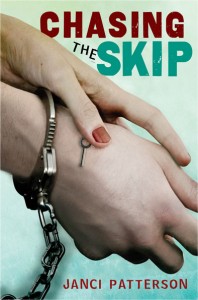
Everythings Fine by Janci PattersonI met Janci Patterson a few years ago when she was shopping her book Chasing the Skip to NY publishers. It’s about a girl named Ricki. Her mother flakes and runs off,  and so Ricki goes to live with her estranged Dad who happens to be a bounty hunter. I was hooked right there. But it gets better. Ricki gets to ride along and help and, wouldn’t you know it, develops a crush on a guy the dad is chasing.

I loved the premise. Traditional publisher Henry Holt loved it too and thought Janci had done a great job telling the tale, so they made her an offer that Janci accepted. It was published in 2012.

Sounds like a match made in heaven, right?

Well, Janci just released another book called Everything’s Fine, a mystery about a girl named Kira. Her best friend commits suicide immediately after her first date with her longtime crush, Bradley Johansen. Kira’s devastated and wondering why. She’s sure the answers are in her friend’s journal. As she searches for it she quickly learns she’s not the only one who wants that journal. Someone else is trying to keep the secrets the journal contains hidden.

Another great premise. And this book won the Utah Art’s Council award for Best Young Adult Novel. Clearly, Janci can tell a story. But Janci didn’t take this one to NY.

She’s publishing it as an indie.

Here are her own words explaining what helped convince her going indie was doable.

A Paradigm Shift

For years I refused to think about self-publishing. This wasn’t because of the stigma, honestly, but because of all the work I watched my self-publisher friends put into creating, shipping, and marketing their books. I couldn’t do that! I told myself. I wanted to be a writer, not a publisher.

When it became obvious to me that self-publishing was the next logical step in my career, I was terrified. Having published with a big publisher, I wasn’t willing to skip steps in the publishing process–it was my editor’s keen eye and the rounds of revision we did together that transformed CHASING THE SKIP from a messy dJanci Patterson - Chasing-the-Skip-webraft into a product I was proud of. I wanted to be just as proud of my independent work, and for that, I knew I’d need help.
I knew just enough about book and cover design to know that I couldn’t slap them together on my own and expect them to be instantly good. But when I did the math on what I’d have to pay an editor and a book designer and a cover designer to put out even one book (let alone the several I have waiting), I knew that I couldn’t afford it. Self-publishing felt even more impossible than selling books in New York–I knew how I wanted to do it, but I didn’t have the resources.

So it was with this trapped feeling that I attended the Precision Editing Group’s workshop on indie publishing last fall. The workshop was packed with great information, but the thing that impacted me the most was a presentation by Heather Horrocks. She was talking about the importance of editors, and as a side comment, said something to the effect of, “yes, all my books have now been edited, but when I first got started, I didn’t have an editor because I couldn’t afford it.”

It’s not my intention to suggest that editing isn’t important, because it is. But that one sentence blew my mind. I’d been working with the New York publishing paradigm for fourteen years. And in that world, there are very few ways to be published. You query agents. You send books to publishers. You do your very best to follow all of the guidelines and to do everything perfectly right, hoping to minimize the barriers that stand between you and success as a writer.

But this self-publishing thing was a whole different game. I sat in the audience at the workshop, stunned. That was the moment when I finally realized this truth: there are as many ways to publish as there are people who are publishing. There is no one right way to do it. There are so many things you can do that can help you succeed. It’s better to do something than nothing, because nothing is never the road to success. Even if that means you’re doing it wrong.

So when I got home, I made a list of my assets. Forget about what I lacked. Forget about what I didn’t know. What did I know how to do? What resources did I have access to? And, most importantly, who could I ask for help?

If you’re looking to self-publish, I’d suggest that you do the same. Because here’s the thing–your list of assets is going to be uniquely yours. You have a unique set of skills; you know a unique network of people. You don’t need to worry about who and what you don’t know. Instead, focus on what you do have, what you can do. If you’ve been writing for years, you probably have some book-related skills. If you’re part of a community of writers to which you regularly contribute, you probably have some friends who you’ve helped in the past, or can help in the present, who would be motivated to help you out in return. Start from there, and you can pick up the rest as you go along.

In the end, I did have my book edited (repeatedly!) and my cover designed by a graphic designer. I was able to do that because I had friends who believe in me who were willing to enter into financial agreements that didn’t involve them getting paid in full upfront. I wouldn’t have thought to work out those arrangements when I was focused on doing things right–it was only when I opened my vision to look at what was possible that I began to envision what shape my own unique path might take.

Each path to publication is different, not only for each writer, but also for each book. With all the options available to us, it’s not enough to focus on our feet, doing only the next “right” step. Opportunity is everywhere. Focus on what you have, and even if you don’t win the jackpot on the first try, at least you’ll be playing the game.

 

Share

Similar Posts

  • Where the Wild Things Were by William Stolzenburg

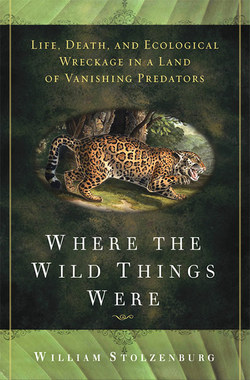
    I live among ranchers in northern Utah, people whose livelihood walks around on four legs. People who can lose thousands of dollars of future income if they lose one good cow or calf. People who think one of the dumbest things to happen in recent times in the West is the reintroduction of wolves to Yellowstone. Now, I don’t agree with them, but I do think they have good cause.

    Contrary to what people will tell you, wolves do not kill just for food. Wolves kill because they like killing. If you don’t believe me, then believe Temple Grandin, an expert on animals, who asks the question in her Animals in Translation: “Is it fun to kill a groundhog?” 

    She reviews a number of studies done on animals and answers with an unequivocal yes, predators love to kill. In fact:

    “Animals like having their predatory killing circuits turned on, and will turn them on themselves if you show them how. When you think about what predatory killing is all about, of course it ought to feel good, because predatory killing means dinner. Killing a mouse feels good to a cat the same way finding a luscious ripe banana feels good to a primate.” (p138)

    What this means is that when wolves come to kill sheep, they don’t just kill one old and decrepit ewe. No, they do what they did on a neighbor’s land a few miles from my home. They maim and kill five or six. Not because two wolves were that hungry, but because it was fun and they could.

    Sheep are like popcorn to wolves. Compare them to elk or other wild animals. The reason why wolves tend to indeed eliminate the young, weak, and old in the wild is that those poor specimens tend to run a bit slower than their brethren. In the wild, slow means dead. For the wolf, it’s hard work to run down an elk or buffalo. And if you’re a hungry son-of-a-gun, you’re not going to go chasing after another dinner while there’s fresh meat in front of you because the rest of the pack will eat it before you get back. And you ain’t going to catch one on your own anyway. But sheep aren’t elk. Cattle aren’t elk. They’re bred for meat, not sprinting. Sheep are easy meat. And the wolves can’t help themselves.

    But even if the wolves exercise restraint and eat just one, that’s cash. That’s clothes for the kids. That’s a mortgage. That’s heat. And it’s a danger for children as well (adults I don’t worry about: who cares about a few devoured adults?). My girls like to hike. And while I’m sure wolves will usually stay away, a sick or starving wolf will risk humans just as sick and starving mountain lions do. You get a different mindset about predators when you live up where I do. When they’re not something you see caged up in the zoo or on PBS.

    For all these reasons and others, I couldn’t wait to read Where The Wild Things Were by William Stolzenburg. Folks, the book is fabulous–well-written and interesting from page one to the very end. The key point is that predators play a huge role in maintaining a healthy diversity of both plant and animal life in any given ecosystem. Stolzenburg begins with starfish and moves through otters, killer whales, jaguars, mountain lions, and wolves. Along the way he reveals just how important killing is.

    Yes, killing is critical to life as we know it.

    Because without it, the most dominant herbivores will end up eating all the food. And this will end up killing off most of the other herbivores. It will kill off the great variety of flora in any given system. It can turn a paradise into a hell as Stolzenburg illustrates with the islands of Lago Guri in Venezuela. 

    Of course, some people think the answer is to bring back all the big predators. The rewilding supporters want to populate the West not only with wolves, but also lions (African), jaguars, cheetahs. Heck, they salivate at the idea of giant Pleistocene bears that can run faster than a horse (yeah, I want one of those up where the Boy Scouts camp).  I think it’s good the wolves are back in Yellowstone. But I don’t want packs of wolves eating my friend’s herds and daughters (of course, maybe a few Boy Scouts are okay). Still, I believe there has to be another alternative. What that is I don’t know. But we all need to think about it. We do. And great way to start is by reading Stolzenburg’s book.

    Share
  • Peak

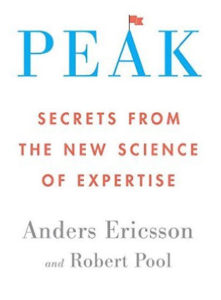
    peakbyandersericssonHow many pushups can you do in a row?
    10, 20? Could you do 100?

    And you’d have to be a freak if you could do 500 in a row, right?

    Well, no.

    You’d just be human.

    In 1980 Minoru Yoshida of Japan did 10,057 pushups nonstop.

    In 1993 Charles Servizio of the good old USA did 46,001 pushups in 21 hours and 21 minutes.

    In 2016 David Escojido of the USA did 2,298 pushup in 1 hour.

    You might think that these folks must be oddities. They must be gifted. They must have some weird thing in their DNA allowing them to do these things.

    But you’d be wrong.

    None of these people were born that way. In fact, what researchers are finding is that most of the folks that we think are prodigies—folks like Mozart, Tiger Woods, chess masters who can play 20 games at once without even looking at a board—the biggest thing that separates them from the rest of us isn’t DNA.

    Anders Ericsson, a researcher at Florida State University, has spent the last 30 years studying what gives experts their edge. And he reveals in Peak: The New Science of Expertise that he and other researchers have found that while there are some physical traits like height and size that definitely make a difference in some physical activities (notice how all the top gymnasts are short), what really sets people apart is how much of a certain type of practice they’ve done.

    Not just practice, but a certain type of practice.

    Practicing “hard” doesn’t do much for you. Putting in a lot of hours doesn’t do much either. Instead, you need to practice in a way that has been shown to lead people to actually improve their performance. You still have to put in a lot of time practicing—there is no shortcut—but only the type of practice he explains in the book seems to lead to the increase of performance.

    Is he saying that anyone can do anything?

    No. When I first looked into his research, one of my big issues was that it seemed he was claiming anyone could do anything with 10,000 hours of practice.
    But he’s not saying that.

    Is he saying genetics has no influence?

    It can, but what he’s found is that it doesn’t have the role we normally think of when we think of top performance. And, most importantly, we place artificial limits on ourselves by thinking people are born to this or that activity.

    There is far too much to post here. What you need to know is that what he shares in this book is fascinating, compelling, and surprising. I’ve been training people for over thirty years. And I found myself enlightened. If you’re at all interested in education, or getting better at some activity (from parenting to golf), or helping your kids get better, you’ll want to read this book. Highly recommended.

    Share
  • |

    Jolie, Salt, & trading suspsense for surprise

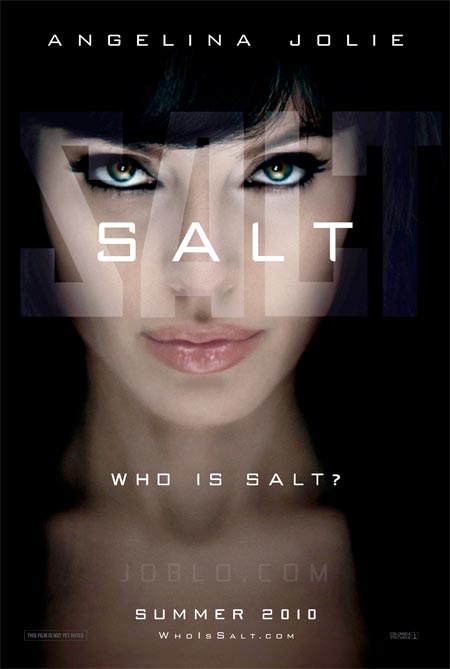
    Last week I went and saw Salt. Wow. The movie started with a bang and was off to the races with lots of great action. Unlike many action films where the characters perform stunts which are simply too hokey for me to buy into, I found myself believing in all but two of Salt’s. So I was wowed most of the time instead of thinking about whether they were using wires or what or that it was all so wrong and geeze don’t these guys have consultants? They weren’t as stunning as the opening of Casino Royale, but what is? 

    But it wasn’t just action. The premise and acting were all great as well (yes, I recant, I slammed Jolie a while back as an actress cast only for her face value; and while you know that’s one of the reasons why she was here, she still was convincing in her role). Furthermore, the story had a lot of great reversals and reveals. But this was also its ultimate downfall.

    When I got to the ending, I did not feel a climax release. No catharsis. No afterglow. It just ended and left me feeling empty. It’s an awful feeling. Totally unsatisfactory. Such a maddening cut off. 

    But why? It was all so good up to that point.

    *** SPOILERS ***

    As I was talking it over with Nellie I believe I indentified the answer: in their effort to be surprising, the director and writers removed everything that would have built suspense. So instead of getting a Sixth Sense ending where the surprise adds to the climax and gives it a wonderful texture, we got a slap of surpise and then nothing.

    For me to feel relief, triumph, and the desire to stand up and cheer–all those great climax emotions–I have to be worried about a character. Stressed, thinking they’re going to fail. They need to fight courageously against insurmountable odds and actually come to a point where it appears all is lost. Where I groan inside. All this creates massive pent up worry and anxiety for them. And at that point, the character snatches victory from the jaws of defeat.

    Boom! The climax floods me and it’s delight, relief, cheer, joy.

    It’s just like a football game where we bite our nails until the very end. Where our non-ranked team is playing the #3 team in the nation. Maybe we jump ahead in the second quarter, but in the third we fall behind. We make some great plays but can’t catch up. And when we do put points on the board, the other team immediately responds. There are three seconds left. We’ve stalled at the twenty yard line. We have one more play. From the moment it starts it appears to be broken, our QB is going down, and then . . . he passes to a running back who has made some space. Who is standing open in the end zone! Yeeeeeaaaaaaahhhhhh!

    In order to feel a release a climax, something has to build up. The thing that builds is worry, fret, desperate hope. This is what we mean when we talk about suspense. We know the team’s goal, see their predicament, see the overwhelming odds. See them about to lose it all. The dread of defeat and what will be lost rises.

    But in Salt the director and writers went for the effect of surprise instead of suspense and triumph. The moment Salt starts in on the Russian president I thought she was the bad guy. Yes, there was the bit about the spider that had me wondering. Yes, I knew she felt anguish about her husband being killed (that smart little reveal in her expression). I knew all of that. But the movie kept me busy thinking she was the bad guy up until almost the very end. Everything in the film lead me to believe this. Not because I didn’t get it. I got it precisely. It’s exactly what the director wanted. It was the setup for the big surprise/reversal at the end.

    But when they went for surprise by not letting the audience know what Salt was really up to, the immediately removed the possibility of suspense. So I didn’t feel any suspense at her infiltrating the old group of spies. No relief at her killing them–that was just her revenge. No suspsense when she went to the White House. Nothing when she chased the president down the elevator shaft. The whole time I was thinking, crap, they really did indoctrinate her. She’s bad.

    More importantly, there was no rooting, no worry building to release proportions.

    Not until the very end do we realize what she’s been trying to do. Oh, the role reversal with her and Ted Winter (btw, like Liev Schreiber who plays the part) was all a big surprise, as it was designed to be. But the surprise faded and there was . . . nothing to replace it. That’s how surprise works. It’s a relatively short effect. 

    Yes, she kills Winter. Yes, he was a threat at the end with his scissors, but I didn’t care that much. I hadn’t been whipped into a fever pitch. Not like I was in Gladiator with the emperor and the lead in the coliseum. There was no pressurized worry ready to burst. There wasn’t any because we hadn’t had any time for it to build and because by that time nothing for Salt was really at stake. The one meaningful thing she stood to loose–her relationship with her husband–was taken away from us in an earlier scene when he was shot dead. So what was at stake? A big old nuclear war. Well, who cares about that? Nobody. It’s too generalized. We cared about Salt and her husband.

    The result was that the director and writers traded climax for surprise. Alas.

    So here’s my conclusion. Surprise is a relatively easy effect to create. You simply have something unexpected but logical occur. Relief, triumph, climax needs something much different. And surprise can be a part of it. But in our effort to build surprise we must not remove the conditions necessary for please-dear-mother suspense. Suspense requires we root for and worry about a character for a significant period, our unease growing until it’s drawn taut, straining. All the time something significant has to be at stake. Something we can sympathize with. Something personal to the person we care about. Only then can we feel the climactic release. Only then will we stand up and cheer in holy-crap-no-way relief and delight.

    Share
  • Basic Economics, Avatar: the Last Airbender

    How to not be duped by political blarney

    Karl Marx was not a scientist. Nor was Adam Smith before him. They were philosophers. Theorists. Idea men. That’s what all economists in those days were. They had little tested knowledge, and so which economic system was best was all a matter of opinion.

    But things are now much different. Nations and local governments tried the various theories. And we’ve seen the results. We now have a whole century of data. Furthermore, economists now are scientists. They use scientific methods and deal with tested knowledge. Sure, there are still controversies, just as there are in any science, but the basic principles of economics today are NOT matters of opinion.

    For example, we know what happens when governments impose price controls in all their many varieties—rent caps, minimum wages, laws against price gouging, and medical care cost limits. These last few years we’ve seen a dramatic demonstration of what happens when they meddle with the prices of home loans. We know what happens when they impose tariffs or give subsidies to special groups like farmers or steel producers. We know what happens when they create barriers to people entering a market to compete, like they’ve done with immigrants. We know what taxes do.

    The unfortunate thing is that many of these principles seem to be ignored by our politicians. And by those who vote them in. And so we can have a Congress pass massive health care legislation that will cause health care shortages just as similar laws caused shortages in other countries. This is how we have a president who in a recent speech to the U.S. Chamber of Commerce suggested, in good Marxist fashion, that it was business owners who kept the American workers down by hoarding all the profits. Has he not looked at the data which shows that huge profits invite more competition, which tries to get ahead of the leader by cutting prices, which allows the American workers to get more for less, thus raising their standard of living?

    In the 1980’s and 1990’s India and China began to make fundamental changes to their economic policies, doing the things that have been proven to work. Suddenly, the economies of those nations started to grow. It’s estimated that 20 million people in India rose out of poverty in a decade. In China, more than a million people rose out of poverty EACH MONTH.

    But this seems lost on a number of politicians. Don’t let it be lost on you. We have critical elections coming up. One of the best things we can do is educate ourselves about these basic economic principles so we can cut through all the political blarney. I haven’t found a better, more enjoyable book on the subject than Basic Economic Principles: A Common Sense Guide to the Economy by Thomas Sowell. Sowell is an economist and Senior Fellow on Public Policy at the Hoover Institution at Stanford University. His book is written for the general public and so foregoes dry charts and theoretical ho-hum for lots of real-life examples and straight-forward explanations. There are times when I wish he would have gone into more detail on a few subjects, but what he lacks in depth in a handful of areas, he makes up with breadth. Furthermore, the way he presents the topic was interesting enough to make me stay up late a number of nights well past my bedtime. 

    Great family entertainment

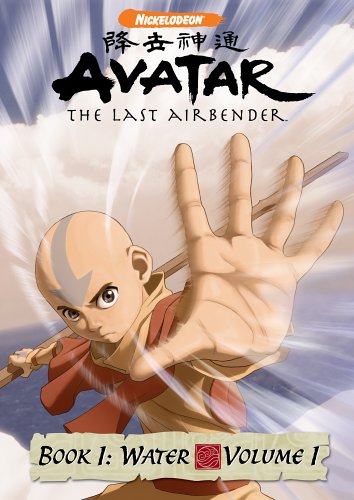
    Do you want some fun family entertainment that includes laughs, wonder, and moments of poignancy? Something you can watch and enjoy with the kids? Then let me recommend the animated TV series Avatar: The Last Airbender. This is NOT the movie Avatar by James Cameron with all the big blue people Nor is it the movie The Last Airbender, based on the TV series, which many fans disliked. This is the original. The one that millions love.

    Through the miracle of Netflix, I started watching it with my girls a few months ago. And we’ve all been sucked in. It’s unlike any “cartoon” I’ve seen. In fact, you can’t call it a cartoon just as you can’t call The Incredibles or Lion King cartoons. This is great story telling. Furthermore, instead of it being a bunch of unconnected episodes, this series is telling a long story. It ran for three years on Nickelodeon and includes more than sixty 22-minute episodes.

    The series follows the adventures of the main protagonist Aang and his friends, who must save the world by ending the destructive war with the Fire Nation. Aang’s world is divided up into four nations—Air, Earth, Water, and Fire. In each nation are “benders” who can powers with the element of that nation. So Air Benders can fly and create huge winds; Fire Benders can generate and throw fire; Water Benders can create ice and waves.

    So it’s fantasy, and all of that is cool, but it’s the characters that we enjoy the most. We quote and laugh at some of their lines. And then there are the episodes with true dramatic moments.

    Avatar has been nominated for and won many awards, including the Annual Annie Awards, the Genesis Awards, the primetime Emmy awards and a Peabody Award. It’s excellent entertainment.

    Share
  • Short Reviews: Icefall, Gravity, 42, Z, and Lynda.com

    The last few weeks I’ve been burning the candles at both ends with publication tasks. So no time for long reviews, but I still wanted to share.

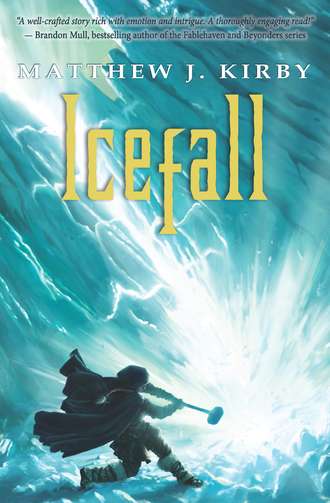
    Icefall by Matthew KirbyIcefall by Matthew Kirby

    Wow. I loved this book. LOVED IT! It’s Norse historical fiction. A war is coming, and the king sends his children away to a remote fjord steading to keep them safe. He also sends a number of trusted warriors, a company of beserkers, a cook, a thrall, and a skald. But the fjord isn’t remote enough.

    It’s a fine tale full suspense, wisdom, surprise, and two lovely character arcs. It’s told from the point-of-view of Solveig, the king’s plain daughter. And her voice and the details Kirby includes totally transported me to their world. A wonderful tale, wonderfully told.

    Gravity

    I don’t know if I like 3D very much, but Bullock and Clooney do a marvelous job. Do you remember Tom Hanks in the excellent Castaway where he’s marooned on a tiny island? This is Bullock’s Castaway, except the physics of space are deadly. A great film.

    42

    This film is about Jackie Robinson, the first Black man to play in the White leagues of American baseball, and recounts his first year. It stars Harrison Ford as the owner of the Brooklyn Dodgers, the guy who is determined to bring Blacks into the game he loves, as well as Chadwick Boseman who is new to me. I watched this with the whole family, and we were all enthralled. What a great story.

    World War Z

    I not a big zombie fan. So for me to recommend this means it had to be good. It was good. A delicious thriller with plenty of scare. I really liked the thriller feel to this. My wife and two youngest daughters sat on the couch holding each other’s hands. I sat in my La-Z-Boy throne heart pumping with the action.

    Lynda.com

    As I mentioned above, I’ve been working hard trying to get my books out the door. (Please, boys, just get out! It’s time for you to make your way in the world!) I’m using Adobe InDesign to format them for Kindle and EPUB, but I barely know the program. That caused some big problems. But then I subscribed to Lynda.com–a training website. I can’t tell you how happy I am that I did.

    For $25 per month (and you can just subscribe for one month), you get access to hundreds of high-quality online classes recorded by experts. Each class is usually a few hours long, made up of videos that are usually each shorter than ten minutes. The site allows you to create playlists of various courses you want to take, makes recommendations, and lets you know which videos in a class you’ve watched. It also includes a verbatim transcript so you search for the part of the video that’s interesting to you.

    The workhorse I’ve been using is “InDesign CS6 to EPUB, Kindle, and iPad” by Anne-Marie Concepcion. It’s 7.5 hours long.  I’ve also been referring to parts of “InDesign CC Essential Training” by David Blatner and “Creating Long Documents with InDesign” by Mike Rankin. And I have 16 other courses in my playlist that I can’t wait to get to like “Designing a Book Cover” by Nigel French and others on graphic design, typography, and logos.

    If you need training on some software product, go out to Lynda.com and see if they have a course for you.

    Share
  • Good Stuff! StoryBrand

    Folks running for office, especially our wonderful citizens running for local county offices, business owners, and any of the rest of us who what to persuade people to listen, I’ve got something for you.

    I will bet that most of you aren’t aware that you’re muddling your message and losing votes, sales, and converts to your causes.

    Of course, maybe you’re way ahead of me. I thought I knew what I was doing. I have a master’s degree in business, spent a few years in business consulting, have created a few small startups, and currently am a product manager for large software company. Despite all of that, I had somehow missed something vital. Something simple and powerful. Something that has a dramatic effect on sales, votes, and converts. On getting people to even listen to what I had to say.

    And I’m not alone. I saw another company struggling with it this weekend.

    On Saturday I went and watched the latest Marvel movie at a theater in Logan. One of the pre-movie video ads was for a local company called Conservice. I don’t know how many thousands of dollars they spent on the ad they played. Or how much they spent on the many other ads we’ve seen over the years. But when it finished, I turned to Nellie and said, “I still don’t know what that company does or why I should care.”

    “I know,” she said. “I know.”

    We were both baffled. After years of seeing their ads, we still have no idea what they do, how it would make our lives better, or what action we should take to use their service.

    They have wasted thousands and thousands of dollars on their marketing.

    There’s another local company that advertises during those pre-movie slots. It’s called ARS. I saw one of their ads this weekend as well. But it only reminded me of what I already know. I know exactly what they do, how it would make my life better, and what action to take.

    If you have a flood, fire, or plumbing backup—whatever—they clean it up. “Got a mess? Call ARS.” That’s their one-liner.

    If I ever have a mess, I will call ARS. I will never call Conservice. I have no idea what they do.

    What’s the difference here?

    Clarity.

    And what generates that clarity?

    A complete focus on the customer. The ARS ads are all about the customer and their problems and needs.

    The Conservice ads, on the other hand, are all about Conservice. We’ve been in business for x years. Here’s what our building looks like. Here’s a worker planting a bush. Blah, blah, blah.

    The ARS ads are all about me, the guy in the theater seat, the thing I want and the problem I have. ARS features me as the hero in my own story. They present themselves as the helper—the Yoda or Gandalf or Haymitch who helps the hero get what they want. You got a mess? We’ll help you.

    The difference in the power of the two ads is night and day.

    Of course this means it’s been verified that I’m a dolt. After all the years in business and education, I should have known this. But the surprising truth is that I’m not alone.

    I look at the marketing we do at the billion-dollar company I work for and see this same issue everywhere. Millions of dollars spent on muddles. I look at company websites on the internet and see more muddles. I recently listened to pitches by many of our local citizens running for office and saw the same thing. It seems this communication muddle afflicts a lot of us.

    About five years ago, when I began investigating an idea for a new company, I came across the Lean Startup method pioneered by a guy at Stanford and began to see the light. But a few months ago, the curtains were completely pulled aside to let in the sunshine. And wow! What a revelation.

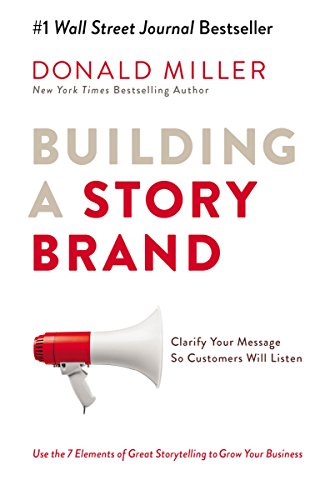
    If you want to get people to listen, you have got to hear what Donald Miller has to say. He’s consulted with thousands of companies on how to clarify their message so people will listen. His framework and method make clarifying your message so easy.

    He calls it the StoryBrand framework, and it’s brilliant. What it does is help you clarify your message so that a customer or voter or whoever will know within three seconds:

    1. What you offer
    2. How it will make their life better
    3. And what action they should take if they are interested

    But it goes beyond that. It helps you actually define what you should be offering in the first place. It’s a powerful product development tool. I’ve started using this in all my business efforts. And in my training and presentations.

    For example, I just used it to develop a presentation I delivered at a huge writer’s conference last week. The results were that after the presentation, I had a line of people wanting to thank me. I had people telling me I made them cry. Others wanted to give me a hug. They were grateful. I had people tell me it was the best presentation of the conference.

    This was not because I’m brilliant. I’m a dolt, remember. It’s because I used the StoryBrand framework to focus on those people. Their needs. Their problems. Their aspirations.

    If you’re running for office, if you have a business, if you want to persuade anyone to do anything, then let me recommend you listen to this guy and learn about this framework.

    Get the revelation. Get out of the muddle. And get people to listen.

    And when you’ve finished the Miller stuff above, read How to Write Copy That Sells by Ray Edwards, the guy who has partnered with Miller. It’s all about clarifying your message as well.

    Share

3 Comments

Comments are closed.