The beast is finally finished. Now I send it to my copy editor to brush a bit off here, comb a few strands of hair back, and shine a few buttons there.
It is done.
This means release is weeks away.
I will be announcing an early bird sale to those who have signed up for the Good Stuff Notification. If you want to be sure to get in on that sale, sign up at the top of the left sidebar.
Folks, I have finally finished draft 1 of The Drovers.
Let there be much rejoicing.
It clocked in around 75,000 words, and as soon as I finished, I realized I had two shorter novels. And this is exactly what I had originally planned. I wanted to tell a very long story in many shorter chunks. So I now have two 35,000 short novels. Since only writers think in word counts, here are some other books to give you a comparison.
Louis L’Amour’s westerns: most average around 50,000 words.
James Patterson’s Maximum Ride and Witch & Wizard series: average around 60,000 words.
Richard Paul Evans’s Michael Vey series books: average around 77,000.
The first three of Horowitz’s Alex Rider books: around 55,000.
Brandon Sanderson’s Steelheart books: around 100,000.
My books usually get a bit larger with the second draft, so I expect these will probably end up around 45,000 words. We’ll see.
What I’m really looking forward to is telling a long story in these smaller chunks and unrolling the story like it’s done on TV. You can do things over 20 or 30 episodes that you simply can’t in one big novel. This doesn’t meant I won’t be able to have big climaxes. Of course, I will. It just means that I’m going to do it in a slightly different form. I already have the basic ideas for the next dozen or so books. And now that I’m rolling, I expect things will go faster.
The working title of book 1 is “Hireling.” The working title for book 2 is “Outcast.
The cast so far:
Ferran: the main character, a scrappy boy that’s trying to keep his mam and sister from bondage
Itch: his dog
Krov: the big woodsman’s son, aka the Lover
Winwalom: Ferran’s best friend who is manifesting forbidden powers
Ranoc: the boy who wants to be one of the king’s rangers
Caswal: the mean one who has it out for Ferran
Borros: the drover and former grimsman
Lagash: the cook and foreigner who once beat Borros in battle
A cracking good story idea requires five critical elements.
Until you have all five, you’ll struggle to plot. You’ll write a few scenes and run out of gas. You’ll feel like the story just isn’t going anywhere.
And that’s because it isn’t. It can’t. A story isn’t a story without all five elements.
However, once you develop these five things, your story will suddenly roar to life. There are a few other elements that are important as well, but these five things form the core of the story setup.
In this course you’re not going to merely learn about all of those story elements. You’re going to go deep and learn what can only be learned by actually doing the work and developing story idea after story idea with personal one-on-one feedback from someone who knows what they’re doing.
When you finish, you won’t just know story theory. You will be a story idea machine. And you will be that because you have put in the work. The right work.
Again, this is not a course full of lectures and videos. This is a course where you’re going to work. And develop the insights and skills that only come from doing the work.
You’re actually going to:
Come up with story setup after story setup after story setup
And improve them with one-on-one feedback.
It’s going to:
Eliminate years of you wandering about in the story wilderness trying to figure things out on your own.
Put you miles ahead of other writers who have no idea what’s really at the core of story.
You are going to learn how to develop killer story ideas on purpose instead of on accident. Which means you’ll be able to do again and again. Reliably. Like clockwork.
Course details
The focus of the class is not on learning about story, although you will do that. The majority of your time will be spent on developing stories.
You can’t become a carpenter by watching videos and reading books about it.
You have to get out on the work site, cut wood, and pound nails. You have to make the mistakes all beginning carpenters make, get feedback, and improve.
The same goes for writing.
And you’re going to work in this class. You develop 21 story setups. In fact, you develop more because the 21 are just the ones you turn into me. And with each one your skills, insights, and abilities grow.
In the beginning, your setups will be bare bones. By the end, they’ll be fully developed setups that beg to be written. Setups you can use to immediately write the first draft of your novel, whether that’s in outline or chapter form.
Here’s what you do each week.
Week 1.
Uncover the secrets of what’s really at the heart of story and how to generate ideas.
Define your genre requirements
Create story setups 1-3
Week 2.
Uncover the secrets to compelling characters
Create character sketches
Create story setups 4-7
Week 3.
Uncover the secrets to formidable obstacles
Create story setups 8-11
Week 4.
Uncover the secrets to interesting casts
Create story setups 12-15
Week 5.
Uncover the secrets to managing multiple storylines and series
Create story setups 16-19
Week 6.
Create story setups 20-21. These are your capstone projects where you apply everything you’ve learned and take it to the next level
In this class you develop story idea after story idea after story idea. You are going to be marinated in the work of developing characters, THOMs, goals, obstacles, settings, casts, and more. And because of that, each week will not only bring an explosion of insights, but new skills and abilities.
Every week you get two private, one-on-one, live sessions with me where you get encouragement and feedback on what you’ve developed. And you’ll have access to a private Facebook group where you can apply the principles to brainstorm even MORE ideas for each other’s stories.
At first you might feel a bit shy and worried about your ideas and abilities. But you’ll soon get over that. By the end of the course you’ll be one of those people that can generate terrific ideas easily. And you’ll be able to do that because you will have put in the work to become a different writer.
What’s the price?
Hours of one-on-one instruction from a professional editor or author costs thousands of dollars. An MFA program can cost $25,000 to $30,000 or more!
But this course won’t cost anywhere close to that.
Plus you’re going to learn things here you’ll never get in an MFA program (I know. I was accepted into a top-ranked program).
The cost of this course is $799. And I personally guarantee your results. You’ll be totally oh-my-gosh-I’m-so-happy-I-took-that-class satisfied, or I’ll give you your money back. No questions asked.
Now’s your chance to stop spinning your wheels. I can’t tell you how much I wish I’d had something like this when I’d started:
The secrets about the true core of story.
The secrets about how to come up with ideas.
Actual work with personal one-on-one feedback.
Laser focused on what actually matters, not a bunch of ridiculous writing rules.
When you finish, you will be a story idea machine.
You won’t know plotting. That’s a different course and set of skills. You won’t know how to write chapters. But you’ll know how to create the engine that powers all the rest of that. You’ll know how to create the core that makes awesome plots and chapters possible.
If you want to take this course, click the button below and contact me. I will tell you exactly how to apply.
I’m not going to be able to accept everyone who wants to take the class. I have a very strict limit on the number of students I can work with. So you need to get your application in before the deadline of midnight, December 11th.
Sector 5 is a new radio program on K-TALK radio, AM 630. It’s hosted by Dickie Shannon, a long-time DJ, and is all about science fiction, fantasy, aliens, paranormal–the weird, fantastic, and inexplicable. Dickie says it’s Garrison Keillor meets Art Bell. We’re going to talk about my book, writing, and weird crap. He takes callers. So be ready to share your stories and enjoy the fun!
Carrie Hinkel-Gill at Moonlight, Lace and Mayhem has been interviewing me. It’s been thought-provoking and fun. Here are the last two installments. Check it out:
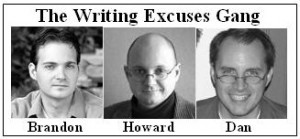
Here’s the third episode I recorded with the Writing Excuses guys.
In the first podcast we talked about putting and not putting ourselves in our writing and making characters who don’t all sound like the author. In the second, we talked about how to not repeat yourself as an author. In this one, I shared some basics about generating emotion in readers and dealing with negative emotions writers face when they encounter rejection, compare their career with others, hit writer’s block, or hear someone didn’t like their story.
As usual, the guys had some great insights. Check it out: Emotion in Fiction.
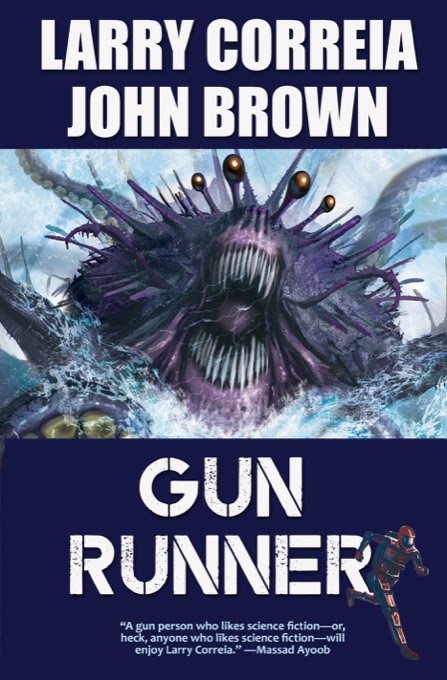
Even if you don’t win, you can still get copies at Uncle Hugo’s that were signed by both Larry and I! You can pre-order one now, and get it shipped to you as soon as they’re available in February.
Uncle Hugo’s is one of those rare indie bookshops that specializes and knows their customers. They’re the oldest independent science fiction bookstore in America.
Reading your process outline, exactly where the line edit and copy edit fit into the sequence is unclear to me. Could, ahem, a line edit of that outline clarify things?
Updated. Let me know if that clarifies things for you.
That is much clearer. Thanks for the update!
Congrats! I’ve been looking forward to Curse for a long time; it’s great to hear it’s that much closer to being done!
Congratulations to you, and hooray for us.
By the way, what ever became of the cover art riddle? Something that was wrong or did not belong? I do not think you ever revealed your answer.
I wanted to post it when we got closer to release. You should see the post as we get closer and the release day stuff begins to ramp up. Glad to know you’re still wondering.
Have you gotten any progress report on how the copy edit is going?

 Sector 5 is a new radio program on K-TALK radio, AM 630. It’s hosted by Dickie Shannon, a long-time DJ, and is all about science fiction, fantasy, aliens, paranormal–the weird, fantastic, and inexplicable. Dickie says it’s Garrison Keillor meets Art Bell. We’re going to talk about my book, writing, and weird crap. He takes callers. So be ready to share your stories and enjoy the fun!
Awesome!
Reading your process outline, exactly where the line edit and copy edit fit into the sequence is unclear to me. Could, ahem, a line edit of that outline clarify things?
Updated. Let me know if that clarifies things for you.
That is much clearer. Thanks for the update!
Congrats! I’ve been looking forward to Curse for a long time; it’s great to hear it’s that much closer to being done!
Congratulations to you, and hooray for us.
By the way, what ever became of the cover art riddle? Something that was wrong or did not belong? I do not think you ever revealed your answer.
I wanted to post it when we got closer to release. You should see the post as we get closer and the release day stuff begins to ramp up. Glad to know you’re still wondering.
Have you gotten any progress report on how the copy edit is going?
John,
The copy editor is about 75% done.