The Basic Basics of Writing” by Algis Budrys
Want to get the basics in a very succinct article? Read Algis Budrys on story.
Want to get the basics in a very succinct article? Read Algis Budrys on story.
 How do writers juggle writing and family?
One of my heroes is Mary Higgins Clark who, as a single mom, started a career. She got up very early, wrote for 1-2 hours in the morning, and became a mega-seller.
I have four girls. And a full-time job. When the first two were little my wife was working and I was Mr. Mom going to school. Then we switched.
Here’s my experience. While I love writing, my stories do not run to me and give me wonderful strangling hugs after school like my youngest. While I laugh at the humor I come up with in my stories and enjoy it, it cannot replace the uncontrollable giggling I experience when I go on dates with my second. While writing lifts me, it does not fill my office with notes and wallpapers of love like my oldest. And writing never drags me out to play ghosts in the graveyard or hide and seek–daughter #3. Nor will my stories and novels be there for me when I’m old.
While writing is incredibly fulfilling, my wife, kids, and other relationships are a joy it cannot replace.
What all this means is that I try to recognize that I can’t let family and writing compete. They can’t be equal priorities. Family comes first. But this doesn’t mean I don’t write. I block out times to write. These are my writing times. I get up early to make time for this. I don’t watch a lot of TV. I don’t read a million blogs, nor, alas, can I read fiction at the level I used to. I make time. But I also make blocks when I just forget writing (even though it can be hard).
Specifically, here’s my average work week.
5:00 AM rise, wake and get centered for the day
6:00 AM work (“work” is my day job and writing)
6:30 AM family and breakfast
7:30 AM go to work (at home). Try to get in 7-8 hours at day job and 2 hours writing. When I did commute I wrote for 1 hour during lunch and 1 hour in the morning before I went to work. Then I’d take a 2 hour block on Thursdays.
5:30 PM family etc.
9:30 PM bed
On Saturdays I get a few more hours writing. Sunday I forget everything but family.
With the new book contract I have to become a bit more creative. But if it ever comes down to sacrifice the last 2 years of my oldest being at home and writing, well, the books will go.
When my writing plans meet reality, I try to adjust and find other slots for writing. It wasn’t easy in the beginning, but it’s become much easier. And I don’t worry about what I might have accomplished in writing if I’d just had the extra time. Such what-if’s, I’ve found, are almost always poisonous. And who the heck cares? Because while I want to write wonderful stories, I think the greatest loss I think I might experience at the end of my life (believing in an after life or not) is looking back and seeing that I traded the opportunity for wonderful relationships for a rapidly mouldering spot on the shelves.
Washington Irving wrote a funny and wonderful piece on this mouldering in his “The Mutability of Literature” in THE SKETCHBOOK OF GEOFFERY CRAYON. I recommend every writer read this to put life and writing into perspective.
My first semester in college I earned a GPA of, ta dum, 0.68. How do you earn such amazing grades? Well, I’ll tell you: the super secret strategy is to get an F in everything except ballroom dance. In that you get an A.
I couldn’t squeeze any juice out of my textbooks, but I sure could fox trot.
And I wasn’t partying. Dope and beer bongs were never for me. I wasn’t skipping class. I was lugging this huge valise around with every textbook I had. I think it weighed something like forty pounds. I was stitting in classes looking studious and taking notes. Well, except for physics which started early. 7:30 a.m. if I recall. What kind of a nut job takes a class at 7:30 a.m.? I did. I tried really hard to stay awake. I know I saw the professor shoot a gorilla with a tennis ball once. But the rest of the time I was in la la land catching z’s.
A 0.68, and I was in the honors program.
Obviously, I didn’t know how to go about learning. I’m glad the university didn’t give up on me. They put me on probation and told me I had to take a class on studying. A class on how to take the reponsibility for learning into my own tentacles. A class that shared techniques that actually helped.
One of the techniques was taking breaks. You were to work hard for 30 or 45 or 50 minutes and then take a break. Why? Well, because studies had shown that someone who, for example, was going to study for two hours could learn more by taking a ten or fifteen minute break in the middle than someone who worked the whole two hours. Spending more time on studying actually meant you learned less.
I’ve found this method applies to more than just reading textbooks. It also applies to writing. My practice is to set a time for 45-50 minutes. My goal is to write as hard and fast during that period as I can. To be totally focused on the task at hand. And then, when the timer dings, to literally get up out of my chair, walk about, and take a break. Then come back at the top of the next hour and start another 45 minute session.
But I’m not the only one doing this. A lot of folks use this method. Author Annie Bellet writes about her use of it in The Quest for Productivity and shares some of the reasons why it helps her. Read what she says there. If you haven’t done a 45/15 or 48/12 session, give it a go. See if you don’t actually get more done in less time.
Oh, btw, as for my grades, not only did I NOT drop out (or get kicked out) and become a hobo living in a trailer by the river, I ended up getting a 3.8 in my masters of accounting program. I think it’s safe to say I figured that school thing out. 🙂
T.C. Boyle is one of my favorite writers. He saved me in my undergraduate program. I was buying the The Best American Short Story, Pushcart, and O’Henry anthologies. I was reading for my coursework. And so much of it bored me to death. And then one day I began reading “The Ape Lady in Retirement” and my eyes hung out because finally the text was interesting. Finally someone wrote a story I could read start to finish.
I immediately bought his anthologies–Greasy Lake, If The River Was Whiskey, Descent of Man. I was in heaven. Now, not all of his stories worked magic on me. But when I was having a hard time finding one story in a whole anthology, his books seemed like a treasure trove.
He didn’t do as well in his novels. Oh, the writing was just as good. The characters and descriptions just as odd and stunning. But he didn’t keep my interest. The problems never built into anything. Nevertheless, I loved him.
I’ve been having a brief conversation with him and the fan boy in me is delighted to finally talk to this guy. And after reading an interview with him, I realize why he probably spoke to me. While the other literary fiction authors were following the tastes of the fringe group, Boyle at least wanted to entertain.
In his interview he says.
Everybody has forgotten that literature, like all art, is, at root, entertainment. It is supposed to entertain you. It’s not supposed to be some conundrum to be resolved by some professors in the university. It’s not a game. It’s not masturbation. It’s art. And I think great art is great on all levels. But the first level on which it must be great is that it must be entertaining.
Amen, brother Boyle. Amen!
Here the full Boyle AWP interview.
However, I still think he misses the mark. In it he says about bestsellers:
But it’s mainly vampire books and Tom Clancy and all the rest of it. I don’t understand why we can’t make our books more available to everybody-not by compromising what we do, but by popularizing them, getting them out to the public.
I think that now we don’t have great editors. We have editors who are basically trying to hold on to their jobs and who publish good books once in a while. They’re basically cheerleaders for the books. They’re not editors, really. They’re incapable of being editors; they don’t need to be. Because editing is done-self-editing is done-through the apprenticeship in the writing programs. Nearly everyone from my generation on to your generation and beyond will have been through an MFA program. It’s just the way it is now. It’s a different world. It’s essential.
I’d like to suggest that Boyle, despite his love of entertainment, still misses the mark in his interview because you cannot popularize something that only appeals to a small market. The reason why Stephenie Meyer, Patterson, et al sell exponential circles around folks like Don DeLillo or Louise Erdrich is because Meyer and gang are very good at delivering what the largest portions of the reading public want. They deliver types of entertainment that DeLillo and Erdrich do not. (And I mean “entertainment” in a very broad sense.)
We could point at the Oprah effect (whether you like it or not, Mr. Cold Mountain) and say that’s not true. It’s all PR and marketing. But that assumes publisers are idiots. And while some of them may be, I think it’s an extreme assumption. Publishers are in it for the love AND money. And you can be sure that the board of directors is looking for smart, money people to lead the companies. You don’t make money, you’re fired.
Which means that IF the publishers found literary fiction sold like hotcakes they’d promote it like hotcakes. But literary fiction too often fails to entertain anybody but a handful of fringe readers. And so trying to popularize it can only have a limited effect. When people are thirsty, not many are going to pass up tall glasses of ice water for the pickled jalapenos at the end of the line.
Meyer, Clancy, Grisham, Roberts etc are masters of entertainment. And, like it or not, that’s the main reason the small portion of the public who actually read go to fiction.
I think it’s fine to cater to the fringe audience if that’s your pleasure. But I think it’s ridiculous to think such fare is better than what most people enjoy. Or that it deserves any special veneration. The MFA programs I’m familiar with seem, by and large, to miss the point. Instead of teaching the meat of fiction (entertainment) they focus on teaching students to serve up the parsley with great pomp. And when the customers go elsewhere to get the meat they crave (or the salad for you vegans), they respond by saying the customers are simply too dumb to get it or have no taste.
Now, I’m not saying the folks I work with in the MFA program are idiots. Or jerks. Almost everyone I’ve met has been extremely nice and smart. They have great insights. But there is a strong pressure in that culture, amost a moral pressure, to think about fiction this way. And it’s based on their tastes.
I think we all do this. 90% of what’s out there is crap. But it isn’t, really. The truth is that 90% of what’s out there simply doesn’t appeal to us. And so because it doesn’t deliver the goods, it’s crap to us. The problem is when we don’t realize the difference and begin to think that because we don’t have the taste for something that it’s garbage.
It’s not.
And that’s one thing the gentle and smart people in my program have shown me. I’m just as liable to make this mistake as anyone.
So what MFA programs need to do is teach fiction. The meat. As well as the parsley. They need to teach all the genres, not just one. Alas, for the meat you have to go to communications departments to even talk about it. And then hope you find someone like Dolf Zillman, Bryant Jennings, Jenefer Robinson, or Peter Vorderer.
Which leads me to the next point. Boyle is wrong about editors and writers. The majority of the authors that actually sell never set foot in an MFA program. MFA’s teach students to write for a small fringe market. And so they’ll dominate that fringe market, but not the big markets. Not what most people actually read.
Since I haven’t worked with any editors in that so-called golden age of editing, I cannot comment on the difference. But I do know that the editors I and other authors have worked with do many edits on the projects they oversee. They are thorough. They want it to be the best story it can be. It’s true they won’t take something that’s a complete mess and work on it. But why should they? There are so many better manuscripts out there it only makes sense.
Anyway, I love Boyle. Probably becasue he loves plot and story as much as language. His shorts saved me in my undergrad program. They were one of the few interesting things I read. I just am dismayed that these writing programs are so far off in the weeds.
 When we find a great teacher, we prize them not only because what we learn improves our lives but also because good learning can be one of the most exhilirating things we experience. Unfortunately, a lot of teaching stinks. It’s boring, rambling, forgettable.
I’ve made a study of teaching. I’ve had to. For almost 20 years I’ve taught and designed courses in the private sector. And for many of those years my work has been in a revenue generating department. What that means is that if my classes are ineffective and dull, nobody signs up, revenue falls, and a lot of folks will stand around and wonder if it might not be better to just replace me with a potted plant. At least a plant would be something pleasant to look at, plus it would also clean the air.
Now not everything I do is stellar (I wish that were so). Sometimes in the quality, cost, speed triangle, quality is the thing that takes the hit. But the point is I have to be alert and try to miminize the schlock. But how do you do that? How do you develop and deliver effective and interesting education?
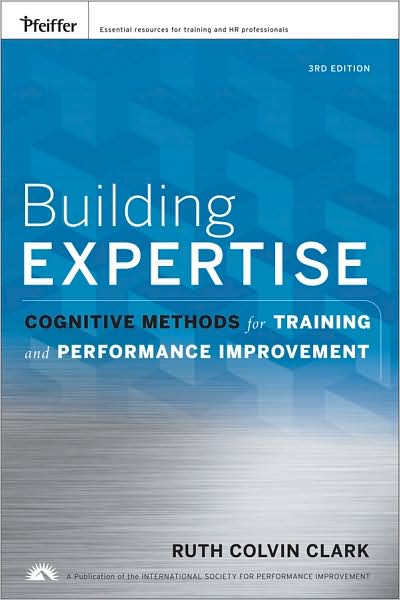
Luckily, the field of instructional technology (I’m not talking about computers, but principles of instruction) has come a long way in identifying what works and what doesn’t. This is important because teaching theories of the past (many of which are still used today) often relied on rules of thumb and anecdotal evidence. Their precriptions were often ineffective and sometimes counterproductive. What’s exciting is that in the last few decades researchers in this area have put techniques and principles to the test. We know better now than ever before how to structure learning that is effective and interesting. And I have yet to find a better explanation of the proven techniques and principles than Ruth Colvin Clark’s Building Expertise: Cognitive Methods for Training and Performance Improvement, 3rd Edition.
Don’t let the “training” part fool you. We often associate “training” with learning procedures and simple tasks (which is what leads to the “we want to provide sex education, not sex training” obfuscation). But Clark isn’t using the term that way. Training here includes all types of learning.
What Clark does is not only share the techniques that build expertise, but also the psychological reasons and research-based evidence for those techniques. This isn’t nonsense based on personality or political correctness. It’s practical and proven.
Among other things, you’ll learn:
You’ll learn when taking notes can actually be counterproductive and what you can do about it. Or how making your delivery more personable (and what that means) can actually improve attention. You’ll see why lots of practice isn’t always the best answer–sometimes your child will learn more if you do half of their homework questions for them.
You’ll find that there “Is no Yellow Brick road” in teaching. Instead, you’ll see that the effectiveness of any method depends on whether it’s suited to the specific situation. And Clark will explain what the key factors in any situation are so you know which methods to apply and the trade-offs you’ll make when you do.
If you’re a teacher in any setting–family, job, church, school, or recreation–or if you’re trying to teach yourself, this book (specifically the 3rd edition) will be a goldmine for you. I can’t recommend it highly enough.
Two excellent podcasts by the Writing Excuses team. Check them out. I added my data points in the comments to both.
Writing Excuses Episode 30: Talking Revision with Moshe Feder
Writing Excuses Episode 29: Talking Publishing with Lou Anders
I have found that having a logline is not only essential to pitch a story, but it also helps me as I’m writing the story. An unnamed producer sent this to Orson Card who passed it onto his online workshop. It is the best tutorial I’ve ever come across on writing loglines. And everything Christopher Lockhart says about loglines can be used when pitching your novel to agents and editors. I would also read his article about pitching your story. Now I did a little digging and found these resources as well that include both Lockhart articles plus a examples of loglines that work and don’t and few other articles that you might find helpful.
Comments are closed.



Good article. I just finished reading “Story” by Robert McKee, which it reminded me of in a lot of ways.
It IS good.
However, one thing it’s missing is surprise. Stories thrive on the unexpected disaster and twist. It’s also missing the fact that the disasters are often yes-but turns. So many times it looks as if the hero actually succeeds, but we find out very soon they haven’t. And “problem” isn’t quite enough. Any old problem won’t do. It has to be a problem that meets certain criteria. Still, it’s an excellent article. For the basic basics, it’s perfect.
I’m interested in hearing what are the criteria for a good problem.
You’re coming to LTUE, right? I’ll be talking about it then.