Billenkoek

netherlandsSo I lived for almost two years in the Netherlands and Belgium and learned the Dutch language, which is full of delights. Today’s delight is billenkoek.

Now koek means cake. A koekje (small cake) is a cookie. Boterkoek is butter cake, this delicious sweet, to-die-for Dutch version of shortbread.

So what does billen mean?

Back in the day when I’d visit various Dutchies (the people, not political territories), they’d always ask if I was thirsty. And very frequently when I’d ask for water, someone would say, “Water? The frogs wash their billen in that.”

Billen means bum as in behind, butt, buttocks. Bil is singular, one half of the full billen, if you will.

So what do you think a billenkoek is?

No, not that.

It’s a spanking.

“Honey, you’ll clean the dishes, or you’re going to get a little bum cake. What will it be?”

Gotta love the Dutch.

Share

Similar Posts

  • The MacFarlane (Tor), Correia, Hines Cage Match: Put It In The C Story

    Larry Correia is a big-booted barbarian who likes to fight in a cage. And a lot of us love to watch big-booted barbarians go at it.

    We like demanding matches. We like a little blood and good sportsmanship (of course, sportsmanship in the cage is different than in other venues). And we respect both sides for showing up and giving it their best.

    This last week Larry Correia battled with Alex Dally MacFarlane (and Tor, the silent partner, who thought her new column would be a great idea and has given her their big platform to talk) and Jim Hines. If you didn’t watch the match, here are the links.

    I’ve enjoyed reading the give and take in this fight. For me, the barbarians seem to have landed more blows (and done so with many more funny and memorable one-liners.) But that doesn’t mean Alex Dally MacFarlane shouldn’t crusade.

    And I mean crusade, as in battle.

    Underneath it all MacFarlane wants to change something. She wants to change hearts and minds. A lot of us want to change hearts and minds about various things. A lot of us will show up and risk getting bloody for such things in a variety of settings. Heck, Correia the Barbarian was even willing to spend two years of his barbarian life trying to change hearts and minds in a setting where big boots are not allowed (poor Correia, more sad puppies).

    But here’s the deal.

    If you want to win someone like me, you’re going to do it not by scolding or brow beating me or by mandating something and then trying to back it up with sticks.

    You’re going to do it by writing something so delightul that I cannot but help listen to you.

    You’re not going to tell me what I can’t write.

    You’re not going to tell me what I must write.

    You’re going to model writing that makes me want to write that thing.

    You’re going to be like Tolkien and spawn five decades of writers who want to do nothing more than imagine worlds filled with strange races and wonderous settings and weird talking tree men who have lost their wives.

    You’re going to invite like-minded folks to join you in creating wonders. Or in just having a good old time.  And not worry about other writers inviting folks to their creations, which might be totally different from yours.

    And those wonders and good times are the things that will work the magic.

    Miguel Sabido is a master of entertainment with message. Here’s a great piece in The New Yorker introducing him, his work, and methods. Notice what made his stuff so effective. The new ways of thinking he wanted to offer were never found in the A story. They were never found in the B story.

    Why?

    Because the number one thing the story had to do was suck people in (entertain).

    And so the new thing to consider was in the C story.

    MacFarlane, put it in the C story. And build a Middle-earth. Or a ring world. Or at least some vampires that sparkle.

    In the meantime, I’ve got a barbarian book on the shelf that looks like a mighty good time. I think I’m going to give it a read.

    Share
  • The Surprising Truth About Militias and the Second Amendment

    When the founding fathers spoke of “militias,” they were not referring to a bunch of yahoos running around in the woods with paint on their faces outside of state control.

    They were referring to a citizen army under state control.

    So is “militia” just the old-time word for what our army is today?

    No.

    A standing or “regular” army is one made up of professional, full-time soldiers like the US Army, the Marines, the Navy, and the Air Force. And it’s permanent, meaning you don’t disband the army when the fighting is done.

    A militia back in those days was something completely different.

    The problem of a standing army

    The founding fathers knew they needed to provide for the common defense, but they saw standing armies controlled by a central government as an immediate threat to the liberty the new union sought to preserve.

    Why would they think that?

    Easy. History was littered with case after case where standing armies had become a law unto themselves and oppressed the populace. One glaring example is what happened to the Roman empire. It suffered centuries where this faction and then that faction of the army was in control, and it brought nothing but a continual procession of civil wars and bloodshed.

    History also showed that even if the military didn’t take over, kings and queens were happy to wield standing armies to impose their will and oppress the people. Remember: the world then was ruled by monarchies. The founders had never seen a standing army wielded by any other type of power.

    So the founders didn’t want to give a president or any other central authority that power. They feared doing so would only pave the way to the ruin of the new nation they sought to form.

    So if you don’t have a standing army, how do you defend your country?

    The fyrd

    The founding fathers thought they saw a solution in a tradition of duty that went back hundreds of years in England. In the days when the Saxons ruled England, the kings and dukes would muster and deploy the fyrd to help them fight their wars.

    The fyrd was made up of all able-bodied free males between certain ages, regardless of their vocation. It was their duty to provide their own arms and defend the land when called by their leaders. So this was an army made up of farmers, tanners, smiths, tailors, etc.

    But the fyrd wasn’t a standing army. Nor was it populated with full-time soldiers. This citizen army was to be called out when needed, and when the crisis was over, it was disbanded, and the men went back to their vocations.

    The militia scheme

    The founders took this idea and tweaked it. Back in the Saxon days, the king controlled the fyrd. In this new scheme, the United States would rely on a fyrd (which they called a militia), but the powers to control it would be split between the president, Congress, and the States.

    First, Congress, not the president, was the only authority that could declare war and summon the state militias. So the president would be the commander in chief when the militia was active. But the minute Congress decided to end a war and disband the militia, that army dissolved, leaving the president as commander in chief of only the tiny number of troops that had been authorized as the regular army (less than 1,000 at the time).

    Second, while the Federal government would provide the weapons the militia would use when it mustered them for war, the state governments would be the ones to appoint the officers and train the soldiers. You can’t run an army without officers. So this would prevent the Federal government from taking control by stacking the army leadership with those loyal to a despot president or Congress.

    So the militia was supposed to be the main force that fought our wars, and it was supposed to be temporary. It’s true that Congress did authorize a standing army, but it was tiny. And with this setup, the founders figured we’d have the army we’d need, but we’d avoid the problems standing armies had posed in the past.

    So militias, as thought of by the founders in the 1700s, were not groups outside the government’s control. They were temporary citizen armies. And power over them was broken up between the president, Congress, and the States so no one group or person could wield them tyrannically.

    1791 and The Bill of Rights

    Accordingly, the founders wrote the articles and sections of the Constitution in 1787 to set all of this up. However, many anti-federalists were concerned that the Constitution didn’t go far enough to protect the rights of individuals and limit the power of the Federal government. In fact, many of the founders were so concerned about the issue that they refused to ratify the Constitution as it was.

    The only way they’d sign on is with the promise of the Bill of Rights. When they knew that bill was forthcoming, delegates from nine of the original thirteen states ratified the Constitution. The delegates of two other states waited until the document was produced. The final two (North Carolina and Rhode Island) waited until 1791 when the Bill of Rights, which includes the second amendment, was passed.

    So let’s look at the language of the Second Amendment in light of what we know about the fear the founders had of standing armies.

    “A well regulated Militia being necessary to the security of a free State, the right of the people to keep and bear Arms shall not be infringed.”

    Why did they include this? It was not because they wanted the citizens to be able to hunt or protect themselves with guns. They figured that was a given. They included this amendment because they concluded that an armed citizenry would make it impossible for tyranny to arise.

    Noah Webster, a Federalist, stated the idea this way when trying to persuade Pennsylvania to ratify the Constitution:

    “Before a standing army can rule, the people must be disarmed; as they are in almost every kingdom of Europe. The supreme power in America cannot enforce unjust laws by the sword; because the whole body of the people are armed, and constitute a force superior to any bands of regular troops that can be, on any pretense, raised in the United States. A military force, at the command of Congress, can execute no laws, but such as the people perceive to be just and constitutional; for they will possess the power, and jealousy will instantly inspire the inclination, to resist the execution of a law which appears to them unjust and oppressive”

    So the second amendment was included in the Bill of Rights because enough of the founders feared that the Constitution could be read in a way that would allow the Federal government to disarm the populace. Disarming the populace would open the way to a standing army under Federal control. And that would open the way to tyranny.

    When all was said and done, the founders separated the power of the military in this way:

    • Only Congress could declare war and muster the militia
    • Only Congress could finance it
    • There would be no standing army to speak of
    • Only the states could appoint officers to the militia
    • The government was forbidden to infringe on the rights of individuals to keep and bear arms

    So what happened?

    Militias didn’t work

    The problem is the militia didn’t work well enough to actually provide for the common defense.

    It didn’t work during the Revolutionary War. The republic had to create the Continental Army. That army was supported by the militias, but the colonists found they couldn’t rely on the militias alone. They had to have the regular army to fight the British.

    After the war, the Continental Army was disbanded, but the militias simply weren’t good enough to face the threats the new nation faced, and George Washington himself openly lamented it. The troops took a licking in 1791 at the battle of St. Claire’s and then time and again during the War of 1812.

    Heck, militias didn’t even work in the days of the fyrd. In those days, the Saxon and Norman kings relied on their house warriors (their standing army) and mercenaries for most of the work. They only supplemented with the fyrd.

    1792

    After the defeat in 1791, the early leaders concluded they needed a regular army with the training and skill it possessed. So in 1792 Congress authorized the creation of the First Legion of the United States, a standing army of 5,190 men. The legion was renamed “The United States Army” in 1796.

    In 1792 Congress also passed the Militia Acts. The acts were written to expire in two years. But Congress wrote another in 1795 to replace them. These laws authorized the president to called out the militia “whenever the United States shall be invaded, or be in imminent danger of invasion” and “whenever the laws of the United States shall be opposed or the execution thereof obstructed, in any state, by combinations too powerful to be suppressed by the ordinary course of judicial proceedings, or by the powers vested in the marshals by this act.”

    So a mere five years after the Constitution was first ratified, and a year after the Bill of Rights, Congress dramatically increased the size of the nation’s standing army and gave the President the authority to call out the militia! It’s clear that right from the beginning the militia scheme started showing some cracks.

    Today

    The First Legion was small. But it grew again in 1808, and then again during the war of 1812. And it continued to grow slowly, then ballooned in the 1900s until we now have more than a million troops in the armed forces of the US.

    The National Guard is what the militias of the 1800s transformed into in the early 1900s, but, wouldn’t you know it, the National Guard is now mostly under the control of the Federal government too.

    What does this mean?

    It means we now have the most powerful standing army the world has ever known and almost no militia. It means our military is a complete 180 of what the founders envisioned.

    I’m not saying it’s bad. I love our military.

    I’m merely pointing out that militias back then meant a certain thing and the founders wanted them for a certain reason. And that we have completely replaced that arrangement with the exact opposite.

    As for tyranny, we still have armed citizens. Maybe this is enough to deter tyranny as Webster claimed. Although the disparity between what the citizens can arm themselves with now and what the regular army has is nothing like it was in the 1700s. So maybe there are other laws and aspects of our culture that have prevented it. Maybe it’s both.

    Either way, it’s important to understand what the original militias were, why the founders wanted them, and what the second amendment was all about.

    More

    Helpful articles

    US Constitution – Provisions for the military

    Here are all of the parts of the original seven articles of the Constitution that deal with the military.

    Article 1 – The Congress
    Section 8

    This section gives Congress seventeen powers. Six of these have to with the common defense. Those military powers granted are:

    • To declare War, grant Letters of Marque and Reprisal, and make Rules concerning Captures on Land and Water;
    • To raise and support Armies, but no Appropriation of Money to that Use shall be for a longer Term than two Years;
    • To provide and maintain a Navy;
    • To make Rules for the Government and Regulation of the land and naval Forces;
    • To provide for calling forth the Militia to execute the Laws of the Union, suppress Insurrections and repel Invasions; [notice there are only three cases that warrant the calling forth of the militia]
    • To provide for organizing, arming, and disciplining, the Militia, and for governing such Part of them as may be employed in the Service of the United States, reserving to the States respectively, the Appointment of the Officers, and the Authority of training the Militia according to the discipline prescribed by Congress;
    Section 10

    This section prevents the States from doing thirteen things. Three of these have to do with the military.

    “No State shall, without the Consent of Congress, lay any Duty of Tonnage, keep Troops, or Ships of War in time of Peace, enter into any Agreement or Compact with another State, or with a foreign Power, or engage in War, unless actually invaded, or in such imminent Danger as will not admit of delay.”

    Article 2 – The President
    Section 2

    “The President shall be Commander in Chief of the Army and Navy of the United States, and of the Militia of the several States, when called into the actual Service of the United States;”

    Article 4 – The States
    Section 4

    “The United States shall guarantee to every State in this Union a Republican Form of Government, and shall protect each of them against Invasion;”


    Share
  • I’m done being Amazon’s fool

    Do you see this picture? This is Jeff Bezos laughing at John Brown. Because John Brown was a fool.

    Let me explain.

    When I sell my ebooks on Amazon for $2.99 to $9.99, Amazon charges me 30% of the price. I keep 70%. That’s a decent deal. I’m happy to do business with them as a partner with my ebooks.

    But Amazon’s got some alter ego going when dealing with folks selling used books. When I sell used books, Amazon somehow thinks it’s a swell deal for all of us little guys if they take a huge chunk of the pie. Look at the numbers below.

    Order date: 04/08/2017
    Price: $3.98
    Shipping: $3.99
    Amazon fees: -$3.99 (100% of sale price)
    Your earnings: $3.98

    Order date: 04/05/2017
    Price: $5.50
    Shipping: $3.99
    Amazon fees: -$4.21 (77% of sale price)
    Your earnings: $5.28

    Order date: 03/23/2017
    Price: $3.50
    Shipping: $3.99
    Amazon fees: -$3.91 (112% of sale price)
    Your earnings: $3.58

    Order date: 03/15/2017
    Price: $1.49
    Shipping: $3.99
    Amazon fees: -$3.61 (242% of sale price)
    Your earnings: $1.87

    You might think, hey, John, you’re making a few bucks on each. But no, what you see above is what I get from Amazon. I still have to ship the product. And if I purchased the book somewhere, I have to cover those costs as well.

    For example, look at the last one. Amazon feels that not only do they need to charge me the total sale price of the book, they also need more than half of the shipping costs. That book cost over three dollars to ship plus a little for a bubble mailer because I actually care that the book is in great shape when the buyer opens the package. So I lost money. But Amazon did just fine.

    And Bezos was laughing because John Brown, the fool, was paying Amazon for the pleasure of taking time to list the book, shelve the book at his house, package it, and then post it. It was as good as going to Disneyland!

    The fees used to be lower.

    Order date: 06/26/2014
    Price: $3.59
    Amazon fees: -$2.88 (a mere 80% of the sale price)
    Shipping: $3.99
    Your earnings: $4.70

    I hated the fees they were charging then, but after postage, we could still make a buck or so on books priced at this level. Not anymore.

    So adios Amazon. I’m done being your fool. And shame on me for taking so long to recognize it. I’m moving all my used book stock to Half.com because they actually have a good thing going. Look at what they charge for their services.

    $0.75 – $50.00: 25.0%
    $50.01 – $100.00: 22.5%
    $100.01 – $250.00: 20.0%
    $250.01 – $500.00: 17.5%
    > $500.00: 15.0%

    That means on that $1.49 book, they would have charged me a whopping 37 cents.

    Hey, profit for them AND me. And a great price for the buyer. Win-win-win.

    How nice.

    Share
  • No Apology: The Structure

    I posted my review of No Apology on a few sites the other day. I can understand how some folks might be skeptical that the book is nothing more than a PR puff job. But I’m surprised at how many refuse to even test their assumptions with ten or fifteen minutes of reading (or listening to a few minutes of the book on audio).

    Too bad for them. They’re missing out.

    For those who think they know Romney from what’s being reported in the press, I want to suggest you listen to or read Pat Caddell’s recent comments on 9/21/12 at the Accuracy in Media conference. Caddell is a Democrat, BTW. He is the founder of Cambridge Survey Research, a public opinion pollster, and an expert in analyzing public opinion.  He’s been working for democratic campaigns for a long, long time. He started with the McGovern campaign.  Then worked for the Jimmy Carter campaign, for Gary Hart, for Joe Biden, and Jerry Brown. His speech is titled “The Audacity of Corruption”.  Find it here: http://www.aim.org/video/pat-caddell-the-audacity-of-corruption/

    Back in college I took this class on epistemology (how we know what we know). It was fascinating. One of the best classes I took. One of the things the professor taught us was that the first step in examining someone’s ideas was to capture them. So he’d have us research all sorts of stuff and then write a short paper in which we restated the ideas in summary form.

    A few years later I read Steven Covey’s 7 Habits of Highly Successful people. An amazing book. One of the habits was to seek first to understand, then to be understood. He pointed out that probably the best measure of whether you have actually understood someone is that you can restate their point in your own words to their satisfaction.

    First seek to understand, then to be understood. Capture.

    I’m going to try to do that here.

    I’ll start by outlining the structure of the book.

    CHAPTERS 1-3
    Romney shares some interesting insights about the four main current geopolitical strategies being employed by major players around the world and the threats they pose to us. He also considers lessons from great nations in the past that have fallen—what were their mistakes and how can we avoid them.

    CHAPTER 4
    Romney discusses key ways we can grow American “soft power” and maintain our “hard power” abroad.

    CHAPTERS 5-9
    Romney discusses domestically what we need to do to remain internally powerful, and, therefore, prosperous and free. Topics include the economy and jobs (chapter 5), the entitlement programs social security, medicare, and medicaid (chapter 6), health care (chapter 7), education (chapter 8), and energy (chapter 9).

    CHAPTER 10
    Romney suggests that culture is a huge factor in the success of nations. He summarizes key values and practices he feels will promote a strong culture.

    CHAPTER 11 – EPILOGUE
    Romney provides a method for gauging how we’ll we’re doing—a set of national indicators—as well as a summary of all the things he discussed in the preceding chapters that he believes will make and keep America strong.

    The central overarching theme of the book is that America will only remain strong if we follow certain principles. We’re at a point where many feel America is starting its demise. Romney rejects that must be the case.

    In the next post, I’ll capture chapter 1 and make my few comments. I hope you join me 🙂

    Share
  • |

    All you need is a little beating and robbery

    Mrs. Brown, my wife, teaches language arts for the 7th and 8th grades as well as reading comprehension. She’s big on reading. She wants to provide every opportunity for kids to not only get good at it, but also learn to love it.

    And so her walls are lined with bookshelves full of awesome books teens love. She reads the first chapters of books to her classes to let them sample various stories. She features their book reports. She has them paste the covers of the books they’ve read on pages displayed around the classroom. And the school’s awesome librarian supports with her own programs.

    The 7th and 8th grade students at Rich Middle School are marinated in a big celebration of reading.

    In Mrs. Brown’s class, it’s fairly straight forward to get an A on reading, which is a huge part of your grade—all you’ve got to do is read.

    But how much reading do they need to do? How do you track it? And what books should they read?

    Check this out.

    First, she tests each student to see what his or her reading speed is.

    Next, she takes the number of hours they’re supposed to be reading each week for homework (I think it’s 2 or 2.5), then does the math to get a feasible reading word count for the trimester for each student. She may adjust it a bit, depending on the student’s ability.

    Third, she presents that number to the student, and the two of them set a word count goal for the trimester. Talk about an individualized goal.

    If you want to get an A in reading, all you have to do is reach that word count goal.

    How do you know how many words a book has?

    The Accelerated Reader program provides that information.

    But how does she know that they’ve read the books?

    She uses the Accelerated Reader tests. And if there isn’t one, the student can write a report.

    And what books do the students read?

    Any dang book they like.

    I love this. The kids get to select their own books and just read, read, read.

    Another part of this is that she pings each student once a week to ask them what book they’re reading, what page they’re on, and what they think of the book. This weekly check-in provides the more frequent accountability students of that age need.

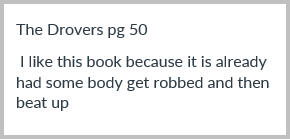
    Yesterday, she received this report from one of her 8th grade boys who is reading Prey, the first book in The Drovers series.

    Oh, yeah.

    I’ll take that any day (grin).

    Rock on, budding reader.

    Share
  • Federal Spending 1972-2011: What The?!?

    Last week a chart made the rounds, ranking the Presidents since Reagan on spending.  Look at Reagan.  That happy man is a freaking profligate. Obama, on the other hand, heck, he’s doing better than Bill Clinton.

    Except there are a few problems.

    First, I can’t tie this data out to the official CBO numbers.

    Second, it does a bit of apples and oranges because the numbers are based on each president’s whole time in office.  What does it mean when Obama increases the debt by 35% over three years, but it takes Bill Clinton almost EIGHT YEARS to increase the debt that much?  A better measure would be an average per year.

    Third, some have suggested this chart monkeys with the numbers, allocating the first year of each president’s first term to the previous president.

    Fourth, the president isn’t the only one in Washington. Senators and Congressmen also have responsibility.

    Finally, while a % increase in debt is a helpful measure, it’s not the only story. And it can be misleading if viewed on its own. For example, if we have $1 of debt, and I increase that to $10, I’ve increased our debt by 1000%. Holy Schnitzel!  But if we have $500 million of debt and I increase it to $600 million, I’ve only increased it by 20%. Which is worse?

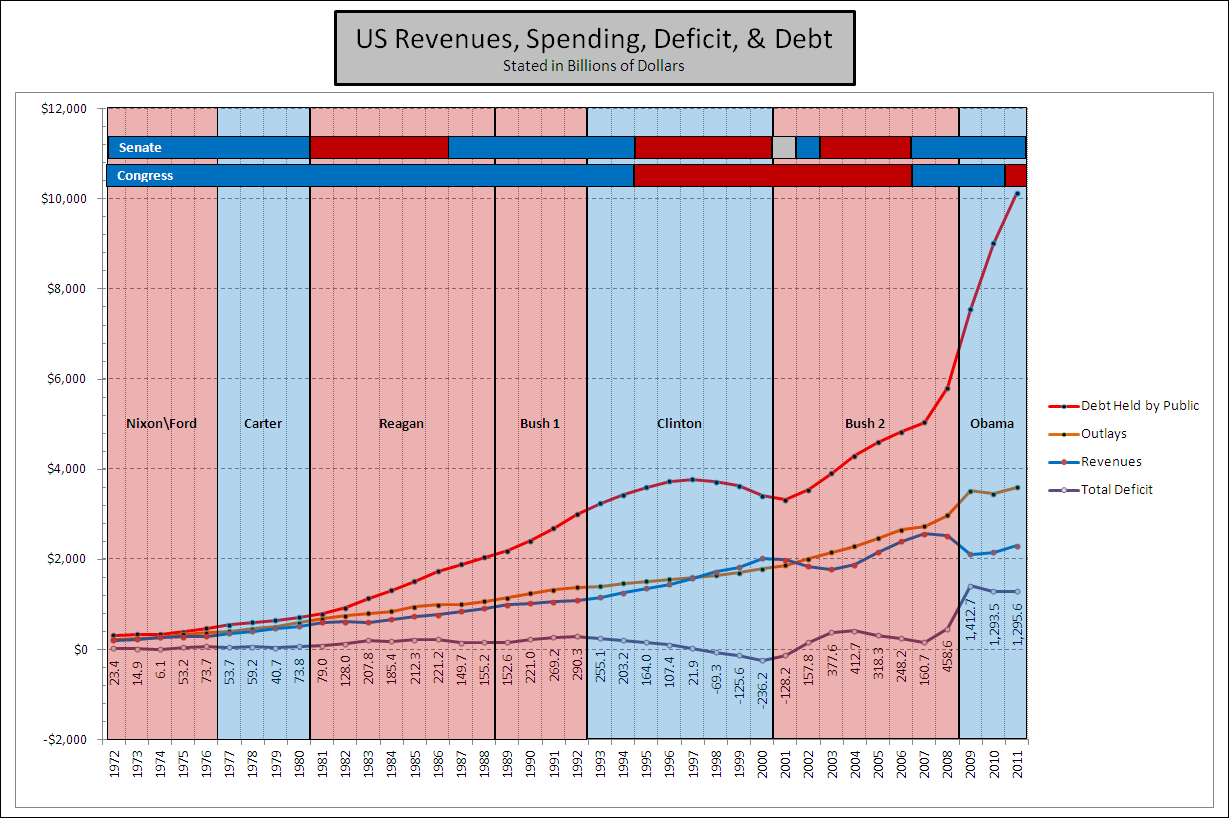
    So I went out to the CBO and took their numbers from 1972 – 2011.  You may get the XLS file yourself: http://www.cbo.gov/publication/42911. Then I made sure to identify who was in charge when and marked it with spiffy colors (Red is Republican, Blue is Democrat). Here are the results. Click on it to see it in its full size glory.


     What does this tell us?

    First, there was only ONE four-year stretch in the LAST FREAKING FORTY YEARS where the folks in Washington did not spend MORE than they took in. That was the four year period from 1998 – 2001.

    What the?!?

    Look at that chart again. There is a serious and systemic spending problem in Washington.

    What happened in 1998 to change what had been going on for almost three decades? That was when the citizens got fed up with Washington, threw out a great number of the Senators and Congressmen, and bought into the Contract with America.  This was when Newt Gingrich was Speaker of the House. This was when Clinton was getting pounded for all sorts of stuff and worked with those particular Republicans in Congress to balance the budget.

    Second, the deficit, the purple line at the bottom, tripled when Obama took office.  And stayed!  Who put that first chart together? Oh, yeah. It was Nancy Pelosi.

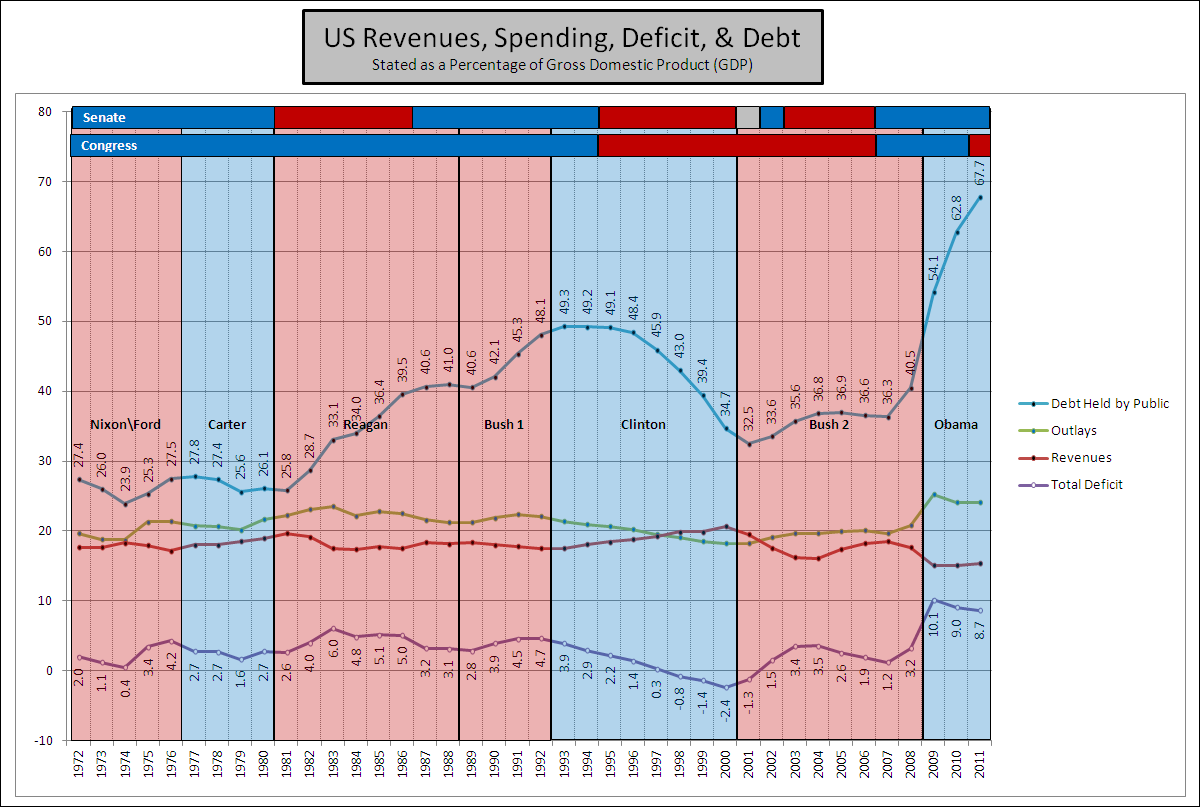
    You might say, well, raw dollars is good.  But what’s really important is how big a percentage that spending is of our nation’s GDP. If you’re spending 100 billion when the nation is producing 1 trillion, that sounds big, but it’s actually not as big a deal as when you’re spending 100 billion and the nation is only producing 200 billion. Okay, let’s look at these numbers as a % of GDP.

    Again, 1998-2001 were good years. On a % basis, the folks in Washington during that time did better than anyone else in not spending the nation’s wealth.  There’s no doubt that Reagan, Bush 1, Clinton during his fist 3 years and the Congress during those times were all happy to be big spenders.  Look at the debt burden during their years. But Obama and the Democratic majorities in Congress since 2007–drunken sailors compared to those guys. And then the Republicans come in and it doesn’t change. Gridlock?

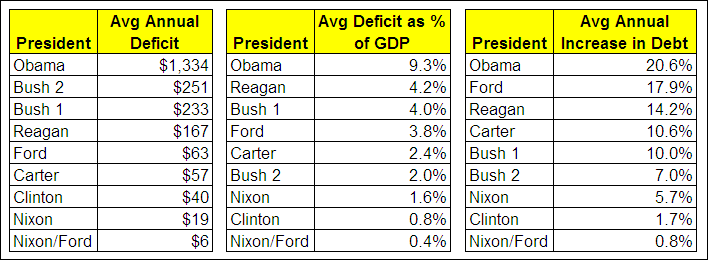
    Let’s look at our presidents since 1972 and see how well they do on an annual basis. Those numbers in the first list, BTW, are stated in billions.

    Seems to me the most fiscally responsible groups were those in charge during the latter part of the Clinton years, the Nixon years, and the year when Nixon resigned.  It appears that during that year the folks in Washinton were so busy with the Watergate scandal they forgot to feed their spending appetites.

    Bottom line: as I said before, Washington has a serious and systemic problem with over spending.

    And when I say “systemic” I mean it appears the whole thing is rigged to produce over spending. We don’t just need new people out there. We need a system that prevents the overspending. We need an ammendment that requires a balanced budget and caps the size of the government in relation to GDP.

    We also need to find a way to incentivize Congress to pass a budget each year.  No budget, no pay is a good idea. The current House has indeed passed a budget. But the Democratic Senate has not, preventing us from having a budget at all. Obama submits budgets, but not a soul in the Senate, Democrat or Republican, will vote for them. It’s only the Republican House who seems to want to actually do their job. How can that be? Read It’s Deja Vu All Over Again with National Fiscal Policy for more info.

    This November we need to get a bunch of folks like those in 1998 back in Washington. A President AND a Congress who will actually finally tame the nation’s out of control spending.  Let me suggest you look at your Congressman’s and Senators’ records.  How have they voted? As for President Obama, well, I’m looking at the numbers above.

    Related Links

    Share

2 Comments

  1. lieve John…..

    Billenkoek…Haaaaaaaaaaaaaa…
    Ja …als je billenkoek krijgt omdat je iets stouts hebt gedaan…dan ben je echt de ,,sigaar,,!!
    Nederlands is een vreemde taal…vind ikzelf.
    Al die gezegdes en spreekwoorden….word er helemaal gek van….help!
    liefs…..Hazel.

Comments are closed.